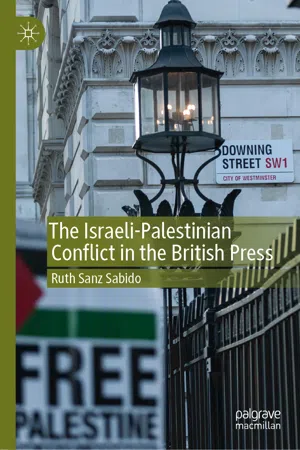
The Israeli-Palestinian Conflict in the British Press provides an extensive empirical analysis of how the Israeli-Palestinian conflict has been constructed in British national newspapers since 1948. It traces the evolution of representations of the conflict by placing them in a historical context, with particular reference to Britain's postcolonial relation to Palestine, and by presenting an in-depth analysis of the evolution of press language, including the use of terms such as 'terrorism' and 'terrorist' to classify agents of political violence. It applies an original approach to the study of media coverage, using a Postcolonial Critical Discourse Analysis framework, an innovative method that examines selected case studies in relation to theories of postcolonialism and discourse. Using this unique hybrid methodology, Sanz Sabido provides a thorough and precise unpicking of a highly mediated conflict.
- English
- ePUB (mobile friendly)
- Available on iOS & Android
eBook - ePub
The Israeli-Palestinian Conflict in the British Press
About this book
Information
Topic
SozialwissenschaftenSubtopic
Journalismus© The Author(s) 2019
R. Sanz SabidoThe Israeli-Palestinian Conflict in the British Presshttps://doi.org/10.1057/978-1-137-52646-5_11. Introduction: The Promised Land and a Land of Promises
Ruth Sanz Sabido1
(1)
Canterbury Christ Church University, Canterbury, UK
The Israeli–Palestinian conflict, 70 years after the creation of the state of Israel, continues to create an international impact and gain widespread media attention. This conflict has raised numerous discussions regarding the exact nature of the problem, “whether it is a clash of religions or races, or a territorial dispute involving historical claims to the land” (Devore 1976: xxii). Since the early days of the conflict, the struggles between Palestinians and Israelis have indeed been about territoriality, identity, ethnicity, religion, economics, competing nationalisms, colonialism and imperialism (Milton-Edwards and Hinchcliffe 2008: 22). This is, in effect, a deeply multifaceted conflict that has been complicated by a wide range of factors. It follows, therefore, that the conflict may also be subjected to a multifaceted form of analysis.
All the aspects mentioned above, along with others, have played some part in the development of the conflict. One key historical development in the history of these clashes was the establishment of the British Mandate of Palestine in 1923—a form of colonial administration that lasted until 14 May 1948, when the Zionist state was created (El-Eini 2004; Robson 2011). According to Home (2003: 293), the boundaries that are often established between the coloniser and the colonised were applied in Palestine during the Mandate, following the Lugardian ideology of British colonialism between the two World Wars. In his analysis of Lord Frederick Lugard’s The Dual Mandate in British Tropical Africa ([1922] 1965), Bello (2017) points out that the dual mandate of the British Empire aimed to open Africa to the civilised world and the African mind to civilisation. This approach was applied through the creation of two social roles: the one of the civiliser and the one that needs to be civilised. This binary translated into discursive strategies that naturalised the infantilisation and fetishisation of the native populations. But of course, this process was not only conducted through language, nor was it only applied in Africa. Referring to Palestine, Home (2003) argues that the British Mandate modified complex land laws and regulations inherited from the Ottoman land code, and these were later passed to the successor Israeli state, eventually becoming “the tools for ethnocratic control, through which Israel came to claim public ownership over virtually all its physical territory”. Similarly, Robson (2011: 2) points out how the British colonial administration made the decision to promote communally organised legal and political structures following the example of imperial policy in India and elsewhere.
Proceeding from a strict definition of the postcolonial as “what comes after colonialism” (Young 2001), 1948 would be considered by some postcolonial scholars as the temporal marker of postcoloniality between Britain and Palestine, because it was at that point when Palestinian lands would no longer be ruled or administered by Britain. From this perspective, the end of the British Mandate meant that the colonial era had come to an end and a postcolonial period had begun. Even though this is by no means the only factor that has shaped the development of the conflict, it is worth paying attention to this historical fact, as the Mandate ineluctably steered the fate of the Land and its people. When it comes to media representations of acts and agents of political violence within the conflict, the extent to which (post)colonial history and responsibilities are visible in contemporary discourses sheds light on the connections between discourse and power, and helps to identify which aspects of the conflict have been erased.
This is what this book does: focusing specifically on the postcolonial relationship between Britain and Palestine, it examines the representations of the Israeli–Palestinian conflict in the British press, starting from the premise that media representations in Britain should be analysed in relation to Britain’s role as a postcolonial power. In this respect, Brunt and Cere (2011: 3) have argued that Britain’s role as the colonial ‘centre’ is strongly intertwined with British contemporary media cultures, and thus these media cultures should be explored through the lens of postcolonial theory. Drawing upon a variety of discursive material, Said (1978) had previously stated that in non-totalitarian societies, certain cultural forms predominate at the expense of other cultural forms, which are excluded. In his view, this cultural leadership is what gives Orientalism—the notion of ‘us’ Europeans standing against, or in contrast to, all ‘those’ non-Europeans—its durability (Said 1978: 7). Indeed, the term ‘Orientalism’ refers to the idea that European identity is superior in comparison with all the non-European cultures, which are presented as backward and dependent. In addition, there are numerous media analyses that are concerned with the representations of race and ethnicity in the western media (Hall 1997; Macdonald 2011; Poole 2002; Poole and Richardson 2006). Hall (1997) also makes explicit connections between colonialism and the use of binary opposites, such as ‘civilised’ and ‘uncivilised’. Furthermore, most academic work on the postcolonial has focused on literary works, while overlooking media representations and, more broadly, media production.
Yet, postcolonialism is not only reflected on novels about former colonies, but it involves “a whole theoretical or ideological agenda” which is “far from historically or politically innocent” (Eagleton 1998: 125). The postcolonial agenda and lack of innocence, to use Eagleton’s terms, must be partly understood in terms of Western capitalism, which also contributes to the maintenance of financial channels of domination by controlling key economic resources and through military interventions. Pawling (2011) argues that the mass media play a vital role in the dissemination of Western versions of freedom and democracy, as well as in the formation of the ‘subject’. Referring to major media organisations, such as Rupert Murdoch’s News Corporation, Pawling (2011: 43) points out that “an Anglo-American version of political reality is presented as the only ‘rational’ basis for interpretation and action”. This version of reality is therefore inherently orientalist and, consequently, Postcolonial Theory should not only be applied to the study of novels, but also to the study of the media discourse.
This is the debate to which Postcolonial Critical Discourse Analysis (PCDA) seeks to contribute. PCDA should be understood as a theoretical and methodological advance on previous discussions, and as an additional alternative to research that is concerned with the connections between postcolonial legacies and the media (Sanz Sabido 2016). PCDA draws upon Postcolonial Theory and a Historical Approach to Critical Discourse Analysis, with the objective of exploring past and contemporary discourses that are impregnated with postcolonial political, economic and social structures. It also examines the ways in which linguistic classifications are used to divide societies into groups on the basis of difference. In this book, I apply this framework in order to analyse some of the ways in which colonial and postcolonial relations between Britain and Palestine have emerged in the news coverage of the Israeli–Palestinian conflict since 1948, the moment when the British Mandate of Palestine came to an end.
Existing studies based on Wodak’s Discourse-Historical Approach have primarily focused on climate change and global warming (Carvalho 2005; Reisigl and Wodak 2009). Other topics that have also been explored from an historical perspective include racism, anti-Semitism and discrimination (Reisigl and Wodak 2001) and European identities (Muntigl et al. 2000). Here, I examine the representations of political violence within a longstanding conflict, with a particular focus on the use of the term ‘terrorism’, the visibility of different agents in the news discourse, and the historical contextualisation of the clashes at different points in the coverage.
As regards the Israeli–Palestinian conflict, this has been widely discussed at length in various academic spheres, including history (Dowty 2008), law (Cattan 1976), art (Boullata 2009), and cinema (Dabashi 2006; Gertz and Khleifi 2008) to name but a few. Numerous studies have also been carried out on particular aspects of the media representations and reception of the conflict (Evensen 2007; Kaposi 2014; Muravchik 2003; Parfitt and Egorova 2004; Philo and Berry 2004, 2011; Zaharna 1997; Zayyan and Carter 2009), and there are some comparative studies on television abroad (First 2002; Noakes and Wilkins 2002).
Some of the more recent studies on Palestine, to mention but a few, include Matar and Harb’s (2013) project on some of the ways in which the conflict in Lebanon and Palestine is narrated, including a multiplicity of experiences, discourses and memories, which are always linked to the events of 1948 and what they meant to the Palestinian people. From a different perspective, Rodgers (2015) combines his own experiences as a correspondent with the analysis of news coverage of the conflict from the end of the British Mandate to 2014, and supports his findings with a wealth of sources and contacts that he has garnered throughout his career as a journalist. In addition, Hollis (2016) offers a useful examination of the representations of Palestinians in British political elite discourse between 1915 and 2015. Her analysis only mentions media discourse in passing, as her main focus is, as she describes it, ‘political elite discourse’, and the contemporary role of Britain in relation to Palestine is considered to be that of a Permanent Member of the United Nations (UN) Security Council. Nevertheless, the findings of Hollis’ analysis, namely that Palestinian...
Table of contents
- Cover
- Front Matter
- 1. Introduction: The Promised Land and a Land of Promises
- 2. Postcolonial Critical Discourse Analysis: Theory and Method
- 3. Contextualising the Conflict: A Brief History of the Land
- 4. Contextualising the Israeli–Palestinian Conflict in the News
- 5. Situating Political Violence: ‘Terrorism’ and Discourse
- 6. ‘Terrorism’ and the Israeli–Palestinian Conflict in the News
- 7. Identity, Conflict and Visibility
- 8. Conclusions
- Back Matter
Trusted by 375,005 students
Access to over 1.5 million titles for a fair monthly price.
Study more efficiently using our study tools.
Frequently asked questions
Yes, you can cancel anytime from the Subscription tab in your account settings on the Perlego website. Your subscription will stay active until the end of your current billing period. Learn how to cancel your subscription
No, books cannot be downloaded as external files, such as PDFs, for use outside of Perlego. However, you can download books within the Perlego app for offline reading on mobile or tablet. Learn how to download books offline
Perlego offers two plans: Essential and Complete
- Essential is ideal for learners and professionals who enjoy exploring a wide range of subjects. Access the Essential Library with 800,000+ trusted titles and best-sellers across business, personal growth, and the humanities. Includes unlimited reading time and Standard Read Aloud voice.
- Complete: Perfect for advanced learners and researchers needing full, unrestricted access. Unlock 1.5M+ books across hundreds of subjects, including academic and specialized titles. The Complete Plan also includes advanced features like Premium Read Aloud and Research Assistant.
We are an online textbook subscription service, where you can get access to an entire online library for less than the price of a single book per month. With over 1.5 million books across 990+ topics, we’ve got you covered! Learn about our mission
Look out for the read-aloud symbol on your next book to see if you can listen to it. The read-aloud tool reads text aloud for you, highlighting the text as it is being read. You can pause it, speed it up and slow it down. Learn more about Read Aloud
Yes! You can use the Perlego app on both iOS and Android devices to read anytime, anywhere — even offline. Perfect for commutes or when you’re on the go.
Please note we cannot support devices running on iOS 13 and Android 7 or earlier. Learn more about using the app
Please note we cannot support devices running on iOS 13 and Android 7 or earlier. Learn more about using the app
Yes, you can access The Israeli-Palestinian Conflict in the British Press by Ruth Sanz Sabido in PDF and/or ePUB format, as well as other popular books in Sozialwissenschaften & Journalismus. We have over 1.5 million books available in our catalogue for you to explore.