eBook - ePub
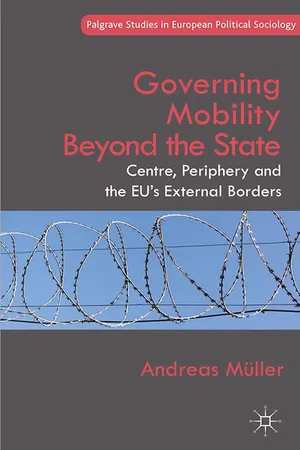
Governing Mobility Beyond the State
Centre, Periphery and the EU's External Borders
- English
- ePUB (mobile friendly)
- Available on iOS & Android
eBook - ePub
About this book
This book explores the structural tensions and conflicts that arise with the abolition of border controls between the EU's member states and how this conflict ridden relationship affects and is affected by the institutional shape of the EU's external borders.
Information
Topic
SozialwissenschaftenSubtopic
Europäische Politik1
Introduction
For a considerable part of modern history, the question of borders was mainly one of war and peace. Policies related to borders were characterized by the interplay of military defence and conquest. Only after World War II, and particularly in Europe, did national borders gain a unique degree of geographical stability. But at the same time processes were launched which prevented national borders from being exclusive matters of unconstrained national sovereignty, and instead made them also subject to political decisions beyond the nation states. The European Community and later on the European Union (EU) provide the most developed examples for these processes originating mainly from regional integration, but also from the deregulation of international trade and investment. Until the mid-1980s international policies on borders were mainly limited to addressing the economic functions of national borders. Within the General Agreement on Tariffs and Trade (GATT), nation states participating in the International Trade Organization (ITO) decided to which extent their national borders should serve as economic boundaries, and to what extent they should be permeable for foreign investment and trade. Thus, GATT and later the WTO provide a first contribution to a new phenomenon, the emergence of post-national borders. This concept relates to the tendency that the functions and configurations of stable borders between nation states were increasingly subject to decisions outside national forums of policy making. However, such developments were not confined to the pure economic function of structuring the international exchange of capital, goods and investment. Most prominently, in the European Community, the borders between the member states were also deprived of the function of limiting access to national labour markets due to the agreement to establish the European Economic Community. Given that the ‘monopolization of the legitimate means of movement’ (Torpey, 1998) was a process equally important for state formation as the monopolization of the legitimate use of force (Weber, 1926), the dismantling of border controls within the EU and uncontrolled mobility across borders marks a new quality of Europe’s post-national borders.
Thus, the European Union provides not only the most advanced case to study the institutionalization of post-national borders, but it also poses important questions about the transformations of the state. While, following Torpey (1998), the modern state had exclusive control over mobility on its territory, this no longer holds for contemporary European states: neither is the individual EU member state sovereign with regard to mobility on its territory, nor does it still have the means to control access to its territory. Both sovereignty and control can only be exerted in collaboration with EU bodies and other member states. Consequently, the question emerges as to how mobility and territorial access are governed in the EU. For this reason, the present study will focus on the transformations of borders in the EU, and in particular how the dismantling of internal border controls is linked to the institutional shape of the EU’s external borders. These external borders are of particular interest since they are at the same time both borders of nation states and of the most advanced type of supranational organization. Thus, the question emerges of how the institutional and territorial structure of the EU, and hence the politics of borders, defines the EU’s policy on its external borders and the working of these borders. This question forms the underlying theme of the present work.
In addition to the institutional peculiarities stemming from the EU’s supranational character, the EU’s external border also differs in substantial terms from its national counterparts. At the external EU borders, ambivalent processes can be observed: on the one hand, the Schengen acquis, the establishing of an EU border control agency, modern surveillance technologies and the implications of the EU’s asylum policies contribute to a decrease in the border’s permeability and thus evoke mental associations with ‘Fortress Europe’ (Broeders, 2007; Huysmans, 2000; Neal, 2009). On the other hand, policies such as the European Neighbourhood Policy and the Eastern Partnership, which promote open borders and seek to alleviate the consequences of the eastern enlargement in 2004 (Berg and Ehin, 2006; Smith, 2005), are pursued and partially implemented at the same time and with the same geographical focus. Within the scope of these polices, several cross-border cooperation agreements aim at facilitating cross-border interaction and hence intend to soften the border regime. It is supposed that this ambiguity constitutes an attempt to delegate exclusion tasks to neighbouring countries and thereby transform them into buffer areas (Vobruba, 2007). Hence, the present study will also address to what extent a staged border regime emerges which opens the border to the immediate neighbours while at the same time erects new barriers of exclusion and control at the borders between the neighbours and third states.
The fundamental, underlying questions this book is going to answer are: How is mobility controlled under post-national conditions of restricted sovereignty? How is mobility and territorial access controlled in a post-national polity?
In order to answer these questions we will focus our attention on the substantial change in the horizontal relations between the EU member states that has been set into motion by the dismantling of internal border controls.
The answers we thus obtain not only reveal the instability of European Integration but also lead to fundamental questions about the nature of power and authority under conditions of increasing transnational interdependencies.
Therefore, it is necessary to explore the perceptions of those political actors which participate in the decisions on these borders as well as their interests in the external borders. Thereby we can reconstruct how EU member states are affected by the dismantling of border controls and how these states become susceptible to the actions of other member states. From there on, it is possible trace how the member states’ vulnerability to each other contributes to the institutional shape of the external borders as well as to the delegation of exclusion tasks to states outside the EU.
The answer provided in this way will focus mainly on the relations between centre and periphery within the EU. We will show that the dismantling of internal border controls constitutes two types of member states: centre and periphery. Furthermore it will be shown that the tensions between centre and periphery are the driving force both for codifying controls at the external borders and for the exterritorialization of migration controls.
From this perspective, the study focuses on two different factors. Regarding the external border, it addresses the border’s institutional development concerning cross-border mobility between Poland and Ukraine because it is assumed that political relations and the quality of political cooperation between the adjacent countries are important factors for the border’s permeability. Thus, if we want to study the distinct features of the EU’s external borders, we need to explore those parts of the border where the EU’s border policy is particularly successful. Here, exterritorialization of migration control as well as the gradual opening of borders is the most advanced of all EU neighbour states. Therefore, the Polish–Ukrainian border provides the possibility of exploring to what extent the EU’s unique territorial and supranational structure contributes to the incorporation of neighbouring states in policing the EU’s external borders as well as in its efforts to control migration, and hence whether it is systematically linked to the EU’s political qualities. For this reason, the present work focuses on the EU’s border with Ukraine since this country is, both in the academic literature and as perceived by policy-makers, a case of particularly well-developed cooperation (Emerson et al., 2007; Gawrich et al., 2010; Herman and Finkel, 2007).
Since the unique feature of post-national borders consists of the variety of political actors involved in the decisions about their configuration, the participation of different political actors within the EU is the second factor upon which the study focuses. In this regard, the project explores the way in which the European Commission, Germany, and Poland perceive the EU’s external borders, the interests that follow from these perceptions and the resulting contribution to the institutional shape of the external borders. Poland enters into the study’s focus due to its particularly long common border with Ukraine, and its political weight that distinguishes it from Ukraine’s other neighbours. To focus on Poland also follows the underlying assumption that the external border produces geographically different effects within the EU, depending on a country’s proximity to this border. Thus, the focus on the member states draws also on the German perception of the external EU-borders, since from the member states in the EU’s geographical centre, it is one of the most influential countries while still having strong interests in the EU’s eastern neighbours.
However, a sole focus on the member states would not do justice to the EU’s peculiarity. What distinguishes the EU from other regional associations of nation states is the strength of its supranational institutions. Stable cooperation between states is enabled by the ‘institutionalization of a sovereign third unit’ (Bach, 1995) with the authority to monitor and even assure the member states’ adherence to their agreements. Therefore, the present study also focuses on the European Commission as the ‘guardian of the treaties.’ The political importance of this actor is further increased by its exclusive right of initiative in an ever growing area of policies.
Recent events, such as the debate about the reintroduction of border controls at the Danish–German border, the dispute between France and Italy about refugees from northern Africa, and Franco-German attempts to regain national sovereignty on border controls, have revealed the instability of the EU’s common area without internal border controls and thereby also the high salience of the supranational level in stabilizing this area. Thus, the way the Commission strives to maintain the common area and therefore balances out centrifugal tendencies among the EU’s member states is another recurrent issue of the present study.
The work itself is largely divided in two parts. While Chapters 2–4 lay the theoretical, conceptual and methodological foundations, the empirical Chapters 5–8 approach the political actors’ perceptions and policies on the external borders and trace their influences on the border’s institutional configuration.
As emphasized by Chapter 2, this work departs from an understanding which closely links borders to the exercise of migration control, but rather perceives them as institutions which emerge in the process of state formation. The chapter discusses the added value of this concept in contrast to the currently prevailing likening of borders with migration control. As it is argued here, these approaches assume that borders perform specific functions and therefore presume identity between the institution and its function. Such approaches, however, are prevented from keeping track of institutional change and the development of functional equivalents. Thus, they encounter substantial challenges when addressing the transformations of borders in Europe. Only by theoretically distinguishing the border as an institution from specific border functions such as customs or migration control, is it possible to analyse the institutional transformation of borders within the EU and at its edges. To this end, the theoretical chapter conceptualizes borders as institutionalized rules that spatially separate the exercise of authority and allocate this exercise to different power organizations. With this understanding, the debate about the EU’s borders and how they are affected by the European Union’s institutional structure and variable geometry, which forms the topic of Chapter 3, appears in a new light. This chapter places the present study within the larger debate both about the EU’s policy on justice and home affairs as well as within the debate about the borders of the EU and the way they are affected by the enlargement process. Thus, Chapter 3 also prepares the ground for the research design and methods applied within the scope of the present case study as they are documented in Chapter 4.
Starting with Chapter 5, the empirical analysis is presented. While Chapters 5–7 trace the development of the political actors’ positions on external borders, Chapter 8 highlights the borders’ institutional development. Because these processes take place simultaneously, cross-references to institutional developments described in Chapter 8 are necessary. Political actors not only have genuine interests in the shape of a particular institution, their attitudes also respond to the development of the respective institution as well as to the projects of other actors in the policy area. Chapter 5 opens up the empirical study by exploring the Commission’s long-term interests in external borders. It is argued that the Commission is less concerned with the regulation of cross-border mobility as such, but as a means to different ends. In fact, the Commission’s policy on external borders is mainly fuelled by its interest in maintaining and stabilizing the EU’s area of free movement and hence to assure the abolition of internal border controls. Since the area of free movement provides the source of the Commission’s involvement in justice and home affairs, its main objective is to prevent a situation that would push the member states in the geographical centre of the European Union to reintroduce border controls at their common borders with other EU members. To that end, the Commission seeks to increase the trustworthiness of external borders, first by reducing the peripheral member states’ discretion when policing the borders, second by redistributing the costs of border controls to the EU as whole, and finally by developing alternative means of controlling migration.
As Chapter 6 argues, the German position is characterized by the attempt to maintain the beneficial achievements of the 2004 enlargement. These benefits consist of more effective migration control due the eastward shift of the EU’s external border, which delegated the obligations both to police the border and to take responsibility for asylum seekers to the new member states. From this situation, a two-fold strategy results because Germany first obstructs all attempts to open the border by a more liberal visa policy and instead pushes for a system of strict border controls. Second, Germany obstructs reforms of the current responsibilities for asylum applications and thereby indirectly contributes to the pressure on the peripheral member states to secure the border.
Though sharing the same geographical focus, the Polish position contrasts substantially from the German one. As Chapter 7 argues, the Polish policy on external borders is mainly characterized by the objective of establishing a liberal travel regime between the EU and the Western CIS countries. This position is generated by the low significance of migration policy within Poland’s political system on the one hand, and the political and social costs associated with maintaining the visa requirement for the CIS countries on the other hand. Unlike Germany, in Poland immigration is not a politicized issue, and therefore political campaigns and public pressure for restrictive migration controls hardly arise. Instead, the externalities of accession to the Schengen acquis are perceived as a political burden, as adjusting the country’s visa policy to the EU requirements impacts on Poland’s external relations. Because the relations between Poland and the CIS countries are of strategic value for Polish foreign policy, abolishing the visa obligation for those countries is one of the objectives within the country’s EU policies. In addition, the impact of the visa obligation on the Polish eastern border regions also feeds into the Polish promotion of a liberal travel regime.
The outcome of the interplay between these factors forms the topic of Chapter 8. Here, the process of transforming Poland’s eastern borders into external EU borders is traced from the country’s preparation for enlargement until the lifting of internal border controls. This transformation coincided with the integration of the Schengen acquis into the EU’s first pillar, thereby posing the challenge for Poland to pursue a ‘moving target’ in the course of its accession to Schengen. This second type of transformation can be ascribed to the translocation of the Schengen provisions from an intergovernmental agreement into supranational law. Two effects of this translocation are discussed in this chapter. First, supranationalization brings the Schengen acquis under the supervising powers of the EU’s supranational bodies, and thereby it benefits from the same mechanisms that account for the EU’s distinct stability. Second, with the establishment of the EU’s border agency FRONTEX also the practical cooperation of the national border guards was transferred into the EU’s first pillar. In the shadow of this process, the EU gained limited operational capacities and thereby acquired the capability to perform tasks of genuine sovereignty, as became apparent when in 2010 FRONTEX deployed its first Rapid Border Intervention Team (RABIT) under EU colours at the Greek–Turkish border. However, strengthening the supranational elements of border controls is just one of the distinct features of this border. Another one is the incorporation of the neighbouring countries, and the fine tuning of the border’s permeability to achieve and reward this cooperation. Hence, as Chapter 8 analyses, the transformation of Poland’s eastern borders is accompanied by gradual opening for Ukrainian citizens and a reform of the Ukrainian migration and border control system in order to ‘filter out’ irregular migrants before they reach the Schengen area.
Possible implications of these findings are discussed in the final section. In empirical terms, it is discussed to what extent the results can be generalized to the external borders as a whole. In addition, the chapter asks how the EU’s internal structure contributes to Balibar’s ‘Great Wall of Europe’ (Balibar, 2006) and explores the limits of future exterritorialization. Furthermore, it is emphasized that the existence of sharp borderlines which separate between inside...
Table of contents
- Cover
- Title
- 1 Introduction
- 2 Post-national Borders as Functions or Institutions: A Theoretical Framework
- 3 The European Union and the Transformation of Borders
- 4 Methods and Research Design
- 5 Maintaining Internal Freedom of Movement: The European Commission’s Perspective on the External EU-Borders
- 6 Enforcing Selective Migration Policies: Germany and the External EU-Borders
- 7 Promoting Open Borders: Poland and the Visa Obligation
- 8 The Institutionalization of the EU’s Border Regime between Poland and Ukraine
- 9 Conclusion: Synthesis and Outlook
- Annexes
- Notes
- References
- Index
Trusted by 375,005 students
Access to over 1.5 million titles for a fair monthly price.
Study more efficiently using our study tools.
Frequently asked questions
Yes, you can cancel anytime from the Subscription tab in your account settings on the Perlego website. Your subscription will stay active until the end of your current billing period. Learn how to cancel your subscription
No, books cannot be downloaded as external files, such as PDFs, for use outside of Perlego. However, you can download books within the Perlego app for offline reading on mobile or tablet. Learn how to download books offline
Perlego offers two plans: Essential and Complete
- Essential is ideal for learners and professionals who enjoy exploring a wide range of subjects. Access the Essential Library with 800,000+ trusted titles and best-sellers across business, personal growth, and the humanities. Includes unlimited reading time and Standard Read Aloud voice.
- Complete: Perfect for advanced learners and researchers needing full, unrestricted access. Unlock 1.5M+ books across hundreds of subjects, including academic and specialized titles. The Complete Plan also includes advanced features like Premium Read Aloud and Research Assistant.
We are an online textbook subscription service, where you can get access to an entire online library for less than the price of a single book per month. With over 1.5 million books across 990+ topics, we’ve got you covered! Learn about our mission
Look out for the read-aloud symbol on your next book to see if you can listen to it. The read-aloud tool reads text aloud for you, highlighting the text as it is being read. You can pause it, speed it up and slow it down. Learn more about Read Aloud
Yes! You can use the Perlego app on both iOS and Android devices to read anytime, anywhere — even offline. Perfect for commutes or when you’re on the go.
Please note we cannot support devices running on iOS 13 and Android 7 or earlier. Learn more about using the app
Please note we cannot support devices running on iOS 13 and Android 7 or earlier. Learn more about using the app
Yes, you can access Governing Mobility Beyond the State by A. Müller in PDF and/or ePUB format, as well as other popular books in Sozialwissenschaften & Europäische Politik. We have over 1.5 million books available in our catalogue for you to explore.