- English
- ePUB (mobile friendly)
- Available on iOS & Android
eBook - ePub
About this book
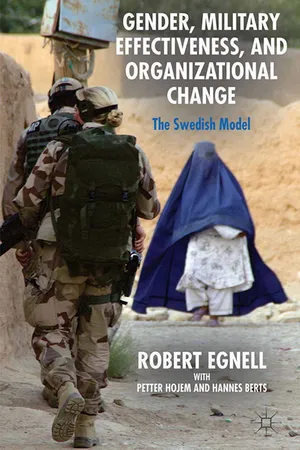
Through extensive analysis of the Swedish Armed Forces this study explores the possibilities and pitfalls of implementing of a gender perspective in military organizations and operations. It established a number of important lessons for similar attempts in other countries and discusses the continued process of implementation in the Swedish military
Information
1
Introduction: The Accomplishments and the Challenges
Why are issues of gender and military effectiveness featured in the same book? It is often assumed that gender awareness and women’s rights have no place in the brutal and hypermasculine world of the battlefield – or even military peace operations. Indeed, military organizations are more often seen as the problem rather than the potential solution to the processes of implementing a gender perspective or promoting women’s rights.
Nonetheless, the importance of a gender perspective in peace operations and military affairs has long been established by feminist activists and researchers, and recognized in a number of UN Security Council Resolutions (UNSCRs) on women, peace, and security. Yet the participation of women in peace negotiations, international peace support operations, and peacebuilding processes remains highly limited.1 Moreover, the tremendous and often disproportionate impact of war and conflict on women – not least the rate of sexual and gender-based violence – is still shocking.2 UNSCR 1325, adopted in October 2000, not only addressed the unique and disproportionate impact that armed conflict has on women, but also recognized the undervalued and underutilized contributions women make to conflict prevention and resolution, peacekeeping and peacebuilding. The resolution thereby stressed the importance of women’s full and equal participation as active agents in peace and security organizations.
UNSCR 1325 was followed by UNSCR 1820, unanimously adopted in June 2008, which focused on sexual violence in conflicts. The resolution acknowledged that sexual violence can and has been used as a tactic of war, with potentially destabilizing consequences, and constitutes ‘a war crime, a crime against humanity, or a constitutive act with respect to genocide’.3 Furthermore, the UN Security Council (UNSC) requested that the UN Secretary General and countries contributing troops to UN peacekeeping missions take measures to combat the use of sexual violence.
Since the adoption of UNSCRs 1325 and 1820, several related resolutions focusing on women, peace, and security have been passed. These include UNSCRs 1888, 1889, and 1960, which focus on establishing structures to increase security for women, men, boys, and girls, preventing sexual violence in conflict, and abolishing impunity for those crimes. Taken together, these resolutions have created an international framework for the implementation of a gender perspective in the pursuit of international security and the conduct of peace operations. Implementing a gender perspective in military organizations and in these organizations’ conduct of operations in the pursuit of peace and stability should be an obvious part of these efforts.
While UNSCR 1325 and subsequent resolutions within the field are rightly celebrated as important steps in advancing the women, peace, and security agenda, there are many scholars who are also highlighting the original resolution’s conceptual and practical limitations and weaknesses.4 A very tangible challenge is the cautiousness with which the Security Council members drafted the language of UNSCR 1325: language that ‘urges’, ‘encourages’, ‘requests’, and ‘invites’ rather than ‘demands’ or ‘instructs’ member states to implement the resolution.5 Consequently, implementation of the resolution at the international and national levels has varied and yielded mixed results.6
Nonetheless, despite their cautious language, the resolutions have led to a range of implementation actions by a broad set of actors. National Action Plans (NAPs) for the implementation processes have been produced in more than 30 countries, and in many cases, there are more specific implementation plans and reporting procedures created for the relevant departments and ministries. Whether military organizations are seen as hurdles or supporters, they are impossible to overlook as key components in any strategy to promote women’s rights or a gender perspective in security affairs.
The Swedish Armed Forces have been among the forerunners in implementing a gender perspective in military organizations and operations. Despite considerable resistance from parts of the organization, during the last decade, the Swedish military has gone through an impressive process of change that started with highly limited and isolated gender-related projects, and that today involves an institutionalized gender organization that has worked to mainstream a gender perspective, conduct training, and establish specific gender-related functions such as Gender Field Advisors and Gender Focal Points. The Gender Field Advisors have deployed with Swedish and international units in conflicts around the world during this process, and have thereby gained important experience and continued to refine the Swedish approach to gender implementation in military operations. The latest development has been the establishment of the Nordic Centre for Gender in Military Operations, a NATO-appointed Centre of Excellence (COE) which aims to function as a platform for continued implementation of a gender perspective in Sweden and abroad.
Aim and contribution
The dual aims of this book are to increase understanding of the implementation of a gender perspective in military organizations and operations by describing and discussing the Swedish case, and to draw a number of important lessons for its continued implementation in Sweden, as well as for similar processes in other countries. A secondary aim is to approach these tasks by bringing the fields of security studies and feminism together in a single theoretical framework that will speak to a wide audience – soldiers and officers, policy-makers, feminist activists, and scholars from the fields of both security studies and feminism.
Understanding the organizational processes of the Swedish case, the driving factors and roadblocks within the armed forces, and the activities conducted in the field, as well as their impact at home and in the area of operations, is essential to the continuing implementation of UNSCR 1325 and the implementation of a gender perspective more broadly. This understanding also has the potential to provide support and lessons for similar processes in the armed forces of other countries, even in other contexts.
Of the many countries currently working to implement their NAPs on gender, many of them, including the United States, are currently embarking on similar processes of implementation within their armed forces. The Swedish case, while still a work in progress, is an example for other countries to follow, both in terms of useful paths and roadblocks to practical implementation, and in terms of the actual impact and importance of gender perspectives in military operations.
The main contributions of this book are thereby threefold. First, it provides a wealth of new empirical data from the implementation process in the Swedish Armed Forces, so it will inform those with an interest in organizational change in general, as well as in gender perspectives in military organizations in particular. The second contribution is theoretical: by marrying the fields of gender theory and feminism with military theory and the strategic studies literature, the book provides a unique theoretical framework for the analysis of the relationship between gender and military effectiveness. By doing so, the study also addresses the tension between the often anti-militaristic nature of feminist scholarship and the use of military force for peace, stability, and women’s empowerment and protection. Finally, the conclusions from the organizational change process and the evaluation of the implementation of a gender perspective in the field of operations provide policymakers and practitioners with an important set of lessons learned for the adoption and implementation of similar processes in other countries and organizations.
Key definitions
This book deals with a number of key concepts, all worthy of much analysis and discussion. Such an exhaustive study, however, is beyond the scope of this book. The definitions below are therefore provided to highlight for the reader how the authors have defined and applied the key concepts. It should be noted that we have used established definitions from NATO and the UN.
Gender refers to the social attributes associated with being male or female that are learned through socialization and determine a person’s position and authority in a given context. This also encompasses the relationships among women and men and girls and boys, as well as the relations just among women and those among men. These attributes, opportunities, and relationships are socially constructed and are learned through socialization processes. Notably, gender does not necessarily equate to ‘woman’ or ‘female perspectives’.7
Gender mainstreaming is defined as a strategy to achieve gender equality by assessing the implications for women and men of any planned action, including legislation, policies, and programmes in all areas and at all levels, in order to ensure that the concerns and experiences of women and men are taken into account in the design, implementation, monitoring, and evaluation of policies and programmes in all political, economic, and societal spheres. This will lead to a condition whereby women and men benefit equally, and inequality is thereby not perpetuated. In military organizations, gender mainstreaming represents the process of recognizing and incorporating the role gender plays in relation to the military organizations’ various operations. Gender mainstreaming does not focus solely on women, but the benefits of mainstreaming practices recognize women’s disadvantaged position in various communities, with the military ones obviously included. The ultimate aim is to achieve gender equality.8
Integration of a gender perspective is a way of assessing gender-based differences of women and men as reflected in their social roles and interactions, in the relative distribution of power and their access to resources. For example, it is used within NATO as synonymous with implementing the provisions of UNSCR 1325 and related resolutions and directives emanating from the NATO itself. The aim is to take into consideration the particular respective circumstances and needs of men and women, as well as how the activities of NATO have different effects on each. More fundamentally, a gender perspective can be implemented by adapting actions aligned with the findings of ‘a gender analysis’.9 Importantly, a gender perspective in operations should not be equated with increasing female recruitment, or lifting the ban on women in direct combat units. These are two completely different albeit often mutually reinforcing conditions.
Gender analysis is defined as the systematic gathering and examination of information on gender differences and social relations in order to identify and understand inequities based upon gender. It could also be understood as the methods used to understand the relationship between men and women within the context of a given society. For example, military planning activities should assess the different security concerns of women, men, girls, and boys in the area of operation, or take account of existing power relations in the community, to ensure that all have equal access to assistance when the military is engaged in providing or supporting humanitarian assistance. Other examples include understanding how customary conflict resolution mechanisms affect women and men differently, and how their social status may change as a result of armed conflict.10
Gender equality refers to the equal rights and responsibilities of and opportunities for women and men and girls and boys. Equality does not mean that women and men will be the same, or achieve the same outcomes, but that women’s and men’s rights, responsibilities, and opportunities will not differ depending on whether they are born female or male.11
Sexual violence is when a perpetrator commits an act of a sexual nature against one or more persons or causes such person or persons to engage in an act of a sexual nature by force, or by the threat of force or coercion, such as that caused by fear of violence, duress, detention, psychological oppression, or abuse of power, or by taking advantage of a coercive environment or such person’s or persons’ incapacity to give genuine consent.12
The arguments in brief
The book tells two interrelated stories. One is of a relatively successful process of organizational change within the Swedish Armed Forces. The other describes and evaluates the work to implement a gender perspective in the field of operations. While the findings from the latter are less conclusive, there are clearly a number of important lessons for future work within this field, both in Sweden and internationally. The findings and recommendations are discussed in greater detail in the concluding chapter.
Findings
As noted above, the process of implementing a gender perspective in the Swedish Armed Forces has been relatively successful, leading to substantial institutional innovations and changes in the operational/tactical planning and conduct in the field of operations. There are three factors that help explain this success: 1. the importance of the work and support of a number of key change agents; 2. the decision to use a limited initial approach that focused on military effectiveness rather than on women’s rights; and 3. the organizational placement of the Senior Gender Advisor in the Swedish military headquarters directly under the Chief of Joint Operations, rather than within the policy or human resources departments.
The first factor explaining the process is that a very small number of key actors, or agents of change, effectively managed the change process. It is difficult to overstate the importance to this process of Charlotte Isaksson, who was the architect of the entire process until she left for a similar position with NATO. In the Swedish military, she created and then held the position of the first Swedish Armed Forces Senior Gender Advisor and built an entire organization of gender experts and advisors around her. However, the large impact of this single actor would not have been possible without the support from a number of surrounding people – not least since she, as a civilian, lacked the authority that accompanies being an officer within an organization structured around formal hierarchies.
Second, the analysis in this book ascertains that the change agents within the Swedish Armed Forces made a strategic decision to approach the implementation of a gender perspective in the organization as an issue of operational effectiveness – as opposed to one ‘merely’ of gender equality, women’s rights, or human resources. The basis of this decision was the reasonable assumption that the introduction and implementation of a gender perspective was likely to face strong resistance within the male-dominated organizational culture of the Swedish Armed Forces. This limited tactic never reflected the more ambitious aims of the implementation process as envisaged by the key agents of change, or the more ambitious agenda entailed in Resolution 1325. However, the decision makers hoped that this limited ‘inside’ approach would be a useful way to gain entry to the organization and to build a platform from which to pursue a more ambitious long-term agenda.
Third, the relative success of the Swedish experience in developing a framework for implementing a gender perspective can also be partly explained by how the process was managed through the work of the Senior Gender Advisor, and by the receptiveness of the Chiefs of Joint Operations who served during this period of change. A key decision was to strategically place the Senior Gender Advisor directly under the Chief of Joint Operations in order to maximize the credibility and centrality of the Senior Gender Advisor position. This was in contrast with other countries that have tended to organize the units responsible for implementing a gender perspective within their policy planning processes or human resources departments, thereby effectively sidelining Gender Advisors and diminishing the importance of implementing a gender perspective as crucial to the core tasks of the organization.
In contrast, the benefit of the Swedish structure is that it considered a gender perspective to be an issue of operational effectiveness rather than just a largely politically-laden human resources issue of women’s rights and participation. The core task of military organizations is to fight and win the nation’s wars, or to apply organized violence, or the threat of such violence, in pursuit of the national leadership’s political aims. This is what these organization are structured, trained, and equipped to do, which means that arguments about women’s equal rights and gender balancing simply do not generate interest. In other words, a gender perspective focused on operational effectiveness is seen as more relevant within the military organization.
The strategic placement of the Gender Advisor and the focus on operational effectiveness not only amplified the implementation of a gender perspective in the...
Table of contents
- Cover
- Title
- 1 Introduction: The Accomplishments and the Challenges
- 2 Gender, Feminism, and Military Effectiveness
- 3 Changing the Armed Forces
- 4 The Implementation and Impact of a Gender Perspective in Operations
- 5 Recruitment, Harassment, and Equal Rights: Human Resource Policies
- 6 Conclusion: Improving and Spreading the Implementation
- Appendix: Interview Questionnaires
- Notes
- Bibliography
- Index
Trusted by 375,005 students
Access to over 1.5 million titles for a fair monthly price.
Study more efficiently using our study tools.
Frequently asked questions
Yes, you can cancel anytime from the Subscription tab in your account settings on the Perlego website. Your subscription will stay active until the end of your current billing period. Learn how to cancel your subscription
No, books cannot be downloaded as external files, such as PDFs, for use outside of Perlego. However, you can download books within the Perlego app for offline reading on mobile or tablet. Learn how to download books offline
Perlego offers two plans: Essential and Complete
- Essential is ideal for learners and professionals who enjoy exploring a wide range of subjects. Access the Essential Library with 800,000+ trusted titles and best-sellers across business, personal growth, and the humanities. Includes unlimited reading time and Standard Read Aloud voice.
- Complete: Perfect for advanced learners and researchers needing full, unrestricted access. Unlock 1.5M+ books across hundreds of subjects, including academic and specialized titles. The Complete Plan also includes advanced features like Premium Read Aloud and Research Assistant.
We are an online textbook subscription service, where you can get access to an entire online library for less than the price of a single book per month. With over 1.5 million books across 990+ topics, we’ve got you covered! Learn about our mission
Look out for the read-aloud symbol on your next book to see if you can listen to it. The read-aloud tool reads text aloud for you, highlighting the text as it is being read. You can pause it, speed it up and slow it down. Learn more about Read Aloud
Yes! You can use the Perlego app on both iOS and Android devices to read anytime, anywhere — even offline. Perfect for commutes or when you’re on the go.
Please note we cannot support devices running on iOS 13 and Android 7 or earlier. Learn more about using the app
Please note we cannot support devices running on iOS 13 and Android 7 or earlier. Learn more about using the app
Yes, you can access Gender, Military Effectiveness, and Organizational Change by R. Egnell,P. Hojem,H. Berts in PDF and/or ePUB format, as well as other popular books in Politics & International Relations & International Relations. We have over 1.5 million books available in our catalogue for you to explore.