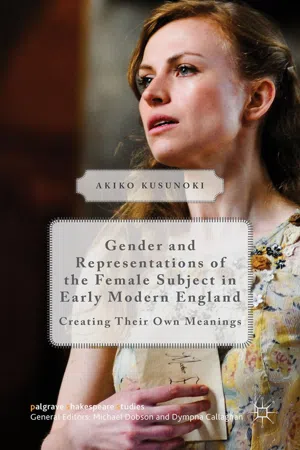
eBook - ePub
Gender and Representations of the Female Subject in Early Modern England
Creating Their Own Meanings
- English
- ePUB (mobile friendly)
- Available on iOS & Android
eBook - ePub
Gender and Representations of the Female Subject in Early Modern England
Creating Their Own Meanings
About this book
This book examines the interactions between social assumptions about womanhood and women's actual voices represented in plays and writings by authors of both genders in Jacobean England, placing the special emphasis on Lady Mary Wroth.
Information
1
Emerging New Attitudes towards Women in Early Jacobean England
Whereas the orthodox concept of a good woman permeated Elizabethan and Jacobean drama, a sceptical tone, which emerged around 1600, marks the playwrights’ handling of female characters, mostly in the plays written for private theatres. These plays pose questions about conventional female virtues by considering them in a social context, satirising them or parodying the works intended to promulgate such norms. In the dramatic works, such sceptical viewpoints developed into a new attitude towards women, an attitude that recognised the capacity for the integrity of women who acted against orthodoxy or, at least, in ways not necessarily in accordance with it. In the late Elizabethan and early Jacobean years, this new attitude was explored ardently, though inconclusively, by John Marston. The attempt culminated in Shakespeare’s Antony and Cleopatra (King’s, 1607) and John Webster’s The White Devil. In the second decade of the seventeenth century, the plays that reflect this attitude increased in number, but no dramatist pursued the issue as thoroughly as Webster did in his two great tragedies, The White Devil and The Duchess of Malfi. Although various factors—social, economic, political, moral—contributed to the emergence of this new perspective on the nature of woman, one incident that worked as a trigger was the introduction of Montaigne’s Essays to English readers via John Florio’s translation of 1603.1 Lucy, Countess of Bedford, instigated Florio’s venture, and Florio dedicated all three books to the learned ladies of the time: Book I to the Countess of Bedford herself and her mother, Lady Anne Harington; Book II to Elizabeth, Countess of Rutland, and Lady Penelope Rich; and Book III to Lady Elizabeth Grey and Lady Marie Nevill. Florio’s translation was extremely popular, not only among intelligent men, but also among educated women; for instance, Lady Anne Clifford, Countess of Dorset, who later became Countess of Montgomery and Pembroke, wrote in her diary on 9 November 1616: ‘I sat at my work and heard Rivers and Marsh read Montaigne’s Essays which book they have read almost this fortnight’ (Diary, 1923 41).2 Judging from her borrowings from Florio’s Montaigne, Elizabeth Cary, later Countess of Falkland, must have possessed a copy of the volume.3 The list of books that Lady Would-be boasts of having read in Volpone includes Montaigne (III. iiii. 90). As shown below, Marston, Shakespeare and Webster, who contributed greatly to the exploration of these new attitudes towards women, were all greatly indebted to Montaigne, both in terms of ideas and expressions.
The impact of Montaigne’s idea of the nature of woman on early Jacobean drama
Montaigne’s particular brand of scepticism itself contains various potential qualities for what became a new approach to the perception of womanhood. His anti-rationalism, elaborated in ‘An Apologie of Raymond Sebond’, stemmed from a keen awareness of the limits of man’s rational capacity, pointing to the senses as the only possible medium for the search for truth. Such an idea inevitably leads to the repudiation of male superiority, which was asserted by men on the grounds of their excellence in the capacity of reasoning; ever since classical times, there had been an assumption that women were inferior, irrational creatures governed by their senses and emotions. Montaigne, on the other hand, argues for an essential similarity between the sexes: ‘both male and female, are cast in one same moulde: instruction and custome excepted, there is not great difference between them’ (1910, Vol. III. 128).4 Furthermore, his emphasis on the power of the senses might have stimulated interest in the power of female emotions—one of the characteristic features of Jacobean drama is the increasing importance placed on them in the dramatic action.
Montaigne’s views greatly contributed to introducing new attitudes towards women in Jacobean England, by insisting on a realistic observation of their natural state and refuting conventional assumptions about womanhood. His naturalistic concept is most explicitly apparent in ‘Upon Some Verses of Virgil’, a chapter on human sexuality. Here he describes sensuality in women as part of their innate nature and as even stronger than men’s: ‘It is a cunning bred in their vaines and will never out of the flesh’ (Vol. III. 81). He therefore thinks it ‘ridiculous’ for men to impose upon women the norm of chastity: ‘It lieth not in them [. . .] to shield themselves from concupiscence and avoid desiring’ (Vol. III. 91). Reminding men of the difficulty with which they fight against their own sexuality, Montaigne criticises the double standard in society and exposes the absurdity of male egotism in demanding chastity in women: ‘we on the other side would have them sound, healthy, strong, in good liking, wel-fed, and chaste together, that is to say, both hot and colde’ (Vol. III. 79). Such attitudes in society, he argues, force women to dissimulation and hypocrisy:
It is then folly, to go about to bridle women of a desire so fervent and so naturall in them. And when I heare them bragge to have so virgin-like a will and cold mind, I but laugh and mocke at them. They recoile too farre backward. If it be a toothlesse beldame or decrepit grandame, or a young drie pthisicke starveling; if it be not altogether credible, they have at least some colour or apparence to say it. But those which stirre about, and have a little breath left them, marre but their market with such stuffe. (Vol. III. 92)
Montaigne’s criticism is extended to society’s arbitrary attitude towards human sexuality itself:
Oh impious estimation of vices. Both wee and they [women] are capable of a thousand more hurtfull and unnaturall corruptions, then is lust or lasciviousnesse. But we frame vices and waigh sinnes, not according to their nature, but according to our interest; whereby they take so many different unequall formes. (Vol. III. 85)
In his opinion a lie is worse than lechery. Human existence, he argues, consists of both soul and body, and sexuality is fundamental to the human make-up. It is, therefore, wrong that society’s moral codes dictate the annihilation of human physicality; such an act is to ‘honour their nature, by disnaturing themselves’ (Vol. III. 108).
Furthermore, he denounces the social assumption about propriety, which regards reference to sexual intercourse as indecent:
Why was the acte of generation made so naturall, so necessary and so just, seeing we feare to speake of it without shame, and exclude it from our serious and regular discourses? we prononce boldly, to rob, to murther, to betray; and this we dare not but between our teeth. Are we to gather by it, that the lesse we breath out in words the more we are allowed to furnish our thoughts with? (Vol. III. 70)
‘Vertue is a pleasant buxom qualitie’, says he, quoting Plato: ‘Let us not bee ashamed to speake, what we shame not to thinke’ (Vol. III. 67). Although Montaigne’s critique on hypocrisy concerns social manners and customs in general, its impact must have been especially strong on women, for whom the adherence to propriety was an absolute condition if they were to be accepted in society.
Montaigne’s scepticism strips love and marriage of their conventional meanings. While love is considered as ‘nothing else but an insatiate thirst of enjoying a greedily desired subject’ (Vol. III. 105), the object of marriage is defined in equally pragmatic terms as preservation of posterity. A sharp distinction is drawn between marriage and love, and though the benefits of marriage are recognised as ‘honour, justice, profit and constancie: a plaine, but more generall delight’, it is denied the pleasures of love, which are ‘more ticklish; more lively, more quaint, and more sharpe’ (Vol. III. 77). He emphasises the rarity of happy marriage, comparing marriage to a ‘cage, the birds without dispaire to get in, and those within dispaire to get out’ (Vol. III. 75). This is an expression that Webster borrows in The White Devil. What gives his detached attitudes toward marriage its particular interest is that he justifies a wife’s dissatisfaction with her husband as well as a husband’s discontent with his wife, by offering a pragmatic understanding of human nature. The evil of a wife’s adultery is extenuated, not through the Christian doctrine of forgiveness, but through a naturalistic acceptance of sexuality inherent in a woman’s nature. Sympathy is extended to rebellious wives who defy social norms, because he thinks that
Women are not altogether in the wrong, when they refuse the rules of life prescribed to the World, forsomuch as onely men have established them without their consent. (Vol. III. 77–8)
Furthermore, Montaigne’s concept of human integrity, based on both naturalism and stoicism, provides a new perspective on aberrant women. His vision of life as constant flux undermines Renaissance ideals of honour and glory, as well as conventional values of custom and ceremony; they reside solely in others’ judgements which ‘change uncessantly’ (Vol. III. 33). For him the only certainty is one’s sense of self, and integrity of life exists in absolute honesty to one’s selfhood:
I care not so much what I am with others, as I respect what I am in my selfe. I will bee rich by my selfe, and not by borrowing. [. . .] See how all those judgements, that men make of outward apparances, are wonderfully uncertaine and doubtfull, and there is no man so sure a testimony, as every man is to himselfe. (Vol. II. 348–9)
Reducing man’s reason to ‘the chiefest source of all the mischiefs that oppresse him, as sinne, sicknesse, irresolution, trouble and despaire’ (Vol. II. 151), he thinks it better to follow the law of nature in one’s self than man-made codes:
it is safer to leave the reignes of our conduct unto nature, than unto ourselves. [. . .] For, I would prize graces, and value gifts, that were altogether mine owne, and naturall unto me, as much as I would those, I had begged, and with a long prentiship, shifted for. It lyeth not in our power to obtaine a greater commendation, than to be fauoured both of God and Nature. (Vol. II. 152)
With respect to the development of new attitudes towards women, Montaigne’s insistence on trust in one’s own sense of self is of great importance. It offers a positive viewpoint towards women’s assertion of themselves, which unless it had been for the expression of Christian virtues, would have been denied in sixteenth and seventeenth-century England. In other words, it served as a kind of sanction for women’s defiance of conventional norms in society, such as those prescribed in Overbury’s A Wife, and for women following the dictates of their own conscience.
Women in John Marston’s plays and Florio’s Montaigne
The influence of Montaigne upon Marston is seen not only in his extensive borrowings of phrases and ideas from Florio’s translation of the Essays, but also in his attitude towards women; those of his plays written after the publication of Florio’s translation of Montaigne’s Essays are marked, as in Montaigne, by an acceptance of female physicality. In this respect, The Malcontent (Queen’s Revels, 1604) seems to represent a transitional phase. It contains no borrowing from Montaigne, and the date of its original version is unknown, though it has been placed as early as 1600 (Chambers, 1967, Vol. III. 431–2). Even so, Marston’s naturalistic understanding of women is already present, though his approach is different from that in his later plays. In his Satires and early plays, he portrays women (except for a stereotypically chaste woman like Mellida in Antonio and Mellida) as symptoms and causes of the evil and folly of the decadent age. Not only is a woman ‘craftie natures paint’ and ‘Her intellectuall is a fained nicenes/Nothing but clothes, & simpering precisenes’ (The Scourge of Villanie viii, 1961 153), but she also causes human degradation by corrupting men’s reason; women are like ‘Glowe wormes bright/That soile our soules, and dampe our reasons light’ (The Scourge of Villanie vii, 1961 146).
In some parts of The Malcontent, however, he modifies such a simple condemnation, by viewing errant women in relation to the state of the society in which they live. The female characters in the play, with the exception of Maria, who appears only in the last act, embody the typical feminine vanity and disorderliness attacked by moralists and satirists since the Middle Ages. They are sexually aberrant, and, as Mendozo cynically remarks, concerned only with their beauty and sex, fearing ‘Bad clothes, and old age’ (1. 6. 158). The Court itself is represented in the image of a brothel, with Maquerelle, a vigorous and ribald bawd, presiding over this world of sexual vice.
What separates Marston’s bawd from other bawds in Elizabethan and Jacobean drama is her pragmatic perception of the situation in which women are placed. Unlike Middleton’s bawds, who exploit human sexuality simply for materialistic gains, Maquerelle seduces women into sexual licence not only for profit, but out of her own awareness of the helplessness of women. Act 2 Scene 4 offers the satirical spectacle of her beauty salon, in which she invigorates Emilia and Beancha by means of her posset. Maquerelle tells them of the importance of youth and beauty for women: ‘youth and beauty once gone, we are like Beehives without honey: out a fashion, apparell that no man will weare, therefore use me your beauty’ (2. 4. 168). She advises them to disregard male criticism of female vanity, saying that they do not understand the position of women:
Men say, let them say what they will: life a woman, they are ignorant of your wants, the more in yeeres the more in perfection they grow: if they loose youth and beauty, they gaine wisdome and discretion: But when our beauty fades, godnight with us, there cannot be an uglier thing to see then an ould woman, from which ò pruning, pinching, and painting, deliver all sweete beauties. (2. 4. 168)
Some of the phrasing, and much of the sentiment, of Maquerelle’s traditional advice is taken from the 1602 translation of Guarini’s Il Pastor Fido, but Marston constructs the play’s world in a way that gives depth to her words.
A little more than a decade later, Mary Wroth describes the issue of ageing for women as a more serious matter ...
Table of contents
- Cover
- Title
- Copyright
- Contents
- List of Figures
- Acknowledgements
- Introduction: Concepts of Womanhood in Early Modern England
- 1 Emerging New Attitudes towards Women in Early Jacobean England
- 2 Female Selfhood and Ideologies of Marriage in Early Jacobean Drama: The Duchess of Malfi and The Tragedy of Mariam
- 3 Lady Mary Wroth and Ideologies of Marriage in Late Jacobean England
- 4 Representing Elizabeth I in Jacobean England
- 5 Women and Publishing Their Works in the Late Jacobean Years
- Conclusion
- Notes
- Bibliography
- Index
Trusted by 375,005 students
Access to over 1.5 million titles for a fair monthly price.
Study more efficiently using our study tools.
Frequently asked questions
Yes, you can cancel anytime from the Subscription tab in your account settings on the Perlego website. Your subscription will stay active until the end of your current billing period. Learn how to cancel your subscription
No, books cannot be downloaded as external files, such as PDFs, for use outside of Perlego. However, you can download books within the Perlego app for offline reading on mobile or tablet. Learn how to download books offline
Perlego offers two plans: Essential and Complete
- Essential is ideal for learners and professionals who enjoy exploring a wide range of subjects. Access the Essential Library with 800,000+ trusted titles and best-sellers across business, personal growth, and the humanities. Includes unlimited reading time and Standard Read Aloud voice.
- Complete: Perfect for advanced learners and researchers needing full, unrestricted access. Unlock 1.5M+ books across hundreds of subjects, including academic and specialized titles. The Complete Plan also includes advanced features like Premium Read Aloud and Research Assistant.
We are an online textbook subscription service, where you can get access to an entire online library for less than the price of a single book per month. With over 1.5 million books across 990+ topics, we’ve got you covered! Learn about our mission
Look out for the read-aloud symbol on your next book to see if you can listen to it. The read-aloud tool reads text aloud for you, highlighting the text as it is being read. You can pause it, speed it up and slow it down. Learn more about Read Aloud
Yes! You can use the Perlego app on both iOS and Android devices to read anytime, anywhere — even offline. Perfect for commutes or when you’re on the go.
Please note we cannot support devices running on iOS 13 and Android 7 or earlier. Learn more about using the app
Please note we cannot support devices running on iOS 13 and Android 7 or earlier. Learn more about using the app
Yes, you can access Gender and Representations of the Female Subject in Early Modern England by Akiko Kusunoki in PDF and/or ePUB format, as well as other popular books in Literature & European Literary Criticism. We have over 1.5 million books available in our catalogue for you to explore.