- English
- ePUB (mobile friendly)
- Available on iOS & Android
eBook - ePub
About this book
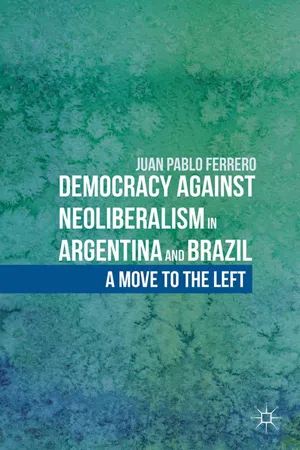
This book provides a comprehensive analysis of the emergence of left-wing politics in two of the largest South American nations: Argentina and Brazil. It looks in particular at the transformation of democracy seen as "point of arrival" into democracy seen as an unending struggle for greater equality.
Information
1
Interrogating Democracy: From Political Regimes to Politics
Introduction
The debate on democracy is as rich as it is extensive, but in the context of Latin America it gains particular strength in light of long-lasting dictatorships that have shaped the sociopolitical arena of its recent fascinating history. Discussing democracy therefore means also discussing the concepts of social order, insubordination, economy, politics, the nature of continuity and change, the subject of change, and others.
Dictatorships are no longer the rule on the Continent, which has enjoyed almost 30 years of free and competitive elections, but social science but interpretations forged during the 1970s and 1980s continue to dominate the debate on the matter, leaving the past 30 years largely unaccounted for. Their foundational analysis, as well as more recent developments within the same philosophical principles, constitutes a necessary point of departure to rethink democratic issues in South America today. Social movement literature has remained subordinated to the principles and development of the transition perspective. More recently, studies accentuating participatory democracy have challenged the emphasis on “regime change” and “regime consolidation,” suggesting the importance of integrating subaltern actors into the quest for democracy.
In this chapter, I seek to critically explore theories of democracy in light of the idea of the ceaseless enacting of equality in order to argue in favor of radical democracy as the fundamental argument guiding this book. Democracy as the ceaseless enacting of equality comes full circle, departing from its narrow sense of representation and moving closer to its foundational meaning of self-government. I follow Göran Therborn1 in reading social theory as “strung between two poles . . . as explanatory framework for a set of social phenomena [and] as an attempt to make sense of such phenomena.”2 I argue that both the transition school and the participatory democracy perspectives posit different theoretical limitations to the analysis of democratization as transformative sociopolitical action. My contention is that the narrative of democracy needs to engage with the production of democratic subjectivities in order to give account for the potential and the limitations of the ceaseless enacting of equality, that is, the production of politics in posttransition contexts.
Firstly, I discuss the spurious relationship between democracy and representation. Secondly, I discuss the contributions and limitations of the transition school. Thirdly, I assess participatory democracy in light of its epistemological foundations. Fourthly, I introduce the radical democracy approach, the ideas of which inspire the analytical model that this book puts forward. Final remarks anticipate the subject of the chapter that follows, building on the reflections presented in this one.
Representative Democracy
The modern concept of representative democracy is constructed upon a fundamental displacement, which James Madison described as being the “total exclusion of the people in their collective capacity from any share in the latter, and not in the total exclusion of the representatives of the people from the administration of the former.”3
It was not until the United States of America drafted its Constitution in 1787 that the notion of representative government was created, and as a consequence the ancient notion of democracy was paired with the modern notion of representation. Madison, Alexander Hamilton and others, all of them authors of the famous journal The Federalist Papers, elaborated on what up until then had been thought of as two incompatible elements in the formation of the political system: the advancement of universal suffrage (adult, male), on one hand, and the conservation of private property, on the other. The authors of The Federalist Papers were primarily pragmatic in stating, unlike Jean-Jacques Rousseau, that the idea of self-government was utopian. Democracy was primarily seen as an institutional deterrent to tyranny encompassing the preservation of property rights. Self-government and equality were, as a consequence, left outside of the equation. Democracy was negotiated through mechanisms of mediation between the people and forms of government that have permeated debates on democracy ever since: institutions and representation. As suggested by Bernard Manin,4 to a large extent, the foundation of representative democracy was not only philosophically and historically disconnected from ancient Greek democracy but essentially rejected the idea of self-government in return for the notion of representation.
Two competing perspectives of democracy emerged within the liberal tradition in the twentieth century, each providing different accounts of the process of liberalization as well as the understanding of the path toward modernization. Both (neo)corporativism, on the one hand, and pluralism, on the other, supported the need for political liberalization, but disagreed on the relationship between organizations, politics, and society. Robert Dahl5 is a prominent author in the latter tradition, whereas it is Philippe Schmitter6 who most emphatically proposed to revisit the notion of corporatism in the 1970s in order to precisely question some of the assumptions of pluralists’ ideas. They both wanted to narrow the gap between democracy theory and existing, real sociopolitical arrangements but assessed the situation differently. For Dahl,7 democracy resembled “goals that we cannot attain ourselves,”8 which is why he advanced an operational notion of democracy that he distinguished by introducing the notion of polyarchy: a political system that is different from the idea of self-government as well as from existing oligarchic and authoritarian regimes. Literally meaning “the government of the many” (as opposed to the “government of the few”), the notion of polyarchy supports rather than questions the notion of representative democracy as conceived by the Federalists. Moreover, Dahl puts forward a set of conditions for an association to be called democratic, including the achievement of certain egalitarian entitlements. These criteria are effective participation, equality in voting, enlightened understanding, the exercise of final control over an agenda, and inclusion of adults.9 If any condition were violated, members of the association or citizens of the country would not experience the egalitarian political status that is necessary for the establishment of democracy.
Labor organizations make collective action more effective, although their effects tend to be detrimental to the administration of the public good, according to the theory of collective action based on the rational choice paradigm.10 Followers of the pluralist version of democracy, who are influenced by Joseph Schumpeter, such as Mancur Olson, James M. Buchanan, and Gordon Tullock, include the radical defense of private property, free markets and enterprise, limited government, and libertarianism within their democracy narrative. Unlike corporatists, their unit of analysis is the individual, and they assume an instrumental (therefore neutral) notion of the state. For this tradition, the formation of collective action is governed by the game theory–inspired “prisoner dilemma,” which suggests that endeavors in collective cooperation are bound to fail by the same logic governing individual action, which is dominated by the maximization of individual gains.11
Institutions, more specifically political institutions, became the center of theoretical concern as one way to deal with collective action “dilemmas.” From this perspective, if the logic of collective action is threatened by “external costs,” which prevent intersubjective cooperation, the function of institutions in society is to lower the costs hence making the creation of political consensus possible. The new institutionalism of Douglass North12 greatly influenced the perception of institutions on the part of those concerned about “transition” and “consolidation.” They support the notion that the “rules of the game” governing the formation of society tend to “reduce uncertainty by providing a structure to everyday life.”13 Institutions are, following the same metaphor, different from “players,” whose aim is to “win the game” within the given set of rules. There are noticeable parallels between Olson and North. The interaction between organizations or agents and institutions therefore becomes an essential aspect in the analysis of institutional development and institutional change. North14 suggests that the resulting path of institutional change is shaped by the incentive structures provided by institutions and by the feedback process by which human beings perceive and react to change in the opportunity setting.15 The innovation in North’s perspective on institutions is that he takes into consideration not only the effects of formal institutions but also the importance of informal constraints as a relevant source of path dependency.16
The emergence of mass democracy needs to be assessed for the corporatist approach in relation to processes of industrialization, global reorganization of capital, and the role of the working class and its organizations as a gravitating collective influencing the depth and direction of the democratization wave. Corporatism is a form of interest intermediation (rather than representation) rivaling other means of group politics, such as the one proposed by the pluralist views of an interest group.17 Corporatists question whether formal interest associations transmit the preferences of their members and whether such representation is a major task of these groups. Corporatists pay attention to the mode of structuration of such efforts in modern societies, inscribing its perspective into a Parsonian structural-functionalism. Alongside the political participation undertaken by citizens, corporatists notice the presence of centralized groups and corporatist structures that function in practice as representational bodies, adding (and eventually replacing) political representational modes. Corporatists (or neocorporatists) restrict the concept of corporatism, in terms of its praxis, to release it from the ideological use primarily associated within fascism.18 Schmitter defines corporatism as
a system of interest representation in which units are organized into a limited number of singular, compulsory, non-competitive, hierarchically ordered and functionally differentiated categories, recognized or licensed (if not created) by the state, and granted a deliberate representational monopoly within their respective categories in exchange for controlling selection of leaders as well as the articulation of demands and supports.19
In a nutshell, corporate arrangements reflect the development of formal and informal institutions that are different from what pluralists called intense minorities.
Studies inscribed in this tradition20 interestingly not only integrate the relationship between collective formations (proletarian, bourgeoisies) vis-à-vis democratization but equally highlight the positive role of labor movement organizations in pushing for liberalization and redistribution. In their own language, the initial incorporation of the labor movement supposes the presence of critical junctures that matter insofar as it cements the institutional framework, which in turn affects democratization processes.21 Unlike pluralists, the unity of analysis for corporatists is the working class and not the individual. The objective of researching democratization needs to center, therefore, on the role of the working class, as well as the interaction between the working-class pressure and elite choices within given scenarios. Although corporatists tend to use the term “bourgeoisie democracy,” their Marxist background is limited by its articulation within the social democratic agenda.
Beyond the many differences between authors reviewed above, all of them share the same understanding of the path from traditional to modern society, that is, the idea of “modernization.” Democracy represents, in all cases, a dependent variable of established capitalist relationships. The latter does not guarantee the development of the former, but it constitutes a necessary prerequisite:
Our theoretical grounds, our assumption is tha...
Table of contents
- Cover
- Title
- Introduction
- 1 Interrogating Democracy: From Political Regimes to Politics
- 2 Trade Unions and Social Movement Organizations within and beyond Neoliberal Times
- 3 Self-organizing: Grass-roots Activation
- 4 Networking: Horizontal Deliberation by Default
- 5 Demanding: The Political Effect of Social Demands
- 6 From Heterogeneous Complexity to Antagonistic Simplicity: The Institution of the Limit
- 7 From Disagreement to Participation? A Move to the Left
- Conclusion The Politics of Democratization: Democratic Subjectivities in Posttransition Contexts
- Notes
- Bibliography
- Index
Trusted by 375,005 students
Access to over 1.5 million titles for a fair monthly price.
Study more efficiently using our study tools.
Frequently asked questions
Yes, you can cancel anytime from the Subscription tab in your account settings on the Perlego website. Your subscription will stay active until the end of your current billing period. Learn how to cancel your subscription
No, books cannot be downloaded as external files, such as PDFs, for use outside of Perlego. However, you can download books within the Perlego app for offline reading on mobile or tablet. Learn how to download books offline
Perlego offers two plans: Essential and Complete
- Essential is ideal for learners and professionals who enjoy exploring a wide range of subjects. Access the Essential Library with 800,000+ trusted titles and best-sellers across business, personal growth, and the humanities. Includes unlimited reading time and Standard Read Aloud voice.
- Complete: Perfect for advanced learners and researchers needing full, unrestricted access. Unlock 1.5M+ books across hundreds of subjects, including academic and specialized titles. The Complete Plan also includes advanced features like Premium Read Aloud and Research Assistant.
We are an online textbook subscription service, where you can get access to an entire online library for less than the price of a single book per month. With over 1.5 million books across 990+ topics, we’ve got you covered! Learn about our mission
Look out for the read-aloud symbol on your next book to see if you can listen to it. The read-aloud tool reads text aloud for you, highlighting the text as it is being read. You can pause it, speed it up and slow it down. Learn more about Read Aloud
Yes! You can use the Perlego app on both iOS and Android devices to read anytime, anywhere — even offline. Perfect for commutes or when you’re on the go.
Please note we cannot support devices running on iOS 13 and Android 7 or earlier. Learn more about using the app
Please note we cannot support devices running on iOS 13 and Android 7 or earlier. Learn more about using the app
Yes, you can access Democracy against Neoliberalism in Argentina and Brazil by J. Ferrero in PDF and/or ePUB format, as well as other popular books in Social Sciences & American Government. We have over 1.5 million books available in our catalogue for you to explore.