- English
- ePUB (mobile friendly)
- Available on iOS & Android
eBook - ePub
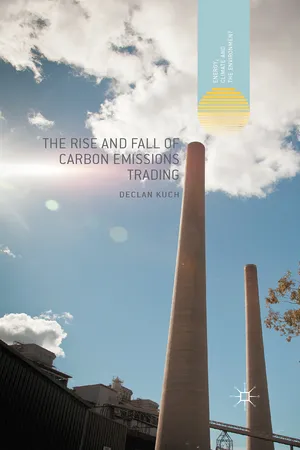
The Rise and Fall of Carbon Emissions Trading
About this book
This book presents the results of the first full-scale emissions trading schemes in Australia and internationally, arguing these schemes will not be sufficient to 'civilize markets' and prevent dangerous climate change. Instead, it articulates the ways climate policy needs to confront the collective nature of our predicament.
Information
Topic
PhilosophieSubtopic
Droit de l'environnement1
The Rise of Emissions Trading as a Market Mechanism and the Promise of ‘Civilized Markets’
‘It matters what stories tell stories, it matters what thoughts think thoughts, it matters what worlds world worlds’
– Haraway, 2014
Who and what makes a difference to contemporary markets? The unnerving sense of collective disaster around crossing the two-degree Celsius ‘guardrail’ of global-warming emissions puts this question into stark relief: Can carbon markets save us by ‘civilizing markets’, as many hope, or are they part of the infrastructure that will hurtle us over the guardrail as critics have feared? The alluring promise of carbon pricing to civilize otherwise barbarically destructive tendencies in capitalism has achieved a near hegemonic status in climate-policy circles, leading to major experiments with carbon emissions trading schemes (ETS) at city, regional, national and international levels in places such as Australia, the European Union, New Zealand, and at the city level in Asia.
Claims that emissions trading schemes are suitable for all these jurisdictions and innately superior to other climate policy have relied upon strong rhetoric from economists. In its strongest form, economists claim that emissions trading won out over alternative regulations because its successes were self-evident. The federally appointed Australian expert, economist Ross Garnaut, best summarizes the victory of emissions trading:
There was for a while in the twentieth century a great contest of ideas, about whether market-based or regulatory approaches to managing the economy were more conducive to economic welfare. The regulatory approach went under the name of ‘central planning’. The case for regulation depended on assessments of high transactions costs and instability in the market economy, on the capacity of Government to take a wide range of decisions more reliably than individual economic actors, and on the capacity of Governments to secure intended outcomes when they intervene directly to replace private by official decisions. That contest of ideas was won decisively by the market economy. It was not won in theory. It was won by observing the results of predominantly market-based decisions and predominantly regulatory interventions.1
This is not a book against carbon pricing, but rather a story about its origins, capacities and possible worlds, a story different to the one put forward by Garnaut and other neoclassical economists. As Richard Lane has forcefully argued, ‘this understanding of the “laws” of efficiency – emissions trading as efficient, and of command-and-control regulation as inefficient – is wrong. It is wrong because it simply takes these as given, as facts that were settled “behind the scene, above our heads and before the action”’ (Lane, 2012: 584). Far from a popular mythology of facts being supposedly translated by scientific evaluation into economic policy, economists have made markets in close negotiation with policymakers through establishing bureaucratic agencies, measurement devices and new accounting methods that align with a liberal world view. Garnaut’s claims about the supremacy of regulatory emissions trading schemes over taxes and more direct regulation are one of many claims by governing actors – from entrepreneurs to economists and regulators.
The development of tradable permits and offsets are one way to stake a claim: that you are making a difference by redrawing the line between ‘business as usual’ and some imagined other future. Capitalism and markets only attain their identities in contrast to the non-capitalist or the non-market (Mitchell, 2002: 245), as with Garnaut’s sharp distinction between markets and ‘the regulatory approach’ of ‘central planning’. The difficulty with emissions trading schemes so far has been establishing an identity as a market separate from taxation and regulation whilst also requiring the resources of regulators and the authority of law.
Emissions trading schemes have failed to respect any clean boundaries in economists’ designs. Cap-and-trade schemes have invariably included carbon offsets, whilst fixed pricing mechanisms have blurred the boundaries between trading and taxation – a vexing point for participants in debates about carbon pricing in Australia, where an introductory fixed price was legislated to give way to a floating price2 (Bailey et al., 2012). In fact, Google searches for ‘carbon tax’ eclipsed the analogous searches of ‘emissions trading’, ‘carbon market’ or ‘carbon trading’ in 20113 at the height of Australia’s climate policy debate.
Such pervasive linkages between law and price blur Garnaut’s sharp distinction between carbon markets and ‘command and control’ in practice. And, yet, neoclassical economists remain ever faithful to the power of prices, arguing that if the costs of carbon emissions can be fully internalized by companies, the problem of climate change would be solved. Here, parsimony is the objective, as exemplified by Massachusetts Institute of Technology (MIT) economists Henry Jacoby and John Reilly in their ‘one page plan to fix global warming’. In drawing attention to what is marginalized and ignored by pricing regimes, this book is a plea to move beyond the neo-liberal impulses that underpin comments such as: ‘Getting the price right ... is a key principle of a carbon pricing instrument’ (World Bank and Ecofys, 2014: 33), and ‘[W]hat’s needed is a carbon price, period’.4 These comments suggest a world in which the signifier of price reigns over all others, perhaps expressing an anxiety that imagining the end of capitalism could be easier than imagining the end of the world.
Empirical and critical analyses of emissions trading
This chapter lays out the framework of analysis by first providing a brief empirical assessment of emissions schemes’ effectiveness to date and then by providing an overview of critical perspectives on emissions trading before laying out my own framework of analysis drawing from the performative turn in economic sociology, from assemblage thinking and from governmentality studies. My aim with this framework is to put the ‘histories of capital in conversation with human histories’ (Chakrabarty, 2009) by examining the co-constitution of resource-extraction and modern political institutions in ways that recognize nonhuman agency. As Jo Guldi and David Armitage state in their call for a return to long duree thinking:
the major abstract concerns of climate scientists and the policy specialists who responded to them were questions over periodization, events, and causality; they were problems in the philosophy of history.… We are in a world that more and more looks to history to make sense of the changing nature of world events. But what if protecting the planet requires rejecting prosperity? That line of thinking would require a very different theoretical toolset than the one that currently dominates corporations and policy. Moreover, a true sustainability will involve unthinking the power of terms like ‘improvement’, ‘development’, and ‘growth’, which modern capitalism has inherited from the last two centuries of its historic development, and which are embedded in all economists’ definitions of success with knowledge of these events, institutions, and discourses, however, the possible future of action becomes wider again. These stories are therefore vital for our time; they illustrate how important narrative history is for clear thinking about the future. They also raise important questions about the kind of story-telling that we most need right now. (Guldi and Armitage, 2014: 33)
The rise and fall of carbon emissions trading documented in this book seeks to move beyond the obsession with price in a climate-policy debate. Much of the literature – academic economics papers, NGOs’, consultancy and government reports – advocating carbon emissions trading either ignores or sidelines the empirical assessment of the emissions trading scheme’s effectiveness. The fetish of price is most pronounced in reports by the ‘Carbon Disclosure Project’ carried out by a not-for-profit industry body ‘providing the only global system for companies and cities to measure, disclose, manage and share vital environmental information [working with] market forces to motivate companies to disclose their impacts on the environment and natural resources and take action to reduce them’.5 CDP reports provide information about internal carbon prices used by companies and which are mostly employed to identify inefficiencies – collapsing sustainability justifications for pricing carbon with competitiveness ones (Nyberg and Wright, 2012).
The World Bank’s (2014) State of the Carbon Market reports, which have been published annually since 2007, also focus on abstractions: quantities of permits bought and sold, sectoral coverage of schemes, linkage rules and other minutiae. Simple percentage assessments of emissions reduced against some baseline are surprisingly difficult to find – and this is largely because they rely on counterfactual assessments. Few are willing to quantify ‘what would have happened otherwise’. The impossibility of economic prediction is often the excuse for advocating a carbon tax instead of trading (Wara, 2014), or for treating ex post evaluations with a great deal of scepticism (Tietenberg, 2006).
Studies of the effectiveness carbon emissions trading show modest reductions to date. The first phase of the EU emissions trading scheme resulted in an estimated 8 per cent reduction (Ellerman and Buchner, 2008). The second phase reduction was 2–4 per cent larger because they coincided with the global financial crisis. Meta-analysis of top-down and bottom-up studies found ‘some early evidence of a small but non-trivial impact on emissions abatement’ (Laing et al., 2013). Windfall profits have amounted to billions of euros, and carbon prices were passed through in electricity, diesel and other sectors where limited technologies changes were recorded (Laing et al., 2014). The New Zealand Environment minister anticipated the country’s emissions trading scheme to result in a 1 per cent reduction from business as usual projections (Bullock, 2012). During the scheme’s short lifespan, Australia’s carbon price led to a 1 per cent fall in national emissions, with electricity sector emissions falling 8 per cent before being repealed by the conservative Abbott government in July 2014.
The public death of emissions trading schemes through an election is the most spectacular way for a scheme to end, but this has been the exception rather than the rule. New allowances simply cannot be issued once a fixed period over which reductions are scheduled to take place has ended. This occurred with British Petroleum’s internal scheme where planned business never materialized and so no new caps were announced. Having met lax targets, the scheme was shelved (Victor and House, 2006). The Chicago Climate Exchange followed a similar trajectory, collapsing as businesses pledged voluntary reduction commitments to 2010, but no further (Reyes, 2014: 6). The UK emissions trading scheme followed a trajectory similar to the NSW GGAS scheme analysed in Chapter 3. This scheme was dominated by a small number of large players who made simple modifications to their industrial practices, thereby allowing lax emissions caps to be met as cheap credits flooded the market (Reyes, 2014: 6).
Longstanding carbon taxes seem to offer some solace, showing sustained reductions in European nations such as Norway, the Netherlands and Sweden (Withana et al., 2013). However, another set of literature using such concepts as ‘carbon leakage’ or the ‘Jevons Paradox’ calls their effectiveness into question. Research collating emissions data internationally shows that rich nations are effectively outsourcing their emissions to the developing world, where carbon-intensive manufacturing has been relocated during this same period (Hertwich and Peters, 2009). Global emissions even rose significantly during the recent financial crisis (Peters et al., 2013).
Critical literature centred on the development of carbon emissions’ trading schemes has burgeoned in recent years, and it can be grouped according to three main sets of arguments (see also Table 1 below):
(1)Economist advocates such as Garnaut (2008), Stavins and his colleagues (2010; 2010; 2012) and Tietenberg (2006; 2013), who argue that neoclassical price theory is superior to all other regulations and that failures in carbon markets have been impeded by law and government. This argument relies on a linear theory by which pricing concepts have been tested and proven (Voss, 2007; Voss and Simons, 2014).
(2)Opponents of carbon markets who argue that they do not work because the theories that underpin them are wrong and the interests they serve are undesirable. Lohmann (2006) exemplifies this.
(3)‘Performative’ moderates, such as Callon (2009), who argue that ‘matters of concern’ must be accommodated in the design and revision of carbon markets during periodic assessments for them to work. This approach implicitly seeks to move beyond what Gibson–Graham (2006) term capitalocentrism: the hegemonic representation of all economic activities in terms of their relationship to capital.
Opponents of carbon markets argue that they are founded upon ‘fictional commodities’ (Lohmann, 2006; 2010). The concept of ‘fictional commodities’ was first introduced by the ‘father’ of the substantivist social science, Karl Polanyi ([1944] 2002) to refer to the ways land, labour, and money are created by the market to allow for its very own existence. Lohmann’s (2010: 12) critical outline of the process of carbon marketization centres on commodification:
Step 1: The goal of overcoming fossil fuel dependence by entrenching a new historical pathway is changed into the goal of placing progressive numerical limits on emissions (cap).
Step 2: A large pool of ‘equivalent’ emissions reductions is created through regulatory means by abstracting from place, technology, history and gas type, making a liquid market and various cost savings possible (cap and trade).
Step 3: Further tradable emissions reductions ‘equivalents’ are invented through special compensatory projects, usually in regions not covered by any cap, and added to the commodity pool for additional liquidity and corporate cost savings (offsets).
Step 4: Project bundling, securitization, financial regulation, ‘programmatic offsets’ and so forth provide further help in making ‘reductions/offsets’ into a speculative asset class.
This book takes a different approach, charting how the real and fictional are performed in the making of carbon offsets by translating such things as photographs, measurement devices, economic models, accounts and a range of heterogeneous elements to make socio-material networks in which numbers appear objective and transparent.
The emphasis I place on performativity highlights the importance of differentiating between forms of carbon markets, something that critiques policies using tradable permits often fail to do (e.g., FoE, 2009). Performativity, with its emphasis on process, can therefore be distinguished from substantivist accounts anchored in the representation of economic actors and institutions. Throughout this book, Larry Lohmann’s work is outlined as exemplary of this representationalist perspective, by counterposing ‘fictitious’ commodities with ‘real’ communities.
Whilst Callon understands economics as a facilitator within a network, Lohmann’s accusation that carbon offsets are both morally wrong and a ‘fictitious commodity’ disavows this experimental ideal. A performative perspective, however, does not respect the boundaries of real and fictional, of objects and ideas, of nature and culture and of representation and reality (Mitchell, 2002; Mitchell, 2014) but, rather, argues that economics builds worlds in its own image of rationality and efficiency. These worlds are not superimposed upon already-existing social relations, but reconfigures them in a politics of market design that neoclassical economists guard fiercely. The ambition of re-grounding environmental economics from its lofty claims of rationality to a more mod...
Table of contents
- Cover
- Title
- Introduction
- 1 The Rise of Emissions Trading as a Market Mechanism and the Promise of Civilized Markets
- 2 Marketizing Civil Regulation: Acid Rain Regulation as the Experimental Bridge to Carbon Markets
- 3 Governing Carbon Emissions: NSW GGAS
- 4 The Technopolitics of National Carbon Accounts
- 5 Economists in the Wild: Clean Development and the Global Politics of Carbon Offsets
- 6 The Paradox of Measurable Counterfactuals and the Fall of Emissions Trading
- Conclusion: Beyond 8%: Resituating Emissions Trading
- Notes
- References
- Index
Trusted by 375,005 students
Access to over 1.5 million titles for a fair monthly price.
Study more efficiently using our study tools.
Frequently asked questions
Yes, you can cancel anytime from the Subscription tab in your account settings on the Perlego website. Your subscription will stay active until the end of your current billing period. Learn how to cancel your subscription
No, books cannot be downloaded as external files, such as PDFs, for use outside of Perlego. However, you can download books within the Perlego app for offline reading on mobile or tablet. Learn how to download books offline
Perlego offers two plans: Essential and Complete
- Essential is ideal for learners and professionals who enjoy exploring a wide range of subjects. Access the Essential Library with 800,000+ trusted titles and best-sellers across business, personal growth, and the humanities. Includes unlimited reading time and Standard Read Aloud voice.
- Complete: Perfect for advanced learners and researchers needing full, unrestricted access. Unlock 1.5M+ books across hundreds of subjects, including academic and specialized titles. The Complete Plan also includes advanced features like Premium Read Aloud and Research Assistant.
We are an online textbook subscription service, where you can get access to an entire online library for less than the price of a single book per month. With over 1.5 million books across 990+ topics, we’ve got you covered! Learn about our mission
Look out for the read-aloud symbol on your next book to see if you can listen to it. The read-aloud tool reads text aloud for you, highlighting the text as it is being read. You can pause it, speed it up and slow it down. Learn more about Read Aloud
Yes! You can use the Perlego app on both iOS and Android devices to read anytime, anywhere — even offline. Perfect for commutes or when you’re on the go.
Please note we cannot support devices running on iOS 13 and Android 7 or earlier. Learn more about using the app
Please note we cannot support devices running on iOS 13 and Android 7 or earlier. Learn more about using the app
Yes, you can access The Rise and Fall of Carbon Emissions Trading by Declan Kuch in PDF and/or ePUB format, as well as other popular books in Philosophie & Droit de l'environnement. We have over 1.5 million books available in our catalogue for you to explore.