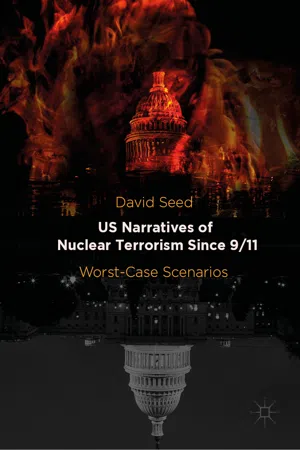
This study examines the US fiction and related films which makes a series of interventions in the cultural debate over the threat of nuclear terrorism. It traces the beginnings of this anxiety from the 1970s, which increased during the 1990s after the collapse of the Soviet Union. The traumatic events of 9/11 became a major reference point for this fiction, which expressed the fear that of a second and worse 9/11. The study examines narratives of conspiracies which are detected and forestalled, and of others which lead to the worst of all outcomes – nuclear detonations, sometimes delivered by suitcase nukes. In some of these narratives the very fate of the nation hangs in the balance in the face of nuclear apocalypse. The discussion considers cases of attacks by electromagnetic pulse (EMP), cyberterrorism and even bioterrorism. Some of the authors examined are present or former politicians, members of the CIA, and former president, Bill Clinton.
- English
- ePUB (mobile friendly)
- Available on iOS & Android
eBook - ePub
About this book
Information
Subtopic
Terrorismo© The Author(s) 2019
David SeedUS Narratives of Nuclear Terrorism Since 9/11https://doi.org/10.1057/978-1-137-54328-8_11. Introduction
Secret/Public
“The single biggest threat to U.S. security, both short-term, medium-term and long-term, would be the possibility of a terrorist organization obtaining a nuclear weapon” (Sanger 2010). With this grim warning, President Barack Obama opened the 2010 nuclear summit in Washington, DC. The following year his warning was repeated in a Rand Corporation report which tacitly recognized the role of fiction in dramatizing this fear, stating that “so far, at least, nuclear terrorism has occurred only in novels. Nuclear terror, on the other hand, is a fact. What matters now is whether we are its victims or its masters” (Jenkins and Godges 98). Indeed the threat from a smuggled nuclear device has been institutionalized by Homeland Security since 2004 as National Response Scenario Number One, designed by the Department of Homeland Security. Popularly known as a “nuclear 9/11”, this scenario includes elaborate emergency management procedures and is based on a premise that highly enriched uranium and bomb components have been smuggled into the USA for a 10-kiloton device which would probably target Washington, DC, New York or Los Angeles. 1
American Narratives explores the different ways in which US novelists have dramatized fears of nuclear terrorism since the 1970s. 9/11 serves as a major reference point in this fiction, but the surge of novels during the 1990s reflected rising anxieties over nuclear materials appearing on the black market after the collapse of the Soviet Union. 2 Further, I address terrorist scenarios which specifically involve nuclear and related weapons rather than terrorist attacks generally. In their survey of fiction dealing with terrorism from 1970 to 2001, Robert Appelbaum and Alexis Paknadel find that the exaggerations heightening conspirators’ capacity to inflict damage suggest this is a “fiction of fear, nightmarish in its concocting of terrors, ghoulish in its concocting of agents of mass destruction” (Appelbaum and Paknadel 402). In contrast to such a sweeping and impressionistic account, this book will demonstrate the care taken by the majority of writers to authenticate their narratives, often through close reference to news items, official reports and similar documents.
The focus of this study will fall on US fiction and will only bring in British fiction as they connect to the former national theme. Among the very few British writers engaging with this subject, Alistair Maclean sets Goodbye California (1978) entirely in the USA, describing the seizure of a terrorist group led by a fanatical Moslem of nuclear materials and physicists from a California power plant. One of the group’s “demonstrations” is to detonate an atomic device along the San Andreas Fault to trigger an earthquake. In Ian Fleming’s Moonraker (1955), former Nazi Hugo Drax plans to drop an atomic bomb on London. By 1979 the film adaptation had replaced national revenge with a more grandiose target—the whole human race. Nuclear issues became a staple theme in the Bond movies generally, from the theft of nuclear missiles in Thunderball (1965) to the seizure of a nuclear submarine to target New York in The Spy Who Loved Me (1977) and the theft of plutonium in The World Is Not Enough (1999). The Bond style impacted on James Cameron’s 1994 film True Lies, where a jihadist threatens to destroy Miami with a smuggled nuclear device. The potential threat is completely overshadowed by the film’s repeated use of comic effects and the final showdown between the conspirator and Arnold Schwarzenegger playing the role of a covert counter-terrorism agent. However, Cameron’s plans for a remake were put on hold after the impact of 9/11 because, as he explained, “terrorism is no longer something to take as lightly as we did in the first one” (Brew 2010).
On the other hand, the lure of the nuclear spectacle persists. Vince Flynn’s 2010 novel American Assassin is essentially an exploration of CIA training for their special operatives, but when adapted for the screen in 2017 a nuclear bomb was introduced through a conspiracy by Iranian hardliners headed up by a renegade American special agent. The latter carries the bomb towards the American Sixth Fleet, but is killed by the protagonist who jettisons the device before it can reach the target vessels. The explosion which follows offers a visual spectacle divorced from human casualties and the fleet survives intact from what is in effect a man-made tsunami.
Given the extreme nature of the threats posed, plausibility becomes a constant concern in these narratives, which begins to emerge before the Cold War has ended, but which frequently draws on the nuclear fiction of this earlier period. In fact, we shall see in the following chapters how the Cold War functions as a complex inheritance, both material and in the collective mentality of the security establishment. This continuity is explicit in the December 2017 number of Harper’s magazine which ran a forum called “Destroyer of Worlds: Taking Stock of Our Nuclear Present”, whose title echoes J. Robert Oppenheimer’s declaration after the Trinity atomic bomb test in 1945. 3 The investigation of the past is sometimes mimed out as a symbolic historical excavation, for example, in Jefferson Bass’s Bones of Betrayal (2009), a murder mystery set in the Oak Ridge nuclear plant. The narrative is introduced and framed by post-9/11 measures like the Disaster Mortuary Operational Response Team (DMORT) Weapons of Mass Destruction programme to prepare for responses to terrorist “dirty” bomb explosions and similar events. The novel opens in with such a disaster simulation, alerting the reader to the continuing possibility of such events. 4 In most cases, however, the prime targets in this fiction remain the cities of New York, Washington, DC and Los Angeles.
In his 2007 survey of the nuclear threat, The Seventh Decade, Jonathan Schell has argued that, in contrast with the polarities of the Cold War, “nuclear policy has always been a scene of rampant illusion and obfuscation, and just recently the maze’s trap doors, dead ends, false bottoms, illusory exits, mirages, and misleading appearances have multiplied” (14). Transpose these terms on to narrative and we have a foretaste of the complex variety of plots which we shall be examining in this study.
During the Cold War, novels repeatedly dramatized the worst case of nuclear war, whereas the fiction published since the collapse of the Soviet Union has confronted a more fragmented geopolitical situation where terrorists, with or without the covert backing from nuclear states, might be able to obtain weapons of mass destruction. The term repeatedly used to describe such a threat to the USA is “asymmetrical”, denoting the massive imbalance in military resources. In the fiction examined here, this imbalance manifests itself as the disproportion between the usually small number of conspirators and the massive damage which even a single nuclear weapon could cause. 5 One narrative which exemplifies the transition out of Cold War polarities is Nimitz Class (1997), by the British author Patrick Robinson, where a US aircraft carrier disappears from the Indian Ocean apparently in a nuclear detonation. As an accident is discounted, the likelihood emerges, as one character notes, of “military terrorism” (124) on a grand scale. The event proves to be the result of Iraqi money financing the “hiring” of a lost Russian submarine by a captain who, under false identity, has been trained by the British and Israelis. Russian and American agencies join forces to track down and neutralize the rogue sub, a collaboration reflecting the new geopolitical status quo. 6
Throughout the 1990s, reports began to emerge of a growing black market in nuclear materials within the former countries of the Soviet Union which were to feed into the plots of subsequent novels. One of the first journalists to report on the Ukraine, for example, was the journalist Mary Mycio, whose 2013 novel Doing Bizness (discussed below in Chapter 2) billed itself as a “nuclear thriller”, but which essentially describes how by the early 1990s Ukraine had become a nuclear bazaar for competing customers. 7 Much closer to the dates in question, T. Davis Bunn’s Riders of the Pale Horse (1994) explores the conditions favourable to smuggling nuclear materials in the post-Soviet Caucasus rather than describing actual instances, tracing the networks which might operate in the region. 8 To bolster the topicality of his subject, Bunn adds an epilogue dramatically entitled “We Have Been Warned”, which assembles a series of news reports from 1992 to 1993 concerning nuclear smuggling, militant Islam and speculative scenarios of nuclear attacks on American cities. Just in case any of Bunn’s readers miss the point, he makes his warning explicit: “the danger, both to Christian evangelism and to the Western world as a whole […] is growing as the power base of Islamic fundamentalism extends itself wider and wider” (Bunn 344). Suffice it to note that the smuggling and seizure of nuclear material have remained staple ingredients of this fiction. 9 For example, R. L. Young’s The Black Ships (2014) briefly describes attempts to hijack seaborne shipments of nuclear material, extrapolated from an actual 2013 theft of Cobalt-60 pellets in Mexico. We shall return to these writers’ use of news items below.
Extrapolative Scenarios
In 1962, the strategist Herman Kahn examined the threat of thermonuclear war through the scenario, which he explained as “an attempt to describe in more or less detail some hypothetical sequence of events” (Kahn, 143). He continued that scenarios “help to illuminate the interaction of psychological, social, political, and military factors, including the influence of individual political personalities upon what otherwise might be abstract decisions” (144). The more Kahn fleshes out scenarios, the closer they approach narrative summary. Indeed later in Thinking About the Unthinkable, he incorporates into his discussion novels like Nevil Shute’s On the Beach (1957) and Pat Frank’s Alas, Babylon (1959) as explorations of possible nuclear futures. For him, such novels share a characteristic of scenarios in modelling possible events, often suppressed from public consciousness not because they are improbable, but because they represent a reality too terrifying to contemplate.
Deliberately or not, in his Counter-Terrorism Handbook (2005) James H. Jackson echoes Kahn’s words when he argues that terrorism since the late twentieth century has been a continuum, affected but not initiated by the events of 9/11. Turning to nuclear terrorism, he continues: “one of the excuses voiced by the US intelligence and administrators over 9/11 was that never before had such an attack taken place. It is an absurd defence. It is the role of those charged with national security to think the unthinkable, to plan for the unlikely” (131). Jackson here opens up the collective role performed by the writers discussed in this volume. They are fleshing out the scenarios that he accuses the security establishment of ignoring. In short, they are thinking the unthinkable.
Sometimes with deliberate intent, the novels examined here are extending a practice followed by a number of non-fictional security studies. The following example makes the strategy explicit. During an extended discussion of nuclear security in the USA, Barry L. Rothberg steps briefly aside from contemporary fact and states:
Consider a fictional scenario to focus the problem. America wakes up to CNN reports that a low-yield nuclear device has been detonated in lower Manhattan. The World Trade Centre, the Empire State Building, and Wall Street have been vaporized. The immediate death toll is well over a million, and more will die from radiation and fallout. A long-term increase in incidences of cancer will add to the carnage. (81)
In order to dramatize the nuclear threat, Rothberg extrapolates a hypothetical news report of a detonation in New York. Only briefly evoking the destruction, he continues that the weapon is discovered to have been Russian, originating in the nuclear city of Arzamas. We shall see later in Chapters 3 and 5 cases of novels evoking just such a scenario.
Herman Kahn’s use of scenarios to shape security planning was increasingly followed after the events of 9/11. In 2009, the defence analyst Andrew F. Krepinevich published 7 Deadly Scenarios, a lugubrious series of speculative narratives designed to substantiate his conviction that “the United States is confronting perhaps the greatest set of challenges to its security since the end of the Cold War” (10). 10 Surveying the use of scenario planning in the military, he stresses that “scenarios do not attempt to predict the future. Rather their purpose is to identify and highlight potential changes – especially disruptive changes – in the threat environment” (27). Krepinevich approaches scenarios as a means of military planning, but his approach bears more broadly on the present volume in the sense that all the fictional narratives considered here could be approached as scenarios of possible imminent futures positioning themselves at different points along a scale of threat.
The particular account in Krepinevich’s volume, which most closely resembles the fiction examined here, “War Comes to America”, describes the actions of a “radical Islamist group” (90), which has acquired a number of ex-Soviet nuclear devices. One morning in 2011 (only two years after the volume’s publication date), a detonation takes place in downtown San Antonio, which triggers a frenzy of media activity and only partially effective responses from the emergency services. This closely followed by a second blast in Chicago where “landmarks like the Sears Tower simply disappear” (77). Further detonations take place in San Diego (a misfire), central Boston and on a tanker in the Gulf of Mexico. Krepinevich heightens the plausibility of his account by referencing fictitious news reports and unwittingly reveals the multiple assumptions underlying such scenarios by focusing mainly on the administration and the working of the National Security Council. The social disruption that would follow even one of these blasts remains unexamined. As intelligence emerges about the conspiracy, the president decides that all the devices have been accounted for, but in a final ironic twist the CIA receives a convincing report from an Islamist group claiming responsibility and warning that “they have other nuclear weapons in the United States and will begin using them within a week unless we meet their demands, which are as follows…” (90). The fact that the sentence is unfinished reflects the lack of finality to the scenario, which could be taken on a number of levels as a parable of presidential indecision, inadequate intelligence or the broader inability of the administration to respond to the serial crisis. And one of the key unknowns remains the number and location of devices still in the USA.
In one of the most judicious studies of this subject, Will Terrorists Go Nuclear? (2008), the Rand Corporation researcher Brian Michael Jenkins draws a distinction between terrorism and terror, arguing that “nuclear terrorism is about events. Nuclear terror is about the imagination, about what might be” (Jenkins 2008, 25–26). Jenkins helpfully avoids the conventional polarity between fact and fiction, projecting instead the notion of a cultural field which extends beyond politics and journalism into areas of popular culture. This approach will be followed in the present volume, which is a study of fears embodied in narrative scen...
Table of contents
- Cover
- Front Matter
- 1. Introduction
- 2. Beginnings
- 3. Pre-emptive Investigations
- 4. Suitcase Nukes
- 5. After the Blast
- 6. Visions of Apocalypse
- 7. EMP and Cyberterrorism
- 8. Bioterrorism
- Back Matter
Trusted by 375,005 students
Access to over 1.5 million titles for a fair monthly price.
Study more efficiently using our study tools.
Frequently asked questions
Yes, you can cancel anytime from the Subscription tab in your account settings on the Perlego website. Your subscription will stay active until the end of your current billing period. Learn how to cancel your subscription
No, books cannot be downloaded as external files, such as PDFs, for use outside of Perlego. However, you can download books within the Perlego app for offline reading on mobile or tablet. Learn how to download books offline
Perlego offers two plans: Essential and Complete
- Essential is ideal for learners and professionals who enjoy exploring a wide range of subjects. Access the Essential Library with 800,000+ trusted titles and best-sellers across business, personal growth, and the humanities. Includes unlimited reading time and Standard Read Aloud voice.
- Complete: Perfect for advanced learners and researchers needing full, unrestricted access. Unlock 1.5M+ books across hundreds of subjects, including academic and specialized titles. The Complete Plan also includes advanced features like Premium Read Aloud and Research Assistant.
We are an online textbook subscription service, where you can get access to an entire online library for less than the price of a single book per month. With over 1.5 million books across 990+ topics, we’ve got you covered! Learn about our mission
Look out for the read-aloud symbol on your next book to see if you can listen to it. The read-aloud tool reads text aloud for you, highlighting the text as it is being read. You can pause it, speed it up and slow it down. Learn more about Read Aloud
Yes! You can use the Perlego app on both iOS and Android devices to read anytime, anywhere — even offline. Perfect for commutes or when you’re on the go.
Please note we cannot support devices running on iOS 13 and Android 7 or earlier. Learn more about using the app
Please note we cannot support devices running on iOS 13 and Android 7 or earlier. Learn more about using the app
Yes, you can access US Narratives of Nuclear Terrorism Since 9/11 by David Seed in PDF and/or ePUB format, as well as other popular books in Politica e relazioni internazionali & Terrorismo. We have over 1.5 million books available in our catalogue for you to explore.