
- English
- ePUB (mobile friendly)
- Available on iOS & Android
eBook - ePub
About this book
This book investigates for the first time the parallels between two island appendages of much larger governments - Okinawa, Japan's southernmost island prefecture, in ferment over historic US bases; Jeju embroiled over a new South Korean naval base. The people of Okinawa and Jeju share a common fear of bloody conflict again erupting around them and suspect their governments would sacrifice their interests in a much larger war in a fight for regional control between the US, Japan, and China.
Information
1
Clouds on the Horizon
Kirk, Donald. Okinawa and Jeju: Bases of Discontent. New York: Palgrave Macmillan, 2013. DOI: 10.1057/9781137379092.
Kyoko Miyagi in her eighties feels the passion. She waits patiently in a park near the U.S. marine corps air station in Futenma, a district of Ginowan City that’s crowded with shops, offices and apartments in the urban sprawl north of Naha, capital of Okinawa, the southernmost island prefecture of Japan. “I’ve experienced war,” she says, somehow smiling when asked why, on an overcast Sunday afternoon, she’s going to an anti-American protest outside the base. “I think we should never have a base anywhere.”1
Unlike almost all the others going to the demonstration, Miyagi bears first-hand memories of the mass suffering of the thousands caught between two terrible fighting machines: the Japanese Imperial Army and American marines. In the last great battle of the Pacific War, these two alien forces turned much of an historically peaceful, idyllic island of verdant farmland, triple-canopy jungle, rocky cliff faces and sandy beaches into a killing ground in which more than 200,000 people were killed, 94,000 of them civilians who had had no notion, even as the war neared Japan, of the fate that awaited them.
“A lot of people lost their lives,” says Miyagi, 18 at the time. “It was a battlefield. I was a survivor of Himeyuri. We were as a group. I was a nurse. I took care of the wounded soldiers. My group was saved. We were in the cave at the time. Luckily no bombs came down on me. When we thought it wasn’t dangerous, we left. At the end, the U.S. soldiers told us to come out.”
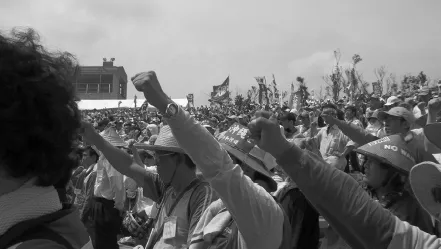
FIGURE 1.1 Protesters waving fists at anti-base rally, Okinawa
The nurses of Himeyuri—the Princess Lily corps—are the best remembered, in brochures, in tours of the island, among the tens of thousands who died. That’s partly because they were from elite families, educated at the exclusive Himeyuri School and dedicated to the welfare of the Japanese soldiers whom they were serving. They were so trusting, so committed that they had full confidence in what they were hearing whenever they were told the island’s Japanese defenders would drive out the Americans in a matter of days after the marines staged their initial landing on April 1, 1945. Nearly 200 of them died in the final American assault two and half months later—one-tenth taking their own lives. Just as they had had full faith in ultimate Japanese victory, so were they now convinced that all the stories they had heard about Americans raping and torturing women were true.2
Seated beside Miyagi, Yoshi Tokashiki, in her seventies, a dozen years younger, does not share such vivid memories. Her experiences, terrible though they were, were not quite so awful. “I was with my family, with relatives,” she says. “There were so many American ships. Then the Americans told us to leave the cave. We were sent to the northern part of the island by ship, my mother and sisters and a baby. We survived together. My father had to go to war. He returned later. We are against having the bases here.”3
The American bases are very much a part of life on Okinawa, the principal island of the Japanese prefecture by the same name. When people think of Okinawa, they have in mind one island, long and narrow, slightly more than 60 miles, 100 kilometers, from northeast to southwest, 20 miles, 32 kilometers, across at the widest point. Okinawa Prefecture actually stretches nearly 400 miles, 640 kilometers, while the arc of the entire Ryukyu chain extends south from Kagoshima Prefecture on Kyushu, the large southernmost “main” island of Japan.
Thus Okinawa Prefecture covers two-thirds of a chain beginning south of Amami Island, part of Kagoshima Prefecture, and extending 620 miles, 1,000 kilometers, to the small unpopulated islands in the East China Sea called the Senkakus by Japan, the Diaoyu by China and the Diaoyutai by Taiwan, the “Republic of China.” These hotly disputed islets are about 254 miles, 410 kilometers, southwest of Okinawa, that is, the principal island of the Ryukyus, but only 90 miles, 145 kilometers, west northwest of the island municipality of Ishigaki. That makes the Senkakus part of Ishigaki city, Okinawa Prefecture, to which they are formally consigned by Japan even though no one lives there and the mayor of Ishigaki and his aides are forbidden from visiting. The Senkakus are 87 miles or 140 kilometers northeast of the nearest Taiwan county, to which Chinese authorities, both in the mainland capital of the People’s Republic in Beijing and in Taipei, the capital of Taiwan, the Republic of China, say they belong, and 230 miles, 370 kilometers, east of the closest point on the coast of mainland China.
It was on Okinawa Island, mostly in the southern portion, that the Americans and Japanese fought the hardest battle of the war in the Pacific—and certainly one of the bloodiest battles in all World War II. It is on this island that the United States continues to enjoy the rewards of that great victory in the form of America’s most important air base in the Pacific, at Kadena, a few miles north of Ginowan, the city that includes Futenma. The U.S. air base at Kadena, the marine air station at Futenma and the marine base at Camp Schwab, on the northeastern coast, are the most important among more than 40 U.S. military installations where 27,000 U.S. troops are stationed on the island. As of 2013, that’s the highest concentration of U.S. forces in one fairly confined area between Hawaii and Afghanistan before the U.S. began disengaging from the Afghan conflict.
Yoshi Tokashiki, more than Miyagi, talks about the disillusionment of “reversion”—the word for the transfer of the islands back to Japanese rule in 1972 after 27 years under American military control. “Before reversion we were expecting a democratic system,” she says. “Now the Japanese do not listen to the feelings of the Okinawan people. They just put their interests from the top level. We are wondering, what are the real interests? Now the Japanese are thinking of changing Article Nine.”
No one in Japan better knows what Article Nine is about than do the Okinawans. It consists of three sentences in the constitution adopted by Japan during the American occupation under the victorious General Douglas MacArthur after World War II—the Pacific War to Japanese. Those sentences are enough for people to call the document, thrust on Japan by its American occupiers, Japan’s “no war” constitution. “Aspiring sincerely to an international peace based on justice and order, the Japanese people forever renounce war as a sovereign right of the nation and the threat or use of force as means of settling international disputes,” says the first sentence. “In order to accomplish the aim of the preceding paragraph, land, sea, and air forces, as well as other war potential, will never be maintained. The right of belligerency of the state will not be recognized.”4
Tokashiki does not trust the people who rule the country from far-off Tokyo any more than she trusts the Americans whose military presence forms an every day part of the lives of the 1.4 million people in Okinawa. “We don’t need either the U.S. or the Japanese military,” she says. “There’s always war over territory like the Senkaku Islands.” She has a happy if somewhat unrealistic solution. “My idea is to share the natural resources with everyone in the world.” Like many Okinawans, she has relationships with Americans that strengthen her belief in the need for harmony across national and ethnic lines. “One of my sisters is married to an American, living in Hawaii,” she says. “All people in the world are brothers and sisters. The Okinawan people are welcoming to outsiders.”5
The friendly nature of Okinawans adds a special dimension to the confrontation of forces and interests and dreams extending over a vast stretch of open sea and the people who inhabit their disparate islands. Okinawans may have Japanese citizenship, pay Japanese taxes, hold Japanese passports and speak and read Japanese as their main though not quite their only language, but they still are not totally “Japanese.”
That view is shared by Okinawans and “real” Japanese alike. The people of Okinawa are descendants of the citizens of the Ryukyu Kingdom, the nation that comprised the Ryukyu Islands for centuries, paying tribute to China while trading with both China and Japan, before succumbing to pressure in the early seventeenth century for Japan to take over military affairs. Finally, in the early years of the rise of Japan under the Emperor Meiji, the Ryukyu Kingdom was annexed totally by Japan in 1879.
Long before the onset of World War II, the people were Japanized as the Japanese never succeeded in Japanizing the people of Korea, which ceded authority to Japan in 1905 five years before its annexation as a Japanese colony. Japanese colonialists in Korea took over valuable land, banned Korean entrepreneurs from heavy industries and demanded they speak Japanese and take on Japanese names. Koreans did so reluctantly, under protest. Who knows what problems the Japanese would have had bringing the Koreans under control had Japan not been foolish enough to bomb Pearl Harbor on December 7, 1941, and go to war with the United States, Britain and a host of others in defense of its ill-got empire?
And who would imagine that Japan’s Emperor Hirohito on August 15, 1945, would go on the air for the first time in his life to tell his “subjects” that “the war situation has developed not necessarily to Japan’s advantage” and the time had come to “to pave the way for a grand peace for all the generations to come by enduring the [unavoidable] and suffering what is insufferable”—that is, to surrender unconditionally?6 No sooner had he read the surrender than the Koreans, subjects no more, cast off the appurtenances of their “Japanese-ness,” threw off the yoke of the Japanese language and Japanese names and gladly asserted their “Korean-ness.”
Not so the Okinawans. Nowadays, Okinawa actually enjoys the benefits of Japanese rule—a payoff for the presence of the bases. “Just because Okinawa has bases,” says Tokashiki, “Japan gives a lot of money to Okinawa.” Indeed, she goes on, “Some people get lazy just waiting to get money from someone. We want to change that. We should be more independent. Even if we get money from the bases, we are truly against having them.” The government, she says vaguely, “should use the money to help people instead of spending it on bases.”
Miyagi, the survivor of the worst days of the battle of Okinawa, still lectures from time to time about her experiences in the war. “I’m invited to speak about how bad it was,” she says, quickly summarizing the worst aspects of the American military presence. “With the Americans we experienced many rapes by American soldiers and many traffic accidents,” she says. “It is very unfair. Peace is what is most important.”
Actually, Okinawa has been at peace ever since the fighting ended on June 22, 1945, and the American command formally declared ten days later that the battle was over and the Japanese defenders completely annihilated. The war, though, was far from over. The U.S. forces that had fought for the island were now training there and at bases elsewhere in the Pacific for what they expected would be a much bloodier final assault on “mainland” Japan. U.S. marines, the majority of the 12,520 U.S. ground troops killed in the conquest of Okinawa, were expected to lead the charge across mainland beaches as they had done in a series of Pacific island campaigns, most famously the five-week battle for Iwo Jima in February and March, before landing on Okinawa on April 1, 1945. They were sure the Japanese, the real Japanese, would fight to the death—something most Okinawans had tried to avoid though 122,228 of them, 94,000 civilians and 28,228 soldiers from Okinawa, did die along with 65,908 soldiers from “mainland” Japan.7 The exaltation of victory on Okinawa, as the American forces were repeatedly reminded while they trained for the fight to the finish on the mainland, would be short-lived.
Who knew at the time that instead President Harry S. Truman would order the atomic bombing of Hiroshima on August 6 and then of Nagasaki on August 9, costing the lives of a quarter of a million people?
If Okinawa as such has been at peace since the Japanese surrender six days after the bombing of Nagasaki, it has still been very much at war—not on Okinawan soil or in wars anywhere inside Japan but elsewhere throughout the region, from Korea to Vietnam, and on to the Middle East, from Afghanistan to the Persian Gulf to Iraq and even, on occasion, Eastern Europe. That’s because, as the victor’s reward for conquering the island, the United States established bases on Okinawa that endure as training areas as well as springboards for rapid deployment. Entire marine divisions left Okinawa for Korea in the Korean War and again for South Vietnam during the Vietnam War. The chemical Agent Orange was stored at Kadena Air Base on Okinawa for loading on to the planes that sprayed it over vast stretches of Vietnamese jungle, burning away vegetation, exposing enemy hideouts—and leaving a deadly residue that killed and maimed thousands of Vietnamese peasants as well as American and South Vietnamese soldiers.
The United States also had Clark Air Base and the Subic Bay navy base in the Philippines, two of the largest American bases overseas until the Philippine senate refused to renew the lease in 1990, and nine bases in Thailand. Planes regularly flew missions from these bases over the region dubbed “Indochina” by its French conquerors and colonialists in the nineteenth century decades before their final defeat at Dienbienphu in northwestern Vietnam in May 1954. Kadena, however, was the major point of departure for the B52s that terrorized the jungles of Vietnam, Cambodia and Laos from 1965 to 1973 when the United S...
Table of contents
- Cover
- Title
- 1 Clouds on the Horizon
- 2 Visions of War
- 3 Battling on the Beach
- 4 On-and-Off Base
- 5 Populist Politics
- 6 The Southern Front
- 7 Island of Peace
- 8 War or Peace?
- Epilogue
- Comparative Statistics
- Bibliography
- Index
Trusted by 375,005 students
Access to over 1.5 million titles for a fair monthly price.
Study more efficiently using our study tools.
Frequently asked questions
Yes, you can cancel anytime from the Subscription tab in your account settings on the Perlego website. Your subscription will stay active until the end of your current billing period. Learn how to cancel your subscription
No, books cannot be downloaded as external files, such as PDFs, for use outside of Perlego. However, you can download books within the Perlego app for offline reading on mobile or tablet. Learn how to download books offline
Perlego offers two plans: Essential and Complete
- Essential is ideal for learners and professionals who enjoy exploring a wide range of subjects. Access the Essential Library with 800,000+ trusted titles and best-sellers across business, personal growth, and the humanities. Includes unlimited reading time and Standard Read Aloud voice.
- Complete: Perfect for advanced learners and researchers needing full, unrestricted access. Unlock 1.5M+ books across hundreds of subjects, including academic and specialized titles. The Complete Plan also includes advanced features like Premium Read Aloud and Research Assistant.
We are an online textbook subscription service, where you can get access to an entire online library for less than the price of a single book per month. With over 1.5 million books across 990+ topics, we’ve got you covered! Learn about our mission
Look out for the read-aloud symbol on your next book to see if you can listen to it. The read-aloud tool reads text aloud for you, highlighting the text as it is being read. You can pause it, speed it up and slow it down. Learn more about Read Aloud
Yes! You can use the Perlego app on both iOS and Android devices to read anytime, anywhere — even offline. Perfect for commutes or when you’re on the go.
Please note we cannot support devices running on iOS 13 and Android 7 or earlier. Learn more about using the app
Please note we cannot support devices running on iOS 13 and Android 7 or earlier. Learn more about using the app
Yes, you can access Okinawa and Jeju: Bases of Discontent by D. Kirk in PDF and/or ePUB format, as well as other popular books in Social Sciences & Asian Politics. We have over 1.5 million books available in our catalogue for you to explore.