- English
- ePUB (mobile friendly)
- Available on iOS & Android
eBook - ePub
Global Beauty, Local Bodies
About this book
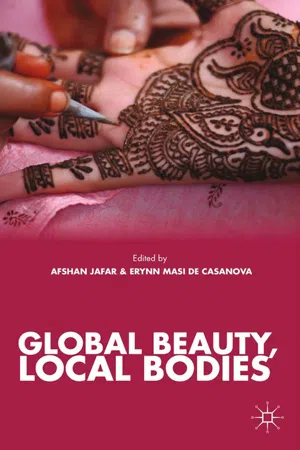
This collection of original scholarly work and first-person accounts takes globalization processes and the transnational links these processes create as the jumping-off point for an examination of what it means to be, have, or aspire to a beautiful body.
Information
Topic
Ciencias socialesSubtopic
Política1
REFASHIONING GLOBAL BODIES
COSMOPOLITAN FEMININITIES IN NIGERIAN BEAUTY PAGEANTS AND THE VIETNAMESE SEX INDUSTRY
Oluwakemi M. Balogun and Kimberly Kay Hoang
WOMEN’S BODIES AS NATIONAL REPRESENTATIONS
Women’s bodies are symbolic sites where debates about the development of a nation take place. Shifts in the global economy, cultural globalization, and postcolonial trajectories map onto women’s altered embodiments (Dewey 2008; Mani 1998; Otis 2012). These bodies represent a nation’s shift toward modernity (Rofel 1999) through economic progress and development. Bodily practices and markers of appearance such as dress, makeup, and grooming are vehicles of collective identity in which women’s bodies are often the terrain where national identities are produced, maintained, and resisted (Choo 2006; Gal and Kligman 2000; Huisman and Hondagneu-Sotelo 2005). The embodiment literature has established how cultural constructions of the body are shaped by the role of local and global media consumption (Casanova 2004), the quest for upward mobility (Edmonds 2010; Rahier 1998), and the tension ethnic and racial minorities face in establishing ethnic or racial authenticity while incorporating into multicultural societies (Craig 2002; King-O’Riain 2008; Rogers 1998).
Several studies claim that Western-defined beauty standards such as lighter skin and slim figures have spread throughout the world as a result of the multinational cosmetics industry (Chapkis 1986), diffusion of mass media (Shilling 2003), and the production of New York and Paris as the fashion capitals to a new generation of consumers around the world (Jones 2011). Other scholars dispute the Western origins of these beauty standards, noting that in some instances they may predate colonialism and have a much more complex internal history unconnected to the West (Li et al. 2008; Wagatsuma 1967). This debate highlights the extent to which beauty standards are internally or externally constructed within a nation in an era of rapid globalization. The current scholarship often assumes a one-dimensional understanding of the diffusion of Westernization and ignores how developing countries fuse embodied practices and nation-building projects to emerge into the contemporary global economy.
We bridge both of these perspectives by centering the intricate local, national, and global forces at work in the body projects of Nigerian beauty contestants and Vietnamese sex workers. In this chapter we ask: How do women’s bodies come to shift nation-based hierarchies to represent their nation’s rising status in the global economy? Nigeria and Vietnam both filter their beauty ideals through the prism of international standards. These standards are perceived to be a set of principles that all nations around the world are held accountable to, but are shaped by local context. International standards serve as buzzwords that frame not only beauty culture, but also the political economy. In Dewey’s study (2008) of Miss India, she notes that economic liberalization policies shape how the pageant seeks to conform to international standards while preserving Indian national culture for a global audience. Our participants view these standards as being previously defined by the West, linking this control to an imperialist past and economic might. We show how the women in both industries recognize, and take part in, the shifting orientation of international beauty standards. Women in both nations perceive this shift in international standards of beauty as trending toward the ascendance of developing countries that are beginning to have a presence on a global stage. That is, they counteract assumptions of Western dominance within global beauty culture by emphasizing that international beauty standards are multidirectional. Developing countries are internally redefining their own beauty standards, which, while not completely dismissive of the role of Western influence, center on contemporary African and Asian ideals. Simultaneously, they envision that in the near future their countries will play a significant role in defining these international beauty standards for other nations, which they directly link to their establishment as leaders in a globalizing world economy.
GLOBAL CONNECTIONS: TWO DIFFERENT COUNTRIES AND INDUSTRIES
We now turn to our ethnographic data, independently collected by each author in Nigeria and Vietnam. In Nigeria we examine the country’s premier national beauty pageant, where Oluwakemi Balogun conducted 10 months of ethnographic field research and 55 formal interviews with female pageant contestants, organizers (who are mostly men), corporate sponsors, and judges. Turning to Vietnam, we focus on the highest paying niche market of Ho Chi Minh City’s (henceforth referred to as HCMC) sex industry, where Kimberly Hoang completed 15 months of ethnographic field research along with 54 informal interviews with female sex workers, male clients, bar owners, and madams. Both studies took place between 2009 and 2010, allowing us to observe comparable contemporary patterns in two countries where women played a critical role in representing their respective nations’ shifting place in the new global economy.1 These shifts discursively map onto the representations of women’s bodies. These bodies highlight the adoption and redefinition of international standards of beauty that do not always neatly align with Western hegemonic ideals.
Vietnam and Nigeria are both emerging nations. Following in the footsteps of capitalist economies in their respective continents, they are both the second fastest growing economies in their regions. Hayton (2010) dubs Vietnam the rising “dragon” following in China’s trajectory of rapid economic development. Similarly, Nigeria is lauded as the up-and-coming “giant” right after South Africa. These two seemingly disparate nations have one thing in common: they are both rapidly developing economies that provide people with new opportunities to reconfigure social structures and the place of their nations in the global world.
Much of the scholarship on economic restructuring utilizes a top-down analysis focused on the state or on the movement of capital in analyzing how developing countries modify their place in the international political economy. However, this study takes an ethnographic approach that emphasizes how women in local spaces play a significant role in constructing new forms of embodied femininities in the cultural economy (Mears 2010) in order to reposition themselves—and by extension their nations—on the global stage. Both beauty pageants and the sex industry are sites of heightened femininity that serve as fruitful spaces to study how women interpret and understand the political and economic changes that are taking place in their countries. Our complementary data focus on the distinct looks cultivated by women in both institutions, which remain managed in part by others around them, such as madams, patrons, fans, and organizers. We reveal the public and hidden constructions of femininity through bodily practices within cultural performance and the underground economy.
Beauty Pageants in Nigeria
The Silverbird Group, a Nigerian-based media conglomerate with branches in Ghana and Kenya, coordinates the Most Beautiful Girl in Nigeria. The Most Beautiful Girl in Nigeria (MBGN) is the most visible beauty pageant on the Nigerian national scene and has sent contestants to the top beauty pageants in the world since 1986. At the finale, MBGN chooses five winners who go on to represent Nigeria at different beauty, modeling, and promotional contests within the country and around the world. The winner and first-runner up continue on to Miss World (a British-based pageant) and Miss Universe (a US-based pageant), respectively. MBGN produced the first black African winner of the Miss World contest in 2001.
The organizers of this pageant push forward a gendered nationalist vision that molds women into cosmopolitan subjects who publicly represent the nation. While its organizers are primarily Nigeria based, MBGN also relied on grooming and production experts outside of Nigeria, most notably from the United States and South Africa. These experts are said to internationalize the Nigerian pageant system and offer contestants a leg up in the Miss World and Miss Universe competitions. Contestants are trained to embody “international standards” through their looks, movements, and high self-confidence. The Silverbird Group has sponsored three different international pageants within Nigeria, which brought in delegates from throughout the world to compete: the Miss Intercontinental pageant from 1986 to 1990, Miss World 2002, and Miss Silverbird International in 2004. Contestants are chosen at various cities throughout Nigeria, primarily in the southern part of the country (Benin and Port Harcourt in the Central South, Lagos in the Southwest, and the capital Abuja in 2010). Semifinalists selected from these screening venues then compete in Lagos, where 30 finalists are chosen to compete in the final show. The pageant’s finale activities are usually centered around Lagos, the port-metropolis and commercial hub, where much of the country’s wealth is concentrated.
Pageant contestants’ public exposure and fame provided them with direct access to some of the nation’s most powerful political officials, elite businessmen, and acclaimed celebrities. MBGN’s first prize package includes: $21,000, a brand-new car, endorsement deals, and lavish gifts. Through shifts in embodiment, such as access to high-end styling treatments and brand-name clothing, contestants (especially pageant winners) embrace a newfound lifestyle that signals the nation’s rising position in the international political economy.
High-End Commercial Sex in Vietnam
Khong Sao Bar, located in the heart of HCMC’s business district, services the highest-paying niche market for commercial sex in Vietnam. As one of the most profitable bars in HCMC that caters to the country’s wealthiest businessmen and political officials, this bar was hidden. In order to get a table, the clients had to have a preexisting relationship with the madam or be introduced by a top-paying regular client. High-end Vietnamese sex workers entertain foreign guests, helping to cement business deals that direct capital into the country while also serving as emblems of progress and development.
Vietnam’s elite businessmen operate some of the nation’s top finance, real estate, and trade companies. Collectively, these men are responsible for directing the majority of capital through foreign direct investment (FDI) projects into the country. As regular patrons, they spend an average of $1,000–2,000 per night and $15,000–20,000 per month in Khong Sao Bar. There were three madams who ran the bar. These women trained sex workers on how to sit, drink, sing, dance, and maintain appropriate relationships with their clients. Workers earned roughly $2,000 per month, comprising tips for joining men at their tables and $150–200 for each sexual encounter. The madams earned $3,000–4,000 per month in tips and got a small percentage of all alcohol sales in the bar.2 In order to sell Vietnam to foreigners as a place to do business, local firms rely on hostess bars to help them dramatize Vietnam’s potential as a lucrative location for foreign investment. In sharing the ritual of male drinking (Allison 1994) with their guests, clients showcased their wealth. They also noted the transformation of the nation through a focus on the changes that women’s bodies underwent. Sex workers embodied transformations through skin lightening creams, plastic surgery, and conspicuous consumption that helped local Vietnamese men convey to their investors a lived sense of Vietnam’s dynamism and faith in the nation’s promise for rapid economic development.
SITES OF ATTRACTIVENESS: REDEFINING “INTERNATIONAL STANDARDS”
In both pageant contests in Nigeria and the sex industry in Vietnam, women had to contest with converging local, national, and global idealized femininities. Many of these women engaged in embodied practices that on the surface appear to embrace Western standards, yet they defied this interpretation by framing their own practices as way to solidify their cosmopolitan status. Similarly, Saraswati (2010) argues that beauty practices like skin lightening, which are usually associated with whiteness, are not automatically equated with Caucasian ideals, but rather with cosmopolitanism and transnational mobility. Women in both countries attempted to pluralize and expand international standards of beauty, sometimes with critical reflections on Western feminine ideals.
The MBGN pageant strived to carefully craft a glossy image of their contestants to represent the very best of the nation as a whole. Pageant organizers insisted that the contestants strived toward fulfilling international standards of beauty, which they did not equate with universal Western-based criteria. MBGN defined international beauty standards through a set of criteria focused on height, weight, body shape, and facial features. While they acknowledged that these criteria were previously dictated by American and British definitions due to their control of international pageants, they also insisted that these pageants have been forced to change as a result of the increasing participation and success of contestants from the developing world. They emphasized the multidimensionality of international standards by strategizing within them, selecting delegates who tapped into distinct niches in global pageantry. For example, candidates sent to Miss Universe are described as glamorous “model-types” who are tall, slim, and dark. Miss Universe, owned by the mogul Donald Trump, is viewed as a corporate enterprise focused on integrating the modeling industry into the Trump business empire. Dark skin was viewed as important for Africans because it makes them stand out as exotic. In contrast, organizers sent a “girl next door” type to the Miss World pageant, a British pageant organized and privately owned by the Morley family. To appeal to Miss World’s “beauty with a purpose” tagline, organizers and judges focused on picking a fresh-faced, innocent-looking candidate with mass appeal. These candidates tended to be more shapely, shorter, and lighter-skinned.
These parallel preferences for light-skinned and darker-skinned contestants were equally elevated as part of the ideal “international standards” for Nigerian representatives. Beyond highlighting the social dimensions of skin color, by both marketing light skin as a marker of global “mass appeal” (Glenn 2009) and capitalizing on dark skin as a form of desired “exotic beauty,” MBGN manages beauty ideals through a global cultural economy, highlighting some flexibility in striving for international legitimacy. The national director of MBGN detailed the difference in the following way:
Well for Miss World, it is a family-owned organization. They are looking for a likeable personality in a woman, someone they would consider a daughter. A nice person, sweet and lovable person who can achieve goals. For Miss Universe, I see them looking for an exotic model who can model for Gucci and the rest, you know, a high-flying person. We will be looking for a wholesome person for Miss World and a commercially viable person for Miss Universe. Someone that can do an advert, be on the billboard, can stand in front of the TV camera.
MBGN Organizers contrasted the two international pageants as striving toward a natural versus a glamorous look, which they mapped onto skin color. That is, through this strategy of emphasizing the marketability of skin color, pageant organizers viewed international standards in a much more flexible manner that did not always value light skin.
Contestants worked to achieve vibrant, even-toned skin free of blemishes, regardless of their skin color. Visible scars were pointed out, scrutinized, and debated over the course of the screening process. During the audition, a couple of the chaperones pointed out a woman who had tried out for the past two cycles of MBGN. While she had made the cut in the past, she did not go on to win the crown. “Each year she comes back cleaner and cleaner,” one chaperone said. When asked to clarify what she meant by this statement, she responded that each time she returns to audition her skin looks fairer. This observation was just one of many which pointed to how contestants’ bodies physically shifted as a result of participating in the pageant, which in this case was linked to access to exclusive skin and makeup treatments that seemingly made their skin “cleaner.” In preparation for the pageant, contestants often rubbed skin ointments and lightening creams to “tone” or smooth out their complexions. In particular, contestants sought to eliminate black patches on their elbows and knees. These beauty ideals were not framed in terms of achieving Western ideals, but rather as a means of establishing class status, since lighter skin was not always the desired result, but rather achieving an even skin tone. This finding is similar to other scholars’ work, which shows how lighter skin serves as a means of not only promoting Western beauty ideals, but also secures and verifies upward mobility (Hunter 1998; Pierre 2008; Rahier 1999). The ability to physically alter one’s body and the associated financial resources attached to these shifts denoted a higher-class status.
The pageant often touted its winner...
Table of contents
- Cover
- Title
- 1 Refashioning Global Bodies: Cosmopolitan Femininities in Nigerian Beauty Pageants and the Vietnamese Sex Industry
- 2 Aesthetic Labor, Racialization, and Aging in Tijuana’s Cosmopolitan Sex Industry
- 3 In Praise of Big Noses (Personal Reflection)
- 4 ¡Más que un Bocado! (More Than a Mouthful): Comparing Hooters in the United States and Colombia
- 5 Most Days I’m Beautiful: A Reflection on Skin and Body Hair in Cambodia (Personal Reflection)
- 6 Reproducing Beauty: Creating Somali Women in a Global Diaspora
- 7 The Before-and-After Template: Researching and Reflecting on Body Image Concerns in Globalizing India (Personal Reflection)
- 8 Metrosexuality as a Body Discourse: Masculinity and Sports Stars in Global and Local Contexts
- References
- Notes on Contributors
- Index
Trusted by 375,005 students
Access to over 1.5 million titles for a fair monthly price.
Study more efficiently using our study tools.
Frequently asked questions
Yes, you can cancel anytime from the Subscription tab in your account settings on the Perlego website. Your subscription will stay active until the end of your current billing period. Learn how to cancel your subscription
No, books cannot be downloaded as external files, such as PDFs, for use outside of Perlego. However, you can download books within the Perlego app for offline reading on mobile or tablet. Learn how to download books offline
Perlego offers two plans: Essential and Complete
- Essential is ideal for learners and professionals who enjoy exploring a wide range of subjects. Access the Essential Library with 800,000+ trusted titles and best-sellers across business, personal growth, and the humanities. Includes unlimited reading time and Standard Read Aloud voice.
- Complete: Perfect for advanced learners and researchers needing full, unrestricted access. Unlock 1.5M+ books across hundreds of subjects, including academic and specialized titles. The Complete Plan also includes advanced features like Premium Read Aloud and Research Assistant.
We are an online textbook subscription service, where you can get access to an entire online library for less than the price of a single book per month. With over 1.5 million books across 990+ topics, we’ve got you covered! Learn about our mission
Look out for the read-aloud symbol on your next book to see if you can listen to it. The read-aloud tool reads text aloud for you, highlighting the text as it is being read. You can pause it, speed it up and slow it down. Learn more about Read Aloud
Yes! You can use the Perlego app on both iOS and Android devices to read anytime, anywhere — even offline. Perfect for commutes or when you’re on the go.
Please note we cannot support devices running on iOS 13 and Android 7 or earlier. Learn more about using the app
Please note we cannot support devices running on iOS 13 and Android 7 or earlier. Learn more about using the app
Yes, you can access Global Beauty, Local Bodies by A. Jafar, E. Casanova, A. Jafar,E. Casanova in PDF and/or ePUB format, as well as other popular books in Ciencias sociales & Política. We have over 1.5 million books available in our catalogue for you to explore.