eBook - ePub
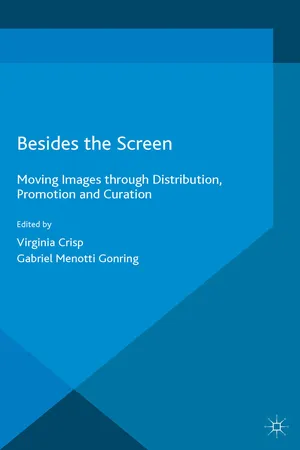
Besides the Screen
Moving Images through Distribution, Promotion and Curation
- English
- ePUB (mobile friendly)
- Available on iOS & Android
eBook - ePub
Besides the Screen
Moving Images through Distribution, Promotion and Curation
About this book
New media technologies impact cinema well beyond the screen. This volume speculates about the changes in modes of accessing, distributing, storing and promoting moving images and how they might affect cinematographic experience, economy and historiography.
Trusted by 375,005 students
Access to over 1.5 million titles for a fair monthly price.
Study more efficiently using our study tools.
Information
1
Introduction: In the Grooves of the Cinematographic Circuit
Gabriel Menotti Gonring and Virginia Crisp
It has become commonplace to talk about the influence that technological developments have on audiovisual media. At some point in the 20th century, video and broadcast television came to disturb the traditional organization of the cinema, revealing the image as soon as it was captured and bringing it into the audience’s home. Currently, computer synthesis and online networks have even stronger effects on the medium as they increase the public’s agency in the dynamics of the movie market. Film, as Professor Janet Harbord has so concisely summarized, ‘is not what it used to be’ (2007, p. 1). A number of technological, industrial and social shifts have affected it in recent years, the most notable being the fact that film is no longer ‘filmed’ – at least not on celluloid. Inasmuch as this might be the origin of a crisis in medium specificity, it is also what allows film to seamlessly converge with other media, escaping from the bounds of cinematic presentation into potentially limitless sites of exhibition and consumption, from mobile phones to public facades.
It is impossible to count here the myriad ways that film production, distribution, exhibition and consumption have changed over recent years; not least because by the time of publication the ‘new’ developments will undoubtedly have been superseded by yet more epoch-altering changes. Suffice to say that while the methods of production and consumption of film and other media content undergo an endless cycle of birth, rebirth and death, so too does the scholarship that attempts to grasp the complexities of the mediated world we all inhabit. Film studies and its cognate disciplines have been trying very hard to keep up with these fundamental transformations of their subjects.
This volume was inspired by one such attempt: a series of conferences organized in 2010 and 2012 by a group of then-PhD candidates at Goldsmiths, University of London. Named Besides the Screen, these events meant to address seemingly disparate areas of study in audiovisual media, such as archiving, curating, distribution, exhibition, codification, projection, piracy and marketing. In spite of their obvious differences, these practices had been put together for two reasons: first, the fact that they are generally overlooked by the field’s scholarship; second, the fact that they are being equally overhauled by digital computation. In paying attention to them, one comes to realize that new media technology impacts cinema well beyond film. It also promotes a reorganization of its logic of circulation, modes of consumption and viewing regimes. In that sense, the scrutiny of these spaces, practices and structures that happen around visual surfaces may give a new depth to film studies.
The chapters presented here, as a sample of the work that has developed out of the Besides the Screen events, have been organized according to three key themes: the distribution, promotion and curation of moving images. This volume’s main argument is that we must leave the image aside for a while and examine these largely invisible processes if we are to fully consider how cinematographic experience is mediated by the various sociotechnical changes that occurred in the early decades of the 21st century. In other words, it is only by looking besides the screen that one is able to generate a really cohesive picture of the converged media landscape that we have around us.
This is by no means the first endeavour to address such themes and suggest that film studies could profit from sidestepping film. Nevertheless, while a great deal of interesting research about audiovisual practices is being conducted, the results seem to take the form of an archipelago of scholarships: islands of specialized knowledge that very rarely interface with one another. If we mean to honour the intrinsically relational character of cinema, would it not make sense to produce connections between all the academic work already being undertaken? So, bringing economic and materialist concerns together with an interest in the aesthetics and language of audiovisual media, this edited collection aims to fill these gaps within the ever-expanding discipline of film studies. To begin with, the following section will chart some of the more significant strands of scholarship that continually intersect and interact to create a ‘film’ studies discipline as dynamic as the industries and practices that it tries to understand.
Contexts, paratexts and cultures: From film to off-screen studies
Since the early days of film theory, following a tradition inherited from literary studies, there has been a focus on textual analysis. However, as the discipline developed it became clear that this method, while potentially unearthing illuminating readings of film, did not have the capacity to reveal how moving image works might be experienced and ‘read’ by audiences during the act of consumption. As Jonathan Gray suggests:
Just as taking apart a machine would not necessarily explain why a given person chose that machine over another tool or machine, close reading may tell us little about how a viewer arrived at a text. Why view this program, or this film, as opposed to the many thousands of other options.
(2010, p. 24)
During the 1990s–2000s, as if responding to this limitation, film studies experienced what could be hesitantly termed an ‘exhibition turn’ led by the work of scholars such as Gregory Waller (2002), Douglas Gomery (1992) and Ina Rae Hark (2002). In the spirit of audience studies, these projects revisited the history of exhibition spaces and practices, analysing the constitution of viewing regimes. Such an approach provided ways to understand the contexts in which film was consumed, and how these contexts affected the meaning and value of the cinematographic work.
Nevertheless, the focus on exhibition only enables a limited understanding of the industrial and social processes that take place after film production and yet play a key role in dictating which works reach audiences in the first place. It is film distribution – that oft overlooked grey space between creation and consumption – that will allow for a more complete picture of moving image’s conditions of existence. This area has long been a site of theoretical interest: for instance, both Global Hollywood (Miller et al. 2001) and Global Hollywood II (Miller et al. 2005) contained sections on film distribution, as did Janet Wasko’s seminal text How Hollywood Works (2003). What these examples demonstrate, though, is how scholarship in distribution was often hidden within larger, more general, studies of the film industry (in particular Hollywood).1 As acknowledged by theorists such as Sean Cubitt (2004), Dina Iordanova and Stuart Cunningham (2012) and Julia Knight and Peter Thomas (2008), film distribution is still a woefully under-researched area. It is only recently that the topic has entered the spotlight of both academic and industry concerns because, in many respects, control of this sector of the industry is being wrestled away from the Hollywood majors who have traditionally dominated it.
On the one hand, there are companies like Netflix, Amazon and Hulu, referred to as ‘disruptive innovators’ by Stuart Cunningham and Jon Silver (2012), who have led the field in providing online video on demand (VOD) and subscription video on demand (SVOD) services. While many of these amenities are only available in certain territories,2 and so the extent to which they have ‘revolutionized’ the worldwide consumption of motion pictures should be stated with caution, these companies now hold the key to an important consumption ‘window’ for film and TV viewing when such release windows were once, at least in the case of the film industry, almost exclusively controlled by the major Hollywood studios.
On the other hand, and at the same time, fundamental changes in film distribution are being caused by developments in the illicit or illegal circulation of content; that is, film piracy. In his book Shadow Economies of Cinema Ramon Lobato helpfully makes the distinction between formal and informal film distribution (2012). Such a distinction allows us to consider the multiple ways that films circulate to and amongst audiences without making the almost inevitable distinction between the legality (or otherwise) of such practices. Thus, informal distribution can refer to lending films to friends or film societies at universities, as much as it might also be a term to describe the sale of counterfeit DVDs by street vendors or the ‘sharing’ of files online through a variety of means.
While Lobato’s terminology is undoubtedly helpful, it is important to also remember that informal/formal and illegal/legal forms of distribution are not mutually exclusive and that there are interactions and connections between such practices on a number of levels. Such intersections between formal and informal modes of film distribution are central to the research interests of one of the editors of this book and are examined in her forthcoming monograph Film Distribution in the Digital Age: Pirates and Professionals (Crisp, 2015). Here Crisp makes the case that while film texts are disseminated in a variety of professional, social and (il)legal contexts, there is a lack of research that directly examines the nature of the relationship between these differing forms of film distribution. As such, she examines film distribution in both formal and informal contexts, whilst considering how these practices of dissemination might ultimately conflict, interact with or complement one another.
Distribution in this context means far more than the link between content production and exhibition in the industrial chain. The film ‘distributor’ may have the power to dictate many parts of the process of content production, dissemination, marketing, exhibition, consumption and preservation, depending on a variety of factors. In fact, one might argue that the very term distribution is misleading when referring to the media industries because, in this context, such intermediaries are more concerned with the exploitation of intellectual property rights rather than the actual dissemination of products.
This is the point where the sheer dissemination of content gets entangled with the exploitation of its meanings. Film marketing, a process that ordinarily resides within the remit of the film distributor, does more than entice potential audiences to attend cinema screenings and purchase DVDs and movie merchandising. The way a film is advertised, marketed and promoted has the power to shape our textual experience before we ever enter the cinema or settle down on the sofa to watch a DVD.
There has been scholarly work on film marketing for some time. In particular, Justin Wyatt’s incredibly influential text High Concept: Movies and Marketing in Hollywood (1994) demonstrated how films since the 1970s are typified as ‘high concept’ by their increased focus on marketing and merchandising. However, as Finola Kerrigan points out, while such examinations of the important function that marketing plays within the film industry are certainly welcome, they often disregard marketing theory and focus on cases of marketing from within film, media and cultural studies. In that sense, Kerrigan’s own work Film Marketing (2010) provides a much-needed comprehensive overview of what film marketing is and how it functions, by bringing theory and knowledge from marketing into dialogue with studies of marketing within the film industry. In his book, Kerrigan suggests that ‘many isolated pockets of film marketing knowledge co-exist within the benefit of cross-reference’ (2010, p. 2). This observation again serves to highlight how an interdisciplinary approach to screen studies is both welcome and necessary as the media landscape continues to evolve.
Despite these important interjections, the focus within screen studies has hitherto invariably been on the film ‘text’ itself rather than its manifold ‘paratexts’: the materials that circulate around it, such as trailers, TV spots, adverts, merchandising, DVD covers and so on. Such ephemeral media has been, at worst, rejected as ‘promotional’ (and thus not a ‘text’ worthy of scholarly discussion) or, at best, simply overlooked or ignored. Nevertheless, they are crucial to the workings of cinema. According to Gray’s book Show Sold Separately, paratexts not only
tell us about the media world around us, prepare us for that world, and guide us between its structures, but they also fill it with meaning, take up much of our viewing and thinking time, and give us the resources with which we both interpret and discuss that world.
(2010, p. 1)
Furthermore, Gray makes a distinction between ‘entryway paratext’ (e.g. trailers that shape our experience of the film before consumption) and ‘in medias res paratexts’ (those experienced during or after the film) (2010, p. 22). Such classification into subtypes serves to illustrate that paratexts are multiple and varied, and are serving to extend the experience of the wider ‘text’ for the audience with every iteration. As their role becomes more prominent and influential, their inclusion within the wider body of film studies becomes imperative.
Intersecting with all of these areas is work on ‘film cultures’ more generally. In 2002, The Film Cultures Reader edited by Graeme Turner brought together chapters on film technologies, industries, meanings and pleasures, identities, and audiences and consumption. In many ways this publication began the work that Besides the Screen seeks to continue. It brought together in a single place considerations about many different aspects of cinema and was not constrained by concerns of uncovering the meaning contained within film texts, but rather examining how meaning is created and developed through the industrial and social processes that constitute film production and consumption.
While such an examination of film cultures rather than film texts might be welcome, there is still a limitation: as modes of delivery (if not also production) for film and TV mingle with one another, speaking specifically of film might be perceived as misleading. The continuing media convergence has caused inevitable repercussions for the study of cinema as a distinct medium. As Harbord suggests, ‘the effects of such transformations, considered together, produce a disorientation, perhaps a momentary vertigo, for film studies’ (2007, p. 2). This sparked renewed interest in the ontology of film itself, along with the realization that ‘intellectual traditions and methods of a discipline determined three decades ago have come to acquire an emptiness’ (p. 2) as the stalwarts of structuralism and semiotics no longer have a place in this brave, new, converged world.
Considering developments in digital technology, does it still make sense for a discipline of ‘film’ to exist distinct from cognates such as television studies? As the title of the pre-eminent film studies journal Screen highlights, these fields have been bedfellows for quite a while, dedicating similar attention to the flat surfaces in which moving images appear. Here, a structural element such as the ‘screen’ seems to work as a useful common denominator for new epistemological endeavours, more aware of the interactions between what used to be considered ontologically distinct media. As our interest moves from the film-as-text to the cultures that surround it, it seems relevant to evoke Gray’s call for the development of ‘off-screen studies’ – which, for him, implies an extension of ‘screen studies’ that considers the way that paratexts help to shape and develop the meaning of the wider ‘text’ (2010, p. 4).
While Gray’s approach is an interesting point of departure, we would like to suggest it does not go far enough to capture the multiple instances where meaning is made during encounters with media content. After all, by focusing on paratexts the textual (albeit the wider textual universe) is still the focus. A thorough study of the phenomena that exist besides screens also needs to acknowledge the material and sociotechnical attributes of cinematographic practices. The articulation of these layers allows for the production of complex links to other media, providing a new understanding of the negotiations and interfaces operating within the process of convergence. In the following sections, we will see how this approach is deployed in the book’s chapters.
Part I – Through many channels: Distribution
Computer networks are systems within which the processing of information is deeply intertwined with its transmission. As audiovisual media fully incorporate these technologies, it is not a surprise that their effects will be felt particularly in the domain of moving image circulation. Carried out by digital means, the practices and structures of film distribution not only become more diverse, opening a territory for disputes of both meaning and value, the influence they exert on film aesthetics, economy and means of operation also becomes harder to deny.
Such is the panorama offered in Alejandro Pardo’s chapter, ‘From the Big Screen to the Small Ones’, which opens this first part and the book. The piece is deliberately broad so as to provide a backdrop to many of the developments discussed in the other texts within this volume. Drawing from both scholarly writing and trade papers, Pardo examines how processes of digitization are transforming the distribution, exhibition and consumption of movies. He brings to the table the perspective of the film industry, concerned with the creation of new business models able to cope with the effects of digital technologies. Such an approach provides a very pragmatic, almost matter-of-factly tone to the survey, which helps undo any suspicion one might have that computer networks would begin a total revolution in film. On the contrary, even though the changes caused by technology are presented as significant, they seem nonetheless manageable. To take care of them involves, fir...
Table of contents
- Cover
- Title Page
- Copyright
- Contents
- List of Figures and Tables
- Acknowledgements
- Notes on Contributors
- 1. Introduction: In the Grooves of the Cinematographic Circuit
- Part I: Through Many Channels: Distribution
- Part II: Under the Spotlights: Promotion
- Part III: In the Files and Out There: Curation
- Index
Frequently asked questions
Yes, you can cancel anytime from the Subscription tab in your account settings on the Perlego website. Your subscription will stay active until the end of your current billing period. Learn how to cancel your subscription
No, books cannot be downloaded as external files, such as PDFs, for use outside of Perlego. However, you can download books within the Perlego app for offline reading on mobile or tablet. Learn how to download books offline
Perlego offers two plans: Essential and Complete
- Essential is ideal for learners and professionals who enjoy exploring a wide range of subjects. Access the Essential Library with 800,000+ trusted titles and best-sellers across business, personal growth, and the humanities. Includes unlimited reading time and Standard Read Aloud voice.
- Complete: Perfect for advanced learners and researchers needing full, unrestricted access. Unlock 1.5M+ books across hundreds of subjects, including academic and specialized titles. The Complete Plan also includes advanced features like Premium Read Aloud and Research Assistant.
We are an online textbook subscription service, where you can get access to an entire online library for less than the price of a single book per month. With over 1.5 million books across 990+ topics, we’ve got you covered! Learn about our mission
Look out for the read-aloud symbol on your next book to see if you can listen to it. The read-aloud tool reads text aloud for you, highlighting the text as it is being read. You can pause it, speed it up and slow it down. Learn more about Read Aloud
Yes! You can use the Perlego app on both iOS and Android devices to read anytime, anywhere — even offline. Perfect for commutes or when you’re on the go.
Please note we cannot support devices running on iOS 13 and Android 7 or earlier. Learn more about using the app
Please note we cannot support devices running on iOS 13 and Android 7 or earlier. Learn more about using the app
Yes, you can access Besides the Screen by V. Crisp, G. Menotti Gonring, V. Crisp,G. Menotti Gonring,Kenneth A. Loparo,R C Jasper in PDF and/or ePUB format, as well as other popular books in Social Sciences & Art General. We have over 1.5 million books available in our catalogue for you to explore.