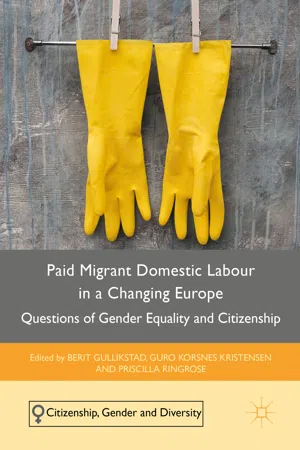
eBook - ePub
Paid Migrant Domestic Labour in a Changing Europe
Questions of Gender Equality and Citizenship
- English
- ePUB (mobile friendly)
- Available on iOS & Android
eBook - ePub
Paid Migrant Domestic Labour in a Changing Europe
Questions of Gender Equality and Citizenship
About this book
This book analyses the changing face of work, gender equality and citizenship in Europe. Drawing on in-depth research conducted in nine different countries, it focuses on the discourses, social relations and political processes that surround paid domestic labour. In doing so, it rethinks the vital relationship between this kind of employment, the formal and informal citizenship of migrant workers and their employers, and the cultural and political value of gender equality. Approaching these as fluid, complex and interrelated phenomena that change according to local context, it will appeal to sociologists, political scientists, geographers, anthropologists and gender studies scholars.
Information
Topic
Ciencias socialesSubtopic
Política© The Author(s) 2016
Berit Gullikstad, Guro Korsnes Kristensen and Priscilla Ringrose (eds.)Paid Migrant Domestic Labour in a Changing EuropeCitizenship, Gender and Diversity10.1057/978-1-137-51742-5_11. Paid Migrant Domestic Labour, Gender Equality, and Citizenship in a Changing Europe: An Introduction
Berit Gullikstad1 , Guro Korsnes Kristensen1 and Priscilla Ringrose2
(1)
Department of Interdisciplinary Studies of Culture, Centre for Gender Studies, Norwegian University of Science and Technology (NTNU), Trondheim, Norway
(2)
Department of Interdisciplinary Studies of Culture and Department of Language and Literature, Centre for Gender Studies, Norwegian University of Science and Technology (NTNU), Trondheim, Norway
The aim of this book is to provide empirically based investigations of paid migrant domestic labour and au pairing, as they are unfolding in nine different European countries—explored through the concepts of gender equality and citizenship. The book will contribute to rethinking these two concepts within feminist research and policy development, in the light of their central importance to policy making and identity making in today’s Europe.
The contributions focus on exploring the ways in which gender equality and citizenship as values, norms, and practices are discursively produced, negotiated in social relations, and played out in political processes in a variety of European contexts. In doing so, they interrogate universalist assumptions and understandings of both gender equality and citizenship. When citizenship is examined together with gender equality, it is often done in a manner which primarily relates to women. We aim to examine these two concepts from a perspective that does not (implicitly) address them as primarily or exclusively relating either to women or to men. We investigate gender equality and citizenship from a localised and historicised perspective, which takes into account the complexity and fluidity of paid migrant domestic work. This approach implies that gender equality and citizenship can be studied as complex and interrelated phenomena. Citizenship is gendered in different ways across different geographic contexts. At the same time, access to gender equality, through policy incentives, for example, may vary depending on citizenship rights, within as well as across contexts. This means that empirical and theoretical investigations that take account of both gender equality and citizenship have the potential to shed new light on both phenomena and on the ways in which they are connected.
This raises a number of questions which we address in this book: In what ways do citizenship and gender equality take on different forms and meanings in localised contexts of the paid domestic labour sector in Europe? How do gender equality and citizenship as values, norms, and practices contribute to producing privileged or precarious positions? And in what ways can the relations between gender equality and citizenship be understood across geographical contexts, within the sphere of paid domestic labour?
The empirical investigations are situated in Finland, France, Germany, Italy, the Netherlands, Norway, Poland, Spain, and the UK. The field of paid domestic labour investigated in this collection covers both men and women as buyers and sellers of eldercare and childcare, au pair work, cleaning, repair, and gardening services. In some chapters, the focus is on policy developments and political discourses and debates, in others it is on lived life and interpersonal relations. What is common to all these contributions is that the focus is primarily on cultural meaning production, whether in the context of political systems, social structures, or everyday practices.
The book looks to a Europe characterised by extensive and rapid changes which are to a certain extent commonly experienced but which at the same time manifest themselves differently in different national and local contexts. European policy is concerned with promoting values such as (gender) equality and (migrant) inclusion (Lewis, 2006), not least by developing the ‘adult worker model’ (Lister et al., 2007). Yet, at the same time, national welfare systems are being eroded and care facilities are increasingly privatised. The entrenchment of neoliberal policies, combined with the persistence of (post)colonial processes (Keskinen, Tuori, Irni, & Mulinari, 2009), represents the background to the steady increase in the demand for paid domestic work and au pairing which is primarily, but not exclusively, being performed by migrant women (Anderson, 2007; Anthias, Morokvasic-Müller, & Kontos, 2013; Cox, 2006; ILO, 2013; Isaksen, 2010; Lutz, 2008, 2011; Palenga-Möllenbeck, 2013; Triandafyllidou, 2013).
Paid Migrant Domestic Labour
Paid domestic labour has re-emerged on the European scene in the last decades. It has never been ‘ectinct’, but in many countries it declined significantly before increasing again (Kilkey, Perrons, & Plomien, 2013, p. 20). This increase is particularly of note in the Nordic countries, where extensive welfare systems and a political and cultural ideal of social equality have rendered paid domestic labour, which is bought and sold on the private market, both unnecessary and unwanted—at least officially (Bikova, 2010; Isaksen, 2010; Kristensen, 2015; Stenum, 2010). In other parts of Europe, it may make more sense to speak of changes in already established practices, especially where there have been, for example, changes in migration practices leading to new, or different, groups of migrants from Europe or elsewhere offering domestic services. Another important change concerns what Triandafyllidou and Marchetti describe as the ‘proletarisation’ of paid domestic work. By this they mean that services, which used to be considered a ‘luxury that only few households could afford’, are now being purchased by employers from the middle and lower middle classes who regard it as ‘not a luxury but a necessity’ (Triandafyllidou & Marchetti, 2015, p. 231).
The particular nature of domestic labour has been widely commented on, among others by Joan Tronto, who points to three of its distinguishing features, namely relating to the institutional setting, to the workplace, and to the relations involved (Tronto, 2002, pp. 37–39). The institutional setting of the household is very different from that of a commercial setting (Anderson, 2000; Isaksen, 2010; Lutz, 2011; Parreñas, 2001). A crucial point to note here is that paid domestic labour is often organised in a way that evades state policy and regulation. The fact that this labour is carried out in private households, as well as being work that is traditionally done by members of the household, makes it appear informal, and this affects employment procedures, work instructions, and wages (Anderson, 2000). Furthermore, since domestic labour usually takes place in private homes, it is often not regarded as employment at all, but rather as help, as an ‘extra pair of hands’. The au pair arrangement, for example, is commonly not organised and regulated as work, but defined as ‘cultural exchange’, with the au pair receiving board, lodging, and ‘pocket money’ instead of a salary (Cox, 2015; Stubberud, 2015a, 2015b). Similarly, as far as home cleaning services are concerned, the widespread occurrence of unregulated arrangements and the concomitant lack of political will to address them is evidence of the fact that such services are considered as less ‘proper’ than other kinds of labour (Gavanas & Callemann, 2013; Lutz, 2011).
Tronto (2002) further argues that relationships within a household are considerably more intimate than those played out within market settings. This may mean that domestic workers may be assigned the status of quasi-family members, entangling workers’ lives with the lives of employers without taking account of the unequal power dynamics of the relationship. Moreover, domestic workers are often expected to reflect varied aspects of their employers’ lives, such as values in raising children and tastes regarding food- and cleaning products (Tronto, 2002), as well as to generally adapt to their employers’ habits (Näre, 2011). Furthermore, the fact that the work is done, not in a public space, but in someone else’s private sphere, also means that the level of control that employers expect to exert over domestic workers is often very great, and non-compliance can be emotionally and psychologically charged.
A third factor that distinguishes domestic service from other market relations, as argued by Tronto (2002), is that it often creates ongoing relationships between employers and employees, and that the quality of these relationships effectively functions as a measuring tool for the quality of the work that is done. This implies a personalisation of relationships, which blurs the distinction between the person that does the work and the work itself, in other words the boundaries between the individual and his or her work are broken down and the worker is defined by the work that is being done (Stubberud, 2015a, p. 77). While these concerns also exist in market relations, they are presumed to be paradigmatic of domestic relations, and thus, constitute a central aspect of domestic labour.
To Tronto’s list of differences between domestic work and market relations, we add three more aspects: gender, class and ethnicity/’race’. Domestic work is frequently described as gendered in the sense that some aspects of this labour have traditionally been carried out by women while other aspects have traditionally been carried out by men. The term ‘domestic work’ is generally applied in a traditionally feminised sense to work revolving around cooking, caring, and cleaning (Anderson, 2000). However, there are also certain types of domestic work that have masculine connotations, which should be studied alongside traditional ‘women’s work’ (Kilkey et al., 2013; Palenga-Möllenbeck, 2013). A substantial difference here, however, is that ‘masculine’ jobs are generally better paid and that those who perform these jobs are rarely live-in domestic workers (Kilkey et al., 2013). There are however exceptions, as demonstrated in research on Sri Lankan men working as cleaners and carers in Naples, Italy (Näre, 2010), and in Ringrose’s analyses of the movie The Intouchables (Chap. 9). According to Triandafyllidou and Marchetti (2015, p. 231), employers also maintain the traditional gender divide since female employers tend to manage female employees’ domestic work, often positioning themselves as ‘mothers’ or even ‘daughters’ of their employees.
As far as class is concerned, the differences in social background between buyers and sellers of paid domestic work have tended to become less marked, as Triandafyllidou and Marchetti point to when they claim that buying these services is no longer a luxury that only a few households can afford (2015, p. 231). In line with this, Stubberud argues that the au pair scheme or rather domestic work itself produces a hierarchical relationship that exists independently of potential similarities between the au pair and the host family (Stubberud, 2015a, p. 21). Doing paid domestic work often means working for low wages in a profession with low status, and doing work that is highly demanding, as Anderson’s concept of ‘dirty work’ indicates (Anderson, 2000; see also Lan, 2006; Näre, 2011). Futhermore, due to the feminization of migration, domestic labour has also become part of a global market and, as such, is saturated with ethnicity/|race|. In general, there is a tendency for those buying domestic labour to be positi...
Table of contents
- Cover
- Frontmatter
- 1. Paid Migrant Domestic Labour, Gender Equality, and Citizenship in a Changing Europe: An Introduction
- 2. Neoliberal Citizenship and Domestic Service in Finland: A Return to a Servant Society?
- 3. The Au Pair Scheme as ‘Cultural Exchange’: Effects of Norwegian Au Pair Policy on Gender Equality and Citizenship
- 4. Paid Domestic Work in Spain: Gendered Framings of Work and Care in Policies on Social Citizenship
- 5. Gendered Work and Citizenship: Diverse Experiences of Au Pairing in the UK
- 6. From Intimate Relations to Citizenship? Au Pairing and the Potential for Citizenship in Norway
- 7. Citizenship and Maternalism in Migrant Domestic Labour: Filipina Workers and Their Employers in Amsterdam and Rome
- 8. Paid Migrant Domestic Labour in Gender-Equal Norway: A Win–Win Arrangement?
- 9. The Intouchables: Care Work, Homosociality and National Fantasy
- 10. Unequal Fatherhoods: Citizenship, Gender, and Masculinities in Outsourced ‘Male’ Domestic Work
- 11. Buying and Selling Gender Equality: Concluding Reflections
- Backmatter
Trusted by 375,005 students
Access to over 1.5 million titles for a fair monthly price.
Study more efficiently using our study tools.
Frequently asked questions
Yes, you can cancel anytime from the Subscription tab in your account settings on the Perlego website. Your subscription will stay active until the end of your current billing period. Learn how to cancel your subscription
No, books cannot be downloaded as external files, such as PDFs, for use outside of Perlego. However, you can download books within the Perlego app for offline reading on mobile or tablet. Learn how to download books offline
Perlego offers two plans: Essential and Complete
- Essential is ideal for learners and professionals who enjoy exploring a wide range of subjects. Access the Essential Library with 800,000+ trusted titles and best-sellers across business, personal growth, and the humanities. Includes unlimited reading time and Standard Read Aloud voice.
- Complete: Perfect for advanced learners and researchers needing full, unrestricted access. Unlock 1.5M+ books across hundreds of subjects, including academic and specialized titles. The Complete Plan also includes advanced features like Premium Read Aloud and Research Assistant.
We are an online textbook subscription service, where you can get access to an entire online library for less than the price of a single book per month. With over 1.5 million books across 990+ topics, we’ve got you covered! Learn about our mission
Look out for the read-aloud symbol on your next book to see if you can listen to it. The read-aloud tool reads text aloud for you, highlighting the text as it is being read. You can pause it, speed it up and slow it down. Learn more about Read Aloud
Yes! You can use the Perlego app on both iOS and Android devices to read anytime, anywhere — even offline. Perfect for commutes or when you’re on the go.
Please note we cannot support devices running on iOS 13 and Android 7 or earlier. Learn more about using the app
Please note we cannot support devices running on iOS 13 and Android 7 or earlier. Learn more about using the app
Yes, you can access Paid Migrant Domestic Labour in a Changing Europe by Berit Gullikstad, Guro Korsnes Kristensen, Priscilla Ringrose, Berit Gullikstad,Guro Korsnes Kristensen,Priscilla Ringrose in PDF and/or ePUB format, as well as other popular books in Ciencias sociales & Política. We have over 1.5 million books available in our catalogue for you to explore.