eBook - ePub
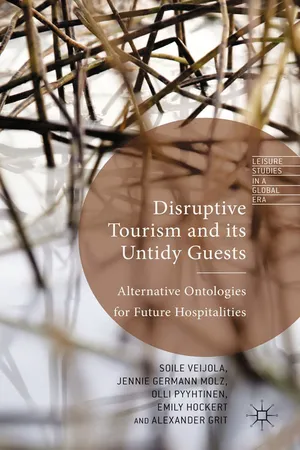
Disruptive Tourism and its Untidy Guests
Alternative Ontologies for Future Hospitalities
- English
- ePUB (mobile friendly)
- Available on iOS & Android
eBook - ePub
Disruptive Tourism and its Untidy Guests
Alternative Ontologies for Future Hospitalities
About this book
This book invokes the radical potentialities of 'untidiness' to envision alternative arrangements of social life and hospitality. Instead of trying to manage sustainability or tidy up tourist situations, the authors embrace the messiness of human relations and argue for more creative, embodied and ethical ontologies of tourism and mobility.
Information
Print ISBN
9781137399496
Subtopic
Social Policy1
Introduction: Alternative Tourism Ontologies
We are expecting guests so we are cleaning our house – even though we very well know that after our guests leave, the house will likely be even messier than it was before. What is the point then? Is all the trouble for nothing? No. If the house was too dirty, our guests would not be able to enjoy themselves, no matter how good the talk, the food, the coffee or the wine. Or, even worse, if they knew our house was always a mess, they would stay away. No one would come. Indeed, should we ever want to sell our home we would take the deep cleanse even further: we would hide photographs, piles of paper, pieces of clothing – all belongings that are too personal – in the cupboards, in the attic or in the cellar. In that case, we would make our home into a blank screen onto which potential buyers could project future scenarios of themselves hosting their own guests in this space. For now, however, we tidy up just enough to make our guests feel welcome, but not so much as to erase every trace of ourselves.
Dirt is the mark of ownership – ‘appropriation takes place through dirt’.1 The dirtier one’s space is, the more the person is attached to it, and the less accessible it is to others. Hospitality, on the other hand, is closely tied with cleanliness. ‘Purifying one’s space is an act of welcoming’, proposes philosopher Michel Serres.2 In other words, hospitality is the opposite of appropriation: while appropriation is to take what is public and common and make it one’s own by way of fouling or enclosing, hospitality means opening up one’s private property and transforming it into something public and accessible for others.
While it is by leaving one’s stain and disorder that one makes something one’s own, one welcomes others by cleaning oneself and one’s space. It is by removing, dispelling or hiding the marks of personal possession that we make our space available for others. In order to be able to give space to the guest the host literally needs to clear up space so that the other can arrive.
And what about the guest? How tidy must the guest be in order to stay or to be welcomed in the first place? Unless we are aiming to practise philosopher Jacques Derrida’s ‘absolute hospitality’3 – an unconditional welcoming of the other, regardless of who that other may be – there are social rules, regulating and constitutive ones, pertaining to being a guest. For instance, by welcoming a guest into our home, we tend to impose on her or him the house rules or the horizons of expectations that this particular shared social space presupposes. From national borders to the thresholds of private homes, we may find our welcome – the one we extend, or the one we receive – hangs in the balance of formulaic calculations of risk, difference and tidiness. Do we measure up? Are we the ‘right’ kind of visitors – the ones with money to spend and with return airplane or train tickets that will take us back where we came from when our planned stopover ends? Are we the ‘right’ kind of hosts? The ones with clean sheets and clean streets? What is lost in these calculations? What do we miss out on when tidiness becomes a prerequisite for the welcome?
Welcoming untidy guests
This book argues that tourism need not merely cater to the paying client, but that it must also welcome untidy guests. Rather than thinking of the untidy guests in empirical categories, we are speaking of them metaphorically and symbolically. Untidy guests are the ones who give an unexpected twist to the social situation we live in, as well as the human condition in general, and who, ultimately, make life worth living and the world liveable. In a parallel fashion, tourism also needs to accept untidy hosts who live their lives instead of becoming the animators of it, turning invisible at the sight of a guest. This is not to suggest, however, that guests and hosts stay neatly on their sides of the dichotomy. Indeed, one of the untidy things that we must also come to terms with is the blurring between hosting and guesting as performances and experiences,4 as hosts become guests and guests become hosts. Instead of crossing out the otherness of the other and forming community only among those with whom we appear to have something in common, we need to configure hospitality also in relation to the unknown, uninvited and possibly disturbing stranger who visits us, lives next door – or is within us.5
Why talk about untidiness? After all, is tourism not about preparing spaces, places and locations to be as shiny, comprehensible and visitable6 as possible for anyone coming by? Is it not about making hotel beds, grooming ski slopes, shoring up beaches with sand, mowing golf courses, levelling slums and organizing displays of indigenous cultures before the guests arrive?7
For us, all this tidying up – no matter how well intentioned – sweeps the generative possibilities of tourism under the rug and ensures that we will continue to repeat existing patterns of governance and inequality. We hold the view in this book that when we are confronted with the unexpected, the unfamiliar or the illegible we can no longer affirm our old ways of thinking, feeling and acting, but have to find alternative, perhaps radical, ways of connecting with others, ourselves and our environments. A different affect, as philosophers Gilles Deleuze and Felix Guattari8 would put it, comes into play at such moments, with the potential to suspend fear, violence and negligence, and replaces them with more ethical ways of relating to unknown others and ourselves in new situations. Instead of trying to bring order9 to tourism by stage-managing or developing it – as the majority of tourism and hospitality course books would have it – we argue that theorists, planners, activists and tourists alike should embrace the messiness of hospitalities in tourism.
Thus Disruptive Tourism and Its Untidy Guests offers the messy metaphor and vital image of ‘untidiness’ for thinking about alternative arrangements of future hospitalities. For this purpose, we play with the counter-intuitive notions of camping, parasite, silence, unlearning and serendipity in our book. With the help of these ‘untidy’ concepts, we wish to disrupt the ontological presumptions of tourism and its theories, which tend to emphasize western notions of managerial order in, among other things, modernist development projects in the so-called Global South.
It is worth adding that we are not against the abiding trend in tourism studies towards more sustainable alternatives to the largely unequal capitalist structure of global tourism.10 We share many of these aims, but we argue that tourism and hospitality studies should focus on disrupting – rather than sustaining – the taken-for-granted composition of tourism and hospitality, and their overriding concerns of management and capitalization of social and communal relations. Thus, we share the views presented within the critical studies of tourism where the need to disrupt dominating discourses of managerialism and neoliberalism in research has also been forcefully articulated.11
However, instead of continuing to valorize the pressing expectations of enhanced self-reflexivity within the Tourism Academia in general terms, we focus in our book on potentialities of being-with other people, with less (not more) organization and management, taking ‘withness’ or togetherness as the ontological starting point of life in general and tourism in particular. For philosopher Jean-Luc Nancy, for instance, being always appears as being-with; existence is necessarily and essentially co-existence.12 On this basis, we configure, in what follows, alternative ontologies of tourism to the ones that take reality to exist through clear-cut and self-subsistent beings, subjects and categories. For imagining alternative ontologies, we introduce the concept of ‘the untidy guest’ to argue that when scholars – and, indeed, tourism itself – confound and interrupt habitual interactions and assumptions, this may lead to new ideas and understandings of the ‘good life’.
Before discussing our paths to the unknown in more detail let us look into current understanding of links between disruptions, hospitalities and tourism as these have been transformed by the era of mobilization, and then return to the company of the untidy guest.
Disrupting tourism
When thinking about tourism and disruption, several images may come to mind. An initial thought might be the unexpected or undesirable disruptions that unsettle the current arrangements of tourism: high-season hurricanes; tsunamis; epidemic illnesses; volcanic eruptions; economic downturns; earthquakes; and terrorist attacks.13 Another might be the ways in which commercialized mass tourism has been seen to disrupt local societies and economies.14 In both cases, disruption motivates theorists, developers and planners alike to build more flexible products, services and workforces that will be resilient enough to weather the storms of economic or environmental upheaval. While acknowledging the way disruption intersects with tourism in the former cases, we are also concerned with disrupting the existing field of tourism and hospitality studies.
What, why and how exactly do we want to disrupt it? For starters, we think that the timeless question of the host-guest relation needs continuous rethinking. The ‘guest situation’, to use Helmuth Berking’s15 phrasing, has always been precarious. Taming the potentially life-threatening arrival of the stranger into a ritual that upholds and celebrates the local way of life has been one of the greatest social inventions in the history of the humankind. The ritualistic welcome also gave the host the power to define the guest situation.16 The interesting etymological aspect of having the same root (hospes, hostis and potis) for enemy, guest and host tell a story beyond comparison in human history.17 And yet, while the figure of the stranger is, in a way, the opposite of and threat to the moral and symbolic order of the local community, society relies on guests and strangers for its very being.18 But the relation is only ever a temporary one, and only for a limited time. The duty of the stranger-as-guest is, as said earlier, to keep on moving after having held up a flattering mirror for the host.
There are other origin stories for the invention of hospitality out there as well,19 but suffice it to say that hospitality’s role ha...
Table of contents
- Cover
- Title
- Copyright
- Contents
- Acknowledgements
- About the Authors
- 1 Introduction: Alternative Tourism Ontologies
- 2 Camping in Clearing: Jennie Germann Molz
- 3 Paradise with/out Parasites: Olli Pyyhtinen
- 4 Towards Silent Communities: Soile Veijola
- 5 Unlearning through Hospitality: Emily Höckert
- 6 Messing around with Serendipities: Alexander Grit
- 7 Conclusion: Prepositions and Other Stories
- Bibliography
- Index
Trusted by 375,005 students
Access to over 1.5 million titles for a fair monthly price.
Study more efficiently using our study tools.
Frequently asked questions
Yes, you can cancel anytime from the Subscription tab in your account settings on the Perlego website. Your subscription will stay active until the end of your current billing period. Learn how to cancel your subscription
No, books cannot be downloaded as external files, such as PDFs, for use outside of Perlego. However, you can download books within the Perlego app for offline reading on mobile or tablet. Learn how to download books offline
Perlego offers two plans: Essential and Complete
- Essential is ideal for learners and professionals who enjoy exploring a wide range of subjects. Access the Essential Library with 800,000+ trusted titles and best-sellers across business, personal growth, and the humanities. Includes unlimited reading time and Standard Read Aloud voice.
- Complete: Perfect for advanced learners and researchers needing full, unrestricted access. Unlock 1.5M+ books across hundreds of subjects, including academic and specialized titles. The Complete Plan also includes advanced features like Premium Read Aloud and Research Assistant.
We are an online textbook subscription service, where you can get access to an entire online library for less than the price of a single book per month. With over 1.5 million books across 990+ topics, we’ve got you covered! Learn about our mission
Look out for the read-aloud symbol on your next book to see if you can listen to it. The read-aloud tool reads text aloud for you, highlighting the text as it is being read. You can pause it, speed it up and slow it down. Learn more about Read Aloud
Yes! You can use the Perlego app on both iOS and Android devices to read anytime, anywhere — even offline. Perfect for commutes or when you’re on the go.
Please note we cannot support devices running on iOS 13 and Android 7 or earlier. Learn more about using the app
Please note we cannot support devices running on iOS 13 and Android 7 or earlier. Learn more about using the app
Yes, you can access Disruptive Tourism and its Untidy Guests by S. Veijola,J. Germann Molz,Olli Pyyhtinen,E. Hockert,Alexander Grit,Kenneth A. Loparo,Kenneth A. Loparo,Jennie Germann Molz,Emily Höckert in PDF and/or ePUB format. We have over 1.5 million books available in our catalogue for you to explore.