eBook - ePub
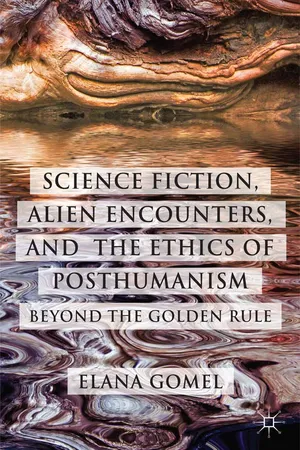
Science Fiction, Alien Encounters, and the Ethics of Posthumanism
Beyond the Golden Rule
- English
- ePUB (mobile friendly)
- Available on iOS & Android
eBook - ePub
About this book
Science Fiction, Alien Encounters, and the Ethics of Posthumanism offers a typology of alien encounters and addresses a range of texts including classic novels of alien encounter by H.G. Wells and Robert Heinlein; recent blockbusters by Greg Bear, Octavia Butler and Sheri Tepper; and experimental science fiction by Peter Watts and Housuke Nojiri.
Information
Part I
Confrontation
1
“The Force that Gives us Meaning”: Alien Invasion and Search for Redemption
“War is a force that gives us meaning.” (Chris Hedge)
Life during wartime
In H.G. Wells’ The War of the Worlds (1897) a group of refugees who are trying to escape the Martian invasion are witnessing an attack of the warship Thunder Child upon a Martian tripod.1 This scene is one of the great depictions of modern warfare in world literature. It vividly conveys the confusion and fear of the civilians caught in the crossfire of the mighty machines, the incomprehensible magnitude of the destruction, and the sublimity of irresistible power. Rendered through an almost cinematic montage of many partial and distorted viewpoints, this chapter feels strikingly modern.
And so does the novel as a whole. It is hard to believe that its images of stampeding refugees, deserted London, and rising clouds of poison gas were put on paper 17 years before World War I. Wells’ prophetic nightmare has become our daily reality. The well-known episode of mass panic occasioned by the radio drama based on The War of the Worlds in 1938 is a testimony to Wells’ imaginative grasp of the experience of modern war. In H. Bruce Franklin’s words, “the Martians, with their armored war machines, poison gas, flying machines and heat beams, are invaders not so much from the neighboring planet as from the approaching century” (2008: 65).
To see the Martians, however, merely as an allegorical stand-in for militarism flattens out the formal and thematic complexity of the novel. The horror of war is balanced by the sense of wonder evoked by the strange and enigmatic aliens. All too often, in critical interpretations of The War of the Worlds the “war” aspect is emphasized at the expense of the “worlds”, so that Wells’ masterpiece is put into the same generic category as, for example, the 1871 Battle of Dorking by George Chesney, portraying a sudden invasion of England by German troops. This interpretation (suggested, for example, in I.F. Clarke’s seminal study Voices Prophesying War) is not incorrect but it is incomplete.
In this chapter I want to consider the narratological, ideological, and ethical implications of the trope of alien invasion in SF. Taking Wells’ novel as my starting point, I will explore its representation of war and its representation of aliens as two potentially clashing discourses, each with its load of implicit assumptions about human nature, morality, and violence. And the question I want to start with is both deceptively simple and profoundly complex: why Martians?
Love thy enemy?
War literature, if it is to be truthful, has to conform to Erich Maria Remarque’s note at the beginning of All Quiet on the Western Front (1929): “This book is to be neither an accusation nor a confession, and least of all an adventure, for death is not an adventure to those who stand face to face with it.” But a war with alien invaders who are enigmatic and incomprehensible is an adventure. The perennial popularity of The War of the Worlds and its innumerable generic progeny bears witness to this. A very incomplete list of alien-invasion movies on IMDb tops 160. Some of the top box-office hits of the last twenty years belong to this genre: Independence Day (1996), Signs (2002), Stephen Spielberg’s remake of The War of the Worlds (2005), District 9 (2009), Skyline (2010), the Men in Black franchise (1997–2012), Attack the Block (2011) and so on. Aliens have also invaded the TV screen in shows such as V (1983–85; 2009–11), Invasion (2005–06), not to mention X-Files (1993–2002). Novels, short stories, video games, and comic books mount new and sophisticated attacks on Earth every month, while a staggering number of people believe the aliens are already here.2 Certainly more people today are willing to consume narratives of alien invasion than to revisit the sorry chronicles of the invasion of Iraq.
It is not surprising that people are drawn to vicarious experience of violence. Nor it is unexpected that the “moral extremity” of war provides a rich arena for such experience (Walzer 22). But are all those who consume narratives of alien invasion only searching for military kicks?
Ordinary war may be a moral challenge but it is not an epistemological one. The enemy is hated precisely because we understand his intention. In classic theories of war, combat is described as a duel, in which the capacity of putting oneself in the shoes of the enemy is crucial. Karl von Clausewitz analyzes military escalation as Theory of Mind run amok, so that so “each of the adversaries forces the hand of the other” (Clausewitz). Some philosophers go even further, contending that representations of war are intrinsic to our sense of humanity. Christopher Coker argues that by making war we recognize the enemy as being human like ourselves:
It is through imitation in war that we are reminded of our shared humanity. Only in war do we recognize ourselves in our enemies. Artists remind us that our humanity is shared – not only do we all feel pain, we also feel shame; war is a product of nature and nurture, and the enemy is not some alien “other” that is impossible to comprehend, let alone communicate. (104)
To illustrate what a confrontation with “some alien ‘other’” would look like, Coker proceeds to discuss at some length a conversation between Captain Picard and an artificial life-form Borg from the SF series Star Trek: The Next Generation. His point is that since the Borg is totally opaque to the reach of human Theory of Mind, there is no actual interaction and, therefore, no actual war. He quotes SF theorist Adam Roberts to the effect that since “there can be no exchange and no negotiation” between the human and the alien, “it is not even worth considering what makes for its ‘otherness’” (Coker 104–5).
But in fact, Roberts’ own discussion of this scene makes an entirely different point: that it represents “striving to contemplate a genuine alienness, an otherness outwith our capacities to conceive” and that the subsequent “humanization” of the Borg in the series “seems a sort of betrayal of the original concept” (2000: 167). In other words, what makes SF interesting is precisely consideration of what lies outside the conceptual and emotional capacities of the human mind.
An alien invasion sits uneasily between the transparency of war and the opacity of alterity. In describing the beginning of the invasion, the narrator of War of the Worlds simultaneously excoriates the complacency of his compatriots and tries to assume the Martians’ point of view: “we men… must be to them at least as alien and lowly as are the monkeys and lemurs to us” (8). This wrenching shift whereby humanity is suddenly perceived from the outside through the alien eyes destabilizes the simple narrative of the just war in which humanity repels an unwarranted aggression. Uneasily situated between “war” and “world”, the trope of alien invasion registers the tension between morality of the Same and ethics of the Other.
Alien invasion as a modality of war literature assumes the ontological and epistemological transparency of the enemy. Alien invasion as a form of SF necessarily partakes in the genre’s cognitive estrangement and sense of wonder which hinges on the radical alterity of the Other (Suvin). Caught in the pull of these opposing agendas, alien-invasion texts splinter along three distinct discursive axes of the humanist, the apocalyptic, and the sublime.
The humanist
The connection between war and virtue has been articulated through the classic distinction between jus ad bellum, the just reason for war, and jus in bello, the just conduct of war. If both obtain, the war is not only justified but positively virtuous. As St. Augustine says in The City of God:
But, say they, the wise man will wage just wars. As if he would not all the rather lament the necessity of just wars, if he remembers that he is a man; for if they were not just he would not wage them, and would therefore be delivered from all wars. (Book xix)
In discussing the moral duality of war, Michael Gelven points out that our “notion of the heroic is profoundly bound up with the notion of the warrior” (117). War can be seen as a source of meaning, as the rejuvenation of a decadent society, as the triumph of good over evil. In his memoir military journalist Chris Hedges describes the ethical appeal of war:
War makes the world understandable, a black and white tableau of them and us… We are one. Most of us willingly accept war as long as we can fold into a belief system that paints the ensuing suffering as necessary for a higher good, for human beings seek not only happiness but also meaning. And tragically war is sometimes the most powerful way in human society to achieve meaning. (10)
Later in the book he waxes nostalgic for the affection and solidarity among soldiers, recalling how the “selflessness of war mirrors that of love” (159). The much-eulogized brotherhood in arms does indeed create “bonds of mutual dependency and sacrifice of self, stronger than any of the friendships made in peace and harmony” (Keegan 427). But it is precisely this sacrificial ethos that can make war seem not only palatable but even morally desirable. War is at its most dangerously seductive when it appeals not to violence and selfishness but to duty and love. War can mobilize an entire society and cement its collective identity. In his Reflections of a Nonpolitical Man (1918) the great humanist Thomas Mann describes his tears of joy at the proclamation of war in August 1914. And even though he later repudiated this sentiment, others did not.
Discussing the possible origins of war, Robert O’Connell makes an important point that rather than being an expression of low egotistical impulses, the individual’s decision to lay down his life for the community is profoundly altruistic, so much so that war cannot be seen simply as an expression of the general human proclivity for violence: “It is clear, however, that going to war, because of the distinct possibility of personal annihilation, constitutes perhaps the most ‘altruistic’ of social gestures” (6). In Blood Rites Barbara Ehrenreich points out the ineluctable connection between war and self-sacrifice that often elevates war to the status of secular religion, in which people “are united by some common purpose” and “feel a surge of collective strength” (15).
War generates a simple moral template that makes the difference between good and evil stark and absolute. But in doing so, it does not “dehumanize” the enemy as is often claimed. Just the opposite: it subsumes cultural, religious, and ethnic differences into the stark moral dichotomy that defuses mutual incomprehension. In war each party has specific interests and goals, which it strives to achieve by violence; and these interests and goals are understandable to the other party, though their moral valuation is reversed. Each side regards itself as virtuous, while denigrating the enemy as vicious. But evil is not an impenetrable enigma. By being branded evil, the enemy becomes merely a dark image of the self. War is not a negation of the Golden Rule but its extension. Historian Claudia Koonz persuasively argues that the movement nowadays regarded as the epitome of evil, Nazism, succeeded to mobilize the German people for war by appealing to their conscience and their “lofty ideals” (2). War is not the opposite of humanism but one of its aspects.
In The War of the Worlds, humanism is put under severe strain. The unnamed first-person narrator is often cynical. His encounters with the curate and the artilleryman show him the least attractive aspects of human behavior, from religious mania to indolence and weakness. He occasionally comments on the fact that humanity’s own behavior gives us no high moral ground as compared to the Martians.
Eventually, however, humanism is validated precisely through being tested in the crucible of war. Describing the results of the invasion, the narrator emphasizes its positive influence upon science and technology and its contribution toward human solidarity. More ominously, he praises the fact that the invasion “has robbed us of that serene confidence in the future which is the most fruitful source of decadence”; a jarring note in the light of the enormous influence the shibboleth of “decadence” was to have upon the rise of fascism and Nazism (Wells 134).
If the benefits of war are clear on the societal level, they are even clearer on the individual level. It is not merely that the narrator is reunited with his wife and resumes the “old life of hope and tender helpfulness” that he believed “had ceased forever” (128). Perhaps more significantly, the very narrative form of the novel shores up the humanistic self. It is narrated in the first person, which is the traditional narrative voice of the realistic bildungsroman, generating a psychologically coherent textual subject. In the middle of the book, however, this narrative voice is strained by unaccountable shifts of focalization that present scenes the narrator could not have seen and events he could not have witnessed. As the narrator is confined in a ruined suburban house, his narrative is fractured by moments of abjection and transcendence.
But at the end the narrator recovers both his self-confidence and his self-coherence. The strange shifts of focalization that marked the war scenes are forgotten; the swarming masses of nameless refugees are resolved into individual survivors; the ending, in which the narrator sums up the lessons of the invasion, has a more assured first-person voice than the bulk of the novel. This voice is still shadowed by fears and doubts, echoes of the apocalyptic and the sublime. But these echoes are muted within an optimistic narrative in which both morality and meaning are recovered through a confrontation with the evil Other.
In The War of the Worlds humanity is the victim of aggression. Self-defense has always been regarded as jus ad bellum. However, the “just cause” which is part of the definition of the just war can only be seen as such if we understand the intentions of the attacker and assume them to be nefarious (Davis 54). But while the narrator speculates constantly on the possible intentions of the Martians, these are only speculations, unsupported by any evidence. In its depiction of an alien enemy whose motivations are obscure and whose atrocities reflect back upon humanity its own behavior Wells’ novel destabilizes this seamless connection between military virtue, abstract justice, and human pride. As he scurries away from the Martian machines, the narrator remembers not that “he is a man” fighting a just war, as St. Augustine would have it, but only that he is a living creature trying to survive. This insight makes him momentarily sympathetic toward other victims of violence: hunted animals and persecuted natives. But this is a passing moment, as the morality of war trumps the ontology of alien encounter.
The triumph of humanism in The War of the Worlds sets a pattern that reverberates through its innumerable imitations, sequels, pastiches, and remakes. From It Came from the Outer Space to Independence Day; from Battlefield Earth to Skyline; from V to Predator, the movie industry has disseminated this pattern so far and wide that it has penetrated the actual language of policy-making. In 1987 President Ronald Reagan in his UN speech used alien invasion t...
Table of contents
- Cover
- Title
- Copyright
- Contents
- Preface
- Acknowledgements
- Introduction: Why Do We Need Aliens?
- Part I Confrontation
- Part II Assimilation
- Part III Transformation
- Postscript
- Notes
- Works Cited
- Index
Trusted by 375,005 students
Access to over 1.5 million titles for a fair monthly price.
Study more efficiently using our study tools.
Frequently asked questions
Yes, you can cancel anytime from the Subscription tab in your account settings on the Perlego website. Your subscription will stay active until the end of your current billing period. Learn how to cancel your subscription
No, books cannot be downloaded as external files, such as PDFs, for use outside of Perlego. However, you can download books within the Perlego app for offline reading on mobile or tablet. Learn how to download books offline
Perlego offers two plans: Essential and Complete
- Essential is ideal for learners and professionals who enjoy exploring a wide range of subjects. Access the Essential Library with 800,000+ trusted titles and best-sellers across business, personal growth, and the humanities. Includes unlimited reading time and Standard Read Aloud voice.
- Complete: Perfect for advanced learners and researchers needing full, unrestricted access. Unlock 1.5M+ books across hundreds of subjects, including academic and specialized titles. The Complete Plan also includes advanced features like Premium Read Aloud and Research Assistant.
We are an online textbook subscription service, where you can get access to an entire online library for less than the price of a single book per month. With over 1.5 million books across 990+ topics, we’ve got you covered! Learn about our mission
Look out for the read-aloud symbol on your next book to see if you can listen to it. The read-aloud tool reads text aloud for you, highlighting the text as it is being read. You can pause it, speed it up and slow it down. Learn more about Read Aloud
Yes! You can use the Perlego app on both iOS and Android devices to read anytime, anywhere — even offline. Perfect for commutes or when you’re on the go.
Please note we cannot support devices running on iOS 13 and Android 7 or earlier. Learn more about using the app
Please note we cannot support devices running on iOS 13 and Android 7 or earlier. Learn more about using the app
Yes, you can access Science Fiction, Alien Encounters, and the Ethics of Posthumanism by E. Gomel in PDF and/or ePUB format, as well as other popular books in Literature & Literature General. We have over 1.5 million books available in our catalogue for you to explore.