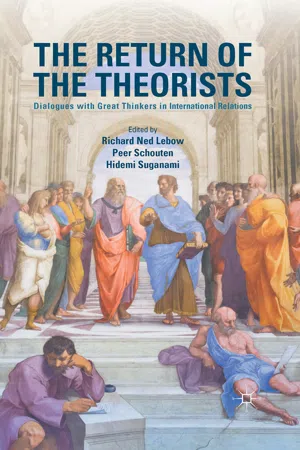
Contemporary International Relations is as much a conversation between the living and the dead as it is among the living. Its debates are thoroughly rooted in and shaped by the thought of many bygone minds, both ancient and modern. With this in mind, The Return of the Theorists presents forty imagined dialogues with foundational theorists. They run the gamut from Homer and Confucius to Hedley Bull and Jean Bethke Elshtain, and span almost three millennia of human history, comprising representatives of a variety of cultures. The interviewers consist of more than forty international relations scholars and political theorists. They too cut across cultures, continents and almost three generations, and each is an expert on the work of the thinker invited. The Return of the Theorists will be of interest to anyone who has tried to enter the mind of bygone thinkers in political thought and International Relations.
eBook - ePub
The Return of the Theorists
Dialogues with Great Thinkers in International Relations
- English
- ePUB (mobile friendly)
- Available on iOS & Android
eBook - ePub
The Return of the Theorists
Dialogues with Great Thinkers in International Relations
About this book
Information
1
Homer (c.850 BCE)
Richard Ned Lebow
Thank you for agreeing to meet with me, even if it is so early in the morning that not even Starbucks is open.
Rosy-fingered dawn is the best time of day.
It also seems to be your favourite epithet. If you are blind, how can you appreciate a sunrise?
Ah, you are a breaker of poets, not of horses. For ancient Greeks, blindness is associated with seers and wisdom. Think of Tiresias in Antigone or Oedipus after he pokes out his eyeballs. They bring light to deathless gods and mortal men.
But what about you? Are you really blind as legend has it? Does everything look like the wine dark sea?
Careful how you use my lines, young man.
Sorry, but I’m curious to know if you are really the blindest of Achaeans.
There you go again!
Do you really need those shades in Hades?
Next are you going to ask me if I am really Homer?
You really are a seer. You read my mind. The consensus among classical scholars is that the Iliad and Odyssey are the product of multiple bards, composed over the course of centuries until a final version was committed to writing sometime in the classical era. I hesitate to say this, but some scholars doubt if there ever was a Homer, and a conveniently blind one at that.
Then why did you appeal to Apollo the far shooter to ferry you across the Styx to meet with me?
I think you’re Homer, all right. I credit you with these epics but I would like to know how your versions differ from what follows, and whether the Iliad is based on a real war. And those are just the beginning of my questions.
It really doesn’t matter if there was a Trojan War, or a swift-footed Ahkileus (Achilles), Agamemnon, a brave man at close-fighting, Odysseus, much beloved by Zeus, or Penelope, the most faithful of wives. It’s what we think about sacred Ilios that counts, and our thoughts are shaped by stories that make an impression on us. My epics shaped a culture because the war caused by Ares, breaker of cities, and its sharp-speared heroes were real for generations of Greeks. Their ‘facticity’ – to use one of your fancy terms – is irrelevant. Consider your own so-called factual events. They too are only known through stories told by politicians, journalists and your intellectuals. They create reality, not represent it, and, unlike my epics, never rise to the level of poetry.
Surely your stories have changed in their telling?
Indeed. It wasn’t until proud-hearted Nietzsche that you moderns came to the realization that authors don’t own texts; they take on a life of their own. We Greeks always knew this truth. Texts are like gifts, they pass from giver to receiver in a long, perhaps even endless, chain. Each time they change hands they assume a new context and come with stories of their previous owners and why they gave them away. So it is with my poetry. I created a gift for my companions, which subsequently passed through many other mouths to become a treasure for all god-fearing Greeks. Am I troubled that others changed and added lines, adapting these epics to the needs of the merging polis? No, my words remain an endless spring that trickles down a rock face to be lapped up by the thirsty below.
I know you moderns think writing a great advance. Plato, student of the splendid Socrates, had his doubts and I remain unconvinced. Stories stagnate when they are committed to writing. You and your colleagues argue endlessly about what they mean rather than assimilating them and using them to give purpose and direction to your lives and helping you live them wisely and honourably. A text is a living resource, not a mud-encrusted fossil to be carefully brushed off and studied under a magnifying glass.
I’m conducting this interview for a book on International Relations theory, so I hope you won’t mind if I focus my remaining questions on that subject?
Feel free, but understand that your interstate relations are markedly different from those of so-called Bronze Age Greece. And the Iliad offers a different kind of account of them than your modern historians or theorists. It offers what the far-seeing Max Weber would call an ideal-type representation of warfare, its causes and consequences.
You’ve read Max Weber?
No, I can’t read. Never learned how. But I chat with him now and again, although it is not easy.
Why is that?
For a start, all his talk about a ‘place in the sun’ for Germany. And here he is in Hades. He doesn’t appreciate the irony, but then he has no sense of humour. He speaks in long and convoluted sentences not connected or held together by metre or signifiers. I’m told his writing is worse. He’s a profound but sloppy thinker, a breaker of concentration, not of horses.
If I can return to the Iliad?
Of course.
War in the Iliad is between Menelaus of the long-shadowed spear, supported by his revenge-seeking Danaans, and the honourable Priam of Dardanus’s line and his Trojans. Each has numerous allies duty-bound to support them, but happy to do so because they see the war as a means of gaining aristeia, or honour, on the battlefield. This is why individual combats feature so prominently and why combatants proclaim their lineage and accomplishments to each other. Aristeia is won by defeating an equally honourable adversary, and more so if they are invited to throw the first spear. Real war was never like this, but there were elements of it in ancient Greek and Roman warfare and in Europe up to the First World War. In the Iliad, there is no distinction between the honour of the individual warrior and that of the ethnos, which today you might describe as the state or nation. Honour remains alive at the platoon level, however, modern wars are not started by warrior-kings intent on upholding their personal honour, but by leaders moved by national honour and interests.
On the subject of other goals, security never appears to be a motive in the Iliad, except perhaps where the Greeks are desperate to prevent the Trojans from setting their ships on fire. Following the advice of the Geranian horseman Nestor they devise an appropriate strategy. In contrast, Hektor and other Trojans reject the sensible advice that they wage a defensive war behind their walls once Ahkileus has rejoined the fighting.
This is correct. Honour trumps other considerations in this war, security included, for the Trojans. You have many modern examples. At the end of World War I, Ludendorff wanted the German army to conduct a suicide offensive in the West to preserve its honour, and his naval counterpart wanted the German fleet to do the same. Honour among combatants was only possible when they regarded one another as equals, as did the Greeks and Trojans. This survived in your culture up until, and even through WW I, where class solidarity among aristocratic officers often trumped national differences. Officer prisoners of war were invited to dinner and sometimes given paroles. In World War II, a kind of camaraderie between some Luftwaffe officers and their RAF counterparts – although the latter were largely middle class – was maintained through the Battle of Britain. German ace Adolf Galland notified the British that their ace Douglas Bader had lost his prosthesis escaping from his burning aircraft and offered safe passage for the RAF to drop a replacement. It is reminiscent of Glaucus, son of Hippolochus, and Diomedes, master of the war cry, exchanging their armour.
Today, adversaries are not equals. Leaders and complicit media demonize the other side to mobilize public opinion and sustain combat morale. The inevitable outcome is mass bombings, Abu Ghraibs, mutilation of prisoners and beheading of journalists. This is not unlike the wars the Greeks fought against local tribes where no quarter was asked or given. In the modern era war has become more institutionalized and legalized, but, alas, more barbaric.
Aren’t you forgetting what happened to broad-streeted Troy and its people once it was defeated, or to the peaceful villages where Ahkileus and his friends killed the men and made off with women and booty?
True. This is one important reason why I end my tale with the return by Ahkileus, son of the lovely-haired Thetis, of Hektor’s body to Priam, noble king of Troy. He regains his humanity, and Trojans and Greeks show respect for one another when Priam breaks his fast and dines with Ahkileus. I agree that the theft of Briseus, the killing of her husband and brother and levelling of her village are acts of barbarism, but her father, with the help of Mars, is able to retrieve her in the end. This doesn’t happen with hostages today, unless vast ransoms are paid.
How did either side feed themselves during ten years of war? Karl Marx was amazed that there is no mention of commerce or logistics anywhere in the Iliad.
Yes, he used to pester me about these omissions. I countered with the observation that there is no mention of honour in Das Kapital. This is in sharp contrast to Schumpeter, whose words are like honey-sweet wine and who believes that entrepreneurs are driven by honour, not profit. They seek to achieve immortality by this means, as Ahkileus did through warfare.
Let’s turn to the rage of Ahkileus and his conflict with Agamemnon, which quickly equals, if not replaces, that between Greeks and Trojans as the focus of the epic. Drawing on the language of modern social science, I would describe their conflict as the inevitable product of the divergence of ascribed and achieved status. Agamemnon is wanax, something like a king, and therefore at the top of the ascribed hierarchy. He is supposed to be the bravest and best leader, but he is not. He’s selfish, gives in to the wrong instincts, and does not set a good example for his fighters. Ahkileus, whom you frequently describe as ‘the best of the Acheans’, is the best warrior and most admired Greek, and at the top of the achieved hierarchy. This is signalled by the decision among the Greek warriors to reward him with Briseus. Agamemnon wants her for this reason, and in the false belief that he can impose himself at the top of both hierarchies, thus restoring their expected unity.
You could put it this way, if you must. In a more general sense, ambitious men – ambitious people – in your era, will always find grounds for resenting one another. However, it is certainly true that swift-footed Ahkileus had no chip on his shoulder and would have accepted Agamemnon’s leadership if he had not behaved in such an insulting manner.
As you were careful to use gender-free language in your last reply, could I close with a question about women?
Why not? After fighting and horses, they are men’s favourite pastime. In my day they talked endlessly about the first two and little about the last. Lovely-cheeked Helen was the exception, and nobody had anything good to say about her, in contrast to Andromache and Penelope, loyal wife and mother of Telemachus, who was greatly admired, but never mentioned in conversation.
Do you think women are inferior to men?
Certainly not. Nor were Greeks superior to Trojans. Both races are equally commendable and the differences in character, intelligence and bravery are not between the well-greaved Acheans and the Trojan breakers of horses but among them. Hektor of the glinting helmet, and Priam, and Menelaus and the huge Aias, are truly admirable, whilst godlike Alexandros (Paris) and Agamemnon are reprehensible. So it is with women. Alexandros and the Argive Helen together – not just Helen – are the cause of the Trojan War and suffering, just as Clytemnestra and Aegistus are in the War’s aftermath. Andromache and Penelope – like Electra and Medea for the later playwrights – are intelligent women. The first two pursue their ends by acceptable means. Indeed, Penelope uses those practices to keep her suitors at bay and remain faithful to the crafty Odysseus, the sacker of cities. She is in every way his worthy counterpart. In my day it was convention, not anything essential about women, that relegated most of them to inferior positions, just as it was for men not of aristocratic birth.
You realize your Iliad has been used to sustain misogyny over the ages?
It is an illustration of the truth to which I earlier referred. People turn to my epics for varied purposes over which I have no control. Sometime they are used sagaciously, but often stupidly. Xenia – guest friendship in your language – is the oldest and most honoured of customs, and the father of the gods is frequently described as Zeus Xenios. Guests must be housed and fed and they in turn must honour, not abuse their hosts. Paris violates guest friendship by running off with Helen and her jewels, and Priam makes war inevitable by honouring this deed, that is by giving refuge to Paris and Helen. He had no choice but to offer refuge as Paris is his son. The other Trojans treat them well although they fully recognize that they are the cause of war and their loss and suffering. What can I do if some readers single out Helen and ignore Alexandros, or for that matter, invent out of whole cloth a lowly trade dispute to explain war between the Greeks and Trojans?
Are you suggesting this is yet another way in which warrior-based honour cultures generate tensions that threaten to destroy them?
It is self-evident that first the abuse and then the forthright practice of xenia were responsible for the Trojan War, just as the intense competition for standing among warriors was an underlying cause of the conflict between Agamemnon and the swift-footed Ahkileus. In a deeper sense, war is a boon and a curse. It allows young men to distinguish themselves and gain honour, but wars that are not quickly resolved threaten to undermine the structure of the society that enables honour and its recognition. This is most apparent in the character of Ahkileus, who rages like a lion, mistreats Hektor’s body, sacrifices young Trojan boys, and only adheres to nomos again when he meets Priam and imagines his father grieving over his body.
Would it be fair to say that Ahkileus and Priam both recognize their imminent deaths and struggle to find a discourse that would allow them to create new selves that would free them from their responsibilities and known fates? In this sense, one could read the epic as the first anti-war literary work.
Ahkileus and Priam struggle to reconcile themselves to their fates rather than to escape them. This heightens the poignancy that brings the epic to a close, and is another reason why it had to end here, before either hero dies. To the extent that there is a search for a new language, it is a task left to listeners – today, readers. Indeed, some of the bards who followed me, who tried to adapt the epic to the polis, strengthened this implicit plea in their treatment of Ahkileus and Agamemnon. There is a parallel here to Aeschylus’s Oresteia, which makes explicit the need to give the city a monopoly over violence to stop, among other things, family feuds. Shakespeare advances a similar argument in Romeo and Juliet, and hints at the connection to the Oresteia by naming the pr...
Table of contents
- Cover
- Title
- Copyright
- Contents
- List of Contributors
- Introduction
- 1 Homer (c.850 BCE)
- 2 Conversations with Confucius (551–479 BCE)
- 3 Lao Zi (6th–5th century BCE?): Dao of International Politics
- 4 Thucydides (c.460–c.395 BCE): A Theorist for All Time
- 5 Discussing War with Plato (429–347 BCE)
- 6 Aristotle (384–322 BCE): The Philosopher and the Discipline
- 7 Niccolò Machiavelli (1469–1527): Two Realisms
- 8 Thomas Hobbes (1588–1679)
- 9 An Interview with John Locke (1632–1704)
- 10 Two Days in the Life of ‘Dave’ Hume (1711–1776)
- 11 The Dangers of Dependence: Sultan’s Conversation with His Master Jean-Jacques Rousseau (1712–1778)
- 12 Immanuel Kant (1724–1804): A Little Kantian ‘Schwaermerei’
- 13 A Fine Bromance: Immanuel Kant (1724–1804) and Niccolò Machiavelli (1469–1527)
- 14 G.W.F. Hegel (1770–1831) and International Relations
- 15 A Brief Encounter with Major-General Carl von Clausewitz (1780–1831)
- 16 A Conversation with Karl Marx (1818–1883) on Why There Is No Socialism in the United States
- 17 Friedrich Nietzsche (1844–1900)
- 18 Émile Durkheim (1858–1917)
- 19 Theory Talk #-100: John Dewey (1859–1952) on the Horror of Making His Poetry Public
- 20 Max Weber (1864–1920)
- 21 The Republic of Norman Angell (1872–1967): A Dialogue (with Apologies to Plato)
- 22 Functionalism in Uncommon Places: Electrifying the Hades with David Mitrany (1888–1975)
- 23 Dialogue with Arnold Wolfers (1892–1968)
- 24 E.H. Carr (1892–1982)
- 25 Modernity, Technology and Global Security: A Conversation with Lewis Mumford (1895–1990)
- 26 More Fragments of an Intellectual Biography: Hans J. Morgenthau (1904–1980)
- 27 The Return of the spectateur engagé: Interview with Raymond Aron (1905–1983)
- 28 A Conversation with Hannah Arendt (1906–1975) 245
- 29 Interview with John Herz (1908–2005)
- 30 Interview with Charles P. Kindleberger (1910–2003), the Reputed Progenitor of Hegemonic Stability Theory
- 31 Karl W. Deutsch (1912–1992) Interviewed
- 32 International Theory beyond the Three Traditions: A Student’s Conversation with Martin Wight (1913–1972)
- 33 John Rawls (1921–2002)
- 34 The Spirit of Susan Strange (1923–1998)
- 35 Questioning Kenneth N. Waltz (1924–2013)
- 36 Frantz Fanon (1925–1961)
- 37 Deep Hanging Out with Michel Foucault (1926–1984)
- 38 Interviewing Pierre Bourdieu (1930–2002) about Pierre Bourdieu and International Relations
- 39 Hedley Bull (1932–1985)
- 40 Jean Bethke Elshtain (1941–2013): A Women’s Refuge, Baghdad, Summer 2015
- Conclusions
- Index
Trusted by 375,005 students
Access to over 1.5 million titles for a fair monthly price.
Study more efficiently using our study tools.
Frequently asked questions
Yes, you can cancel anytime from the Subscription tab in your account settings on the Perlego website. Your subscription will stay active until the end of your current billing period. Learn how to cancel your subscription
No, books cannot be downloaded as external files, such as PDFs, for use outside of Perlego. However, you can download books within the Perlego app for offline reading on mobile or tablet. Learn how to download books offline
Perlego offers two plans: Essential and Complete
- Essential is ideal for learners and professionals who enjoy exploring a wide range of subjects. Access the Essential Library with 800,000+ trusted titles and best-sellers across business, personal growth, and the humanities. Includes unlimited reading time and Standard Read Aloud voice.
- Complete: Perfect for advanced learners and researchers needing full, unrestricted access. Unlock 1.5M+ books across hundreds of subjects, including academic and specialized titles. The Complete Plan also includes advanced features like Premium Read Aloud and Research Assistant.
We are an online textbook subscription service, where you can get access to an entire online library for less than the price of a single book per month. With over 1.5 million books across 990+ topics, we’ve got you covered! Learn about our mission
Look out for the read-aloud symbol on your next book to see if you can listen to it. The read-aloud tool reads text aloud for you, highlighting the text as it is being read. You can pause it, speed it up and slow it down. Learn more about Read Aloud
Yes! You can use the Perlego app on both iOS and Android devices to read anytime, anywhere — even offline. Perfect for commutes or when you’re on the go.
Please note we cannot support devices running on iOS 13 and Android 7 or earlier. Learn more about using the app
Please note we cannot support devices running on iOS 13 and Android 7 or earlier. Learn more about using the app
Yes, you can access The Return of the Theorists by Richard Ned Lebow, Peer Schouten, Hidemi Suganami, Richard Ned Lebow,Peer Schouten,Hidemi Suganami in PDF and/or ePUB format, as well as other popular books in Politics & International Relations & Philosophy History & Theory. We have over 1.5 million books available in our catalogue for you to explore.