eBook - ePub
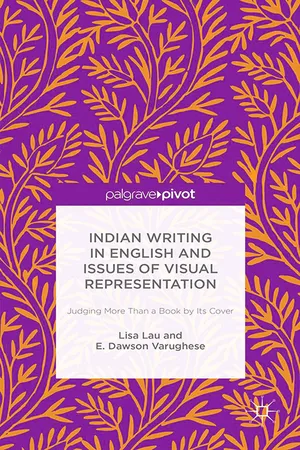
Indian Writing in English and Issues of Visual Representation
Judging More than a Book by its Cover
- English
- ePUB (mobile friendly)
- Available on iOS & Android
eBook - ePub
Indian Writing in English and Issues of Visual Representation
Judging More than a Book by its Cover
About this book
This book examines the use of book covers as marketing devices, asking what exactly they communicate to their readers and buyers, and what images they associate with a genre and create about a culture. Focusing on Indian women's writing in English, it combines the study of text with the study of materiality of the book.
Information
1
Contextualising Book Covers and Their Changing Roles
Lisa Lau
Abstract: This chapter reviews the move from book jackets (as packaging) to book covers (as marketing devices), tracking how the design of book covers has shifted from representing the text between the covers, to representing literary genres and brands. It maps the movement of publishing from being a gentlemanly pursuit, to its current commodification as large-scale commerce controlled by conglomerates. The chapter takes into account the many roles of publishing houses, especially as gatekeepers, and their power and influence in determining availability, access, and audience. It also notes how book covers now have to jostle for space, attention, and sales, concerned less with author intention or artistry, and more with branding and marketing. Book covers continue to play their roles in representation, but of different parties and concerns. This chapter considers books as material objects rather than literary ones, focusing on the corporeality of books and book covers.
Lau, Lisa and E. Dawson Varughese. Indian Writing in English and Issues of Visual Representation: Judging More Than a Book by Its Cover. Basingstoke: Palgrave Macmillan, 2015. DOI: 10.1057/9781137474223.0005.
Development of book covers over the ages
The book cover is something many, even non-readers, are very familiar with, and yet the role and power of which has seldom been given its due attention. Contrary to the popular warning not to judge books by their covers, in this age of rampant image promotion and aggressive advertising, the public are required to judge books by their covers, a necessity in a highly commercialised world crammed with short-attention-span-grabbing devices and conspicuous consumption. The categorisation of books by genre and sub-genre for swift consumer identification and subsequent selection has become increasingly important, altering the role of the book cover from being representative of its book’s contents, to a marketing tool. Through the 20th century, the book cover has changed not just its role, but its method of production, purpose, and meaning, primarily to meet the needs of the industry and 21st century conditions of production and sales, as well as the changing culture of reading and book consumption (including the digital book or e-book). Book covers now set out to be judged, to form consumer expectations, to tap into existing assumptions and stereotypes, to shape genre categorisations, and of course to advertise, seduce, and ultimately, secure sales.
Previous academic attention which extended beyond textual analysis to the study of the book as a product in the circuit of culture, has occasionally included the study of the role played by book covers. Most such studies discussed the development of book jackets from the point of view of the publishing houses (Powers, 2001; Connolly, 2009), with some studies outlining the development of jacket designs and the contribution of artists (Drew and Sternberger, 2005; Baines, 2005). In 2007, Nicole Matthews and Nickianne Moody edited a collection considering book covers in terms of fans, publishers, designers, and the marketing of fiction, taking into account internet bookselling, book prizes, gay, and minority/ethnic literary subgenres. Clare Squires (2009) provides the most comprehensive literature review to date, including in her Marketing Literature the material from publishers, agents, and editors.
However, there has yet to be a holistic study of book covers of any particular genre, and this volume therefore sets out to interrogate the representation of Indian women’s writing by their book covers and to interpret the patterns of representation which can be traced within this genre. The ways in which book covers in the industry today are used require attention and evaluation;
[n]o image that appears on the front cover of a book should be ignored or passively accepted, because in every case, someone has chosen this particular image in order to sell or market the text that follows. Each individual image, paired with its respective work in fiction, creates an expectation for the potential reader, one that either mired in stereotypical representations dating back to the colonial era, or one that is directly relevant to the text at hand. (Pears, 2007, p170)
Pamela Pears makes the argument that covers commercialise, politicise, and create a particularised frame of reception for their books, and therefore it is important covers should not be passively consumed.
A study of book covers would not be facilitated by the fact that there is a scarcity of surviving covers. Book jackets1 were originally regarded as protective packaging for the book itself, intended merely to maintain the book in good condition in the shops and to protect the book during the transportation process. Jackets would have been discarded after purchase and would no more be kept than one would keep the protective packaging on ordinary products bought for consumption today (Powers, 2001, p6). Even today, this practice is not entirely unusual; book jackets, sometimes seen as ‘ephemeral marketing devices’ (Matthews, 2007, pxviii), are still customarily discarded when a hardcover is placed in a library, as per contemporary collection policies of many libraries which still routinely discard covers of books.
Discarded by libraries they may be, but given their key role in the complex (not to say tortuous) process of text production, in considering why readers select the books they do, it is important to consider the materiality of a book, to pay due regard to every stage of a book’s production, transmission, and consumption, as well as the role of institutions and human motives. There are factors beyond and surrounding the text that affect and influence the reader reception of the text: the ‘paratext’ (Genette, 1997). These are often ‘realities which bibliographers and textual critics as such have, until very recently, either neglected or, by defining them as strictly non-bibliographical, have felt unable to denominate’ (McKenzie, 1999, p15). In studying the sociology of texts, D.F. McKenzie (1999) makes the point that forms affect meaning, and that any history of a book must therefore include the ‘study of the social, economic, and political motivations of publishing’ or ‘text production’ (p13).
Gerard Genette (1997) further divides the paratext into ‘peritext’ and ‘epitext’, the former dealing with the physical book itself (its design, format, blurb, cover), and the latter with factors external to the physical book (such as sales, point of sales materials, contracts, etc). This volume focuses more on the peritext of Indian women’s writings. Increasingly, a book’s peritext is designed and created with the epitext in mind, and the paratext as a whole inevitably affects the reading experience of the text, in particular, the reception framework of the text.
From book jackets to book covers, and the decline of the book cover designer
From their humble beginnings as book jackets, book covers first gained importance in the 1890s, when they became recognised as a way to attract buyers, then early in the 20th century, became a promotional tool (Drew and Sternberger, 2005). Alan Powers (2001) suggests that the printed book being traditionally associated with educational rather than commercial ends, was perhaps one reason why book covers were slow to acquire decorative covers. Books were once valued simply for being books; they were not regarded as items which needed to compete for sales, to lure in buyers, and promote themselves via their covers. Apart from being protective packaging, book covers served the purpose of identifying a book, providing details of author and title, but up till the 20th century, were hardly advertising platforms, and as such, not particularly distinctively designed, if designed at all.
Curiously enough, the early book covers often were less to represent the book itself or its textual content, and more to represent both publisher and author. Some book cover designers conceived of cover designs as relating to a series of books, or a particular set of books peculiar to a single publisher (Drew and Sternberger, 2005). Cover designers of the past (such as Paul Rand and Alvin Lustig) would sign their covers as if they were pieces of art; a practice which has fallen into such disuse that it would raise gentle incredulity if such a request were made by book cover designers of today.
During the 1920s, with branded goods a fast-growing feature in the United States, the culture was becoming richer in visual images than ever before as well as increasingly consumer-driven, and consequently books were regarded as commodities which convey consumer messages via their covers, not just textually between the covers (Powers, 2001). The middle of the 20th century also saw the emergence of mass television audiences, further augmenting the culture of visual imagery, some claim at the expense of text. Whether or not that has been the case, book covers today are the ambassadors of their genre, but may or may not be accurate indicators of the text within.
In the age of ‘publishing individualism’, in the 1920s and 1930s, book cover designers were fast losing their influence over designs, and the appearance of the jacket became more dependent on the taste of the firm’s directors than on the artists (Powers, 2001). Even during the 1940s–1960s, despite much design talent available, artists had to take a backseat, and in fact covers were largely an afterthought, often left to the last minute, and it was by no means a given that the book’s contents and cover images were necessarily stylistically matched (Powers, 2001, p41).
The role and influence of individual cover designers continued to decline over the decades of the 20th century, and by the 1980s, art directors would have had to allow designs to go through half a dozen revisions, be shuttled between different divisions of large companies, risk rejection by corporate authorities, suffer micromanagement and changes which computer-generated layouts made increasingly easy to do, and also heed the corporately driven voices of major bookstores (Drew and Sternberger, 2005). ‘The mythic designer-as-artistic-creator was waning in favour of more professionalized designers who could be an effective cog in the gears of a corporate machine’ (Drew and Sternberger, 2005, p105). David Pelham who resigned as art director of Penguin in 1979 said that the art department ‘became the whipping boys, because if a book didn’t sell, if the editor had made a mistake, if the marketing people hadn’t pulled their finger out, if they pulled it out in the wrong direction, they could always say, ‘[s]orry, it was the cover, it was never the book, it was never anything else’ (Baines, 2005, p164).
Thus with the corporatisation and industrialisation of the book production process, the position of the cover designer was compromised, decreasing the individual creativity of the artist; the book cover design would now more likely be attended to by an in-house designer and approved by a sales team, who in turn would liaise with retail buyers who may guess at what would be most marketable (Powers, 2001). With conglomerates and central buying amongst retail chains, just a few key decision makers decide how widely a book is stocked, shelved, displayed; therefore whether these key players like or dislike a cover becomes significant. ‘The head buyers may be shown draft designs, and the sales and marketing staff who present titles to them play a key part in the approvals process for covers within publishers’ (Phillips, 2007, p30). By the 21st century, the cover designer’s influence, control, and decision-making power has waned considerably, giving way to the publisher’s art design and marketing in-house teams, and even the feedback of booksellers which cannot be ignored, as regards what covers with which to ‘front’ books.
It should also be noted that if cover designers have little influence over cover designs, authors tend to be in the same boat. Authors are not necessarily involved in the process of the cover design of their own books and may not have much decision-making power where covers are concerned. In some cases, if the book is a new one, or if there is a choice of a few possible covers, the author may be invited for input. However, in general, only the highest selling authors are likely to gain some degree of control over their covers. Overwhelmingly, particularly at the big publishing houses, authors have little power over their book covers. It would be unlikely the wishes of the author, unless exceptionally well published and hugely profitable, would take precedence over the decision of the sales teams, in-house design teams, and advertising and sales teams of the publishing houses. ‘Few authors have ever demanded or been allowed much choice about the images used or the design of their book jackets, and instances of deep and meaningful collaboration between artist and author are not necessarily to be expected’ (Powers, 2001, p24).
The publishing industry’s effects on peritext and epitext
Over the past two or three decades, there has been a decided move towards a conglomerate takeover of many publishing houses. Bertelsmann, for example, alone owns 10% of global English-language book sales, and with its purchase of Random House, acquired a publisher that already was a conglomerate of 50 formerly independent publishing houses and imprints2 (Bagdikian, 2000, pxxxvii). Squires (2009) also discusses the changing patterns of ownership in 21st century publishing, from national publishing to international conglomerates dominating large segments of market shares. A near ‘oligopolistic control has thus come to exist in publishing in this period [after 2000] [ ... ] and the field of general publishing has increasingly become dominated by a small number of giant corporations rather than populated by small and mid-sized companies, as with earlier 20th century ownership patterns’ (Squires, 2009, p22). Squires argues that changes in the book retail environment have had great impact on literature production, marketing, and reception.
The whole industry of publishing houses and bookselling has come a long way from the days of being a gentlemanly and noble pursuit, suitable to learned scholars eager to promote scholarship and knowledge, or ride their hobby horses, and not too concerned with turnovers and profits. ‘Once a staid and genteel business, even touchy about being called “a business,” bookselling has become a cut-price, cutthroat operation as competitors fight for the largest share of the more than $26 billion book market in the United States’ (Bagdikian, 2000, pxxxviii). The publishing industry has seen large shifts in direction and practice throughout the 20th century, and the turn of the century has brought even more radical changes. The effects and fallout of these radical changes in the publishing industry have been manifold.
With the industry now being clearly and definitively profit driven, the question is no longer whether a book is deserving of publication, but of how well it would be likely to sell. It is difficult (perhaps even unrealistic), within conglomerate publishers and media groups, to sustain the principle that books should not remain unpublished simply because they have limited demand, and that some books with limited public appeal are nevertheless valuable products of our civilisation (Stevenson, 2004). ‘In 1995, Book Publishing in Britain straightforwardly concluded that “publishing is about seeing a market in a manuscript and betting on it” ’ (Barbanneau et al., p3, cited in Stevenson, 2004, p148). That said, publishers themselves are frequently surprised by which books do sell well and which do not, and that is a clear indicator that the value of a book as product is not easy to calculate and not formulaic (Squires, 2009).
With the growing conglomerations and mergers, publishers have increasingly been cutting back on the number of titles published by formerly independent publishers. ‘During the 1980s and 1990s, the old world of publishing was strained to the point of collapse, as firms with a strong individual tradition of patronage and commissioning were absorbed into the multinational conglomerates, and the book trade sought to make more money out of fewer titles’ (Powers, 2001, p107). Moreover, Ned Drew and Paul Sternberger report that with the milieu becoming more corporate and bottom-line focused, publishers are less inclined to experiment with unknown authors, and likelier to opt for better risk, could-be-bestsellers, and trying for superstar deals with best-selling authors. ‘Literary celebrity and highly visible books are two consequences of great importance to the marketplace [ ... ]’ (Squires, 2009, p27).
Given the place and importance of books in society, ‘it follows that significant cultural and political power has therefore been invested in the hands of the same small group of conglomerates’ (Squires, 2009, p22). The number of new publications may be rising, but the number of gatekeepers (which have always been small) are falling still further. This in turn may be part of the cause for the more intense compartmentalisation of genres, imposition of typecasts, and widespread use of genre labels. Squires points out that there can even be internalised competition between imprints (belonging to the same co...
Table of contents
- Cover
- Title
- 1 Contextualising Book Covers and Their Changing Roles
- 2 Positioning Indian Womens Writing in English (IWWE)
- 3 The Mediated Woman on Indian Womens Writing in English (IWWE) Book Covers
- 4 The Post-Millennial Indian Woman on the Book Covers of Kalas Almost Single (2007) and Gokhales Priya in Incredible Indyaa (2011)
- 5 Conclusion
- Index
Trusted by 375,005 students
Access to over 1.5 million titles for a fair monthly price.
Study more efficiently using our study tools.
Frequently asked questions
Yes, you can cancel anytime from the Subscription tab in your account settings on the Perlego website. Your subscription will stay active until the end of your current billing period. Learn how to cancel your subscription
No, books cannot be downloaded as external files, such as PDFs, for use outside of Perlego. However, you can download books within the Perlego app for offline reading on mobile or tablet. Learn how to download books offline
Perlego offers two plans: Essential and Complete
- Essential is ideal for learners and professionals who enjoy exploring a wide range of subjects. Access the Essential Library with 800,000+ trusted titles and best-sellers across business, personal growth, and the humanities. Includes unlimited reading time and Standard Read Aloud voice.
- Complete: Perfect for advanced learners and researchers needing full, unrestricted access. Unlock 1.5M+ books across hundreds of subjects, including academic and specialized titles. The Complete Plan also includes advanced features like Premium Read Aloud and Research Assistant.
We are an online textbook subscription service, where you can get access to an entire online library for less than the price of a single book per month. With over 1.5 million books across 990+ topics, we’ve got you covered! Learn about our mission
Look out for the read-aloud symbol on your next book to see if you can listen to it. The read-aloud tool reads text aloud for you, highlighting the text as it is being read. You can pause it, speed it up and slow it down. Learn more about Read Aloud
Yes! You can use the Perlego app on both iOS and Android devices to read anytime, anywhere — even offline. Perfect for commutes or when you’re on the go.
Please note we cannot support devices running on iOS 13 and Android 7 or earlier. Learn more about using the app
Please note we cannot support devices running on iOS 13 and Android 7 or earlier. Learn more about using the app
Yes, you can access Indian Writing in English and Issues of Visual Representation by Lisa Lau,E. Dawson Varughese,E. Dawson Varughese in PDF and/or ePUB format, as well as other popular books in Literature & Literature General. We have over 1.5 million books available in our catalogue for you to explore.