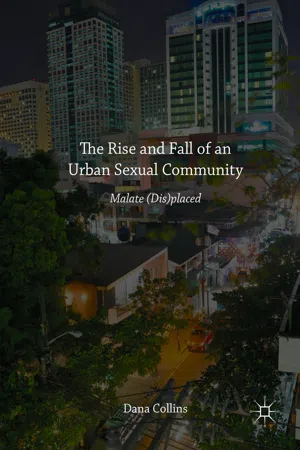
This book examines how gay place-making challenged the juggernaut of neoliberal urbanization in the Malate district of Manila. In this ethnography, Collins explores the creation of place, characterized by neighborhood renewal, gay community and entrepreneurialism, and informal gay sexual labor. Malate teaches us that the power of sexual community to sustain a transgressive, inclusive, gay neighborhood is circumscribed and fleeting, and that urban livability, justice, and freedom must be pursued through organized grassroots political projects if the magic of Malate is to be revived for all its residents.
- English
- ePUB (mobile friendly)
- Available on iOS & Android
eBook - ePub
About this book
Information
© The Editor(s) (if applicable) and The Author(s) 2016
Dana CollinsThe Rise and Fall of an Urban Sexual Community10.1057/978-1-137-57961-4_11. Why Place Matters: An Introduction
Dana Collins1
(1)
Los Angeles, USA
Saturday, February 5, 2000, 9:30 p.m.—Malate, City of Manila
The sounds of Chinese New Year—firecrackers, the backfire of a Jeepney, and the cheers of urban revelers playing in the streets outside of my window—conjure for me the uncertain world of urban spaces. I reflect on my movement into a space that rarely welcomes women. I take a deep breath, disregard my own internalized fears, grab my field notebook, hotel key, a 500 peso note, and head for the door.
The moment I walk outside the barrier of my air-conditioned hotel lobby and onto the street, I am greeted by groups of people strolling and engaging in lively conversation. My sense is that the night is bright, yet I don’t know why. Firecrackers dramatically clap from indefinite parts of the district. I walk toward the cascade of light projected out from random business establishments, which line the street before me. This light places the street activity in a limelight as if the pedestrians’ promenade is part of an elaborate play. Cars are frozen in this activity, as the crowds make it impossible for them to move down my street. Workers busily weave in and out of the establishments and crowds, foregoing participation in the celebratory Saturday night street life.
Rallying the commercial activity of formal business establishments are a plethora of food stalls surrounded by clusters of people consuming fish balls, Lumpia, or iced coconut milk. Cigarette and candy vendors attend to the rest. Cars form a bright line all the way up Adriatico Street toward what seems to be the horizon of the District of Ermita. These lights add a more predictable backdrop to the spontaneous bursts of color and activity arising throughout the neighborhood. The night is humid and heavy, and the car exhaust stings the back of my throat. The scent of frying fish balls from nearby food vendors mingles in the close night air. I feel both crowded and finally at ease, as I find the hum of human urban activity reassuring. I relish my anonymity, sensing this is the first time in two weeks that I have walked these streets without being stared at. There is too much happening in the District of Malate tonight for my difference to stand out.
Cars, people, businesses, consumer activity, and noise compete for space along Adriatico’s intimate block down to Nakpil Street. Just this afternoon, this very space resembled something akin to a quiet, tree-lined neighborhood with moderate commercial activity. Yet tonight, Malate swells with activity, as people and vehicles descend from what I imagine to be all parts of the metropolis. The numbers push at the district’s seams but somehow the neighborhood accommodates them. The crowd—overwhelmingly Filipino—moves along, consuming from the street vendors or clustering in groups at the intersections. The hotels and fine dining restaurants sit idly, ignored by the amazing presence of people in the streets.
I quickly reach the corner of Nakpil Street, turning and encountering a thickening crowd and even more performative street life. The business establishments lining the street are clustered closely together, well lit, and newly renovated. They cater to the steady flow of customers that spill in from side streets. There is little unused space on this block. I walk past art cafés, beach holiday bars, a “Gotham” nightclub, a Spanish Tapas restaurant, airport themed coffee shops, and French, Italian, Thai, European, Gourmet Filipino, Caribbean, and Chinese restaurants. I have the sense that the globe has invaded this narrow neighborhood street. I turn the corner at Maria Orosa Street—an intersection that is consumed by the crowd—and find it difficult to locate Baccus,1 the gay bar to which I have ventured out tonight. Baccus is squeezed inconspicuously between two other food and drink establishments that demonstratively open to the street with large glass windows that connect the patrons inside to the festive street life taking shape outside. I can see the patrons gazing out at me as I approach a muscled young man in a tight patterned T-shirt who is sitting between me and the large metal door, separating me from the inside of this gay bar. He smiles, reaches for a bronze doorknob molded in the shape of a large swimming sperm, opens the door, and welcomes me in.
Thirteen Years Later on Saturday, February 9 at 6 p.m.—Malate, City of Manila
The Dragon Dance parade of the Chinese New Year has just passed my hostel at the corner of Nakpil and Adriatico Streets. The clanging, drumming, and shouts brought me out from my room and on to the balcony where I stood with the other hostel guests and workers, gazing down at the parade inching its way down Adriatico. The sun is setting, and it is still early for a Saturday night. The few patrons on the street stop their hurried walk to throw coins into the dragon’s mouth, as it makes its way in quick starts and stops, gobbling all coins thrown in its direction. The dragon sneakily approaches unsuspecting patrons as if it will consume them as well. This is a playful dance that happens yearly throughout Manila. This is also the most activity that I have witnessed on the streets since my arrival two weeks prior.
I’ve met PK (a former gay host) and his partner, Louis, for dinner this evening, and as we make our way south toward the heart of Malate, we discuss how dead this Saturday night of Chinese New Year seems. We pass Korean and Japanese hostess bars; the women stand out on the street in evening wear or lingerie, calling out to potential customers to come inside. We pass without their acknowledgment. Neither is there a street party to greet us as we round the bend of Nakpil to Maria Orosa Street. We grab a seat at a plastic table and chairs pushed out onto the street outside of Fritz, a gay-owned bar and dance club, just steps away from the business establishment that used to be the gay bar, Baccus. That space is now a Korean KTV bar,2 flanked by other KTV clubs and hostess bars. Street vendors stop by our table in intervals of approximately five minutes, requesting that we purchase anything from flowers to cigarettes to candy, or to ask that we make a modest contribution to their meal that night. The other five tables are occupied by small groups of gay men who are socializing, smoking, and drinking. Only two other foreigners were among this group tonight. Now and again, a gay man walks by our table and recognizes PK, offering his greeting. The street feels empty; there are only two other gay establishments and the Guest Relations Officers (GRO), who are now referred to as Customer Care Associates (CCA), and who work to encourage the public’s patronage of the bars, do not have a crowd from which to draw. Most establishments make use of signs and billboards featuring young Filipina women to draw in an altogether different clientele from the ones clinging to the plastic tables on our side of the street.
PK gestures out at the slow nightlife, “Look at this; this used to be the heart of gay Malate.” I ask him and Louis about Club Fellini, a gay bar and dance space, just across the street from where we are sitting. “You can’t socialize in Fellini; it is a dance club and it is very hard to just hang out and talk. I took some friends from the call center to Fellini one night and we paid our 500 pesos (rolling his eyes) and there was no place to hang out! You go in, you sit, and you are separated from people. There aren’t even chairs at the bar. There used to be a bar with chairs and you could hang out and talk. But now there are all of these dark secluded corners and you just sit there and wait to be picked up. And then you go. So we had a terrible time.” Their experience confirms my experience of Club Fellini from the night before. Club Fellini announced their closure just two weeks later.
Louis had to use the restroom and he returns to our table visibly upset. The muscular doorman charged him the 200 pesos door charge to enter Fritz to use the toilet. PK leaps up from the table and demonstratively walks over to the doorman, claiming in English and loudly that he knows the owner and that he is like a gay mother to him. He proceeds to argue in Tagalog, gesturing inside the bar and raising his voice at the end of each sentence. He then stomps over to the top of the steps and looking down on the street-level tables where we are sitting, he starts to undo his belt, gesturing that he is going to urinate right there, down the very steps that mark the bar’s entrance. Louis, who had been translating the exchange for me all along, stops and states, “I don’t care if he does; he has a nice package.” PK does not urinate on the steps; he angrily walks down the street out of our eyesight and finds a darker location to relieve himself. Upon his return, we collectively complain to our waiter, who repeatedly apologizes, and with a worried look on his face, tells us that he will bring some free beers for the night. I leave soon after, and note that the crowds in the street remain sparse, which leads the doormen from some establishments to focus their persistent energy on getting me to come inside. Later that night, PK sends a text message to let me know that they have received their free beer.
* * *
Malate (Dis)placed offers an ethnographic story of both the making and unraveling of urban sexual community in a global South city neighborhood. This story unfolds in a former sex and current tourist district, Malate, in the City of Manila, the Philippines. Malate is a prominent character in this story, as are the powerful and marginalized urban actors who make neighborhood change, “gay” community, and who forge a place in the conflicted racialized-class relations of this gentrifying district. The story offers a picture of these actors’ place-making over a period of thirteen years, from 2000 to 2013, where I witnessed firsthand the rise and unraveling of gay-led gentrification.
I had arrived in Malate in 2000, prepared to study gay tourism and sex work in this former sex district. Yet as I spoke of this research interest, my participants’ eyes glazed over and they communicated that too many, often global North researchers, had already descended upon their beloved neighborhood to study the sex trade, overlooking the powerful aspects of people’s lives, work, and community—“You should study what is happening here, to our neighborhood”; “I’ll tell you one thing, it’s got soul”; “actually, … it is one of the few places in Manila that has a sense of place” they would all tell me. I did not see or experience place when I first arrived; yet time and again a wide range of urban actors—who were both Filipino and foreign, working and elite classes, gay-identified and straight—continued to assert that there was something special about Malate. It was through their lived experiences that I was encouraged to pay attention to place—or how people assert a right to access urban spaces; draw from urban magic, identity, memory, and belonging; and both collectively and informally struggle to make urban spaces meaningfully theirs in a rapidly globalizing city. Their encouragement eventually led to my exploration of place-making in the rise and fall of urban sexual community, and how place is powerful in people’s imaginations and actions, yet loses out to the neoliberal forces of city government and global capital.
I tell this kind of story of urban change so that we can see how place-making is at once local, global, personal, political, and rife with neoliberal controls. A key theme that arises in this story of sexuality, neighborhood change, and struggle is what I am calling intimate neoliberalism.3 Sexual community as it manifests in Malate, and within gay enclaves in cities globally, cannot exist outside of the neoliberal relations of tourism, global urbanization, and gay consumerism that offer both economic fuel and a late capitalist ethos of individualism and consumerism. Sexual community is a response to these neoliberal structures; but it is also something else entirely. It is the geographical, cultural, and imagined connection to a place that sexual others claim in the face of the marginalizing and homogenizing forces of neoliberal globalization. Intimacy shows the deep penetration of neoliberal control into desire, identity, and lifestyle, all of which manifest within urban sexual spaces worldwide. But it also highlights how actors often employ intimacy—in the form of desire, identity, and relationships—to resist these alienating forces. These practices of intimate resistance, including key rejections of global homogenization and commoditization of urban space and identity, came to be the place-making strategies that are so central to Malate’s story. The lesson of this story is that urban change projects need to be organized, through explicit po...
Table of contents
- Cover
- Frontmatter
- 1. Why Place Matters: An Introduction
- 2. The History of Place: From Urban Community to Heritage Conservation
- 3. The Magic of Place: Players in the Nakpil Revival
- 4. The Sexuality of Place: Gay Hospitality and the Production of Desiring Labor
- 5. “Love, Autonomy, and Our Attempts at It”: Coming of Age in Malate
- 6. The Exclusions of Place: Gay-led Gentrification Within Nakpil’s Second Wave
- 7. Conclusion: Malate 2013
- Backmatter
Trusted by 375,005 students
Access to over 1.5 million titles for a fair monthly price.
Study more efficiently using our study tools.
Frequently asked questions
Yes, you can cancel anytime from the Subscription tab in your account settings on the Perlego website. Your subscription will stay active until the end of your current billing period. Learn how to cancel your subscription
No, books cannot be downloaded as external files, such as PDFs, for use outside of Perlego. However, you can download books within the Perlego app for offline reading on mobile or tablet. Learn how to download books offline
Perlego offers two plans: Essential and Complete
- Essential is ideal for learners and professionals who enjoy exploring a wide range of subjects. Access the Essential Library with 800,000+ trusted titles and best-sellers across business, personal growth, and the humanities. Includes unlimited reading time and Standard Read Aloud voice.
- Complete: Perfect for advanced learners and researchers needing full, unrestricted access. Unlock 1.5M+ books across hundreds of subjects, including academic and specialized titles. The Complete Plan also includes advanced features like Premium Read Aloud and Research Assistant.
We are an online textbook subscription service, where you can get access to an entire online library for less than the price of a single book per month. With over 1.5 million books across 990+ topics, we’ve got you covered! Learn about our mission
Look out for the read-aloud symbol on your next book to see if you can listen to it. The read-aloud tool reads text aloud for you, highlighting the text as it is being read. You can pause it, speed it up and slow it down. Learn more about Read Aloud
Yes! You can use the Perlego app on both iOS and Android devices to read anytime, anywhere — even offline. Perfect for commutes or when you’re on the go.
Please note we cannot support devices running on iOS 13 and Android 7 or earlier. Learn more about using the app
Please note we cannot support devices running on iOS 13 and Android 7 or earlier. Learn more about using the app
Yes, you can access The Rise and Fall of an Urban Sexual Community by Dana Collins in PDF and/or ePUB format, as well as other popular books in Social Sciences & Politics. We have over 1.5 million books available in our catalogue for you to explore.