eBook - ePub
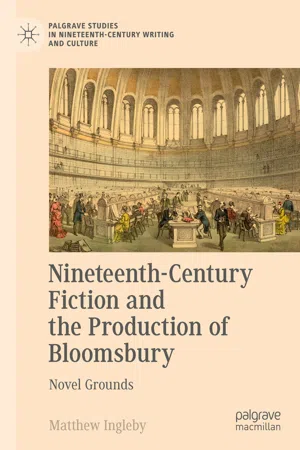
Nineteenth-Century Fiction and the Production of Bloomsbury
Novel Grounds
- English
- ePUB (mobile friendly)
- Available on iOS & Android
eBook - ePub
About this book
This study explores the role of fiction in the social production of the West Central district of London in the nineteenth century. It tells a new history of the novel from a local geographical perspective, tracing developments in the form as it engaged with Bloomsbury in the period it emerged as the city's dominant literary zone. A neighbourhood that was subject simultaneously to socio-economic decline and cultural ascent, fiction set in Bloomsbury is shown to have reconceived the area's marginality as potential autonomy. Drawing on sociological theory, this book critically historicizes Bloomsbury's trajectory to show that its association with the intellectual "fraction" known as the 'Bloomsbury Group' at the beginning of the twentieth century was symptomatic rather than exceptional. From the 1820s onwards, writers positioned themselves socially within the metropolitan geography they projected through their fiction. As Bloomsbury became increasingly identified with the cultural capitalof writers rather than the economic capital of established wealth, writers subtly affiliated themselves with the area, and the figure of the writer and Bloomsbury became symbolically conflated.
Information
Topic
LiteraturaSubtopic
Literatura general© The Author(s) 2018
Matthew InglebyNineteenth-Century Fiction and the Production of BloomsburyPalgrave Studies in Nineteenth-Century Writing and Culturehttps://doi.org/10.1057/978-1-137-54600-5_11. Introduction: Writing Bloomsbury’s Trajectory
Matthew Ingleby1
(1)
Department of English, Queen Mary University of London, London, UK
Matthew Ingleby
This book explains how the West Central London district known as Bloomsbury underwent a gradual transformation in the nineteenth century from social marginality to intellectual centrality, which was mediated through fiction. It traces the contours of Bloomsbury’s changing cultural imaginary before 1904, when Virginia Woolf (née Stephen) moved into the neighbourhood. Woolf was the most significant literary member of the early twentieth-century coterie of intellectuals and artists that came to identify themselves with Bloomsbury’s streets and squares, and hence became known as the “Bloomsbury Group.”1 But writers had a strong interest in Bloomsbury long before the “Bloomsbury Group” phenomenon. In Nineteenth-Century Fiction and the Production of Bloomsbury, the evolution of the neighbourhood’s identity in the 100 years that preceded Woolf’s residency there is presented as a sequence of definitions and re-definitions that were not only reflected in literary representations in this period but performatively enacted by them.
My study shows that Bloomsbury, both in fact and fiction, became increasingly associated with literary production from the 1820s onward, and that by the 1890s the question of literary writing’s autonomy had become one of the most definitive themes of novels set in the neighbourhood. This book’s focus on one material space of fiction writing shared between nineteenth-century and early twentieth-century literary cultures sheds new light on the continuities and discontinuities at one of the most contested junctures in British literary history, between the Victorians and “modernism”—that moment when critical claims about literature’s autonomy were at their most extravagant. I argue that neither the influential literary geographies inscribed by nineteenth-century Bloomsbury fictions nor the “Bloomsbury Group” myth itself was a mere disinterested reflection of the place, being, rather, means of position-taking within the literary field. Both the spatial and the cultural production that characterized urban modernity were subject to shifting relational systems of value that experienced enormous changes in this period. Critically historicizing nineteenth- and early twentieth-century Bloomsbury’s deepening cultural association with intellectual production, the chapters that follow show that the simultaneous restructuring of London’s literary field and its residential market were intimately connected, and that fiction was both an engine for and a product of these twin developments.
Though the lion’s share of Nineteenth-Century Fiction and the Production of Bloomsbury explores the literary representation of the neighbourhood between the 1820s and early 1900s, in its conclusion this study directs its attention to the spatial logic underlying that early twentieth-century cultural construction, the “Bloomsbury” of the “Bloomsbury Group.” As Regina Marler suggests, the highly ironized, highly qualified, “Bloomsbury” that now circulates as a reified brand within the academic culture industry was first ventured by Woolf and her friends as a semi-private joke.2 I interpret the capricious “Bloomsbury” implied within the “Bloomsbury Group” as a specialized geographical manoeuvre, which not only borrowed from pre-existing nineteenth-century traditions of constructing Bloomsbury but also moved beyond them. In the conclusion, I close-read a series of texts by Woolf that can be seen to have subtly contributed to this new development in Bloomsbury’s cultural imaginary. By dissolving a place and a small selection of its frequenters into a playful idea in quotation marks, Woolf and her friends self-mythologized their “Bloomsbury” in order to bracket it from the neighbourhood at large, attempting thereby to secure the cultural capital associated with the Bloomsbury district from any contaminating reference to the mass literary marketplace. In resituating the “Bloomsbury” of the “Bloomsbury Group” in relation to ideas about Bloomsbury that were mediated through nineteenth-century fiction, this study joins research by Steve Ellis and Emily Blair, who have explored Woolf’s affiliations with her Victorian forebears, and by Anna Snaith and Sara Blair, who have uncovered Woolf’s material engagements with Bloomsbury the neighbourhood, beyond her coterie.3 In positing a structural dynamic to Bloomsbury’s trajectory from the 1820s to the early twentieth century, however, the book also seeks to complement the sometimes apologetic revisionism of recent Woolf scholarship with a critical sociological perspective, arguing that the “Bloomsbury” imagined by the “Bloomsbury Group” was an interested geographical intervention, intended to preserve the neighbourhood’s “intellectual” reputation from a sense of the “masses.”4
The first section of this introduction elaborates my account of nineteenth-century Bloomsbury’s trajectory, followed by a section that sets such an account amidst existing historiographies of the neighbourhood. I then go into some detail about the specific role of the thinking of two French sociological theorists, Henri Lefebvre and Pierre Bourdieu, within my analysis of the interaction of urban change and cultural production in nineteenth-century London. After this, the final section unpacks the methodological underpinnings of the new kind of literary geography and literary history this book offers, positioning its workings in relation to the “distant reading” experiments of Franco Moretti.
Bloomsbury was an area that began to grow physically and demographically in the seventeenth century, when the Duke of Bedford built his aristocratic mansion there. However, the majority of its streets and squares appeared in waves of speculative development from 1776 to the 1820s, a sometimes swift and sometimes stuttering process that ended with the long-awaited completion of Gordon Square as late as 1860. The Duke himself moved out of his Bloomsbury estate in 1800. Thereafter, the area became definitively ex-aristocratic and dominated by liberal middle-class professionals, though it hosted also a substantial working-class population, including several pockets of serious poverty. As the century progressed, all kinds of writers lived here, especially at the beginnings of their careers, in order to be close to the British Museum reading room, which was the city’s central site of intellectual work. When, as burgeoning cultural producers at the beginnings of their careers, the sisters Virginia Stephen and Vanessa Stephen chose to move into Bloomsbury in 1904, self-consciously turning their backs on the more socially exclusive West London of their birth, they confirmed the end of one long transitional moment in the area’s history. At the beginning of the nineteenth century, Bloomsbury was defined by the evacuation of its residual upper class. By the beginning of the twentieth, it was a part of Central London that was unusually socially mixed, having developed special attractions to an avowedly bohemian “fraction” of the establishment, often identified as belonging to a self-appointed “aristocracy of letters.”
During this time, Bloomsbury became gradually drawn into the core of the city, as that core physically grew in proportion to the sprawling metropolis around it. In 1800, it would have taken five minutes to escape on foot from Bloomsbury into the fields surrounding it; in 1900, it would have taken more than two hours. The consecration of Bloomsbury’s centrality within the city was also enacted by the middle of Queen Victoria’s reign through the opening of the three enormous railway stations it hosted at its northern border, the New Road (later Euston Road). These stations were Euston (1837), King’s Cross (1852), and St Pancras (1867), each of which successively confirmed Bloomsbury as a major node coordinating traffic across the nation. Euston , in particular, was a key site for the unprecedentedly globalized imperial metropolis, connected as it was to Glasgow and Liverpool, prime ports of Empire and world trade at the point of their massive expansion. When, having circumnavigated the world for a bet, Phineas Fogg from Jules Verne’s Eighty Days around the World (1873) finally returns to London by train from Liverpool, it is at Euston station he disembarks. The northwards border of Bloomsbury operated in this period not only at a local but also a global level, defining it as central to a world city’s transnational exchange of people, things, and, most importantly, ideas.5
Notwithstanding how demonstrably central the neighbourhood was to the nation’s intellectual life, its centrality rarely presents within the cultural imaginary straightforwardly in the nineteenth century. Instead, in fiction from the 1820s onwards, Bloomsbury’s centrality tends to manifest itself in dialectical relation to a persistent sense of the peripheral. Indeed, when one considers the body of literary representation of the area over the period between the Duke of Bedford’s exit and the Stephen sisters’ entrance, Bloomsbury’s intellectual importance was confirmed not despite its socio-economic marginality but in some way because of it. Over the course of the nineteenth century, Bloomsbury’s marginality was recast within the cultural imagination as a kind of autonomy—the autonomy on which its claims to intellectual centrality depended. Just as literature, one of the area’s chief products, began to achieve in this same period a kind of value that depended on its peripheral and allegedly autonomous relation to the market, the cultural idea of Bloomsbury underwent a “conversion” from socio-economic marginality to intellectual centrality.
As Franco Moretti says, fiction is grounded in space: stories happen somewhere and are produced out of the ideological demands made by particular geographies. Bloomsbury is clearly part of the socially mediating, middle-class “third London” that Moretti argues is only fully opened up to fictional representation within the nineteenth century.6 But Bloomsbury, which becomes in this period a major zone of literary production, also produces much more locally specific kinds of story. By telling a local history of the nineteenth-century novel, the following chapters show how Bloomsbury’s trajectory from socio-economic marginality to intellectual centrality was negotiated through a series of related narrative “solutions” to tensions grounded in this particular terrain but by no means parochial in their wider cultural significance.7 New readings of canonical works such as Vanity Fair (1848), Mrs Dalloway (1925), New Grub Street (1891), News from Nowhere (1890), and The Golden Bowl (1904), alongside lesser-known New Woman, sensation, and “silver-fork” fiction, reveal the cultural work performed by these novels’ geographies, all of which construct Bloomsbury, in one way or another, as a space marginal to—but also potentially autonomous from—the city’s dominant socio-economic logic. Since they anticipate the overt claims to autonomy made by the Bloomsbury group, the “local narratives” to be found within nineteenth-century Bloomsbury fiction indicate continuities between the locale’s cultural imaginary in the nineteenth and the twentieth centuries. In its middle-class aversion to aristocratic snobbishness about the area’s marginalization from centres of fashion, its conflicted philanthropic relation towards the working class, its dissidence or permissiveness in terms of gender and (implicitly) sexuality, and its anxiety about the status of literary work as labour, the Bloomsbury nineteenth-century ficti...
Table of contents
- Cover
- Front Matter
- 1. Introduction: Writing Bloomsbury’s Trajectory
- 2. Bloomsbury Entertains: Dinner Parties and the Literary Geographies of Class
- 3. Bloomsbury Versus the Marriage Plot: Boarding-House and Barrister Bachelors
- 4. Bloomsbury’s Vocations: Philanthropic Medicine and Iatrophobic Fiction
- 5. Women in the Walkplace: Tracking Bloomsbury’s Female Pedestrians
- 6. In the Valley of the Shadow of Books: Placing Fictions of Literary Production at the Fin de Siècle
- 7. Conclusion: “Bloomsbury” in Play
- Back Matter
Trusted by 375,005 students
Access to over 1.5 million titles for a fair monthly price.
Study more efficiently using our study tools.
Frequently asked questions
Yes, you can cancel anytime from the Subscription tab in your account settings on the Perlego website. Your subscription will stay active until the end of your current billing period. Learn how to cancel your subscription
No, books cannot be downloaded as external files, such as PDFs, for use outside of Perlego. However, you can download books within the Perlego app for offline reading on mobile or tablet. Learn how to download books offline
Perlego offers two plans: Essential and Complete
- Essential is ideal for learners and professionals who enjoy exploring a wide range of subjects. Access the Essential Library with 800,000+ trusted titles and best-sellers across business, personal growth, and the humanities. Includes unlimited reading time and Standard Read Aloud voice.
- Complete: Perfect for advanced learners and researchers needing full, unrestricted access. Unlock 1.5M+ books across hundreds of subjects, including academic and specialized titles. The Complete Plan also includes advanced features like Premium Read Aloud and Research Assistant.
We are an online textbook subscription service, where you can get access to an entire online library for less than the price of a single book per month. With over 1.5 million books across 990+ topics, we’ve got you covered! Learn about our mission
Look out for the read-aloud symbol on your next book to see if you can listen to it. The read-aloud tool reads text aloud for you, highlighting the text as it is being read. You can pause it, speed it up and slow it down. Learn more about Read Aloud
Yes! You can use the Perlego app on both iOS and Android devices to read anytime, anywhere — even offline. Perfect for commutes or when you’re on the go.
Please note we cannot support devices running on iOS 13 and Android 7 or earlier. Learn more about using the app
Please note we cannot support devices running on iOS 13 and Android 7 or earlier. Learn more about using the app
Yes, you can access Nineteenth-Century Fiction and the Production of Bloomsbury by Matthew Ingleby in PDF and/or ePUB format, as well as other popular books in Literatura & Literatura general. We have over 1.5 million books available in our catalogue for you to explore.