- English
- ePUB (mobile friendly)
- Available on iOS & Android
eBook - ePub
About this book
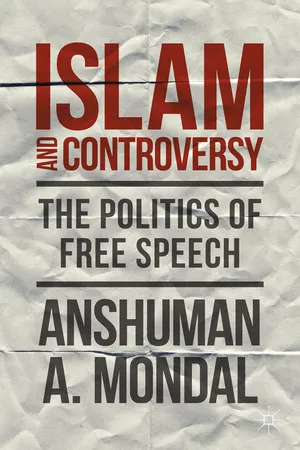
Was Salman Rushdie right to have written The Satanic Verses ? Were the protestors right to have done so? What about the Danish cartoons? This book examines the moral questions raised by cultural controversies, and how intercultural dialogue might be generated within multicultural societies.
Information
1
From Blasphemy to Offensiveness:
the Politics of Controversy
Ayatollah Khomeini pronounced his fatwa on Salman Rushdie over twenty-five years ago. Reviewing the ‘Rushdie affair’ from this vantage point reveals some fundamental continuities as well as radical discontinuities with the present situation.1 On the one hand, on reading many of the contemporary documents chronicling the affair, it is impossible not to realize that the world we inhabit today is vastly different from that in which the controversy took place. We cannot, for example, read of the Muslim protests and the liberal response without conjuring in our minds what Paul Weller has called its ‘entails’: the spectres of 9/11 and 7/7, the wars in Afghanistan and Iraq and, of course, on ‘terror’; the murder of the Dutch film-maker Theo van Gogh; the controversy over the Danish cartoons depicting the Prophet of Islam as a suicide bomber; the firebombing of the publishers GibsonSquare for seeking to publish The Jewel of the Medina; the ‘failure’ of multiculturalism; the ‘problem’ of integrating large immigrant Muslim communities into ‘the West’; or the controversy surrounding the then UK Home Secretary Jack Straw’s comments on the suitability of the niqab in modern Britain, itself an echo of the French ban on the wearing of the hijab in schools and other public arenas.2 In the US, these ‘cultural’ issues may have been more muted, although similarly omnipresent, submerged beneath the rhetoric of the security state, but they have periodically surfaced to the forefront of American consciousness, as demonstrated by the outcry over the proposed Islamic cultural centre and mosque proximate to Ground Zero. All of this had yet to pass when ‘the Rushdie affair’ broke at the end of 1988, and they form a bulwark between then and now. There is a pre-lapsarian feel to the period, one determined by the relative novelty of Muslim political assertiveness, in which the language of the encounter had yet to be formulated.
However, in the absence of that language, the encounter was articulated through the existing models of a conflict between the West and Islam, an additional layer grafted onto the centuries-old discourse of antagonism between Christendom and Islam. What was remarkable was the degree to which people who might ordinarily have taken a more nuanced view of such a situation (artists and intellectuals, especially) felt compelled to take sides, and in so doing compelled others to do the same. Rana Kabbani, for example, noted how this polarizing dynamic – ‘with its added ordure of vitriol and abuse’ – forced her ‘underground Muslim’ identity ‘into the open. Stung by the racial hatred which this affair unleashed . . . I needed to re-examine my allegiances.’3 At the same time, her Letter to Christendom attempted to interrogate and undermine these oppositions by seeking a ‘halfway house’ between ‘two worlds apparently incapable of meeting on common ground’.4 It attempts the same difficult refusal to choose that, ironically, Rushdie later exhorted in his short story ‘The Courter’ – ironic precisely because Rushdie did not take kindly to Kabbani’s defence of Islam, and her unwillingness to rush to the barricades on his behalf.5 Almost without exception, Rushdie’s liberal defenders in the West felt no such need to examine their allegiances – they seemed perfectly apparent and clear-cut.
It is this Manichean discourse that constitutes the main continuity linking our present to the events of 1988–1989. Yet those same events enumerated above are part of a series located squarely within a deep historical continuity, one that long predated the Rushdie affair. The ‘clash of civilizations’ it draws upon is an echo-chamber that reverberates into perpetuity – or, at least, since Christendom first became aware of, and confronted, Islam as a rival.6 Samuel Huntington’s famous thesis was published as an article in Foreign Affairs in 1993, and thence as a book in 1996, long before 9/11.7 It preceded the attacks in Kenya and Tanzania in 1998, and on the USS Cole in 2000. In other words, it predated the actual emergence of radical Islamism as an emergent ‘enemy’.8 Although primarily determined by the end of the Cold War and the fall of the Berlin Wall, it also clearly registers the Rushdie affair in its construction of Islam as a particularly implacable civilizational foe. The Foreign Affairs article quotes Bernard Lewis’ response to the Rushdie Affair in ‘The Roots of Muslim Rage’, and adopts its defining optic as its own:
We are facing a need and a movement far transcending the level of issues and policies and the governments that pursue them. This is no less than a clash of civilizations – the perhaps irrational but surely historic reaction of an ancient rival against our Judeo-Christian heritage, our secular present, and the worldwide expansion of both.9
Huntington’s text was not the origin of this discourse, of course, but it gave it a shape and currency, marshalling the amorphous mass of sentiment swirling around ‘the Rushdie affair’, giving it a semblance of coherence, a smattering of contemporaneity, a macro-political context, and – because of its political influence – the aura of authority.
There does not seem to have been any appreciable shift in the template laid down by ‘the Rushdie affair’ in the intervening years. Each successive controversy has quickly developed into a stand-off between a putative ‘West’ defending freedom of expression, and an ‘Islam’ seeking freedom from offence. The twentieth anniversary of the fatwa, in February 2009, was marked by extensive media coverage and commentary, but the overwhelming impression left by this retrospective appraisal was that it constituted a re-inscription, a repetition with a difference. While many of the prominent Muslim protagonists of the ‘Rushdie affair’ within the British context – foremost among them, Inayat Bunglawala, former spokesperson for the Muslim Council of Britain, and Ghayasuddin Siddiqui, who was then a leading member of the Tehran-backed Muslim Institute – have adapted or retracted their positions vis-á-vis the novel and the issues it raised concerning the respective limits of freedom of expression and religious liberty (as has the Islamic Republic of Iran itself, specifically with respect to Khomeini’s fatwa), liberal positions on the controversy have not altered in any significant respect.10 Indeed, the events of 11 September 2001 and the subsequent ‘war on terror’ have further entrenched them. Thus, writing in the Observer just before the twentieth anniversary, Andrew Anthony concluded that ‘there is nothing more sacred than the freedom to question what is sacred’.11 Likewise, on the day itself, Lisa Appignanesi invoked John Mortimer (the writer and barrister who defended Penguin during the Lady Chatterley’s Lover case) in suggesting that ‘it was almost the duty of writers to offend’, a trope often reprised by contemporary liberal advocates of freedom of speech, most recently by the writers Kenan Malik and Nick Cohen.12 Both these statements reprise, almost to the letter, the positions taken up by Rushdie and his defenders during the controversy over The Satanic Verses, both before and after the fatwa. Appignanesi echoes Rushdie’s famous catechism, ‘what is freedom of expression? Without the freedom to offend, it ceases to exist’, and Anthony reprises Rushdie’s sacralization of literature (despite his assertions to the contrary) in ‘Is Nothing Sacred?’ on the basis that ‘[l]iterature is the one place in any society . . . where we can hear voices talking about everything in every possible way’ – where nothing can be sacred because to make something sacred is ‘to set [it] apart’, and thus remove it from that scrutiny.13
Rushdie himself has significantly hardened his position on Islam and Muslims, and both the emergence of what has been called the ‘New Atheism’ and the backlash against ‘multiculturalism’ have bolstered the liberal conviction that surfaced during the Rushdie affair concerning the cultural obduracy and ‘backwardness’ of Islam.14 These trends have accompanied the rhetoric of the ‘war on terror’ and the ‘clash of civilizations’ articulated by a resurgent neo-liberalism and has resulted in a re-alignment of right- and left-wing liberalisms promoting a united front in the face of a common cultural foe: Islam.
The result of this re-alignment has been the fetishization of freedom of expression as a totem of western culture, and of liberalism as the register of its cultural supremacy (notwithstanding the numerous contradictions within the West that this glosses over). While right-wing neo-liberals and left-leaning social liberals make uneasy bedfellows, they have converged in the wake of the fatwa into a strategic alliance that identifies a fundamental conflict between the West and the so-called Islamic world. Neo-liberals identify ‘Islam’ as a geopolitical enemy that must be overcome to maintain the economic and military superiority of the West, whilst social liberals characterize it the locus classicus of illiberalism. This has been accompanied by a shift towards a more ‘muscular’ liberalism that has been articulated by both right and left liberals, most recently by the current British prime minister, David Cameron.15
Once again, this rhetoric is usually defined by its addressee: Islam. On the right the usual inflection is to exclude Muslims and Islam from ‘our’ cultural ‘norms and values’, which ‘they’ must ‘learn’ in order to demonstrate their integration into society; many left liberals have also subscribed to this culturalist turn in arguments about integration, but amongst them there is also an emphasis on an absolutist conceptualization of freedom of expression in which any limit on not just the right but the exercise of free speech is deemed to be an erosion of ‘[o]ur established and long-fought for liberties to read or not read what we like’.16 As we have seen, this was an argument put forward by Rushdie himself in the wake of the fatwa and has since become common currency in liberal circles: the right to freedom of expression ceases to exist without the ‘right’ to offend. This invokes an ‘all-or-nothing’ argument that invariably conjures up a liberal nightmare in which ‘any sentence might turn out to be a death sentence’.17
This ‘absolutist’ position on free speech has been most extensively articulated by Kenan Malik, in his best-selling account of ‘the Rushdie affair’ and its aftermath, From Fatwa to Jihad (2009), and more recently by the Observer columnist, Nick Cohen, in You Can’t Read This Book: Censorship in an Age of Freedom (2012). Brian Winston, in his A Right to Offend (2012) has also offered a (slightly) more measured, and academic, contribution to this discourse.18 Malik and Cohen, in particular, advocate an especially bold position: the removal of all incitement to hatred legislation, on all grounds – race, religion, gender, sexuality, disability; of laws prohibiting Holocaust denial or denial of other genocides, such as the denial of the Armenian genocide (in France); and they dismiss all feminist objections to pornography as a degradation of women. In the next chapter, I will examine the arguments, tropes and assumptions that constitute this post-Rushdie ‘absolutist’ discourse on free speech, but here, by way of context, it is important to note that the realignment of liberalisms in the wake of ‘the Rushdie affair’ has meant that this largely left-liberal discourse has accommodated antipathies and anxieties that are usually the provenance of the political right, which in turn has helped to embed them firmly within a political consensus that, in Britain today, has acquired an almost hegemonic force. First, it has disavowed multiculturalism as a failed experiment, a disavowal that has accompanied and partly determined the re-signification of ‘integration’ as a synonym rather than antonym of ‘assimilation’.19 Secondly, it declares an impatience with ‘political correctness’, an apparently intolerable limit on freedom of expression that it associates with multiculturalism and its demand to ‘respect’ other cultures. ‘Respect’, then, is the third aspect of this shift in left-liberal discourse, and it has become something of a dirty word amongst contemporary liberal absolutists, often deployed with a sneering sarcasm that denotes contempt for the concept. Whilst part of this shift may have been caused by an unsurprising restatement of liberal first principles as a response to the creeping authoritarianism of then Prime Minister Tony Blair’s ‘respect agenda’ (one inherited with little modification by the subsequent Brown and Coalition administrations), in which the term signals the re-establishment of authority in the face of a supposedly feral, lawless and ‘disrespectful’ underclass, it is also a response to the ‘fallout’ (to borrow the title of Andrew Anthony’s book, which is itself a notable articulation of the shift in left-liberalism) of the Rushdie affair, and the sense in which these liberals have come to see multiculturalism as a vehicle for the advancement of anti-liberal, authoritarian agendas concealed beneath the rhetoric of cultural pluralism. ‘Although the fashion for relativism was growing in Western universities in the 1980s’, writes Cohen, ‘leftish academics did not say we had no right to offend the cultures of racists, misogynists and homophobes, and demand that we “respect” their “equally valid” contributions to a diverse society’ – whilst going on to suggest that contemporary thinkers have now completely succumbed to ‘relativism’ and a politically correct ‘respect’ for the ‘other’.20
What binds these strands of current political orthodoxy is a sometimes explicit, but more often implicit, suspicion of cultural difference and equality; or, more precisely, the equality of cultural difference. That much is apparent in the discourse of the political right, even in its more liberal versions, which has barely concealed its distaste for the equality agenda. Whilst conservatives have embraced the ‘respect agenda’ as a means of upholding and reinforcing established class hierarchies, and have long rejected multiculturalism and the supposed ‘political correctness’ that it requires in the name of an avowed ethnocentrism, left-liberals have come to reject the ‘respect agenda’ in relation to class (whilst nevertheless often sharing the same class prejudices) and culture, although for different reasons: against inequality, with respect to the former, whilst affirming it with respect to the latter – although never actually saying as much. This exposes a secular-liberal cultural supremacism that surfaced in its current form during ‘the Rushdie affair’, but which has deep historical roots within liberalism. I will examine that supremacism in detail in the following chapter, but for now I wish only to point out that it is one of the framing contexts in which the Muslim-related controversies that I subsequently discuss must be read.
Another frame is the tortuous, contradictory and ongoing engagements between the pre-colonial Islamic and other cultural inheritances bequeathed to modern Muslims, on the one hand, and colonial and post-colonial modernities on the other, encounters which have produced the various Islamic modernisms and revivalisms, of which Islamism is but one, albeit a highly significant one in the current conjuncture. Islamism’s historical project has been to contest the terrain of global modernity to which secular-liberalism lays sole and exclusive claim (an ambition that Bernard Lewis unselfconsciously articulates in the passage from ‘The Roots of Muslim Rage’ quoted above). This is why Khomeini’s fatwa must be...
Table of contents
- Cover
- Title
- Copyright
- Contents
- Acknowledgements
- Introduction
- Part I
- Part II
- Part III
- Notes and References
- Index
Trusted by 375,005 students
Access to over 1.5 million titles for a fair monthly price.
Study more efficiently using our study tools.
Frequently asked questions
Yes, you can cancel anytime from the Subscription tab in your account settings on the Perlego website. Your subscription will stay active until the end of your current billing period. Learn how to cancel your subscription
No, books cannot be downloaded as external files, such as PDFs, for use outside of Perlego. However, you can download books within the Perlego app for offline reading on mobile or tablet. Learn how to download books offline
Perlego offers two plans: Essential and Complete
- Essential is ideal for learners and professionals who enjoy exploring a wide range of subjects. Access the Essential Library with 800,000+ trusted titles and best-sellers across business, personal growth, and the humanities. Includes unlimited reading time and Standard Read Aloud voice.
- Complete: Perfect for advanced learners and researchers needing full, unrestricted access. Unlock 1.5M+ books across hundreds of subjects, including academic and specialized titles. The Complete Plan also includes advanced features like Premium Read Aloud and Research Assistant.
We are an online textbook subscription service, where you can get access to an entire online library for less than the price of a single book per month. With over 1.5 million books across 990+ topics, we’ve got you covered! Learn about our mission
Look out for the read-aloud symbol on your next book to see if you can listen to it. The read-aloud tool reads text aloud for you, highlighting the text as it is being read. You can pause it, speed it up and slow it down. Learn more about Read Aloud
Yes! You can use the Perlego app on both iOS and Android devices to read anytime, anywhere — even offline. Perfect for commutes or when you’re on the go.
Please note we cannot support devices running on iOS 13 and Android 7 or earlier. Learn more about using the app
Please note we cannot support devices running on iOS 13 and Android 7 or earlier. Learn more about using the app
Yes, you can access Islam and Controversy by A. Mondal in PDF and/or ePUB format, as well as other popular books in Social Sciences & Literary Criticism. We have over 1.5 million books available in our catalogue for you to explore.