- English
- ePUB (mobile friendly)
- Available on iOS & Android
eBook - ePub
About this book
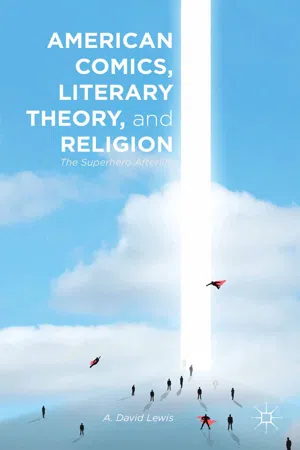
Unlocking a new and overdue model for reading comic books, this unique volume explores religious interpretations of popular comic book superheroes such as the Green Lantern and the Hulk. This superhero subgenre offers a hermeneutic for those interested in integrating mutiplicity into religious practices and considerations of the afterlife.
Information
1
The Six Elements of the Superhero Afterlife Subgenre
Sci-fi. Fantasy. Romance. Erotica. Horror. Mystery. While not all fiction fits comfortably within some category, the massive amount that does should give us a sense of the power of genre. And the reflection on and refinement of selfhood are what make genre vital to religious studies and literary studies. “Religious studies is a public inquiry into the meaning of symbolic discourses,” a hermeneutical discipline, says Mark I. Wallace, the editor of Figuring the Sacred.1 “The world of the text can figure the identity of the sacred and reveal dimensions of the human condition.”2 Genre is the space in which these dimensions can be traced, and that tracing can, in turn, also identify the social importance of a text and how it transmits messages.3 How does a genre, regardless of whether it’s a western or a suspense novel, signal to its audience how it should be read? More important, what do readers do with these signals? Theorist Paul Ricoeur stipulates that a genre, what he calls a mode of discourse, must say something of importance—that it is “worthwhile to analyze it, because something is said that is not said by other kinds of discourse—ordinary, scientific, poetic—or, to put it in more positive terms, that it is meaningful at least for the community of faith that uses it either for the sake of self-understanding or for the sake of communication with others [outside the] community.”4 Ricoeur has religious communities in mind when he explores genre, but he also makes plain that such an analysis of a genre is only pertinent when the works in question are valuable to a community. Understanding what models of self and, in turn, of community a genre conveys is a crucial exercise for both religion and literature. It is particularly pertinent when examining a setting steeped in religious faith, like the afterlife as it is presented in a popular medium such as the comic book. We can move from what readers do with these signals to what these signals can do to readers!
My argument is that there is a superhero afterlife subgenre, a subset of the main superhero genre, that has something wholly (holy?) worthwhile to say about how its audiences conceive of selfhood. The comic book superhero in the afterlife presents a special space for meaning making. The prosocial mission of superheroes and the dis-/re-orienting elements of their afterlife subgenre place the understanding of selfhood squarely at the center of this genre performance.5 I am going to lay out six telltale characteristics—we’ll call them elements—of the subgenre; all six, as I see them, point to an insecurity about individual coherency, questioning whether we are whole and indivisible people at the core.6 By the final chapter, we’ll see that this subgenre ultimately hints at a reluctant attraction among its readers and creators to a disunified and fragmentary, yet still fulfilling, multiplex selfhood.
But let’s not get ahead of ourselves. First, let’s talk a little more about what we mean when we refer to genre.
Defining Genre Generically
In The Architext, literary theorist Gérard Genette emphasizes that the concept of “genre” is understood distinctly differently today from how it was in Plato’s or Aristotle’s time. A succession of critics from the eighteenth century onward claimed that genre was an ancient literary method by which to mark a work: whether it was intended for high or low culture, for instance, or how it related to concrete reality. Genette argues, and I agree, that this usage of “genre” that developed is flawed, particularly because rote categorization would never have been Plato’s or Aristotle’s intent.7
Philosopher Tzvetan Todorov’s The Fantastic shares Genette’s position on “genre”—that is, that it has been misapplied to Plato and Aristotle.8 Divorced of any direct obligation to classical genre theory, modern genres are “the relay points by which the work assumes a relation with the universe.”9 What, specifically, is a group of works trying to communicate? For Todorov, genre denotes what a group of works has in common—repeated elements used to relay a particular understanding, as well as how the group itself is constantly changing. Genre is not about slotting a work into a preexisting schematic.10 Todorov and Genette (and I) work in what could be called theoretical genre, while other theorists, like Northrup Frye, I respectfully argue, are operating in an outmoded historical genre framework. Frye’s overall system falls victim to the same slot placing that many of his predecessors adopted: he is re-creating historical genres rather than allowing the works to guide him to new, theoretical, complex ones.11
When The Fantastic was first translated into English, Christine Brooke-Rose of the University of Paris felt that the distinction between the viewpoints of Todorov and Frye was the difference between theorist and critic, respectively—Todorov was looking for grand, consistent principles while Frye was scrutinizing individual cases.12 Perhaps not coincidentally, in the same volume as Brooke-Rose’s essay, Todorov goes on to detail how the hands-on critic, not just the distant theorist, can empirically examine a collection of works for its generic qualities. He says, “Genres are therefore units that one can describe from two different points of view, that of empirical observation and that of abstract analysis,”13 but, regardless of one’s view, genre is not a slapdash system for pigeonholing.
Since theoretical genre allows for an ever-changing nature in literature, it can help track social shifts, in particular, the circumstances of a particular genre’s group of readers—its community. Mary Gerhart highlights this use of genre and emphasizes that it brings the focus back onto the reader, leading to a revised understanding of “genre as praxis,”14 genre as a manner of action. Genre, seen in this light, is a performance, an active demonstration of the readers’ and writers’ shared community.
Gerhart credits not only Todorov but in particular philosopher Paul Ricoeur for understanding genre as a reflection on reading communities, especially (but not exclusively) religious ones. Todorov’s perspective certainly can include religious communities, since he specifically notes genre’s application as a speech act, such as prayer, even if it has a nonliterary existence—a “life” beyond the page.15 It’s Ricoeur, though, who expands on the issue of genre and religion in a number of works throughout the 1980s and 1990s, such as Time and Narrative, Oneself as Another, and Figuring the Sacred.
Let’s follow this idea of “community” for a moment, particularly through two additional texts located outside of traditional genre theory. The first is Benedict Anderson’s Imagined Communities, which takes the notion of community beyond face-to-face interactions. Shared texts, such as newspapers or religious scriptures, are able to foster imagined membership in a community that never physically interacts. Right now, you could, I suppose, consider yourself part of a community of A. David Lewis readers (if there were ever to become, you know, such a thing). To some degree, certain academic fields and religious institutions already gave rise to this form of community in prior centuries, but with the advent of the telegraph, telephone, and radio, such communities became more widespread. Ricoeur’s model of religious communities continues to function well outside of a religious context, even when considering their expression as online virtual communities. That is to say that Anderson’s reading of imagined community has been tested as fitting with Ricoeur’s model.16
The second text, Matthew Pustz’s Comic Book Culture: Fanboys and True Believers, is a modern application of Anderson’s notions, a degree closer to genre studies, and placed distinctly within the world of comics. Pustz showcases the variety of texts that could contribute to a community or, in the case of comics, a fandom. These texts include the comic books themselves, sure, but also, more loosely, the physical comic book shops and comic book conventions—namely, material items and locations that may have been the traditional places for, to paraphrase Ricoeur, a community’s performance. True to Anderson, though, Pustz discusses the history of the self-published fanzine and the twenty-first-century online comics sites as equally potent areas for community that lack any physical interaction. In short, it’s a self-selected membership, literal or metaphorical, to a group—real or imagined—that shares similar expectations for certain texts (a genre) and has a group influence on their creation as well.
This circular influence on the texts—wherein the readers also influence further works—is what Anis Bawarshi calls the genre function, a nod to Michel Foucault’s author function: in a community, members “are all, ‘authors’ and ‘writers’ alike . . . subject to the genre function.”17 In something of a feedback loop,18 as readers internalize or identify with particular kinds of characters and situations, authors will attempt to pen plots that meet accepted expectations.
Returning to Ricoeur and the idea of community, his Figuring the Sacred most explicitly ties genre not just to a mass community but also to the individuals within it and their personal notions of identity. Time and Narrative suggested that the problem of identity, of determining how one could understand themself,19 was the central concern of shared fictions and histories. His Oneself as Another went on to propose that people come to view their own lives in terms of stories; narratives “give sha...
Table of contents
- Cover
- Title
- Copyright
- Contents
- List of Figures
- Acknowledgment and Apology
- Introduction
- 1 The Six Elements of the Superhero Afterlife Subgenre
- 2 The Comic Book Medium’s Glimpse of Eternity
- 3 Complexities of Character in Fantastic Four: Hereafter
- 4 Planetary, Promethea, and the Multiplicity of Selfhood
- Conclusion
- Notes
- Bibliography
- Index
Trusted by 375,005 students
Access to over 1.5 million titles for a fair monthly price.
Study more efficiently using our study tools.
Frequently asked questions
Yes, you can cancel anytime from the Subscription tab in your account settings on the Perlego website. Your subscription will stay active until the end of your current billing period. Learn how to cancel your subscription
No, books cannot be downloaded as external files, such as PDFs, for use outside of Perlego. However, you can download books within the Perlego app for offline reading on mobile or tablet. Learn how to download books offline
Perlego offers two plans: Essential and Complete
- Essential is ideal for learners and professionals who enjoy exploring a wide range of subjects. Access the Essential Library with 800,000+ trusted titles and best-sellers across business, personal growth, and the humanities. Includes unlimited reading time and Standard Read Aloud voice.
- Complete: Perfect for advanced learners and researchers needing full, unrestricted access. Unlock 1.5M+ books across hundreds of subjects, including academic and specialized titles. The Complete Plan also includes advanced features like Premium Read Aloud and Research Assistant.
We are an online textbook subscription service, where you can get access to an entire online library for less than the price of a single book per month. With over 1.5 million books across 990+ topics, we’ve got you covered! Learn about our mission
Look out for the read-aloud symbol on your next book to see if you can listen to it. The read-aloud tool reads text aloud for you, highlighting the text as it is being read. You can pause it, speed it up and slow it down. Learn more about Read Aloud
Yes! You can use the Perlego app on both iOS and Android devices to read anytime, anywhere — even offline. Perfect for commutes or when you’re on the go.
Please note we cannot support devices running on iOS 13 and Android 7 or earlier. Learn more about using the app
Please note we cannot support devices running on iOS 13 and Android 7 or earlier. Learn more about using the app
Yes, you can access American Comics, Literary Theory, and Religion by A. Lewis in PDF and/or ePUB format, as well as other popular books in Literature & Graphic Design. We have over 1.5 million books available in our catalogue for you to explore.