- English
- ePUB (mobile friendly)
- Available on iOS & Android
eBook - ePub
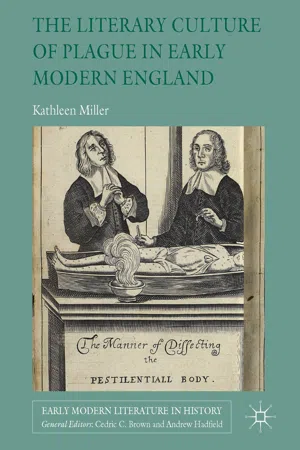
The Literary Culture of Plague in Early Modern England
About this book
This book is about the literary culture that emerged during and in the aftermath of the Great Plague of London (1665). Textual transmission impacted upon and simultaneously was impacted by the events of the plague. This book examines the role of print and manuscript cultures on representations of the disease through micro-histories and case studies of writing from that time, interpreting the place of these media and the construction of authorship during the outbreak. The macabre history of plague in early modern England largely ended with the Great Plague of London, and the miscellany of plague writings that responded to the epidemic forms the subject of this book.
Information
© The Author(s) 2016
Kathleen MillerThe Literary Culture of Plague in Early Modern EnglandEarly Modern Literature in History10.1057/978-1-137-51057-0_11. Introduction
Kathleen Miller1
(1)
Salem, Massachusetts, United States
The Great Plague of London in 1665 has long been remembered as the most memorable of the early modern outbreaks that struck England. Writers responded to the visitation with a great outpouring of texts in which novel interpretations of the disease flourished. However, the epidemic failed to leave behind a significant trail of canonical works by authors such as Ben Jonson, John Donne, William Shakespeare and Thomas Dekker, each of whom had contributed to the literary character of earlier epidemics. How do we reconcile the vivid memory of the outbreak in 1665 against the relative dearth of literary output—in contrast to the dramatic texts, celebrated writers and memorable verse produced during or responding to prior sixteenth- and seventeenth-century outbreaks? The best-known work that responded to the Great Plague of London was, instead, penned over 50 years later in Daniel Defoe’s A Journal of the Plague Year (1722). The enduring memory of the outbreak in 1665 may be interpreted, in part, through the vast increase in print production that addressed the epidemic. Unprecedented levels of textual response emerged across the plague writing subgenres—medical, religious, political, private and public.1 The year provided a novel new context for the disease, one in which medical pamphlets, statistically focused broadsides, political proclamations, religious tracts, life writing and correspondence erupted with commentary on the infection. Citizens negotiated the turbulent plague year and in turn responded to this print culture, debating the merits of plague writing and its messages. The seething print culture of the two decades prior to the Restoration established the power of the printed word and fostered an increased comfort with voicing one’s opinions in a text that could be read by many. The wealth of printed texts contributing to the literary culture of the visitation assisted Defoe in creating a striking portrait of plague-ridden London from a distance of half a century. Even if fewer canonical texts responded to the epidemic, there was no lack of textual response to the Great Plague of London in 1665.
Apothecary William Boghurst’s account of the outbreak, Loimographia (1666; edited edn 1894), details the measures citizens took in the face of the outbreak:
Methods of offsetting the threat of legtters by washing, airing or toasting them provide a curious portrait of sodden letters and their incomprehensible contents or futile attempts to read a charred letter that was left to toast too long. Boghurst describes the fear of transmitting the plague by way of letters and by extension of conveying the disease through texts. Measures like those described by Boghurst highlight an appreciation of pestilence within the material realm.3 In early modern England, it was understood plague could be conveyed through the paper on which these texts were transmitted, with pestilence potentially infesting the rags from which paper was made.4 Late seventeenth-century citizens were unaware that pestilence could be traced to a bacterium and was spread by fleas; however, the notion that plague passed from one person to the next, from one object to the next, was well-established by 1665. In conjunction with this appreciation of the potential for plague to be transmitted by contact came an analogous image of texts being transmitted, duplicated through the press or passed by letter, carrying with them the potential to spread perilous, incorrect and inflammatory ideas. Furthering this metaphor was plague’s ability to mark itself on the body, with the skin etched in boils, blains, tokens and buboes, becoming a page of text that could be read, interpreted and, most horribly, passed to someone else.5I shall name some particulars: First, what care was taken about letters. Some would sift them in a sieve, some wash them first in water and then dry them at the fire, some air them at the top of a house, or an hedge, or a pole, two or three days before they opened them. Some would lay them between two cold stones 2 or 3 days, some set them before the fire like a toast, some would not receive them but on a long pole. A Countryman delivered one thus to my wife at the shop door, because hee would not venture too near her.2
The Literary Culture of Plague in Early Modern England describes the literary culture that emerged from, during and in the aftermath of this epidemic. The outbreak and its accompanying death toll marked the disease’s climax in early modern England. Textual transmission impacted upon and simultaneously was impacted by the events of the plague, playing a pivotal role in the course of the epidemic. Writings that emerged from this context expressed a multiplicity of voices and breached social boundaries by targeting laypeople and experts with many of the same documents. These texts were essential to sharing information, including messages of self-protection, hope and practical knowledge. Though strict regulations governed the publishing industry, many texts presented speculation, exaggerations and tenuous statements as truth. Londoners approached many of these documents with trepidation. These texts’ levels of accuracy were determined through oral discussion and debate within the public and private spaces of print and manuscript cultures. Furthermore, writing about plague saw citizens capturing the enormous event within accepted forms and subgenres of plague writing that had persisted and developed throughout the early modern period. Plague writings map the progress of the disease and the response of its writers.
The Literary Culture of Plague in Early Modern England looks beyond what is known about print culture during the outbreak—that printing increased considerably in 1665 as compared with previous outbreaks.6 This book provides a detailed account of the impact of print and manuscript cultures on representations of the disease through micro-histories and case studies of writing from that time and by interpreting the place of these media in 1665. I consider the theoretical place of disease and death, and how these elements are accommodated in these texts. Print influenced how people dealt with, wrote about and communicated information during the epidemic. Print, in particular, often plays a key role in these documents alongside the subject of plague. The macabre history of plague in early modern England largely ended with the Great Plague of London, but the transformative moment in print culture that it represented left behind the miscellany of plague writings that forms the subject of this book.
Descending into Epidemic
Plague struck London with impressive force in 1665. With the epidemic falling just a few years after the Puritan Revolution and the subsequent Restoration of the monarchy in 1660, the England accommodating the outbreak provided a novel context for a well-known early modern foe. The dreadful realities of the disease, however, remained constant in spite of the flux of the worlds it visited in early modern England. Caused by the bacillus now known as Yersinia pestis, plague is exceptionally dangerous and most often lethal when transmitted to humans. Though typically carried and suffered by rats, the disease can pass to humans via fleas and continue on to devastate a human population, thriving in humid and warm conditions. Death from plague is often gruesome, swift and largely unavoidable, with 60–80% of people who contract the illness dying, typically within 8 days.7 In addition to the victim’s descent into the agony of infection, defined by fever, vomiting and delirium, plague marks itself on the body. Lymph nodes swell into the buboes so frequently referred to in plague writing, while abscesses spot the skin in a multitude of colours, from blue to black to purple, forming the oft-described ‘tokens’8. Descriptions of sufferers from early modern England recount bodies where the borders of the skin have been distorted and warped by the disease, where the fragile boundary between the inside and outside of the body is breached by the pustules, swellings and carbuncles that erupt over the skin.9 These were the torments experienced by plague sufferers during the outbreak of 1665. By the end of an epidemic punctuated by the cries of victims shut in their homes, there were 68,598 plague burials recorded—the single greatest period of plague deaths in early modern England.10 The outbreak reaped the greatest number of deaths of London’s early modern plague epidemics.11 The number represents an even greater impact on London’s population when considered in relation to the diminished number of citizens who remained in city.12 With many fleeing, London’s normally busy streets were struck by an otherworldly solitude in contrast to the typical racket and clatter.13 Not everyone was able to or even interested in escaping the city as it sat in the clutches of the disease. Some of those who remained tell the stories that are described in this book, from dissenting ministers who took up pulpits to preach amongst those left in the city to medical practitioners who hoped to gain better insight into how plague wreaked its revenge on their patients’ bodies. The presence of other citizens is gleaned from the thousands of dead that populated the bills of mortality throughout the visitation or in the descriptions of those jobs executed during an outbreak that were outlined in official orders, such as for searchers and watchmen. Though 1665 marked London’s largest outbreak in terms of human fatalities in the seventeenth century, most years saw p...
Table of contents
- Cover
- Frontmatter
- 1. Introduction
- 2. Continuities in Plague Writing
- 3. Medical Debates on Plague
- 4. Plague and Nonconformity
- 5. Katherine Austen’s Reckoning with Plague in Book M
- 6. Pestilence and War
- 7. Pestilential Poesies
- 8. Conclusion: Recalling the Plague of 1665 in Later Literary Culture
- Backmatter
Trusted by 375,005 students
Access to over 1.5 million titles for a fair monthly price.
Study more efficiently using our study tools.
Frequently asked questions
Yes, you can cancel anytime from the Subscription tab in your account settings on the Perlego website. Your subscription will stay active until the end of your current billing period. Learn how to cancel your subscription
No, books cannot be downloaded as external files, such as PDFs, for use outside of Perlego. However, you can download books within the Perlego app for offline reading on mobile or tablet. Learn how to download books offline
Perlego offers two plans: Essential and Complete
- Essential is ideal for learners and professionals who enjoy exploring a wide range of subjects. Access the Essential Library with 800,000+ trusted titles and best-sellers across business, personal growth, and the humanities. Includes unlimited reading time and Standard Read Aloud voice.
- Complete: Perfect for advanced learners and researchers needing full, unrestricted access. Unlock 1.5M+ books across hundreds of subjects, including academic and specialized titles. The Complete Plan also includes advanced features like Premium Read Aloud and Research Assistant.
We are an online textbook subscription service, where you can get access to an entire online library for less than the price of a single book per month. With over 1.5 million books across 990+ topics, we’ve got you covered! Learn about our mission
Look out for the read-aloud symbol on your next book to see if you can listen to it. The read-aloud tool reads text aloud for you, highlighting the text as it is being read. You can pause it, speed it up and slow it down. Learn more about Read Aloud
Yes! You can use the Perlego app on both iOS and Android devices to read anytime, anywhere — even offline. Perfect for commutes or when you’re on the go.
Please note we cannot support devices running on iOS 13 and Android 7 or earlier. Learn more about using the app
Please note we cannot support devices running on iOS 13 and Android 7 or earlier. Learn more about using the app
Yes, you can access The Literary Culture of Plague in Early Modern England by Kathleen Miller in PDF and/or ePUB format, as well as other popular books in Literature & European Literary Criticism. We have over 1.5 million books available in our catalogue for you to explore.