eBook - ePub
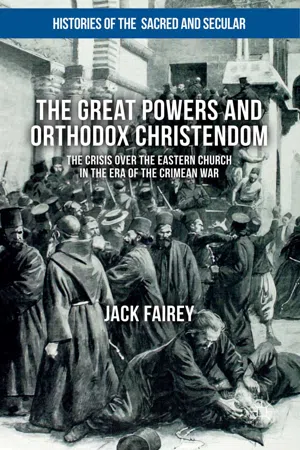
The Great Powers and Orthodox Christendom
The Crisis over the Eastern Church in the Era of the Crimean War
- English
- ePUB (mobile friendly)
- Available on iOS & Android
eBook - ePub
The Great Powers and Orthodox Christendom
The Crisis over the Eastern Church in the Era of the Crimean War
About this book
This new political history of the Orthodox Church in the Ottoman Empire explains why Orthodoxy became the subject of acute political competition between the Great Powers during the mid 19th century. It also explores how such rivalries led, paradoxically, both to secularizing reforms and to Europe's last great war of religion - the Crimean War.
Information
1
Reason in Exile: The War for Orthodox Christendom
It seems almost incredible, in this enlightened age, that the quarrels of a few ignorant Latin and Greek monks . . . should have been able to light up the torch of war, and to involve the most powerful nations in the world in a deadly strife; . . . but the fraud on the credulity of mankind is so completely established, that these monks have succeeded in enlisting both Europe and the East under their banners, carrying havoc and destruction in their train, perhaps unparalleled since the Crusades.1
George Fowler, 1855
The Crimean War was one colossal Comedy of Errors, in which one constantly asks oneself: Qui trompe-t-on ici, which is the dupe? But this comedy cost countless treasures and over a million human lives.2
Friedrich Engels, 1890
Deus vult? The Crusader spring of 1854
In the spring of 1854, a wave of martial religiosity such as Europeans had not seen since the great wars of religion of the sixteenth and seventeenth centuries swept over the continent from Britain to Russia and the Ottoman Empire. ‘It seemed’, recalled one French observer, ‘as though all the religious fervour left in the world had become concentrated on the Eastern Question’.3 The crisis at the centre of this religious ferment began a year earlier. At the beginning of 1853, Tsar Nicholas I had astonished the world by making an abrupt demand that the Ottoman sultan provide him with binding guarantees that the ancient rights and privileges of the Orthodox Church in the Ottoman Empire would remain unchanged, without exceptions and in perpetuity. This unexpected intrusion into Ottoman religions affairs had taken Sultan Abdülmecid aback, but he reassured ‘his brother’, the tsar, that there were no plans to abrogate any of the privileges of the Orthodox Church. He conspicuously refused to sign any formal engagement to this effect, however. A written guarantee, he objected, would turn concessions that the Ottoman dynasty had made of its own free will into capitulations imposed by a foreign power. The Russian government rejected this answer and had retaliated by withdrawing its entire embassy from Istanbul.
The swells of this diplomatic crisis in the Middle East had surged outwards, affecting all of Europe, as the Russian government used every means at its disposal to secure the binding guarantee of Orthodox rights that it desired. On 2 July 1853, Nicholas I took the momentous step of sending an army across the Prut river that separated Russia’s south-western frontier from the Ottoman dependencies of Moldavia and Wallachia. He assured the rest of Europe that this was to be only a temporary occupation and that the treaties of Adrianople (1829) and St Petersburg (1834) entitled Russia to carry out such an action. As soon as the sultan had come to his senses, Russia would vacate the Danubian Principalities without any prejudice to Ottoman sovereignty over them. These promises convinced neither the Ottomans nor most of the courts of Europe of Nicholas’s peaceful intentions and international tensions quickly escalated. Despite repeated expressions of goodwill from both parties to the dispute, events drifted inexorably over the autumn and winter of 1853 towards what The Times predicted would be ‘a sacred war’ in the East between Nicholas at the head of a militant Orthodox Christendom and an Islamic world led by the Ottoman sultan and caliph.4
In St Petersburg, the Russian government made no bones about the religious character and origins of the approaching conflict. Nicholas I loudly insisted upon the piety of his motives and claimed that it was Russia’s legal right, by one reading of the ambiguous terms of the 1774 Treaty of Küçük Kaynarca, to intervene with the Ottoman government on behalf of his co-religionists in the East. Russian newspapers carried declarations of the emperor’s resolve not to shrink from his religious duty when the rights of the Orthodox Church were being trampled upon in the lands of its birth. Holy Russia had no choice but to take up arms in a spirit of piety and charity to protect fellow Christians living under the Ottoman yoke. ‘Russia has not forgotten God!’ Nicholas thundered in one such manifesto.5 ‘We march’, he declared in another, ‘to the defence of the Orthodox Faith’.6
Most Russians – and the lower classes in particular – greeted these manifestos and Russia’s formal declaration of war on 1 November with what one foreign correspondent described as ‘fanatical enthusiasm’: ‘When the manifesto became publicly known here, numerous Russians were seen to fall on their knees in the open street and pray for blessings on their great Czar, the defender of the Orthodox Faith, the war-like champion of their holy Russia.’7 Another foreign visitor noted that: ‘The Greek cross appears everywhere as the sanctifying symbol of the present war; and on every side we hear the words repeated of “Orthodox Faith”, “Holy Confidence”, “Holy Russia”, etc. Texts from the scriptures have come to be mingled with the jargon of the fashionable saloons.’8 Newspapers and sermons preached from pulpits across the country reminded Russians that the Turks were ‘persecutors of the Christian faith’ and ‘insulters of the Holy Places’.9 Such rhetoric stiffened the resolve of enlisted soldiers and produced a flood of peasant volunteers who, much to the horror of the Russian government, abandoned their fields in order to enlist.10
The Russian upper classes approached the coming war with a greater sense of foreboding, but they too considered the struggle a duty imposed by religion and honour. Conservatives, such as the ‘Old Russian Party’ within the bureaucracy and the Slavophiles in literary circles, went further and embraced the conflict as a God-given opportunity to change Russia itself. Officially, Russian policy aimed merely to safeguard the rights of Orthodoxy in the Near East. Russian nationalists, however, wanted to cast aside the limitations that Russia had imposed upon its own foreign policy since the Napoleonic Wars and to advance manfully towards its rightful place as master of the Mediterranean. Conquest of the Balkans was, they felt, part of a world-historical mission. Mikhail Pogodin, the most important Russian journalist of the period, argued forcefully to both his sovereign and to the reading public that Russia’s moment had come to advance interests that were at one and the same time ‘Russian, Slavic, European, Christian!’:
As Russians, we must seize Constantinople for our own security. As Slavs, we must free millions of our elder kinsmen, coreligionists, enlighteners, and benefactors. As Europeans, we must drive out the Turks. As Orthodox Christians, we must preserve the Eastern Church and return to Hagia Sophia her ecumenical cross.11
Other prominent writers lent their pens to this messianic vision. The Slavophile Alexei Khomiakov thus urged his countrymen to humble their pride, repent, and become fit instruments of God’s work in the coming conflict. In a poem from 1854 entitled simply To Russia, he exhorted Russians to embrace the war as a cleansing fire:
Arise then, faithful to your mission,
And rush into the flames of bloody battle!
Fight with cunning for your brethren,
Holding aloft the banner of God with a firm hand.
Smite with the sword – the sword of God!12
The nations of the earth were all waiting for Russia to sally forth as an avenging angel, with ‘love in her soul, thunder in her right hand’, to free the suffering Christians of the Balkans.13
In the Balkan Peninsula itself, many ordinary Orthodox Christians shared this apocalyptic vision of the confrontation between Russia, the Ottoman Empire, and the latter’s Western allies, even as the Serbian, Greek, and Montenegrin governments professed their official neutrality. Greeks noted that exactly 400 years had elapsed since the Ottoman conquest of Constantinople. Surely, Providence had chosen this historic anniversary to set a term to the humiliation of Orthodox Christendom. Pamphleteers in the Kingdom of Greece breathlessly predicted a Russian invasion of the Ottoman Empire and the formation of a united Orthodox front against the manifold enemies of Christ – a motley group that one writer identified as ‘Mohammed and the Pope, Luther and Calvin, Voltaire and Copernicus’.14 ‘Despotism is finished’, he predicted, ‘freedom, the Church of Christ and Orthodoxy shall shine forth!’15
Inspired by such hopes, thousands of Greeks, Bulgarians, Serbs, and Romanians began as early as the summer of 1853 to ask the Russian government for permission to enlist under the banner of their common faith.16 Greek volunteers in Iaşi, the capital of Moldavia, petitioned the tsar to accept them into his army since, as right-believing Christians, they could no longer ‘remain mere onlookers in this contest for the Faith’.17 The Russian government responded by creating the Nicholas I Legion, composed entirely of Balkan Christian volunteers. Over the next two years, these Orthodox legionnaires would fight against the forces of their own sultan on the Danubian front and in the Crimea.18
Spirits ran especially high in the Kingdom of Greece, where both government and populace entertained unrealistic expectations that the time had come to transform their tiny state into the nucleus of a resurrected Byzantine Empire. The Greek government sponsored the formation of paramilitary bands and fomented insurrections all along its border with the Ottoman Empire in Thessaly, Epirus, and Macedonia. The captain of one such band told local Christians that Ottoman rule was finished; every able-bodied man must take up arms and go to meet the conquering Russian army. The tsar himself would come
to meet us with all his compatriots bearing laurels in their hands, and the priests will bless us and our banners with the cross. The little Father of Olympus will prepare lambs and fresh water for us, and after having eaten and drunk the following day we will go to chant the liturgy in the church of Hagia Sophia [in Istanbul].19
When the French and British ambassadors to Athens tried to convince King Otto of Greece and his queen to disavow these provocations, they were shocked to find the royal couple stubbornly defiant. Otto proved impervious to all their arguments and countered that: ‘I am a Christian! I cannot but sympathize with my people and with the Christians who labour under the yoke of the natural enemies of Christianity, and I would hope that every Christian government and people shared the same sentiments’.20
This crusading mood in the Orthodox world was mirrored among Muslims, who responded to the developing crisis with an enthusiasm strongly tinged by religious fervour.21 Beginning in the fall of 1853, tens of thousands of conscripts and volunteers of every age made their way to the Ottoman capital from every corner of the empire: Arabs from the Middle East, Berbers from North Africa, Türkmen from the Anatolian plateau, Albanian mountaineers from the Balkans, and Circassian refugees impatient to avenge the Russian conquest of their homelands in the northern Caucasus.22 The constant parade of exotic arrivals made it seem as though the Muslim world had risen as one. Even old men were caught up in the spirit of volunteerism, as grey-bearded elders showed up for duty equipped with antique lances, kettledrums, and flintlocks. The fancy of the public was particularly struck by the arrival from the wilds of Cilicia of a mounted band of Kurds, who had put aside their feud with the Ottoman state to fight under the banner of the Prophet against the Russian infidels. Their aged chieftainess, Kara Fatma Hanum, caused a sensation by riding into Istanbul at the head of her men on an Arab charger, armed and unveiled.23 As one English reporter reported breathlessly: ‘the Turkish invasion of Europe has been repeated anew’.24
European statesmen rightly feared that the jihadist enthusiasm of ‘Turks of the Old School’ would render the search for peace more difficult.25 From the end of September 1853, volunteers thronged the streets of Istanbul in high spirits, demanding to be led out against the foe.26 Discontented teachers and students from the religious colleges of the capital leavened this inchoate movement and helped to articulate its complaints. In the lead-up to the festival of Eid al-Adha on 10 September 1853, a group of 35–40 members of the religious establishment submitted a formal petition to the Ottoman Supreme Council of Judicial Ordinances (Meclis-i Vâlâ).27 The petitioners confronted the council with a collection of scriptural references, which they used to recall the sultan and his ministers to their duty of avenging the insults that Russia had heaped upon Islam. The demeanour of the volunteers and their supporters threatened serious unrest should the government not commit itself in short order to a declaration of war. The council of ministers bowed under these pressures and recommended that the sultan open hostilities.
In the official Ottoman proclamation of war on 26 September, however, the government was careful to justify this act on the grounds of political principle rather than faith.28 It pointed out that the sultan had met all of Russia’s legitimate requests, that Russia’s interpretation of the Treaty of Küçük Kaynarca was incorrect, and that the tsar’s demands were an affront ‘to the sovereign rights and independence’ of all the diverse peoples of the empire – Christians and Jews as much as Muslims.29 The Ottoman government, in other words, emphasized that it was going to war in defense not of...
Table of contents
- Cover
- Title
- Copyright
- Contents
- List of Illustrations
- Acknowledgements
- Linguistic Conventions and Abbreviations
- 1 Reason in Exile: The War for Orthodox Christendom
- 2 A Patriarch’s Progress: The Great Church under Grigórios VI
- 3 Ponsonby vs the Patriarch: Orthodoxy and European Diplomacy
- 4 ‘The Great Game of Improvement’: Reşid Paşa and Reform
- 5 A Cossack Takes the Cross: Prince Menshikov’s Crusade
- 6 Ambassadors of Peace: Recasting Orthodox Christendom
- 7 ‘A Complete Revolution’: The Great Church and the Great Powers
- Notes
- Bibliography
- Index
Trusted by 375,005 students
Access to over 1.5 million titles for a fair monthly price.
Study more efficiently using our study tools.
Frequently asked questions
Yes, you can cancel anytime from the Subscription tab in your account settings on the Perlego website. Your subscription will stay active until the end of your current billing period. Learn how to cancel your subscription
No, books cannot be downloaded as external files, such as PDFs, for use outside of Perlego. However, you can download books within the Perlego app for offline reading on mobile or tablet. Learn how to download books offline
Perlego offers two plans: Essential and Complete
- Essential is ideal for learners and professionals who enjoy exploring a wide range of subjects. Access the Essential Library with 800,000+ trusted titles and best-sellers across business, personal growth, and the humanities. Includes unlimited reading time and Standard Read Aloud voice.
- Complete: Perfect for advanced learners and researchers needing full, unrestricted access. Unlock 1.5M+ books across hundreds of subjects, including academic and specialized titles. The Complete Plan also includes advanced features like Premium Read Aloud and Research Assistant.
We are an online textbook subscription service, where you can get access to an entire online library for less than the price of a single book per month. With over 1.5 million books across 990+ topics, we’ve got you covered! Learn about our mission
Look out for the read-aloud symbol on your next book to see if you can listen to it. The read-aloud tool reads text aloud for you, highlighting the text as it is being read. You can pause it, speed it up and slow it down. Learn more about Read Aloud
Yes! You can use the Perlego app on both iOS and Android devices to read anytime, anywhere — even offline. Perfect for commutes or when you’re on the go.
Please note we cannot support devices running on iOS 13 and Android 7 or earlier. Learn more about using the app
Please note we cannot support devices running on iOS 13 and Android 7 or earlier. Learn more about using the app
Yes, you can access The Great Powers and Orthodox Christendom by Jack Fairey in PDF and/or ePUB format, as well as other popular books in History & European History. We have over 1.5 million books available in our catalogue for you to explore.