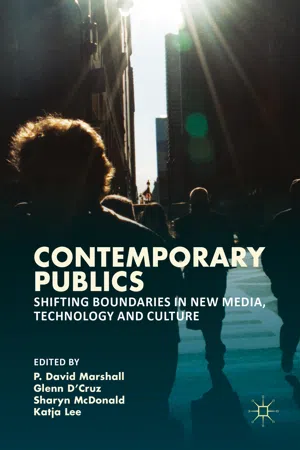
If the twentieth century has been dominated by discussions of the public, public life, and the public sphere, Contemporary Publics argues that, in the twenty-first century, we must complicate the singularity of that paradigm and start thinking of our world in terms of multiple, overlapping, and competing publics. In three distinct streams—art, media and technology, and the intimate life—this volume offers up the intellectual and political significance of thinking through the plurality of our publics. "Countering Neoliberal Publics: Screen and Space," explores how different artistic practices articulate the challenges and desires of multiple publics. "Making and Shaping Publics: Discourse and Technology" showcases how media shape publics, and how new and emerging publics use these technologies to construct identities. "Commodifying Public Intimacies" examines what happens to the notion of the private when intimacies structure publics, move into public spaces, and develop value that can be exchanged and circulated.
eBook - ePub
Contemporary Publics
Shifting Boundaries in New Media, Technology and Culture
- English
- ePUB (mobile friendly)
- Available on iOS & Android
eBook - ePub
Contemporary Publics
Shifting Boundaries in New Media, Technology and Culture
About this book
Information
© The Author(s) 2016
P. David Marshall, Glenn D'Cruz, Sharyn McDonald and Katja Lee (eds.)Contemporary Publics10.1057/978-1-137-53324-1_11. Introduction: The Plurality of Publics
P. David Marshall1
(1)
Deakin University, Burwood, VIC, Australia
Every now and then, there is something infinitely calming in observing ants. As entomologists will explain, ants are remarkably socially connected. Each individual ant will move through its task with an efficiency and direction that is unshakeable. Yet, what one observes about the social behavior of ants is that as they pass each other, they communicate something. It either reinforces the tasks or it changes them. The alteration may appear to be insignificant—a slight change in path or a reconfiguration of their order of activities. As a non-scientific researcher of ants, I may be anthropomorphizing my reading of their forms of communication, and I may not see the other chemicals and agents that are producing these subtle shifts; nonetheless, what I can discern as a popular observer is that ants do not change their overall mission. Their connection of the individual to the collective seems universal, even when there is an errant message flowing along the ant line.
Metaphorically, ants’ social activity crudely describes a kind of idealized public sphere. All are included. Debates (although in the ant-world, these debates only last milliseconds) lead to connected solutions. There is an intuitive sense that all are connected to the collective good in some way. Indeed, if there is an identity that can capture this sensitized connection to the meaning of actions, it would be the very notion of ants as citizens.
Whether we take the notion of the public and the public sphere from Walter Lippman in his Public Opinion or from Jürgen Habermas’ original foray in The Structural Transformation of the Public Sphere, most (if not all) iterations of “public” have contained this overriding communicative relationship of the individual to unity. Debates and discussions define the activity of the public sphere and, on the surface, represent some sort of disunity; but the sense that these debates comprehensively and categorically connect to all people, and that the discursive and communicative plays and counterplays are simply effective, just, and democratic ways of arriving at consensus and compromise, ultimately has put the concept of the public and public sphere in the realm of utopia. The public sphere is and was a mythic concept. As much as it is valued in consensus building, the public sphere is an “imagined community” (Anderson 1983, 15). The related concept of public similarly defined a way to characterize both opinion and belongingness into something coherently accepted as significant, valued, and self-evidently universally constituted and constructed. Using the word public has thus been a way to allow one voice to embody the entire body politic of citizenry. In contrast, other terms that describe the link between the social and the political generally have some negative connotation. From Matthew Arnold’s late nineteenth-century polemic on “mass” culture to Gustav LeBon’s efforts to understand the mental weakness of the crowd, the formulations of collective activities in the nineteenth and twentieth century imagined order challenged by the rabble and the mob. While the mass and the mob were characterized as irrational and seething with raw emotion, the utopian public and its expression in the public sphere were characterized as symbolizing rationality and reasoned argument. The public and the public sphere celebrated non-violence even if the debate was heated; they were terms that indexically pointed to democratic practices and the role of citizenry.
This book’s intervention into the understanding of public and the public sphere similarly realizes the impossibility of achieving these utopian and unified concepts in the contemporary moment. It is the singularity of the concept of public which is challenged in the essays in this collection. Our title, Contemporary Publics, heralds the idea that the mythic quality of the comprehensive public sphere and public needs to be rethought in terms of parallel, overlapping, and competing publics. In addition to this challenge to the universality and utopian quality of what the public and public sphere represents, what also unifies the various approaches taken here is a recognition of how publics are formed through discourse. They may not reproduce the unity of the ant colony, but publics imply a vibrant, contentious engagement of various groups to articulate views, positions, and postures audibly and visibly.
In this opening essay I want to position the intellectual and political significance of thinking through the plurality of publics in three stages. The first stage investigates the multiple uses of the term public as a nomination of different forms of visible cultural engagement. The second stage builds from this multiplicity of definitions to identify the location of the non-public—the private—in this plethora of publics. The final stage identifies the various disciplines and intellectual directions that have informed the essays in this book and how they have further helped situate the value of thinking and using the concept of publics.
Public Uses: Deploying the Terms Public and Publics
Etymologically, public represents one of those words that has had a proliferating array of uses over the centuries. From the Oxford English Dictionary, there are seven variations of the term public as an adjective, and as a noun, another five. Contained in the concatenation are literally thousands of variations. With its Latin origins, public has been deployed in some aspect to reveal something related to the people as a whole and as something visible or at least “conspicuous” (Oxford English Dictionary) for almost two millennia. Moreover, with little variation, it appears in all the European Romance languages and beyond. Habermas, along with most of northern Europe, used Öffentlichkeit or some close variation to express this same adjectival or noun form.
As well as being a ubiquitous term, over time it has also become quite promiscuous in its associations. For centuries, it has been wedded to government as a way to express its representativeness of the people. In this way, public has always had a close affinity to forms of democratic government—hence the word republic. But as it has modified particular nouns, it has migrated somewhat. Terms such as public housing or public works have clear links with government-related initiatives and have developed in the twentieth century to indicate some form of public welfare. Some expressions using public are invocations for political actions of caring: public good, public spirit, and public benefit are examples of this embedded notion of the state and its responsibility for its people.
But its use cannot be contained by these characterizations. A public library expresses something that simultaneously identifies its potential funding by the state but also its openness to a community for its benefit. Like a library, public baths or public square are expressions of an equally open territory, one where no individual can lay claim to its property; all can use it and borrow without taking away from its connection to a commonwealth.
As public becomes attached to these practices and activities, one can see its relationship to visibility. Over the past five centuries, a public life has very often been defined by its relationship to political office, where an individual, by choice or by what Rojek would describe as the “ascribed” role that members of royalty inhabit (2001, 17), works for others—what Habermas calls “representative publicness” (1989, 9–12). However, a public life is also related to those members of society that are seen and, therefore, has come to encompass our celebrity culture, where certain individuals are seen to have a visible presence to the rest of a culture. The rest of us move in and out of public spaces and thereby express acceptable (or unacceptable) public comportment which defines our rather limited public lives. The somewhat contested term public intellectuals has become a way to describe how certain individuals who are normally sealed monastically as academics from the everyday, invest in a public and visible presence via their ideas, possibly for public good. Often it is not their expertise that defines their activities as public intellectuals but rather that they are called upon to become part of political debate as an agent of the public. Even the role of the publican, which has come to mean the person who manages the pub or public house, describes an individual who provides space for the expression of the social self and possibly a collective identity as well. The pub is an inn where all are welcome, and even travellers passing through particular spaces find in the public house something that is beyond the private and foreign domain of their travels.
What becomes more complicated is when public is used in the parlance of commerce and trade. When a company decides to go public, it is a decision that is at least connected to the idea that public means visible. This visibility is closely related to when an individual, after months of media pressure to reveal their private (and apparently compelling) story, decides to be interviewed by the media and go public. The stock exchanges and the share market become ways that a company is reconfigured as accessible to more investors and shareholders, and therefore subjected to this very particular formation of collective activity. Publicly traded companies, which have had an initial public offering, in their new status as publicly listed corporations, are subject to new levels of scrutiny in the publication of annual reports and quarterly profit and loss statements.
In a similar vein, the related words of publication and publishing, like their trade counterparts, address the formalization of text for its wider distribution, but also for its consumption by an audience. One of the largest conceptual debates in cultural theory since Matthew Arnold’s original 1869 treatise involves making sense and relating these collectivities of mass, public, and audience (Arnold and Garnett 2009 (1869)). Where the audience has been related broadly to some form of mediated production, from theatre, newspapers, and film to radio, television, and magazines, the audience has also been an entity that has allowed the conceptualization of both public and public opinion to have some recurring and current reality.
From this survey of the way that the term has been deployed, it is clear that as an idea public has become attached to a wide variety of activities and practices. But interestingly, this plurality of practices and uses did not lead to pluralizing of the term for centuries. Publics, as opposed to public, emerged gradually in the twentieth century from institutions and industries most closely associated with publicity. Historically, publicity is the practice of making known a person or a product. In its deployment over the last two centuries it has been connected to the various entertainment industries as they attempted to attract attention around a particular film, for example, or personality. Publicity also migrated into reputation management for corporations. Over the twentieth century, the field of public relations emerged as an organizational management structure either directly connected to institutions or employed as an agency to service companies in crisis communication situations. The first uses of publics comes from the public relations field and industry. Edward Bernays, self-acclaimed father of public relations, began to see the twentieth-century social field as composed of more than one public and that targeting publics critical to the particular issues or concerns of corporations was essential to his job. Although Bernays used the plural term “publics” only in passing in his first book in 1923 (2015/1923, 142, 168), in 1947 he elaborated further on the idea by identifying “internal and external publics” in an article entitled “The Engineering of Consent.” By 1952, Bernays directly used “publics” to describe the third component of his definition of public relations: “efforts to integrate attitudes and actions of an institution with its publics and of publics with those of the institution” (Bernays quoted in Cutlip 1994, 187).
From these origins, the idea of publics is thus connected to expressing a diversity of opinions and the practices of directing or shaping opinion to particular ends. In public relations itself, public became a way of expressing an organized and coordinated way of thinking for a group or institution and thus any number of publics could exist in a given society. Perhaps because the concept of publics emerged from publicity and its connection to the entertainment industries, the term also became a way for media theorists to conceptualize plurality and difference in contemporary culture. Whereas the idea of audience and audiences defined the experiential relationship people had to cultural forms, public and publics became a way to think of that experience politically and strategically.
The deployment of the term publics shifted from the relatively conservative practices of public relations specialists in the mid-twentieth century to a term that began to describe quite different and distinct communities by the end of the century. Specifically, publics became a way to express new generations of political and cultural visibility in a culture and thereby relied definitionally on how the concept of public is fundamentally associated with attention. The emergence of new publics, or to use Michael Warner’s idea of “counterpublics” (2005), depended on a media economy that privileges difference, novelty and distinctiveness, which could be characterized as formations of publicity and were important methods of conveying news from the centres of power. In conjunction with communities, publics emerged as political entities related to visible cultural movements. In the American context, a recognizable black public emerged from the civil rights movement. Similarly, gay counterpublics established themselves as well as a feminist public from the 1970s onwards. Along with visibility, these publics offered their participants a sense of egalitarian citizenship within their spaces that rivaled the older unitary public sphere that described the nation state (see Emirbayer and Sheller 1999, 150).
These new publics also identified the blind spots of what Habermas attempted to describe as the public sphere. These new publics underline distinctively...
Table of contents
- Cover
- Frontmatter
- 1. Introduction: The Plurality of Publics
- 1. Countering Neoliberal Publics: Screen and Space
- 2. Making and Shaping Publics: Discourse and Technology
- 3. Commodifying Public Intimacies
- Backmatter
Trusted by 375,005 students
Access to over 1.5 million titles for a fair monthly price.
Study more efficiently using our study tools.
Frequently asked questions
Yes, you can cancel anytime from the Subscription tab in your account settings on the Perlego website. Your subscription will stay active until the end of your current billing period. Learn how to cancel your subscription
No, books cannot be downloaded as external files, such as PDFs, for use outside of Perlego. However, you can download books within the Perlego app for offline reading on mobile or tablet. Learn how to download books offline
Perlego offers two plans: Essential and Complete
- Essential is ideal for learners and professionals who enjoy exploring a wide range of subjects. Access the Essential Library with 800,000+ trusted titles and best-sellers across business, personal growth, and the humanities. Includes unlimited reading time and Standard Read Aloud voice.
- Complete: Perfect for advanced learners and researchers needing full, unrestricted access. Unlock 1.5M+ books across hundreds of subjects, including academic and specialized titles. The Complete Plan also includes advanced features like Premium Read Aloud and Research Assistant.
We are an online textbook subscription service, where you can get access to an entire online library for less than the price of a single book per month. With over 1.5 million books across 990+ topics, we’ve got you covered! Learn about our mission
Look out for the read-aloud symbol on your next book to see if you can listen to it. The read-aloud tool reads text aloud for you, highlighting the text as it is being read. You can pause it, speed it up and slow it down. Learn more about Read Aloud
Yes! You can use the Perlego app on both iOS and Android devices to read anytime, anywhere — even offline. Perfect for commutes or when you’re on the go.
Please note we cannot support devices running on iOS 13 and Android 7 or earlier. Learn more about using the app
Please note we cannot support devices running on iOS 13 and Android 7 or earlier. Learn more about using the app
Yes, you can access Contemporary Publics by P. David Marshall, Glenn D'Cruz, Sharyn McDonald, Katja Lee, P. David Marshall,Glenn D'Cruz,Sharyn McDonald,Katja Lee in PDF and/or ePUB format, as well as other popular books in Social Sciences & Linguistics. We have over 1.5 million books available in our catalogue for you to explore.