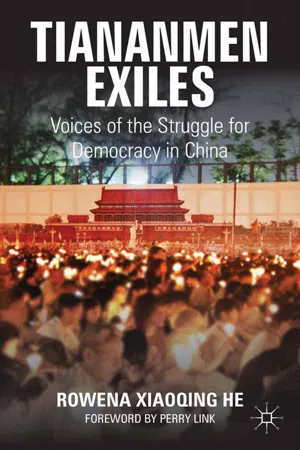
In the spring of 1989, millions of citizens across China took to the streets in a nationwide uprising against government corruption and authoritarian rule. What began with widespread hope for political reform ended with the People's Liberation Army firing on unarmed citizens in the capital city of Beijing, and those leaders who survived the crackdown became wanted criminals overnight. Among the witnesses to this unprecedented popular movement was Rowena Xiaoqing He, who would later join former student leaders and other exiles in North America, where she has worked tirelessly for over a decade to keep the memory of the Tiananmen Movement alive.
This moving oral history interweaves He's own experiences with the accounts of three student leaders exiled from China. Here, in their own words, they describe their childhoods during Mao's Cultural Revolution, their political activism, the bitter disappointments of 1989, and the profound contradictions and challenges they face as exiles. Variously labeled as heroes, victims, and traitors in the years after Tiananmen, these individuals tell difficult stories of thwarted ideals and disconnection, but that nonetheless embody the hope for a freer China and a more just world.
- English
- ePUB (mobile friendly)
- Available on iOS & Android
eBook - ePub
About this book
Information
S E C T I O N T W O
Triumph and Trauma
C H A P T E R 3
On the Road: Yi Danxuan
It is true that I am free here. But knowing that people who shared the same experience as I did are still being imprisoned for what they say and write, I can’t be happy here, either. I hope I can be a free man—to live a normal life with normal freedom in the land where I grew up.
—Yi Danxuan1
It was a late winter afternoon at a Starbucks near Georgetown University in Washington, DC. I was meeting Yi Danxuan for our interview.
“Would you like to sit outside or inside?” Danxuan asked me. We had been to this same Starbucks with other exiled students in June, when we gathered for the candlelight vigil commemorating the Tiananmen anniversary. We usually sat outside in the summer sun.
“Let’s go inside. It is getting cold outside. The sun is setting.” I was trying to remind Danxuan that it was a different time of the day and a different season of the year.
The coffee shop was quiet although it was crowded with young people who seemed to be students at Georgetown. Some were reading alone and others were chatting softly with friends. After I had set up my tape recorder at a corner table, Danxuan came back with two large coffees.
“It is good that you are living in North America. You would have to be rich if you needed that much Starbucks coffee in China.” Danxuan was addicted to Starbucks coffee, which in China is a luxury.
The Context of the Interview: Challenges, Opportunities, and Significance
When the 1989 movement started, Danxuan was an undergraduate student studying business management at Guangdong University of Business Studies. He was elected vice president of the Guangzhou Patriotic Student Federation, leading over 200,000 students from 40 universities and colleges during the movement. The authorities didn’t arrest him right after the military crackdown—they waited until the summer break when most students had left the campus. He was detained for twenty months before an official trial, at which he was charged with “disturbing social order” and sentenced to two years. Such “verdict first, trial second” practices were common for arrested student leaders and intellectuals in 1989.2 Denied permission to resume his college studies after his release from prison, Danxuan applied for undergraduate studies at the University of Mississippi, where his sister was working on her PhD. He was admitted in 1992. In 1999 and 2001, he was elected for two consecutive terms as president of the Independent Federation of Chinese Students and Scholars, the largest organization formed by overseas Chinese students and scholars immediately after the Tiananmen crackdown. He continued his political activism for two decades, and during most of that period he resisted the idea of applying for American citizenship because he cherished the hope of returning to China. In 2008, after sixteen years of exile, he was allowed into China once, right before the Beijing Olympics; one year later, he tried to return again to visit his father, who had been diagnosed with cancer: this time, he was denied entry.
Compared with Wang Dan and Shen Tong, Danxuan was much less expressive; it took a long time for him to open up. However, even when he was quiet and didn’t respond enthusiastically to questions, it didn’t mean that he didn’t have anything to say. He just did not often think aloud, and he was not a natural storyteller. So I tried to be patient and to ask more questions. At times I did become frustrated because so often I needed to read between the lines. But since we had numerous opportunities over the years to have conversations about activism, identity, and exile, I eventually came to understand his struggles and dilemmas as a political activist and as an individual.
From time to time Danxuan would become cautious about what he said to me because he was concerned that I might treat him merely as a “subject” in my study, and he didn’t want everything he said to become “data.” This problem became obvious at one point when Danxuan started to share with me his prison experiences. Since he rarely talked about his time in jail, I was curious, and I kept asking him for more details. All of a sudden he got upset and asked: “Could you stop thinking about your research for a moment when I talk to you?”
Danxuan’s reaction was a reminder that, despite their political identity, my participants are, first and foremost, human beings. I had to develop more delicacy and sensitivity in our communications. I started to wonder if it was a good idea to reveal the identities of my participants; my original decision to do so had been based on the assumption that since the worst had already happened to them, using their real names would not put them under any new or unique risks of political persecution. But I realized that I was not simply interviewing them for a few hours about their perspectives as public figures. They were exposing to me many other aspects of their lives. Even people as socially active as Wang Dan or as media friendly as Shen Tong still want space—time off of the public stage. Danxuan was even more fiercely private: I joked that even in his dreams he probably makes sure that he does not give out detailed information about anybody or anything.
In our interview, Danxuan mentioned that he wrote to his parents only once during his entire prison term, because he knew that anything he wrote would be read and checked by the wardens. Wang Dan, too, tried not to show his emotions when he was imprisoned because he didn’t want the authorities to think that he was defeated, but he failed to do so once when his mother visited him about a year after he was imprisoned. When he saw her graying hair and deteriorating health compared to just a year earlier, he could not hold back his tears. In order not to cry in front of the wardens, he bit his lips until they started to bleed.3 (Only much later did Wang Dan realize that his mother had been jailed because of him.) I could empathize with this even though I had never been imprisoned. Fearing that my emails from abroad would be checked by the authorities, I had cut off contact with my friends and schoolmates in China. Even when I wrote to my family members, I did not expose my thoughts, emotions, memories, or any personal details about my life.
Danxuan would tell me to turn off my recorder during our interviews when he didn’t want to answer my questions related to 1989, fearing that he would put others at risk. I could understand why he wanted to be careful: I myself too had subconsciously avoided revealing specific names, locations, and times when I wrote my memoirs, especially details related to my own experiences of 1989. In fact, Shen Tong shared the same concern: “I cannot say any more about how I left China. The lives of many people depend on it.”4 However, Danxuan’s caution was associated with a sense of emotional disconnect that I was not able to name at the beginning. For example, he was lively when talking about his childhood but he became guarded and disengaged when asked questions about where he hid after the military crackdown. He was not absent-minded but at the same time I often felt that he was not really present. I observed a similar pattern, both verbal and emotional, when Danxuan communicated with others. I was puzzled for a while until he told me about how he had been interrogated after his arrest in 1989. He said the authorities had questioned him for hours and used all kinds of ways to make him divulge information on those involved in the student movement. “They told me that others had already confessed all my activities—they said that no one kept any secrets about me, so I had better tell them everything instead of assuming all the responsibility. They also told me that all the famous student leaders had run away to the United States and were enjoying good lives, leaving us to suffer in prison. I should confess everything to get a shorter sentence.” Danxuan said that the authorities failed to get any information from him that led to the arrest of others. And of course I believed that: I still couldn’t get him to talk even two decades later.
I could have concluded that he was just paranoid and couldn’t get over his past trauma (which likely was a contributing factor), but my experience with the exile community had taught me that I needed to withhold judgment no matter how straightforward things appeared to be. For example, once I had been shocked to hear an exiled student leader, long known for his calm, rational demeanor, begin to advocate violence: “We waited for too long and we tried everything else; violent revolution is the only thing that we never tried.” I later learned that, at the time, this man’s mother had just passed away in China. Reading the letters she wrote from her sick bed, hoping to see her son one more time, I could then understand his desperation and his anger.
I had many occasions in the years that followed to realize that Danxuan was always on the alert. Once when we were having lunch, Danxuan received a phone call. I could tell it was something urgent and serious. It was an exiled student who had managed to return to China with her American passport—her English name on the passport had escaped the blacklist of the Chinese government. She had just started working for an American company in China when the police took her away for interrogation. Although the Communist Party wanted the world to forget about June 4, it also made sure that those who do remember know that the June 4 crackdown will never be over. She was concerned about her safety, so she wanted Danxuan to check on her at a certain time every day but she didn’t want this to become public knowledge. Many activists at the time believed that if a person who was harassed, threatened, or interrogated alerted the Western media, the CCP would punish him/her more severely; most people preferred to remain quiet, hoping not to escalate the situation.
Because of his ongoing political activism, Danxuan had been in contact with many families of the June 4 victims, rights activists, and liberal intellectuals inside China. The CCP has been successful in marginalizing those people by accusing them of selling out their country to anti-China foreign forces; any support or contact with the exiles abroad can be used as an easy excuse to demonize those struggling inside the country. In order to protect these people, Danxuan and others like him kept absolutely quiet about anything they did. Even when exiles were criticized for being useless and doing nothing abroad, they still strictly followed their principle of not speaking. When Danxuan and his associates’ mailing list was hacked, and people inside China were endangered as a result, I was reminded again that their painstaking secretiveness was not a game. I wish that I do not have to be vague in discussing Danxuan’s activities and those of his colleagues, but I do not think I have the right to do otherwise.
Danxuan was probably the only one in the exile community who had more than one family member imprisoned in 1989. His cousin X, the son of his aunt, had been visiting Beijing during the night of the massacre. When X saw a soldier on the street beating an old woman with the stock of his gun, he was so angry that he grabbed the gun and asked the soldier to apologize to the woman. X was arrested as a “rioter” (baotu) and sentenced to five years in prison. Students tended to receive comparatively lighter sentences in 1989. Those who were not students were labeled “rioters”and faced more severe sentences, or even the death penalty. Danxuan was released three years earlier than his cousin. Two other students who were imprisoned for their participation in the 1989 movement in the Guangzhou area were Chen Wei and Yu Shimin, both of whom were students at Zhongshan University where Danxuan’s father was a professor. Chen Pokong, a lecturer at the same university, was also arrested. Danxuan, Chen Wei, and Yu Shimin were all imprisoned for two years and released in 1992, and Chen Pokong was released in 1993.
While I realized that Danxuan had good reason to be secretive, it didn’t mean that I was comfortable with it. What struck me most was that Danxuan’s caution was nearly universal within exile circles. Distrust is often at the root of the discord and infighting among the cohort. Of course there is a distinction between precaution and distrust, but there is also a connection. Under the stresses and uncertainties of exile, some of these once-idealistic young people were fighting with one another, denouncing each other to their associates, and struggling to exclude those with whom they disagreed. I wonder, though, how many could have done better in their place, given all that they had been through, and all that they were still experiencing.
One of the advantages of working with Danxuan was that, compared with Wang Dan and Shen Tong, who were often interviewed by journalists and scholars and who had frequently published and spoken publicly over the years, Danxuan is not a high-profile Tiananmen student leader, and there is not much material about his experiences and perspectives. While the general public’s understanding of the 1989 uprising is limited to Tiananmen Square in Beijing, because of the extensive coverage there by Western journalists, the Tiananmen movement was in fact a nationwide one that engulfed cities and towns throughout China. Even in Jonathan Unger’s groundbreaking book The Pro-Democracy Protests in China, in which efforts are made to include events outside of Beijing,5 the city of Guangzhou in Guangdong province is omitted. Danxuan’s experiences as a student leader in Guangzhou offer a useful counterpoint to the better-known stories of Shen Tong and Wang Dan. Further, Danxuan’s life experiences, particularly his experiences ...
Table of contents
- Cover
- Title
- Section One Introduction
- Section Two Triumph and Trauma
- Section Three Conclusion
- Notes
- Bibliography
- Index
Trusted by 375,005 students
Access to over 1.5 million titles for a fair monthly price.
Study more efficiently using our study tools.
Frequently asked questions
Yes, you can cancel anytime from the Subscription tab in your account settings on the Perlego website. Your subscription will stay active until the end of your current billing period. Learn how to cancel your subscription
No, books cannot be downloaded as external files, such as PDFs, for use outside of Perlego. However, you can download books within the Perlego app for offline reading on mobile or tablet. Learn how to download books offline
Perlego offers two plans: Essential and Complete
- Essential is ideal for learners and professionals who enjoy exploring a wide range of subjects. Access the Essential Library with 800,000+ trusted titles and best-sellers across business, personal growth, and the humanities. Includes unlimited reading time and Standard Read Aloud voice.
- Complete: Perfect for advanced learners and researchers needing full, unrestricted access. Unlock 1.5M+ books across hundreds of subjects, including academic and specialized titles. The Complete Plan also includes advanced features like Premium Read Aloud and Research Assistant.
We are an online textbook subscription service, where you can get access to an entire online library for less than the price of a single book per month. With over 1.5 million books across 990+ topics, we’ve got you covered! Learn about our mission
Look out for the read-aloud symbol on your next book to see if you can listen to it. The read-aloud tool reads text aloud for you, highlighting the text as it is being read. You can pause it, speed it up and slow it down. Learn more about Read Aloud
Yes! You can use the Perlego app on both iOS and Android devices to read anytime, anywhere — even offline. Perfect for commutes or when you’re on the go.
Please note we cannot support devices running on iOS 13 and Android 7 or earlier. Learn more about using the app
Please note we cannot support devices running on iOS 13 and Android 7 or earlier. Learn more about using the app
Yes, you can access Tiananmen Exiles by Rowena Xiaoqing He in PDF and/or ePUB format, as well as other popular books in Politics & International Relations & Asian History. We have over 1.5 million books available in our catalogue for you to explore.