eBook - ePub
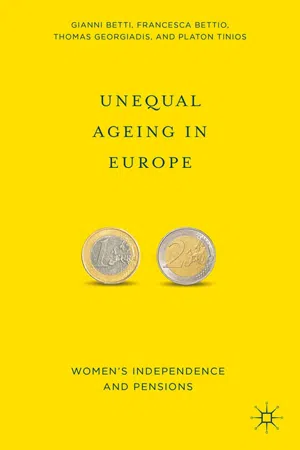
Unequal Ageing in Europe
Women's Independence and Pensions
- English
- ePUB (mobile friendly)
- Available on iOS & Android
eBook - ePub
Unequal Ageing in Europe
Women's Independence and Pensions
About this book
While much is known about the situation in the labour market in the form of gender pay and earnings gaps, rather little is understood about their sequel in old age the gender pension gap. Entering the world of pensions may well signal a step backwards as far as women's independence is concerned, particularly in countries where women have earned economic independence in employment and are now being confronted by institutional frameworks presuming, encouraging or even imposing dependence.
Unequal Ageing in Europe explores the gender pension gap across the member states of the European Union, plus Iceland and Norway. Employing microdata from the Survey of Income and Living Conditions (EU-SILC), along with data from the Survey of Health, Ageing and Retirement in Europe (SHARE), the authors derive key facts regarding pension inequality between women and men. An intuitive indicator for a pension gender gap is derived and contrasted with equivalent indicators for pay and earnings gaps. The authors explore European diversity in a number of dimensions and benchmark their findings against equivalent findings in the US.
Information
1
Women, Old Age, and Independence: Why Investigate Yet Another Gender Gap?
Introduction
Ageing as a challenge for all societies has been known to exist for more than a generation; the Organisation for Economic Co-operation and Development (OECD) produced an authoritative study warning of population ageing in 1980 (OECD, 1981). Awareness of impending changes spread, first to the policy community, then to policymakers; it thus motivated a number of reforms through the world, adjusting institutions to cope with a changing reality.
As time proceeds, what first appeared as a theoretical challenge to society as a whole increasingly has visible implications for individual men and women in advanced societies. Whether directly, as more people are entering retirement, or indirectly, as ageing-driven reforms are spreading, the process of ageing is a potent source of change for everyday lives. Some of these changes were planned for, others were anticipated, yet others may come as surprises.
This book tries to catalog one such category of changes, those affecting the relative position and economic independence of men and women in later life. It does so by focusing on the most important determinant of economic independence, the existence of independent means. This, for the vast majority of women in Western societies, means access to a decent pension. The book complements our knowledge of the field of gender inequalities in work—the gender pay and earnings gaps—by looking at what happens to inequalities after retirement. We know that the world of work has been growing more equal between genders, in some, though not in all, respects. Will this progress mean that the battle for equality in later life has been already won? Is it simply a case of waiting for the gains in equality during the period of work to percolate through to later life? Is the pension system, in other words, a neutral filter reflecting the situation in employment, albeit with a lag?
It is possible to point to features of pension systems that can either reinforce inequalities or, alternatively, correct them. This book takes an agnostic attitude on this question. Having posed the question, it proceeds to describe and compare the situation regarding gender-based pension inequality using comparable information for a wide range of advanced societies. In this context, the book places the primary focus on the countries of the European Union (EU), treating their experience as a kind of gender policy laboratory.
So, the European focus is not simply parochialism. The diversity of experience between European countries, the nature of social policy, and the direction and speed of pension and other reforms mean that the experience of different EU countries span a wide range of experience. This can serve to illustrate the differing impacts that are likely to face any advanced country meeting the challenge of ageing. The common membership of the EU ensures the existence of regular and comparable data for all countries; the fact that all EU members coordinate their policy efforts to meet the ageing challenge implies that this work can plug in and take advantage of an active policy dialogue.
The EU actual experience, as measured by the yardstick of statistical indicators used in this book, can then be usefully benchmarked and compared with experience in other countries. This is done by surveying published work in other advanced countries, as well as direct comparisons in two cases (Israel and the United States) where similarity of data allows construction of the same indicators we derived for the EU. In this way, by starting out in Europe and spreading the inquiry gradually wider, we are able to generalize about the challenges faced by advanced societies more generally.
Much of the literature on ageing entails looking at the macro challenge to societies of impending changes. Our own work, in contrast, treats ageing as a fact of everyday life and sees as a micro problem affecting individuals. Whereas the collective challenges of ageing are similar in nature across all countries, the response to ageing as affecting individuals is likely to be far more varied—reflecting differences in history, institutions, preferences, and policies. Public policy, in order to be effective, needs to understand the complexity of responses as regards gender, while not losing sight of the macro challenges. The plea made in the final chapter is that public policy should be concerned with both dimensions at the same time.
The Need for Gender Vigilance for Older People
Simone de Beauvoir, writing in the 1960s in The Coming of Age (1970), was conscious of a pervasive gender dimension in the way society treated old age:
What we have here is a man’s problem . . . When there is speculation upon the subject (of old age) it is considered primarily in terms of men. In the first place because it is they who express themselves in laws, books and legends. (de Beauvoir, 1996, p. 89)
Things need not necessarily be so bleak. At a later point in the same book, she notes a potential for righting gender imbalances:
For women, the last age is a liberation . . . Now at last they can look after themselves. (p. 489)
A generation later, policy is called upon to diagnose and correct the problems created by human institutions and social processes in order to realize the potential for independence that de Beauvoir sensed existed.
An obstacle that existed then is still present: older women are taken for granted, while in many countries they are insufficiently represented in decision-making fora. Their well-being and independence are the outcome of complex forces: older women and men are affected by long-term social changes like population ageing; they are the first group affected by the cumulative impact of 20 years of gradual institutional reform in pension systems and elsewhere; in the current economic and fiscal crisis, they are frequently one of the groups most immediately affected by fiscal retrenchment. At the same time, today’s older women witnessed in their working lifetime a major transformation in the roles played by women in economy and society, a transformation that took place at different speeds in different countries and is yet to be completed.
Pension systems have changed considerably over the last 20 years, and are changing still. Older women have lived and worked in one system and will collect their pensions when that system will be considerably different. This process is in operation across the world, yet had started at different times and has proceeded at different speeds. Countries are faced with common problems, but choose to deal with them in ways that are affected by their own history, institutions, and preferences. In this way, older women’s pensions across the world carry simultaneously echoes of past disadvantage and premonitions of future vulnerability. Comparing the situation of older women between countries, especially if the ostensive objectives of these countries are comparable, would allow to make inferences about the policy environment and the reform toolbox. The diversity contained in the Member States of the EU can thus be seen as a microcosm for the dilemmas faced by all advanced societies—a kind of laboratory where ideas and inferences can be tested.
These reasons, taken collectively, imply that it is important to know the extent and location of gender differences in pensions. Perhaps more significantly, in a field which is complex and is affected by numerous influences, it is important to track changes over time. If this can be attained, problems might be spotted early on and solutions sought and implemented in a timely fashion.
This book suggests that policy would benefit if a gender gap in pensions (GGP henceforth) indicator were available on a regular basis. It defines such an indicator, which can be easily produced across the EU on an annual basis and extended elsewhere with relative ease. The book investigates its properties and uses it to characterize the dimensions of the problem for different groups of the population and different institutional settings; it points the way to further work. A key insight is that the nature of the problem and our understanding of it are such that it is not sufficient to produce a one-off research report calculating the indicator at a point in time. On the contrary, an indicator on gender imbalances in pension ought to be available on an annual basis to guide policy and orient public discussion.
Why Monitor Gender Differences in Pensions?
Pensions are the single most important component of older people’s income. In contrast to other components, such as return from savings and income from property or rents, which accrue to the whole household and cannot usually be separately attributed to a particular member of the household, pensions are paid to individuals. They thus are an important determinant of economic independence of their beneficiaries—the capacity of an individual to lead an independent life and to take decisions for him/herself. In this way, differences in pension rights between women and men form the foundation of gender differences between the sexes in later life, as regards each person’s capacity for individual choice.
The distinction between economic welfare and economic independence is important to make and to understand. Economic welfare, the access to resources and capacity to well-being, depends on a wider set of income sources, which accrue to the household (Atkinson, 1989; Deaton and Muellbauer, 1980). In order to study welfare, all income entering a household is aggregated, and then apportioned between the members of that household. Given that a household, by definition, is a social unit where consumption is shared among its members, total household income is frequently and by necessity assumed to be distributed equally among its members. In social surveys, which are used to gauge economic well-being, this means that income of men and women living as a couple is equal by construction.1 Indicators, such as poverty rates, which rely on household income, constrain in this way the poverty status of men and women living as couples to be identical. Differences in poverty rates by gender thus essentially rely on comparisons between single member households: people who never married, divorced individuals, widows, and widowers. Due to this fact, gender differences in access to resources are almost certainly severely underestimated in any measure which relies on household income. Should our interest lie in the related, but conceptually distinct, issue of relative independence between genders, this shortcoming is even more distorting.
For people of working age, this train of thought leads naturally to a focus on differences in employment remuneration—most frequently encapsulated by some measure of pay or earnings gap.2 In the case of women, this is essentially an achievement gap, reflecting the fact that women, in many contexts, may be underpaid, undervalued, overworked across the board; their responsibility for unpaid work in the family leads to underrepresentation in the paid labor market. Once people have left the labor market, the analog of pay or earnings is the source of income that replaces them, that is, pensions. An indicator of a pension gap would in this way be a natural complement, almost a sequel, to an interest in gender earnings gaps. Given that many pensions systems are designed to reflect employment experience, one would expect that pensions would reflect the cumulated disadvantages of a lifetime’s involvement in a gender-biased labor market. The further back in time one goes (and hence the older the pension recipient), the more marked one would expect this effect to be.
However, pensions do not simply reflect labor market experiences in a neutral way. Systems which rely on the accumulation and investment of contributions may actually exacerbate inequalities in employment remuneration. In contrast, as the largest single item of social protection expenditure, they are in principle called to correct to some degree what are perceived as imbalances (or even injustices) of the labor market. For this reason, the possibilities of intervening to correct gender imbalances are much greater in pensions than in earnings. An intervention requires information. A focus on gender differences in pensions would be an invaluable addition to the policy toolbox.
Those two arguments, to complement pay gender gaps and to orient public pension decisions, are sufficient to justify a policy interest in pension differences between men and women. Why should that interest entail following those differences in regular time intervals? In other words, why should public bodies or organizations such as the EU consider adding a new pension gap indicator to the set of indicators they publish every year?
An answer to the question of “why an annual indicator?” can be sought in the complexity of influences that combine to produce the pension gender effects that will appear every year. These influences can interact mutually or with other features and can frequently lead to unforeseen outcomes, possibly even some “collateral damage.” The structure of pensions—and hence gender-based differences—is influenced by three sets of factors:
First are very long-term structural changes, operating like tectonic changes to transform the pension environment. Ageing and demography are the most well known of these differences: older women are increasing in number; their state of health is changing while in comparison with earlier periods they have fewer children and social ties are looser. The anticipation of future acceleration of ageing may already have effects on today’s older people, as policy adjusts with a lead.3 Similar in their effects to ageing, are echo effects of past employment patterns. Today’s pensions may reflect yesterday’s employment picture. The pace of women’s emancipation in the labor market has proceeded at different speeds in different parts of Europe (Jaumotte, 2003; Lyberaki et al., 2013; Pissarides et al., 2005), with the North typically more advanced than the South. The older cohorts may be mor...
Table of contents
- Cover
- Title
- 1 Women, Old Age, and Independence: Why Investigate Yet Another Gender Gap?
- 2 Concepts and Literature
- 3 Gender Gaps in Pensions in Europe
- 4 The Gender Pension Gap in Europe: Toward Understanding Diversity
- 5 Benchmarking the Analysis: Europe, Israel, and the United States
- 6 Pension Systems and Pension Disparities
- 7 His and Her Pensions: Intra-Household Imbalances in Old Age
- 8 Looking Ahead: Pension Reforms and Inequality in Old Age
- Appendix 1
- Notes
- References
- Index
Trusted by 375,005 students
Access to over 1.5 million titles for a fair monthly price.
Study more efficiently using our study tools.
Frequently asked questions
Yes, you can cancel anytime from the Subscription tab in your account settings on the Perlego website. Your subscription will stay active until the end of your current billing period. Learn how to cancel your subscription
No, books cannot be downloaded as external files, such as PDFs, for use outside of Perlego. However, you can download books within the Perlego app for offline reading on mobile or tablet. Learn how to download books offline
Perlego offers two plans: Essential and Complete
- Essential is ideal for learners and professionals who enjoy exploring a wide range of subjects. Access the Essential Library with 800,000+ trusted titles and best-sellers across business, personal growth, and the humanities. Includes unlimited reading time and Standard Read Aloud voice.
- Complete: Perfect for advanced learners and researchers needing full, unrestricted access. Unlock 1.5M+ books across hundreds of subjects, including academic and specialized titles. The Complete Plan also includes advanced features like Premium Read Aloud and Research Assistant.
We are an online textbook subscription service, where you can get access to an entire online library for less than the price of a single book per month. With over 1.5 million books across 990+ topics, we’ve got you covered! Learn about our mission
Look out for the read-aloud symbol on your next book to see if you can listen to it. The read-aloud tool reads text aloud for you, highlighting the text as it is being read. You can pause it, speed it up and slow it down. Learn more about Read Aloud
Yes! You can use the Perlego app on both iOS and Android devices to read anytime, anywhere — even offline. Perfect for commutes or when you’re on the go.
Please note we cannot support devices running on iOS 13 and Android 7 or earlier. Learn more about using the app
Please note we cannot support devices running on iOS 13 and Android 7 or earlier. Learn more about using the app
Yes, you can access Unequal Ageing in Europe by G. Betti,F. Bettio,T. Georgiadis,P. Tinios in PDF and/or ePUB format, as well as other popular books in Social Sciences & Business General. We have over 1.5 million books available in our catalogue for you to explore.