- English
- ePUB (mobile friendly)
- Available on iOS & Android
eBook - ePub
About this book
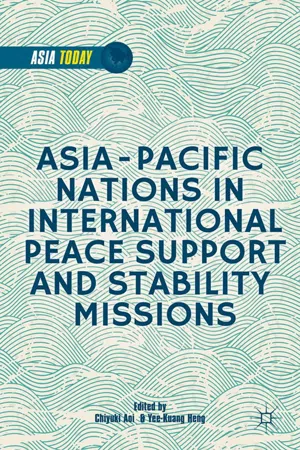
This book aims to provide for a path-breaking cross-regional comparison of the capabilities and readiness of Asia-Pacific countries to contribute to peace support missions, with an eye to identifying emerging trends and policy implications.
Information
1
The Asia-Pacific in International Peace Support and Stability Operations
Chiyuki Aoi and Yee-Kuang Heng
This book evaluates past and current contributions by Asia-Pacific nations to international peace support and stability missions, with a view to identifying trends and future prospects for such contributions. It fills a glaring gap in the existing literature examined below, which tends to focus predominantly on Western nations’ conduct of these said operations. In spite of widespread proclamations of the coming Asian century, there has been a dearth of sustained and systematic comparative analysis of what Asia-Pacific nations can or cannot contribute to international peace support and stability missions. While there are more than 40 newcomers in United Nations (UN) peacekeeping since the end of the Cold War, many of these newcomers, from a rising China to small states such as Singapore, hail from the Asia-Pacific region. On the other hand, more seasoned contributors such as Indonesia are increasingly viewed as an emerging power with potentially larger contributions to managing global security. Taken together, the increasing participation of Asia-Pacific nations in peace and stability missions also reflects a greater desire for countries in the region to play a larger international role commensurate with the eastward shift of economic and political power.
Against the backdrop of these developments, this book focuses on several Asia-Pacific nations—Australia, Japan, South Korea (Republic of Korea [ROK]), China, Singapore, Malaysia, Indonesia, Vietnam, and Cambodia—and their attempts to define and develop their respective roles in international peace support and stabilization. Needless to say, this list of countries is far from exhaustive. Neither should it be seen as wholly representative of the “Asia-Pacific.” Although located in a geographically proximate region, the Asia-Pacific is a contested geographical concept as well as a divided region, with no overarching institutional framework, although there are several institutional settings in which the majority of states in the region are represented.1 Instead, given pragmatic constraints of space in a volume like this, we have had to make several hard choices. It was decided to cover a sample of countries from Northeast Asia (Japan, China, South Korea), Southeast Asia (Singapore, Malaysia, Indonesia, Vietnam, Cambodia), and Oceania (Australia). These countries were selected based on a desire to have a sample of relative newcomers as well as more experienced troop contributors. Another variable was the range of power capabilities on offer, from small wealthy city-states like Singapore; middle powers like South Korea, Australia, and Malaysia; to larger nations like Indonesia, Japan, and China. This in turn would provide a more nuanced comparative understanding of where these states stand, with regard to their own specific national interests, ambitions, capabilities, and potential for future contributions. Our chapter contributors were specifically asked to assess not only the policies and motives of these Asia-Pacific nations when participating in international peace support operations (PSO) and stability missions but also institutions, pre-deployment preparations and doctrines. Future trends and developments are also assessed. Despite the active interest in and evolving nature of peace support/stability participation by many states in the Asia-Pacific, the realities and capabilities of these nations remain poorly understood. Hence this book aims to provide for a first, cross-regional comparison of such capabilities and readiness to contribute to peace support missions.
Peace Support and Stability Operations: The Demand and Supply Equation
A central purpose of this book is to highlight demand-side challenges arising from contemporary developments in peace operations, and assess how Asia-Pacific nations are equipped (supply-side) to respond. Peace operations and their variants have expanded worldwide as the Cold War ended. The number of UN peacekeepers, for example, increased from 11,000 in 1989 to 78,444 in 1993.2 After a brief lull in the mid to late 1990s, the number eventually reached 101,939 in March 2010. Fifty-four missions were established in the post–Cold War years as opposed to thirteen during the Cold War. In the meantime, regional and subregional organizations, most notably the North Atlantic Treaty Organization (NATO), Economic Community of West African States (ECOWAS), African Union (AU), and European Union (EU), also newly embarked on PSO.
While the deployment of troops for international peace operations is always subject to political decisions in national capitals and at the UN Security Council (UNSC)—hence making accurate prediction of future operations an unreliable affair at best—the demand for peace operations in its various guises does not seem to be declining at the time of writing. The UN remains (and has been for quite some time) one of the largest troop-deploying entities in the world today, deploying more than 93,000 uniformed personnel throughout the world in 15 missions. These missions respond to both “old” and “new” conflicts. Decades-old conflicts are managed by peacekeepers in Cyprus, Lebanon, Golan Heights, India/Pakistan, and Western Sahara. Kosovo, Afghanistan, and Haiti continue to be ongoing concerns. More recent conflicts have been ended with the help of UN missions such as in East Timor, Sierra Leone, and soon Liberia. Others are more protracted, such as those in the Democratic Republic of the Congo (DRC) and Darfur. An indication of ongoing demand for peace operations can be seen in the DRC, where a decision was made in March 2013 to deploy an Intervention Brigade with an unprecedented offensive mandate to function within the existing UN peacekeeping operations (UNPKO) there (United Nations Stabilization Mission in the DRC [MONUSCO]). A 12,600-strong integrated UNPKO mission was also authorized for Mali in April 2013, not forgetting the major UN deployment to assist the nascent South Sudan state. Extrapolating from such trends, one can assume more conflicts will flare up in the future and some, if not all, will certainly require peace operations (in its various forms) to be managed by the UN, regional security arrangements like the Association of South-East Asian Nations (ASEAN), or by coalitions of states independently. Indeed, within the Asia-Pacific, there are potential cases of border disputes whereby peacekeepers could conceivably be deployed. The Thai-Cambodian dispute over the Preah Vehear temple complex has already seen Indonesia touted as a possible contributor of peacekeepers. Furthermore, there have also been calls by some Asian analysts such as the dean of the University of the Philippines’ Islamic Studies, for ASEAN peacekeepers to be deployed to help end the conflict in Sabah.3
As for “new” conflicts’, the post-9/11 world witnessed a proliferation of stability operations, a variant of which includes counterinsurgency. Most notably, US-led coalition operations in Afghanistan and Iraq have seen Asia-Pacific nations such as Australia, Singapore, South Korea, and Japan contributing forces. Although it is unlikely that these missions will continue on the same scale in the near future, given the distinct lack of political appetite, they cannot be simply wrapped up overnight. For example, Afghanistan in its best-case scenario will require some sort of Western oversight in the foreseeable future. Somalia, Yemen, Libya, and Mali, where there were Western interventions recently, may also require long-term stabilization efforts. Even the aftermath of nonintervention in Syria may entail some Western attention to rebuild the state. Lack of political will notwithstanding, governments need to prepare conceptually and operationally for contingencies involving these destabilized areas. Investigating empirically to what extent Asia-Pacific nations are capable of contributing to such contingencies is thus a worthwhile undertaking.
The Evolving Peace Support Environment
The quantitative expansion in demand for peace support and stability operations worldwide alluded to above has also accompanied significant qualitative changes in the nature of these said operations. In the post–Cold War era, the nature of peace support and the role of (civilian and military) actors involved has transformed dramatically.4 Characterized by fragile peace agreements and unstable, often varying, levels of consent, this development poses a particular challenge to peacekeepers often issued with limited mandates and inadequately equipped not only with military materiel, but also possibly with outdated doctrines. The United Nations and regional organizations are asked to intervene in ongoing conflicts or fragile post-conflict situations, or situations requiring stabilization. Although the preference of the UN is to have a peace agreement and consent in place before peacekeepers are sent, these could often be challenged by local forces. Member states are increasingly called upon to provide the UN with the necessary political backing and resources in order to implement peace agreements with credibility and tactical use of force (“robust” peacekeeping) if necessary.5 Operationally, these newer missions may also require more advanced or robust military capabilities, which many troop-contributing countries have been reluctant to deploy for various reasons. For example, the Intervention Brigade in DRC entails weaponry such as attack helicopters, and assets such as special forces. The demand for these higher-end capabilities in peacekeeping is only likely to go up, if the trend is for conflict to become protracted, more complex, and UN intervention more likely.
The UN’s Western members have gone further by incorporating the notion of peace enforcement in the category of “peace support operations” so as to allow for a more flexible and strategic management of precariously fragile peace agreements on the ground. This development in turn has had ramifications for the types of capabilities needed for peace operations, and for doctrinal requirements. Depending on actors and organizations, the approach to “robustness” of force and fragilities in consent and peace processes has varied significantly, with the UN more concerned with consent as a prerequisite for successful operations and the existence of a peace agreement to be implemented “with credibility.”
Furthermore, there is a constant need for troop deployments to support peace, that is, to prevent peace process from falling into disarray, help rebuild state institutions, and to create various conditions suitable for implementation of the mandate. These qualitative aspects require civil-military coordination, whole-of-government approach, and civil affairs skills, usually above and beyond what was required in the past for “traditional peacekeeping.” This calls for a tighter integrated approach, where principles of political primacy and legitimacy are seen as the key.6 These aspects represent one of the most hotly debated (and contested) issues in doctrinal debates. It would be crucial, therefore, to investigate to what extent Asia-Pacific nations are aware of and able to deal with such shifts in the peace support environment.
Such changes go hand in hand with the evolving demography of UN peacekeepers, which reflects both the changed nature of peacekeeping environments and the varying politico-security interests of the nations involved. The majority of troops in UN missions now come from developing nations (although senior and commanding positions remain dominated by Western nations). In 2011, the top ten Troop Contributing Countries (TCCs) were all developing countries.7 Western countries, meanwhile, shifted their focus to non- UN-led coalition missions, preferring to limit their contribution to UN peace operations in areas such as rapid reaction capabilities, logistics, intelligence, training, and enforcement capabilities, rather than mere boots on the ground.8 There is a corresponding need to analyze the capacities of Asia-Pacific nations to fill gaps created by Western countries.
There have also been key normative developments, namely a focus on the civilian population protection mandate of peacekeeping forces, in the spirit of or in actual reference to the idea of Responsibility to Protect (R2P or RtoP)9 or the older international norm of protection of civilians in armed conflict.10 The R2P acknowledges the primary responsibility of sovereign states in protecting their own citizens from genocide, war crimes, ethnic cleansing, and crimes against humanity, and if sovereign states fail, it is the responsibility of the international community, with the UNSC taking leadership, to act in each aspect of prevention of crimes against civilians, reacting to such events, and of rebuilding after such catastrophes. The concept was included in the 2005 World Summit Outcome Document.11 Although imple...
Table of contents
- Cover
- Title
- 1 The Asia-Pacific in International Peace Support and Stability Operations
- 2 Australia and International Peacekeeping: Policies, Institutions, and Doctrines
- 3 Japanese Participation in Peace Operations: The “Civilian” Contribution?
- 4 Korean Approaches to Peace Support and Stability Operations
- 5 Red and Blue: China’s Evolving United Nations Peacekeeping Policies and Soft Power Development
- 6 The Quest for Relevance in Times of Peace: Operations Other Than War and the Third-Generation Singapore Armed Forces
- 7 Malaysia’s Peacekeeping Operation Contributions
- 8 Indonesia’s Peacekeeping Operations: History, Practice, and Future Trend
- 9 The Contrasting Cases of Cambodia and Vietnam: Active Engagement and Considering Engagement in United Nations Peacekeeping Operations
- 10 Standing Up to Be Counted: Asia-Pacific Nations and Peace Operations
- Index
Trusted by 375,005 students
Access to over 1.5 million titles for a fair monthly price.
Study more efficiently using our study tools.
Frequently asked questions
Yes, you can cancel anytime from the Subscription tab in your account settings on the Perlego website. Your subscription will stay active until the end of your current billing period. Learn how to cancel your subscription
No, books cannot be downloaded as external files, such as PDFs, for use outside of Perlego. However, you can download books within the Perlego app for offline reading on mobile or tablet. Learn how to download books offline
Perlego offers two plans: Essential and Complete
- Essential is ideal for learners and professionals who enjoy exploring a wide range of subjects. Access the Essential Library with 800,000+ trusted titles and best-sellers across business, personal growth, and the humanities. Includes unlimited reading time and Standard Read Aloud voice.
- Complete: Perfect for advanced learners and researchers needing full, unrestricted access. Unlock 1.5M+ books across hundreds of subjects, including academic and specialized titles. The Complete Plan also includes advanced features like Premium Read Aloud and Research Assistant.
We are an online textbook subscription service, where you can get access to an entire online library for less than the price of a single book per month. With over 1.5 million books across 990+ topics, we’ve got you covered! Learn about our mission
Look out for the read-aloud symbol on your next book to see if you can listen to it. The read-aloud tool reads text aloud for you, highlighting the text as it is being read. You can pause it, speed it up and slow it down. Learn more about Read Aloud
Yes! You can use the Perlego app on both iOS and Android devices to read anytime, anywhere — even offline. Perfect for commutes or when you’re on the go.
Please note we cannot support devices running on iOS 13 and Android 7 or earlier. Learn more about using the app
Please note we cannot support devices running on iOS 13 and Android 7 or earlier. Learn more about using the app
Yes, you can access Asia-Pacific Nations in International Peace Support and Stability Operations by C. Aoi, Y. Heng, C. Aoi,Y. Heng in PDF and/or ePUB format, as well as other popular books in Politics & International Relations & Asian Politics. We have over 1.5 million books available in our catalogue for you to explore.