eBook - ePub
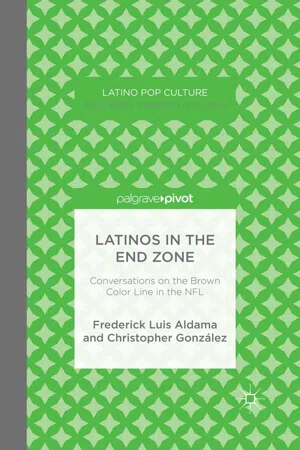
Latinos in the End Zone
Conversations on the Brown Color Line in the NFL
- English
- ePUB (mobile friendly)
- Available on iOS & Android
eBook - ePub
About this book
Here, Frederick Luis Aldama and Christopher González offer a thought-provoking conversation on the history of Latinos in the pro football leagues. As they weave their way through significant points where culture, politics, and history congeal (an early twentieth century era of Brown Color Lines, the Great Depression, WWII, birth of television, Civil Rights struggles, the twenty-first century Latino demographic explosion, among others), Aldama and González thread together an alpha-to-omega, all-encompassing story of Latinos in the NFL. They push hard at issues such as racial prejudice, including why Latinos have historically had to cross into the Canadian Leagues to prove themselves to white American officiators and the glaring omission of prominent Latino names honored within the hallowed interiors of the Pro Football Hall of Fame. Encyclopedic in scope and powerfully pointed in its analysis, they put the spotlight on the significant contribution made by Latinos in the history of pro football.
Information
Print ISBN
9781349486908
9781137403087
Subtopic
Cultural & Social Anthropology1
From Scrimmage Lines to End Zones: Latinos in the National Football League
Abstract: “A Question of the Brown Scrimmage Line,” provides a nuanced socio-cultural analysis of exclusionary practices and trends in the early history of the pro leagues—or what the authors identify as the brown color line.
Frederick Luis Aldama and Christopher González. Latinos in the End Zone: Conversations on the Brown Color Line in the NFL. New York: Palgrave Macmillan, 2014. DOI: 10.1057/9781137403094.
Frederick Luis Aldama: Christopher, we could go back several millennia but the plot of Latinos in football doesn’t become caught up in extremes till the moment when it becomes codified as a professional sport in 1920 when it was identified as the American Professional Football League (APFL).
Christopher González: It really is the place to begin when discussing the sport as a professional endeavor, though the APFL would become the NFL only two years later. However, we’d be remiss if we didn’t at least acknowledge two key innovators that predate 1920. Fabled Notre Dame Fighting Irish coach Knute Rockne is noted for developing and popularizing a key development of American football, a development that would distinguish it from its cousin rugby—the forward pass. It’s hard to imagine the game we know today without a quarterback throwing the football down the field, but that’s how the game was initially designed. When Rockne instituted the forward pass, the game essentially became what we know today, though there would be minor adjustments along the way. The other innovator is Glenn “Pop” Warner, a prolific and successful early coach—and coach of Jim Thorpe—who among other things innovated the now familiar play called the screen. Today his legacy is in the “Pop Warner” programs that begin to develop football players at a very early age. Though these two men shaped the game at the collegiate level, their contributions began to make their way into the professional game. But for our purposes, we’ll begin at 1920.
FLA: While racial prejudice and segregation practices meant that Latinos would not appear in the AFL till the 1930s, it’s worth recalling that football during this period and before still carried the marker of being a rough, working-class game.
CG: It has certainly never been what we might call a safe sport. Football’s early years were marked with many serious (some fatal) injuries to players, and a constant tweaking to the rules was initiated, a tweaking that has never stopped. But by the 1930s the game had now become very close to what we know today, and the decade was marked with a settling of the foundation upon which the NFL would build itself into the premiere commercial sports league in the U.S., if not the world.
FLA: Just as its cousin rugby was not the venerated sport of the bourgeoisie (tennis, golf, polo), neither was football. Moreover, it was a sport that inhabited a kind of borderland: as neither soccer nor rugby but a hybrid combination of both that made something new. Many an athletic pundit and others viewed it with suspicion.
CG: It’s hard to believe it now, in a time when football is such a ratings and economic juggernaut, but in its early years football was essentially a boorish sport. And it was so out of necessity. We’re talking about a full contact sport with only minimal protective gear. The advent of the protective facemask was many years away, and the thin leather headgear egregiously called a helmet was the extent of protection. Broken noses and lost teeth were all too common. Seen in the light of the more passive type sports such as tennis and golf, an observer of the NFL’s early years might have thought the players were just simply not going to last that long. In truth, even in today’s game the pro career averages less than ten years before players are compelled to retire either because of diminishing skills, or more often, as a result of injury.
FLA: Oddly, while it was certainly not tennis or golf, this hybrid was played at elite universities like Yale and Princeton, Harvard, Tuft, Rutgers, Columbia—all of which had formed football associations in the middle of the 19th century.
CG: As I suggested earlier, the development and proliferation of football in the college ranks really was the impetus for the NFL. As you note, Frederick, these universities were playing an early form of football for over 50 years before the APFL appeared. To put that into perspective, that’s longer than the current Super Bowl era of the NFL. (There have been 42 Super Bowls as of the writing of this book.) These college football programs—many in the Ivy League—in many ways helped shape the development of the game of football.
It’s an interesting thing to note this early connection between football and higher education. In this case, we’re talking about the premier universities of the time. So, even though the game may have had a workingman’s ethos about it, the men who played it at the collegiate level were the sons of America’s captains of industry. But already we can see these barriers of entry during the inception of game of football. Not just anyone was going to get into Yale or Harvard, and thus not just anyone could play on these collegiate teams.
FLA: By the time of the early 20th century when professional athletic clubs began to give football a formal presence in the sportsworld, it was already in the shadow of an established pro baseball.
CG: And it might have very well stayed in baseball’s shadow but for one crucial technical innovation: television. I have the feeling we’ll discuss the issue of television and how it changed the NFL forever, but for now let me just say that between the two games—baseball and football—football is designed perfectly for the medium of television. The NFL is a ratings behemoth, and the Super Bowl is perennially the highest rated television show of any given year. So, while football may have been at a disadvantage early on, it was propelled to stratospheric heights once games became televised.
FLA: The game seems plagued from the outset with all variety of contradictions: working class identified and a marginal sport (banned even for a spell for its violence in the 1860s) yet it was played by WASPs (sons) of elite families at elite universities.
CG: I think you’re absolutely spot on. It does seem like a contradiction. On the one hand you have roughneck types playing this contact sport, but it was also a sport that emanated from the ivory towers of American academia. That contradiction might be resolved if we examine how the game went from East coast elite universities, migrated to the Midwest, and ended up in Central Ohio. Right around the time the young NFL began to solidify in terms of its teams, the college game spread to universities in all areas of the country. It was during this “Ohio League” time of the game’s development that the working-class nature of the game came to fore. Smaller cities surrounding Columbus, such as Canton, became early stalwarts of the NFL. This was an important transition for the game, but because players were still selected from institutions of higher learning, the issues of access we’ve discussed already were in place since the inception of the professional game.
FLA: Of course, universities like Yale, Harvard, Princeton today are not known for their football, as it became more popular in college in its nascent days, universities would use their football puissance as a marker of distinction.
CG: Without question it is the reason Notre Dame was able to become such a name-brand institution. Knute Rockne was a maestro on the gridiron, and it was football that gave that puissance you mentioned to universities like Notre Dame. The University of Michigan also became an immense powerhouse in collegiate football’s early days, and they won the first ever Rose Bowl, crushing Stanford 49–0. Collegiate football programs spread down the Atlantic coast and through the South, and across the Midwest. And again, we can’t ever seem to leave the issue of economics when it comes to this particular sport. Football was (and is) a revenue dynamo. So while its early years might have been marked with ivory-tower distinction, it soon demonstrated a different kind of elitism—in this case, big time revenue streams. Money talks, as they say.
FLA: Today, public, land-grant universities such as OSU where I teach and that should be recruiting top-shelf Latino students (athletes or otherwise) seem to care more about sustaining a self-enclosed, self-feeding, self-fattening football revenue stream.
CG: The irony of the economics of college football is either disheartening or frustrating. Anyone who is involved in college football must be suffering from a fair amount of cognitive dissonance. On the one hand you have a governing body such as the NCAA whose sole purpose these days seems to be to sanction football programs whose players make side money for talents produced by their own bodies. On the other hand, the NCAA and top-tier university football programs generate an enormous amount of wealth on the backs of these students. It is a controversy that rages consistently, though it may wax and wane depending on who the latest culprit may be. Every televised game, every t-shirt with a school logo, every bit of memorabilia and merchandise feeds this football economic system. Though the NCAA often touts itself as the last bastion of pure amateurism in a cold, cruel professional world, the truth is that college football, like its cousin the NFL, is a business where fortunes are won and lost. When you think of top-notch college football programs as Fortune 500-types of businesses, suddenly what they do makes complete sense. But if one views these programs as subservient to institutions of higher education, well, then the lens is certainly rose-colored indeed.
FLA: While elite universities continued to open doors only for privileged WASPS, those like OSU and neighboring universities like Oberlin were actually breaking color lines. Not with Latinos, but with African Americans. I think of Oberlin’s early streak with putting on the football field African American players such as William Washington (1897–1899), Samual Samuel Morrell (1901 to 1902), and Nathanial Brown (1908–1909). In the 1920s an NFL club in Akron, Ohio, championed the African American running back, Frederick Douglas “Fritz” Pollard.
CG: It’s interesting that you mention Ohio. Not only is the Buckeye State of key importance to the bourgeoning days of the NFL, but it remains the centerpoint for producing one of the most important barrier-smashing athletes in all of American history: Jesse Owens. On the world’s stage he, a Black man, made Adolf Hitler look like an utter buffoon with his nonsense of a superior Aryan race. The world owes Jesse Owens thanks for that, if nothing else.
But to have such progressive institutions and forward-thinking attitudes on race in Ohio makes perfect sense when you consider the state’s history with race. For many slaves, Ohio was the land of freedom. Crossing the Ohio River was like a baptism and being born again, only this time as a whole human being. I don’t mean to oversimplify the issue; there were certainly barriers for minorities even in a state such as Ohio. But, if we were to introduce a hypothetical here, what if these early football clubs had flourished in, say, Birmingham, Alabama? Would we have seen the likes of a William Washington or Nathanial Brown, in a state that still proudly claimed its segregation provenance as late as 1963?
FLA: Likely not, Christopher. Indeed, while there were pockets of emancipation in the game, at some point in the early 20th century it became the common doxa for coaches to take the position that there weren’t any players of color to recruit.
CG: Such a doxa works especially well when there are few players of color to recruit. I just mentioned Alabama’s sad history of segregation. If in 1963 President John F. Kennedy has to mobilize National Guard troops in order to allow a handful of African American students into the University of Alabama, of course football coaches around the same time would throw up their hands and say, “Well, we tried!” If the institution itself didn’t allow a segregated student body, what chance did any student of color (football player or otherwise) have? I appear to be concentrating on the University of Alabama’s infamy, but there were hundreds of institutions doing the same thing in the first half of the 20th century in America. In 1962 the University of Mississippi, or Ole Miss, had a much more devastating, but similar, situation when James Meredith became the first African American student on campus. At the same time we’re looking at an NFL that was already four decades old, with the Super Bowl era just around the corner, and schools such as the University of Alabama and Ole Miss don’t even have minority students enrolled in classes!
One final hypothetical before moving on. If the NFL, instead of rooting itself in Ohio, had decided to establish itself in Texas, perhaps centered in San Antonio, how many Latinos would we have in the early years of the NFL? I speculate that we’d have had many more than the archive now shows.
FLA: When Latinos and Native Americans were finally added to the roster of pro football teams, like their Black counterparts they weren’t allowed to dress or eat with their white teammates or even stay in the same hotel.
CG: Talk about in-group/out-group! It’s hard to feel like you belong to a team when you’re not treated in the same way. You mentioned Roberto Clemente earlier, Frederick, and he was essentially treated as both a Latino and as an African American. If he wasn’t “damned” because of his dark skin, he was “damned” because of his heavily accented English. It’s stunning that Clemente was able to become one of the greatest MLB players of all time when one considers the added stress and frustration he felt because of such entrenched racism. When minority athletes began making it into the upper echelons of sport, they constantly had the burden of proving that they had as much right to belong as white athletes. The treatment of African American quarterbacks in the NFL is a prime example of this. Athletes always feel as if they have something to prove, in general; it comes with being an athlete. But minority athletes in a segregated society could only produce spectacular athletic feats or they would be dumped at the first poor performance they had.
FLA: During these early days when we began to see more players of color in the football leagues. One of the most significant players to cross the color line in Ohio (Canton Bulldogs) was Wa-Tho-Huk from Oklahoma. Of course, most know him as Jim Thorpe (1888–1953)—another assimilation move, right?
CG: Thorpe, as I mentioned in the Prologue, was an athlete for the ages. No matter to which race or ethnicity he had belonged, he was going to be a nearly superheroic athlete. Thorpe was able to cross the color line, as you put it, though his parents were, like Thorpe himself, of mixed Native and European ancestry. Because he was of mixed heritage, growing up close to his Native culture in Prague, Oklahoma, he was better able to make the transition into a sport world dominated by whites.
Thorpe’s life is utterly fascinating, and I think fewer and fewer people remember Jim Thorpe these days. I think today’s culture tends to reach to its recent past when naming the great athletes. Today it’s all about Michael Jordan and LeBron James. That aside, it’s curious to see how Jim Thorpe’s legacy is handled today. Phenotypically, there is no question that he has Native American features. I suggested earlier that had Thorpe insisted on being called Wa-Tho-Huk, people would view him and the NFL quite differently today. But he’s “Jim Thorpe,” and if you can manage ignoring the occasional black and white photo of him, a person might think of Thorpe as a white man without a significant Native tradition in his genes. James Fennimore Cooper created his famous Natty Bumppo (aka, Deerslayer, aka, Hawkeye) character as a white man who had adopted the best of Native culture, and the NFL seemingly took a Native man and gave him the best of white culture. They took the greatest athlete of the 20th century, according to many, and “whitewashed” him. That’s not to say they didn’t acknowledge his Native ancestry. Rather, they treat it as an “oh-by-the-way” footnote.
FLA: Thorpe story certainly inspires, but it’s not without its tragic aspects. I mean, he was of that generation of Native Americans that was schooled with the express purpose of assimilating into the dominant white culture. At the schools he attended like Carlisle Indian Industrial School and the Haskell Indian Junior College, like academic subjects such as English and History, American sports like football and baseball were used to assimilate Native Americans.
CG: The sad thing is that these Native American kids were losing their culture under the guise of playing a game, though it must have been evident to the adults. Glenn “Pop” Warner, football coach at Carslile, and Thorpe’s coach, often used the White vs. Indian history of conflict in order to motivate h...
Table of contents
- Cover
- Title
- Prologue: Kick Offs
- 1 From Scrimmage Lines to End Zones: Latinos in the National Football League
- 2 From Punishing Penalties to Brown Bodies Raiding the NFL
- 3 Sidelined...No Ms!
- 4 The Blitz...Heroes, Saviors, Saints, and Sinners
- 5 Three Latino Legends: Snapshot by Interview
- Epilogue: End Zones and New Scrimmage Lines
- Works Cited and Suggested Reading
- Index
Trusted by 375,005 students
Access to over 1.5 million titles for a fair monthly price.
Study more efficiently using our study tools.
Frequently asked questions
Yes, you can cancel anytime from the Subscription tab in your account settings on the Perlego website. Your subscription will stay active until the end of your current billing period. Learn how to cancel your subscription
No, books cannot be downloaded as external files, such as PDFs, for use outside of Perlego. However, you can download books within the Perlego app for offline reading on mobile or tablet. Learn how to download books offline
Perlego offers two plans: Essential and Complete
- Essential is ideal for learners and professionals who enjoy exploring a wide range of subjects. Access the Essential Library with 800,000+ trusted titles and best-sellers across business, personal growth, and the humanities. Includes unlimited reading time and Standard Read Aloud voice.
- Complete: Perfect for advanced learners and researchers needing full, unrestricted access. Unlock 1.5M+ books across hundreds of subjects, including academic and specialized titles. The Complete Plan also includes advanced features like Premium Read Aloud and Research Assistant.
We are an online textbook subscription service, where you can get access to an entire online library for less than the price of a single book per month. With over 1.5 million books across 990+ topics, we’ve got you covered! Learn about our mission
Look out for the read-aloud symbol on your next book to see if you can listen to it. The read-aloud tool reads text aloud for you, highlighting the text as it is being read. You can pause it, speed it up and slow it down. Learn more about Read Aloud
Yes! You can use the Perlego app on both iOS and Android devices to read anytime, anywhere — even offline. Perfect for commutes or when you’re on the go.
Please note we cannot support devices running on iOS 13 and Android 7 or earlier. Learn more about using the app
Please note we cannot support devices running on iOS 13 and Android 7 or earlier. Learn more about using the app
Yes, you can access Latinos in the End Zone by F. Aldama,C. González in PDF and/or ePUB format. We have over 1.5 million books available in our catalogue for you to explore.