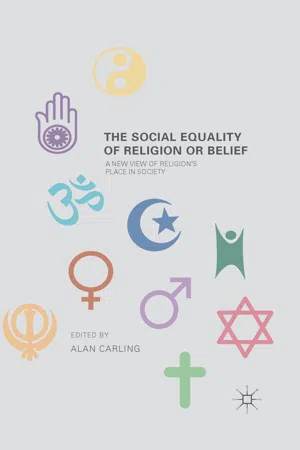
Some countries, like the UK, give special recognition by the state to one or a few religions; other countries, like France and the US, give recognition to none. This book is about a new approach that gives equal recognition to all religions and non-religious belief systems.
- English
- ePUB (mobile friendly)
- Available on iOS & Android
eBook - ePub
The Social Equality of Religion or Belief
About this book
Information
Part I
Religion, Equality and the Law
1
The Problem of ‘Belief’
Yvonne Sherwood
1)The belief must be genuinely held.
2)It must be a belief and not an opinion or view based on the present state of information available.
3)It must be a belief as to a weighty and substantial aspect of human life.
4)It must attain a certain level of cogency, seriousness, cohesion and importance.
5)It must be worthy of respect in a democratic society, not incompatible with human dignity and not in conflict with the fundamental rights of others.
Criteria for ‘religion or belief’, from the Supplementary Notes to the UK Equality Act 2010, s. 10: 52.
I believe; help me overcome my unbelief
Mark 9: 24
Religion and/or belief
It is disorientating for a scholar of religion, like myself, to encounter recent legislation on ‘religion and belief’. We religion scholars are always asking whether religion can and should “be represented as something that derives from belief, as something with external manifestations that can ultimately be traced back to an inner assent to a cognitive proposition, as a state of mind that produces practice” and disabusing first-year students of their belief that religion is all about belief (Lopez 1998: 34). We might reasonably imagine that law would side with this privileging of practice. Legal enquiries into states of mind, intention, mental capability or incapability or mens rea only follow the potentially illegal or incendiary act. Unless there is a visible manifestation of problematic acts or speech acts, states of mind and interiority remain beyond law’s concern. The days of trials of belief for heresies on the Trinity are gone. Belief is precisely what secular states have dispensed with. The iconic cases in law and religion focus on outward, visible symbols: the public wearing of the veil and the cross.1 Why read these signs, these acts, as indices of inner belief? And isn’t ‘belief’ a strangely imprecise word for law, which often represents itself as the discourse of precision? Since its inception, Religious Studies has aspired to a lawcourt model of religion based on observation of acts and behaviours – emphatically not creeds, doctrines and beliefs. How ironic that even as Religious Studies has attempted to base itself on evidence and lived practice, law has (conversely?) revived the old category ‘belief’.
This phrase ‘religion or belief’ is very puzzling and seems to cry out for exegesis. Is the ‘or’ the kind of ‘or’ that marks alternative terms for exactly the same thing as in ‘the Hawaiian, or Sandwich, Islands’ or, more controversially, ‘The Falklands or the Islas Malvinas’? Or is it the kind of ‘or’ that marks real alternatives as in ‘to be or not to be’? The official answer seems to be ‘Both’. Officially, ‘religion or belief’ means ‘religion or the secular equivalent of religion’, or ‘religion, including the lack of religion’. The ‘or’ links opposites. But these opposites are defined in reference to the co-ordinating term, religion, so that belief is an attribute of religion, or other forms of commitment that are considered to be fundamentally like religion in sharing the attribute of belief.
In the quest for an adjective to stand in as the secular equivalent to the ‘religious’, legislators have turned to philosophy and produced the pair ‘religious or philosophical belief’. The pairing is shorthand for the statement (which must be true for a secular democracy) that there are secular commitments which are as worthy of respect as religious beliefs. Religion scholar Donald Lopez (1998: 22) notes that “belief has rarely been discussed alone, but is most often paired with another term to which it stands in a relationship of weakness or strength. When one looks up belief in the Encyclopedia of Philosophy, one is directed to ‘Knowledge and Belief’. When one looks up belief in the Encyclopedia of Religion, one finds the instruction ‘See Doubt’”. ‘Religion or belief’ names ‘religion or the lack of religion’. But now non-religion is presented as an equivalent term that partakes of the intense commitment of belief. In this sense ‘religion or philosophical belief’ is the exact opposite of the old antithesis ‘religion or doubt’ or ‘belief or unbelief’. The pairing is one of correlation as well as contrast. We describe these secular equivalents using a term that has a very special relationship to religion, and that is understood as having been patented by religion: belief. The secular equivalents are like religion because they partake of the mystical interiority of belief.
This correlation-contrast is awkward and attempts to articulate it have inevitably led to anxiety and controversy. The original wording of the Equality Act (2006) defined belief as ‘any religious or similar philosophical belief’. An amendment in 2007 deleted the word ‘similar’. At its removal, Baroness Scotland, the Attorney General, commented that the word was being deleted because it “added nothing and was, therefore redundant”. This is because, in the context of the legislation, “philosophical beliefs must therefore always be of a similar nature to religious beliefs”.2 Commentators like Lucy Vickers (2008: 17) give a different account of the amendment: “To be defined as ‘similar to religion’ was viewed as offensive to some humanists and atheists, and the definition was amended by the Equality Act 2006 to remove the term ‘similar’.” Atheist or humanist groups who had based their identity on absolute differentiation from religion were understandably displeased by being made ‘similar’ to religion. The solution seems to have been to make the correlation implicit, not explicit.
Why this turn to belief and ‘freedom of religion and belief’? The answer is that this is the obvious place for religion to have gone in the epistemologies of secular modernities and the age of human rights. Secular states and the European Union cannot protect or say anything about the gods or religion(s) as such. The Parliament of the European Union could not endorse a reference to historicised ‘Judeo-Christian’ roots, lest it appear to have reneged on the non-partisan pluralisation of religion and the demotion of religion that is the hallmark of the modern democratic state. Gods and religions do not exist for all of us, and so cannot be taken as a general public (universal) category, like sexuality or ethnicity. Religion can only be protected under the rubric of the universal when it goes inside, to the sphere of personal (or ‘community’) commitment. And in the language and idioms of the Christian West, in which these legislative frameworks were devised, the obvious name for this commitment is belief.
In the secular state, the old reverence for the gods turns into respect for human personhood (Sherwood 2012). Sacrality is not removed, but relocated. Belief loses its defining preposition ‘in’ (as in ‘I believe in God the Father’, or ‘I believe in spooks’) and folds back on itself self-affirmingly as the condition of believing or having a belief. Belief is no longer defined by its object (which does not exist for all of us) but by its depth and intensity. According to the United Nations Declaration on the Elimination of all Forms of Intolerance and of Discrimination Based on Religion or Belief (1981) Resolution 36/55 “religion or belief, for anyone who professes either, is one of the fundamental elements in his conceptions of life”, and religion is a “defining feature of human personality”, a “protected characteristic” alongside sexuality/gender, pregnancy/maternity, race/ethnicity, disability and age. (In)famously, Sikhs and Jews qualify under two categories – religion or belief and ethnicity – whereas other groups, such as Muslims and Christians only qualify under ‘religion or belief’.
The incredulity provoked by belief
In his important essay ‘Freedom of Religion or Belief: Anachronistic in Europe?’ (2014), Heiner Bielefeldt (Special Rapporteur on FoRB to the UN) observes that ‘freedom of religion and belief’ is anomalous because, unlike the other categories, it does not receive unanimous support. He identifies two main sources of scepticism. Some religious traditionalists “oppose the human rights approach to faith issues”. But scepticism also arises among liberals, who often see ‘freedom of religion and belief’ as being on a collision course with human rights. In Bielefeldt’s diagnosis, “Freedom of religion or belief has received the somewhat dubious reputation as a human right which is less human, less egalitarian and less secular than other human rights” (Bielefeldt 2014: 55).
We could say more about both positions and also suggest other reasons for scepticism that are directly related to the wording ‘religion or belief’. Understandably, some religious adherents want protection for gods and religion as such, rather than allowing religion to contract into a right or attribute of the human person. They want to keep the object of belief alive and keep the preposition ‘in’, rather than underwrite the secularising move that makes belief fold in on itself as a quality: belief. Conversely, secular liberals feel that the transcendental is being kept alive (on a life-support machine?) in this strange concept of belief. Though the transhuman/transcendental has officially been eradicated (we are protecting believers, not gods or sacred truths), the elevating quality of the transcendental still seems to lurk around the particular valorisation and credence that we give to belief. As Bielefeldt (2014: 55–6) puts it “Freedom of religion or belief obviously has to do with convictions and conviction-based practices, many of which claim a transcendent, ‘transhuman’ origin, while human rights are explicitly conceptualised as ‘human’”, because the universal can only be grounded in the human, not the divine. Freedom of religion is often seen as particularly antagonistic to other (recently-established) rights, such as sexual freedoms and homosexuality in particular. The recent conflagrations around blasphemies and hate speech are widely received as a conflict between two essential hypergoods: freedom of religion versus, and at war with, freedom of speech.3
‘Religion or belief’ is not only perceived as starting fights with other categories on the human rights list. The very concept of belief seems to start a categorical war, all by itself. Surely having a belief is not the same kind of condition as having a disability or having a female body or black skin? Principles of racial and sexual equality are responses to very recent social and political re-organisation, yet they seem firmer, more secure, that the category of religion or belief. In Western epistemologies, religious belief is “cast as speculative and less ‘real’ than the materiality of race and biology” (Mahmood 2009: 81). It is as hard for other religions as for secular liberals to understand (let alone represent themselves in terms of) this valorisation of ‘belief’, particularly when it is coupled with the equally-typical Western assertion that the object of religious belief is not real in the same way that sexuality or ethnicity is real. I would even go so far as to hazard that the recent rise in hate speech provocations on religious grounds have been provoked partly by hostility to Islam, and partly by this potentially provocative category, ‘religion or belief’. Cartoonists and commentators keep asking ‘How are religious identities and, say, ethnic identities to be compared or differentiated? Are they really comparable or “similar”?’ Several commentators on the Danish cartoon affair wanted to press the question (that seemed to coincide with new European legislation) “on what grounds can you equate unchangeable race (skin colour) and religion, if religion is a matter of choice?” (Sajó 2007: 286). The cartoonist for The Guardian, Joe Sacco (2015), pushed the same question from the opposite direction in his cartoon On Satire: A Response to Charlie Hebdo. Why are we content to have our speech and our pens regulated on matters of ethnicity, but not matters of religion? Whether we are supportive of, or disturbed by, the protection of religion, we are disturbed by the gap between the way we conceptualise ethnicity and religion and belief. Ethnicity is given. Belief is chosen – even if it is a particular kind of choice that is compelling. Our faith in the category ‘religion or belief’ seems to depend on our faith in belief as a particular kind of thought or idea that (in a riff on the old Heineken advert) reaches the depths that other thoughts do not reach.
In practice and popular speech in Euro-America, people regularly lose their religion; find religion; go through a religious phase; return to their religion; convert; take on their partner’s religion – or have a hybrid and evolving religious identity, as a BuJew for example. But these commonplaces do not seem to rattle the faith in religion and belief in law and public discourse, where religion signifies intensity, constancy and conviction, perhaps far more securely even that it did in a more religious age. We give great credence to belief. Even the most ardent secularisers such as Richard Dawkins and Christopher Hitchens regularly use the phrase ‘deeply-held convictions’ or ‘deeply-held belief[s]’. The idea of ‘deeply-held convictions’ and ‘beliefs’ in turn organises the ways in which religious representatives represent and talk about themselves in the public realm – and the way we represent them. The media tends to favour representatives of religion who embody our idea of religion or belief as that which saturates every corner of a life. We prefer to look (in wonder) at those we project as the true and deep believers – the Haredim or ultra-orthodox Jews; Wahabi or Salafi muslims; members of the religious right in America – rather than the ‘nominal’ Catholic or the unveiled Muslim teenage girl who has a drink.
How did we come to believe so fervently in belief?
The controversial terminology of ‘religion and belief’ gets to the heart of our confusion about how to think religion, and where to place religion, conceptually and legally, in the secular state. The legal formula ‘religion or belief’ seems to do justice to two fundamental conflicting ideas about religion, both of which we regard as self-defining and essential: ‘It does not exist; it is not real (for all of us)’ and ‘it is hyperreal: more real than the merely real’ – at least for those who believe.
This distinctly Western paradox is compressed in that strange word ‘belief’. The term is distinctly and idiosyncratically our own. In 1897, the father of Comparative Religions, Max Müller (1987: 448), observed: “[T]hat the idea of believing, as different from seeing, knowing, denying, or doubting, was not so easily elaborated, is best shown by the fact that we look for it in vain in the dictionaries of many uncivilised races”.4 He was enough of a genuine comparativist to allow their lack to comment not just on them but us. The fact that uncivilised races don’t have dictionaries (!) and don’t have a word fo...
Table of contents
- Cover
- Title
- Introduction: The Social Equality of Religion or Belief
- Part I Religion, Equality and the Law
- Part II Religious Identity Amongst Others
- Part III Separation and Establishment
- List of Legal Cases
- References
- Index
Trusted by 375,005 students
Access to over 1.5 million titles for a fair monthly price.
Study more efficiently using our study tools.
Frequently asked questions
Yes, you can cancel anytime from the Subscription tab in your account settings on the Perlego website. Your subscription will stay active until the end of your current billing period. Learn how to cancel your subscription
No, books cannot be downloaded as external files, such as PDFs, for use outside of Perlego. However, you can download books within the Perlego app for offline reading on mobile or tablet. Learn how to download books offline
Perlego offers two plans: Essential and Complete
- Essential is ideal for learners and professionals who enjoy exploring a wide range of subjects. Access the Essential Library with 800,000+ trusted titles and best-sellers across business, personal growth, and the humanities. Includes unlimited reading time and Standard Read Aloud voice.
- Complete: Perfect for advanced learners and researchers needing full, unrestricted access. Unlock 1.5M+ books across hundreds of subjects, including academic and specialized titles. The Complete Plan also includes advanced features like Premium Read Aloud and Research Assistant.
We are an online textbook subscription service, where you can get access to an entire online library for less than the price of a single book per month. With over 1.5 million books across 990+ topics, we’ve got you covered! Learn about our mission
Look out for the read-aloud symbol on your next book to see if you can listen to it. The read-aloud tool reads text aloud for you, highlighting the text as it is being read. You can pause it, speed it up and slow it down. Learn more about Read Aloud
Yes! You can use the Perlego app on both iOS and Android devices to read anytime, anywhere — even offline. Perfect for commutes or when you’re on the go.
Please note we cannot support devices running on iOS 13 and Android 7 or earlier. Learn more about using the app
Please note we cannot support devices running on iOS 13 and Android 7 or earlier. Learn more about using the app
Yes, you can access The Social Equality of Religion or Belief by A. Carling in PDF and/or ePUB format, as well as other popular books in Social Sciences & Social Philosophy. We have over 1.5 million books available in our catalogue for you to explore.