eBook - ePub
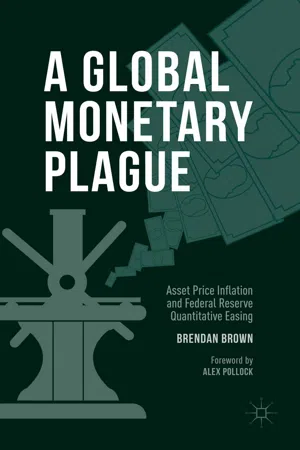
A Global Monetary Plague
Asset Price Inflation and Federal Reserve Quantitative Easing
- English
- ePUB (mobile friendly)
- Available on iOS & Android
eBook - ePub
About this book
The Great Monetary Experiment designed and administered by the Federal Reserve under the Obama Administration unleashed strong irrational forces in global asset markets. The result was a 'monetary plague' which has attacked and corrupted the vital signalling function of financial market prices.
This book analyses how quantitative easing caused a sequence of markets to become infected by asset price inflation. It explains how instead of bringing about a quick return to prosperity from the Great Recession, the monetary experiment failed in its basic purpose. Bringing about economic debilitation, major financial speculation, waves of mal-investment in particular areas, and a colossal boom in the private equity industry, the experiment instead produced monetary disorder.
Brendan Brown puts the monetary experiment into a global and historical context, examining in particular Japanese 'folklore of deflation' and the Federal Reserve's first experiment of quantitative easing in the mid-1930s. The author couples analysis from the Austrian school of monetary economics and Chicago monetarism with insights from behavioral finance, and concludes with major proposals for the present and the future, including ideas for monetary reform in the United States, and suggestions for how investors can survive the current market 'plague'.
Information
1
The Monetary Origins of Market Irrationality
There is a deeply held belief that order emerges out of chaos. If so, the Obama Administration’s Great Monetary Experiment, designed and implemented by its appointed Federal Reserve chief, will have ultimately a happy ending. Social and economic turmoil resulting from years of vast monetary disorder would bring about a swing of the political pendulum, which could sweep away the Federal Reserve. In its place a new monetary order would be constructed. This would include constitutionally protected rules to guide the US along the path of monetary stability.
The Obama Federal Reserve (Fed) would stand accused of having designed and carried out a wild and highly controversial monetary experiment without any serious regard to known side effects .These emanate from its unleashing of irrational forces in global financial markets. The accusers would charge the Fed and ultimate puppet masters in the White House and Congress with having squandered long-run prosperity in the failed bet that the experiment would result in a fast pace of recovery from a great recession which stemmedfrom deeply flawed monetary policies through the previous two business cycles (1992–2007). In fact the economic upturn since the cyclical trough of Spring 2009 has been the weakest ever to follow a Great Recession.
A precondition for such a revolution to occur is a popular revulsion against all those responsible for the monetary misconduct – the senior Federal Reserve officials, the presidents who had nominated them for high office and the Congresses which had approved their policies and passed legislation mandating continued instability. The cause of that revulsion would not just be the cumulative economic damage but also the trauma delivered by the Federal Reserve to the delicate fabric of free society. Results of this trauma include the crony capitalism, monopoly power and intense regulation, which have been features of the US financial experience since the Great Panic.
The purpose of the Great Monetary Experiment
The best introduction to the purpose of the Great Monetary Experiment (GME) is a response that then Fed Chief Ben Bernanke gave at his first press conference (April 27, 2011). The question posed was about his view on the main thesis in Reinhart and Rogoff’s book (2011) that economic upturns following recessions which feature financial panic are always slow and difficult.
Professor Bernanke responded at first with a joke: “I’ve known him (Rogoff) for a long time; I even played chess against him, which was a big mistake”. Then the serious answer followed.
Yes, Professor Rogoff was right (in Bernanke’s opinion). All such recoveries have indeed been slow. But this is not an immutable law. In particular, following such recessions in the past, economic policy had not been sufficiently vigorous. With unusual passion, Bernanke promised boldly that the path-breaking monetary policy tools, which the Federal Reserve was now pursuing under his leadership, would prove the pessimism expressed by Rogoff and Reinhart wrong on this occasion.
Bernanke, in agreeing with Reinhart and Rogoff that all recessions following financial panic have been slow and difficult, was not on firm ground. There has been a growing critique since their book’s publication that US recoveries from such recessions had been strong – except for the particular recovery in question in the aftermath of the 2008 panic (see Taylor and John, 2012, Blog 17/10; Siems and Thomas, 2013; and Bordo and Haubrich, 2014). And then there is the time-honoured Zarnowitz rule, that the deeper the recession, the stronger the subsequent recovery. That rule was based on 150 years observation of US business cycle history (Zarnowitz and Victor, 1992).
Aside from the actual historical evidence conflicting with the Rogoff and Reinhart thesis, there is a body of theory – found in the economic writing of both the neoclassical school (Hoover, 2008) and Austrian school (Mises, 1971) – suggesting that the invisible hand of market forces in the context of monetary stability can indeed bring about a powerful long-term recovery from a great recession (and incidentally there would not have been a great recession in 2008–09 if there had been monetary stability in the preceding years) so long as government does not get in the way. As a new Keynesian economist, Bernanke like Rogoff and Reinhart had either rejected or ignored such theory, stressing instead all the various frictions which would enfeeble or paralyze benign market forces.
In particular, Bernanke had elsewhere (see Bernanke and Frank, 2014) made much of the argument that the invisible hand (of Adam Smith fame) would cease to function when interest rates fall to the “zero rate boundary” (as nominal interest rates cannot fall substantially below zero without triggering huge withdrawals of cash from the banking system). Yet under the conditions of heightened risk aversion and enlarged savings surplus which typify the aftermath of financial panics, the neutral level of short-term and even medium-term interest rates could indeed be negative. In the same vein, Bernanke has stressed the economic frictions which typify “balance sheet recessions” in the aftermath of a boom and bust. These handicap the invisible hand. In particular, high indebtedness weighs on new investment by the business sector and consumption by households.
Counterarguments to Bernanke-ite pessimism
What are the main counterarguments to Bernanke-ite pessimism? Top of the list is denying its premise of price inflexibility. If prices are flexible (both downwards and upwards) and confidence exists in a firm anchor to prices in the long run (as under the gold standard regime), then a pro-cyclical pattern of prices would make the zero rate boundary discussion redundant (see Brown, 2013).
When business conditions are recessionary, many prices and wages would fall to a somewhat below normal level. Yet there would be expectations of higher prices into the eventual expansion phase. (Under the gold standard, the cyclical fall in prices including some nominal wage rates together with the fixed nominal price of gold would generate increased gold production as profits from mining increase – meaning a boost to monetary base growth). And so even with nominal interest rates somewhat positive, interest rates would be negative in real terms. The benign operation of the invisible hand does not depend on piercing the zero rate boundary.
As regards the pessimism about balance sheet recessions, the counterargument focuses on how excessive debt ratios can fall swiftly via the injection of equity and how a climate of enhanced profit prospects and entrepreneurship could indeed ignite a vibrant process of Schumpeterian creative destruction. Specifically, companies finding themselves with a hangover (from the boom-time) of high leverage, due to their total market value (debt and equity combined) having fallen sharply, can nonetheless respond positively to new investment opportunity by issuing equity. They might also conclude in some instances debt-equity swaps with existing debt holders (limiting the latter’s windfall gains from new equity issuance which come at the expense of present equity holders).
Moreover, in the context of much economic destruction of capital stock during the recession (as mal-investment during the prior boom becomes apparent) and of abundant labour supply rates of profit should rise. This means that the set of investment opportunities would expand (so long as government supported banks are not keeping zombie companies alive and thereby sustaining excess capacity). And higher savings should go along with a lower cost of equity capital (as long as government and monetary policymakers are not adding powerfully to overall uncertainty) helping toward a recovery of investment (which might remain well below its previous boom high attained in the midst of much irrational exuberance) and its eventual blossoming.
Some of that investment might take the form of increasing capital intensity of existing production (more input of machinery, IT, knowledge) in specific sectors (not those which are heavy users of labour with little human capital – after taking account of economic obsolescence – now substantially cheaper than under the preceding bubble-economy conditions). Also in this situation, there could well be a flourishing of entrepreneurship based on finding new ways in which capital and now many types of cheaper labour (cheapness could be in absolute wage rate terms or when assessed relative to marginal productivity) can be combined profitably, often satisfying new types of demand for goods and services not apparent before.
President Obama chooses his designer for the “Great Monetary Experiment”
When Bernanke affirmed that he agreed with Rogoff and Reinhart about the weakness of recoveries following financial panic, the reporter had no chance to ask a follow-up question. This might have been why he (Bernanke) disagreed with all the critics and counterarguments as detailed here. It would have been an extraordinary press conference if such an interchange had taken place!
Yet in terms of practical monetary policymaking, it is unimportant why Bernanke disagreed or whether he was even fully aware of such alternative viewpoints. After all, President Obama had nominated Bernanke for a second term at the head of the Federal Reserve in Summer 2009 knowing full well his views, however well founded or not, on the understanding that he would pursue the GME and incidentally, also give his powerful backing to the omnibus Frank-Dodd financial market regulation bill making its way then through Congress. The advisers around the president, including, crucially, the director of his national economic council, Professor Larry Summers, and less importantly, his chair of the council of economic advisors, Professor Christina Romer, who would have influenced his choice, knew exactly what the renomination of Bernanke meant for the conduct of US monetary policy.
A core component of the GME has been what is widely described as “quantitative easing”, or more popularly “QE”. This has been allied to an earlier key shift in the US monetary framework toward targeting a “steady low inflation rate”, which the Greenspan Federal Reserve put into effect surreptitiously in the mid-1990s. At a special FOMC meeting (July 1996) (only revealed in a Fed transcript published many years later), then Fed Governor Professor Janet Yellen persuaded Chairman Alan Greenspan that the aim of price level stability should be adapted to mean a steady state of 2% p.a. inflation. Bernanke was a keen advocate of inflation targeting and had set out ten principles to guide monetary policy under such a framework (see Brown, 2013).
Quantitative easing as practised by the Federal Reserve since 2009 has involved blowing up the size of its balance sheet for the declared purposes of pursuing recovery in the labour market, combatting “deflation danger” and sustaining inflation expectations (and inflation) around the 2% p.a. level.
How has the Fed expanded its balance sheet with monetary base as share of GDP rising from around 7% in 2007 to 23% in 2014?
This has occurred by the Fed Reserve issuing en masse a special category of liability (bank reserves) which pays a small positive interest rate (to the member bank) – above the prevailing zero rate in the market for short-maturity T-bills. These liabilities (bank reserves) are created when the Fed purchases assets including prominently long-maturity US T-bonds and mortgage-backed agency bonds (issued by housing corporations presently administered by the federal government). In effect, the Fed pays for these assets by creating high powered money (in this case, deposits at the Federal Reserve) to use in the settlement of the transaction.
QE is not money printing in the classical sense
Quantitative easing (QE) is not money printing in the classical sense of the central bank (in this case, the Federal Reserve) issuing non-interest bearing reserves or banknotes at a time when market short-term interest rates and the neutral level of interest rates (say short and medium-term) are substantially positive. In that context, the new reserves or currency are like hot potatoes which everyone tries to pass on as quickly as possible (either via lending or purchasing goods). Market interest rates fall sharply and bank lending climbs rapidly. Instead, we could describe the QE operations effected under the Obama Administration during the years 2009–14 as “quasi money printing”.
The accumulation of long-maturity bonds by the Federal Reserve via the proceeds of quasi money printing together with an open-mouth policy about future prospects for short-term rate pegging and for the continuation of zero rate policy in particular are meant (according to the designers of the monetary experiment) to press down long-term interest rates to well below the so-called neutral level. Conceptually at any point of time, there is a set of short, medium and long-term interest rates across different maturities such that the given economy, here the US, follows a path of monetary stability characterized by first, goods and services prices on average following a flat trend over the very long run but fluctuating both up and down over the medium or short run and second, no asset price inflation. These are the so-called natural interest rates – in fact, distinct for each maturity. Where there are expectations of persistent steady state inflation over the long run, we can define the neutral rate as the natural rate plus that inflation rate. We will see later in this chapter how the Fed’s “success” in manipulating downward long-term interest rate depends on its tools (including QE, zero rate policy, forward guidance) unleashing powerful forces of irrationality in the marketplace. These can foster, for example, extreme judgements about the likelihood of secular stagnation (in turn, influenced by positive feedback loops from capital gains on bonds) amidst a “reach for yield” (investors desperate for income pile into long-maturity bonds whilst convincing themselves that the risks involved are only small).
The same investor who has convinced himself or herself about the secular stagnation hypothesis as grounds to reach for yield in the long-maturity US Treasury bond market is not likely to be simultaneously optimistic about economic robustness when assessing equity investment, although in the world of the irrational, such schizophrenia is sometimes encountered! Some investors may not be convinced by the hypothesis of secular stagnation (technically they attach a very low probability to it proving to be correct) but are ready to speculate on how irrational belief in this will evolve. For example they may accumulate aggressive long positions in the 10-year US government bond market on the basis that the secular stagnation hypothesis will gain popularity for some time (meaning that many investors put large probabilities on its forecast outcome becoming reality). When this belief fades suddenly say in two to three years time the average maturity of the once aggressive bond portfolio would have shrunk to say 7 years and so be less vulnerable to price fall. (There is no corresponding fall in the average maturity of equities as the respective businesses in aggregate are continuously making new long-life investments). And in any case the investors might hope to make their exit before that point.
Heterogeneity of opinion and speculation in the form described can allow the equity market and bond markets to go their own ways to some extent, with the optimists on economic robustness crowding into equities and eschewing bonds. In the big picture, though, this degree of freedom is limited given the great mass of investors who are heavily entrenched in both markets. The neutral level of interest rates which reflects this shrunken confidence and also the damage to the longer-term economic outlook by monetary uncertainty (see p. 24) may be in real terms significantly below where it would be in an economic environment free of such handicap. In principle, when these handicaps are eventually removed – meaning the return to “monetary normality” – the neutral level in real terms would jump as the secular stagnation hypothesis lost plausibility amongst investors no longer suffering from income famine and as the dissipating of monetary uncertainty bolstered opportunity for business spenders; but first, there would be the final stage of the asset price inflation disease as described below in which speculative temperatures plunge and a business recession occurs.
Though the monetary experiment depresses the neutral level of rates as described it lowers market rates to an even greater extent, at least as regards long-maturity rates. Below neutral long-term market rates in the context of first, general concern about possible high inflation in the distant future (well in excess of the 2% inflation target) as provoked by the GME and second, desperation amongst investors suffering in the famine of income from risk-free assets (such as short-maturity T-bonds) fuel the process of asset price inflation as defined below. This should, according to the advocates of the Obama monetary experiment, buoy present consumer and investment spending. The hypothesis is dubious both in principle and in practice.
Asset price inflation – a disease of monetary origin
Asset price inflation is a disease of monetary origin which corrupts the “software” behind the determination of prices in the capital markets which guide the invisible hand. In this disease, irrational forces play havoc to an unknown and erratic extent across an array of markets. These forces do not operate with equal strength in all markets continuously but build in those where there are good speculative stories (see Brown, 2014 and below). Under conditions of asset price inflation, many investors make unrealistically high estimates of these stories being the truth.
The chief architect of the GME, Professor Ben Bernanke, has never admitted its key aspect of unleashing irrational forces. Indeed, asset price inflation is not a concept found in the neo-Keynesian economics which he espouses.
According to the neo-Keynesian view, the GME would help rebuild “animal spirits” (a Keynesian term) which had become enfeebled during the great recession. And if the experiment were successful in terms of lifting the US economy on to a long-term flight path of high employment and business spending growth, then the high asset prices induced early in the process could be sustained. Asset prices could climb still further. Hopefully technological progress and a related surge in productivity growth could give a helping hand as had occurred in say the 1920s and 1990s when strong re-bounds in the equity market at first prompted in part by monetary stimulus had subsequently been more than ratified by economic miracle (see chapter 7). Yet despite the chief architect’s silence on the matter, as the great experiment continued, there has been more and more talk about asset price inflation, whether amongst market practitioners, commentators, economists or the policymakers themselves. The term, however, is barely ever defined in this growing discussion.
If we go back in the economics literature, we can find the ter...
Table of contents
- Cover
- Title
- Introduction
- 1 The Monetary Origins of Market Irrationality
- 2 How Fed Quantitative Easing Spread Asset Price Inflation Globally
- 3 A 100-year History of Fed-origin Asset Price Inflation
- 4 How to Cure Deflation Phobia
- 5 A Manifesto for US Monetary Reform
- 6 Japanese Tales in the Mythology of Fed Quantitative Easing
- 7 How Quantitative Easing by the Roosevelt Fed Ended in a Crash
- 8 A Guide to Surviving the Plague of Market Irrationality
- Bibliography
- Index
Trusted by 375,005 students
Access to over 1.5 million titles for a fair monthly price.
Study more efficiently using our study tools.
Frequently asked questions
Yes, you can cancel anytime from the Subscription tab in your account settings on the Perlego website. Your subscription will stay active until the end of your current billing period. Learn how to cancel your subscription
No, books cannot be downloaded as external files, such as PDFs, for use outside of Perlego. However, you can download books within the Perlego app for offline reading on mobile or tablet. Learn how to download books offline
Perlego offers two plans: Essential and Complete
- Essential is ideal for learners and professionals who enjoy exploring a wide range of subjects. Access the Essential Library with 800,000+ trusted titles and best-sellers across business, personal growth, and the humanities. Includes unlimited reading time and Standard Read Aloud voice.
- Complete: Perfect for advanced learners and researchers needing full, unrestricted access. Unlock 1.5M+ books across hundreds of subjects, including academic and specialized titles. The Complete Plan also includes advanced features like Premium Read Aloud and Research Assistant.
We are an online textbook subscription service, where you can get access to an entire online library for less than the price of a single book per month. With over 1.5 million books across 990+ topics, we’ve got you covered! Learn about our mission
Look out for the read-aloud symbol on your next book to see if you can listen to it. The read-aloud tool reads text aloud for you, highlighting the text as it is being read. You can pause it, speed it up and slow it down. Learn more about Read Aloud
Yes! You can use the Perlego app on both iOS and Android devices to read anytime, anywhere — even offline. Perfect for commutes or when you’re on the go.
Please note we cannot support devices running on iOS 13 and Android 7 or earlier. Learn more about using the app
Please note we cannot support devices running on iOS 13 and Android 7 or earlier. Learn more about using the app
Yes, you can access A Global Monetary Plague by Brendan Brown in PDF and/or ePUB format, as well as other popular books in Economics & Financial Engineering. We have over 1.5 million books available in our catalogue for you to explore.