eBook - ePub
Anzac Labour
Workplace Cultures in the Australian Imperial Force during the First World War
- English
- ePUB (mobile friendly)
- Available on iOS & Android
eBook - ePub
Anzac Labour
Workplace Cultures in the Australian Imperial Force during the First World War
About this book
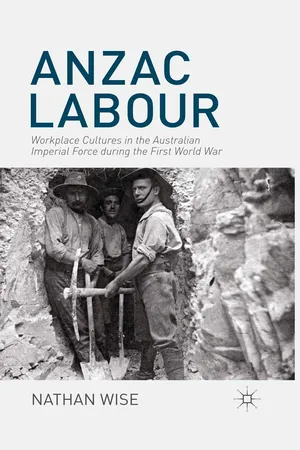
Anzac Labour explores the horror, frustration and exhaustion surrounding working life in the Australian Imperial Force during the First World War. Based on letters and diaries of Australian soldiers, it traces the history of work and workplace cultures through Australia, the shores of Gallipoli, the fields of France and Belgium, and the Near East.
Information
1
Introduction
On 3 August 1918 John Bruce, a corporal serving in the artillery of the Australian Imperial Force (AIF) on the Western Front, penned the following entry within his diary: ‘Same old dope. Dodging work. Pritchard + I were kicking around the cookhouse all day. Peeling spuds etc’.1 Several days later, on 8 August 1918, the five Australian divisions, working together for the first time in the First World War, broke the back of the German army in an offensive that has been described as the ‘black day’ of the German army.2 Thomas Richardson, a sergeant also serving with the artillery of the AIF, wrote within his diary during the day of the attack, ‘Got barrage sheets 4.00 a.m. Opened up three rounds … per minute 4.20 a.m. Got knocked 5.00 a.m.’.3 In the former entry, Bruce described the mundane work of ‘peeling spuds’, and his attempts to evade this work, whereas Richardson described his vital role in providing artillery support for the infantry and receiving a wound (a ‘knock’) from a shell fragment in the process.4 While the style of writing across the two diaries is vastly different, both men were nonetheless writing about something that was central to their daily life within the military – work.
Every day of a soldier’s military service was spent in the environment of work. Their employers – the military – fed, clothed, equipped, sheltered and guided these soldiers through that daily life. Soldiers were always under the authority of their superiors and they could, at any moment, at any hour of any day, be called upon to perform work demanded by their officers, ranging, for example, from the mundane job of peeling potatoes, through to intense and deadly involvement in large-scale military offensives. This daily work ultimately formed an integral part of service personnel’s self-identity, it shaped the daily cultures and group identities that formed within that working environment, and it shaped the way these men approached daily life.5 Indeed, Australian soldiers took the colloquial term for their self-identity – diggers – from a common task they were required to undertake, the job of digging.6
This book is a history of that work, and of those cultures and self- and group-identities that formed as a result of that work, within the Australian Imperial Force (AIF) during the First World War. It documents the labour processes undertaken by men throughout the different theatres of war, and assesses how men responded to those processes within the working environment of the military. It analyses the ways in which men carried their workplace cultures, their approaches to daily life, and their attitudes and behaviour, from their civil lives into the military work environment. And, in particular, it explores how men came to approach and to understand their military service as a job of work, and how this understanding was conveyed and clarified through their diary and letter writing at the time.
One of the most common ways in which soldiers attempted to understand and rationalise their environment was to put pencil to paper and write their feelings down in words. These words now form a vital link between the past and the present. The way these chroniclers wrote about their attitudes and experiences provides an insight into their ideas at the time of writing, and within their own recent past. Within this written material, reflections were often made on what life was like before the war, of how different their lives had become, and of how the chroniclers believed they had changed. Eric Leed demonstrated the importance of these reflections in his book, No Man’s Land, by focusing upon ‘the cultural repertoires of meaning drawn upon by participants to define felt alterations in themselves’.7 Within the following historical investigation, evidence of these ‘cultural repertoires of meaning’ are explored in the letters and diaries of soldiers of the AIF to understand attitudes towards work during the First World War. To support this inquiry, reference is often made to other supporting material such as Operational Orders, Training Syllabuses and War Diaries, but while this supporting material helps to provide a broader context and fill in some gaps, it is not the primary focus of inquiry.
These diaries and letters remain a rich and valuable source for historians of this period. Paul Fussell argued of the Second World War that, in contrast to other sources of evidence, personal diaries, ‘seen and censored by no authority, offer one of the most promising accesses to actuality’;8 a similar promise lies in the written records of Australians during the First World War. Often created to be read by a public audience – usually friends and family at home – this material provides insight into the values and ideals of their creators, particularly how they saw themselves and how they wanted to be seen by others. For example, the language used to describe the behaviour of other soldiers can be assessed to ascertain attitudes towards that behaviour. In the more extensive diaries, some spanning hundreds of pages over several years of military service, we can gain a detailed understanding of the chronicler’s changing attitudes, beliefs and values.
There are, however, limitations in this material. Particular caution must be exercised when assessing the degree to which this writing reflects actual events and experiences of the past. Individual soldiers had a very limited perspective on the broader conduct of the war, and even descriptions of daily activities within their local environment were coloured by their personal views and beliefs. Another consideration is that different soldiers had different motivations for enlisting. These motivations subsequently shaped outlooks on and approaches towards military service and this affected the style of diary and letter writing. For example, the men who enlisted for an adventure wrote in a more adventurous style, often describing their experiences in the popular ‘travel style’ of writing of the late nineteenth and early twentieth centuries.9In contrast, the men who enlisted for a job of work focused more upon the nature of their daily work and they described the features of their regular working environment.10 By reading across these diaries and letters over a broad period, historians can piece together the views and beliefs that shaped the nature of this writing. As noted, both letters and diaries were typically written to be read by a broader public audience at home, but there are subtle differences between the two types of writing. Letters were censored, and they scarcely report in overtly negative terms on the conditions of the military. Instead, they often report on military life in glowing terms and seek to reassure readers at home of the high spirits of the chronicler. In contrast, diaries were privately kept and recorded by soldiers during the war, and, while they were also intended for a public readership among family and friends at home, the entries were not censored and thus report in open and highly critical terms of the conduct of the war and of the way soldiers were treated by the military. Both types of sources provide valuable insight into work and workplace cultures, but both must be approached with caution.
Australian historians utilising these sources have, at times, touched upon an awareness of the soldier as a worker. Graham Seal briefly observed in Inventing Anzac that the Australian soldier
is a temporary bearer of arms and uneasy wearer of uniforms. He is ‘an ordinary bloke’ doing a job of work for a reasonable day’s pay. That this work was in the interests of the Empire to which Australia belonged was a commonplace of the time.11
John McQuilton, and L. L. Robson and J. N. I. Dawes have acknowledged that enlistment in the AIF was another way in which men could secure employment and an income, and thus economically support their families,12 while Bill Gammage also noted that new recruits in the AIF ‘considered the army a job which should be regulated by the conventions attached to any employer-employee relationship. Out of working hours their time was their own, and men cheerfully left their training camps after work to go home or to town, reporting for work the next day as a matter of course’.13 However, all of these scholarly observations were only made in passing. To date, there have been no detailed examinations of the labour undertaken by Australian soldiers, or of how this labour contributed towards the development of workplace identities and workplace cultures.
Only recently have international historians such as Janet Watson, Peter Way, Helen McCartney and Eric-Jan Zürcher begun to explore labour processes within the world’s military forces in detail.14 Way provides an ideal example with his research on the Seven Years’ War in North America.15 He argued that common soldiers were workers who viewed their service in the military as a job of work, noting that, ‘In return for this work, these men received a wage, the illusion of a craft offered by the uniform and a special code of behaviour’.16 Similarly Watson, in her study of the British men and women who served during the First World War, identified soldiers’ approaches towards military service as a job of work. She argued: ‘Some members of the population, both male and female, while generally articulating a clear patriotism, saw their efforts on behalf of the war as work.’17 Leed also provided a brief, but vital, appraisal of war service as a job of work.18 He argued: ‘The realization that war was work and that the comradeship of soldiers was little different than common subjection to the necessity of labor was the essence of the disillusionment of the volunteer.’19 The work of these historians to date demonstrates that the clearest advantage of examining the broader working lives of soldiers in the military environment is that it provides additional insight into how these individuals lived their day-to-day lives. It allows us to broaden our understandings of what ‘military service’ entailed, as well as offering a wider social and cultural environment in which to assess in our attempt to understand the history of warfare.
By focusing upon the history of labour in the environment of the military, this book complements the growing international literature on work within the military, but stands in stark contrast to established Australian military history. Dale Blair argued that ‘military history is a genre governed by its own conventions and, understandably, its focus is more often on uncovering the reasons for victory or defeat’.20 To date, the vast bulk of Australian military histories of the AIF have focused upon the combat environment and the combat experiences of units and individuals. Certainly, while Australian soldiers did identify combat as a type of work, only a small fraction of service personnel’s time in the military was spent in combat environments. This book thus presents a more balanced assessment of service personnel’s time in the military by exploring work and workplace cultures in both combat and non-combat environments. In doing so, it does not ignore combat experiences, but instead places those experiences within an appropriate broader context.
During the First World War, the AIF, much like most other military forces at the time, operated as a semi-independent social organisation, complete with its own clear structure of governance, justice, healthcare, finance and trade/supply. Within each area of the military, distinctly different types of work and workers led to the development of different workplace cultures and workplace identities. This book does not document the work and workplace culture of each and every individual unit that emerged during the war. The task of documenting the peculiarities of work and workplace cultures across all units within the AIF is too great to be covered within a single volume. Rather, by canvassing broadly across different men in different military units throughout different theatres of war, this book identifies the features and themes that were common or, insofar as it can be ascertained, typical of the experience of Australian soldiers during the First World War. As a result, there is no dedicated focus on particular units within the AIF. So, while engineers and tunnellers focused heavily upon manual labour, the work they typically engaged with and their responses to that work was, as will be seen in the analysis that follows, often typical of men serving in different units throughout the military. Similarly, while the working experiences of dedicated non-combat soldiers in the military, such as batmen, medical staff, provosts and men serving in the supply corps, are often considered for context, the finer nuances across those different forms of work and workplace cultures, while certainly worthy of further examination, are far too numerous and detailed to be covered within this single study.
For similar reasons, one major omission from this book is the work of Australian women in the AIF during the First World War. Their omission is primarily due to a recognition that the work and workplace cultures that developed within the medical and nursing services were strikingly different to that of other arms, and, much as is the case with the working experiences of provosts, supply staff and other male medical staff, the experiences of these women within the military requires further examination within a separate detailed study.
Basic biographical details have been provided of the soldiers cited, including their name as stated on their service records, their service number (to enable readers to further pursue details on the individual), their pre-war occupation as stated on their service records (to provide a broader context to their work and their responses to this work within the military) and the details of the archival records consulted relating to this individual. A notable omission in these details is information on the unit an individual served with. Analysis of service records reveals that men often transferred throughout different units, and, as such, attaching any particular unit to an individual in references risked creating a fixed association that was either misleading or inaccurate. Where particularly relevant to the discussion, the unit an individual was serving with at the time has been noted.
The units an individual served in, and the locations they served at, were the two primary factors that determined both the nature of work that men were required to undertake, and the workplace cultures that developed as a response to that work. For example, while the work of digging new trenches was a priority for Australian infantry throughout the Gallipoli campaign, both in the front lines and behind the lines, when these men arrived in France they found the majority of this work had already been completed for them and thus their main task when in the line was to maintain these defences. In contrast, trench digging was an uncommon occurrence for men of the mounted infantry serving in the Near East. To emphasise these differences and draw out the unique features of these experiences in detail, this book examines these different environments and theatres of war through several focused chapters. Chapter 2 explores initial responses to work and early formations of workplace cultures before Australian soldiers were engaged in any direct combat or combat-related work. Chapters 3, 4 and 5 explore work and workplace cultures in the three key theatres of war – Gallipoli, the Western Front and the Near East respectively. And Chapter 6 explores working life in the military following the armistice, the work involved in repairing war-torn Europe, and the workplace training undertaken by soldiers in their attempts to ‘re-skill’ and adjust to civilian forms of employment in preparation for their return to Australia.
Throughout these chapters, the focus upon work and workplace cultures within the military does not seek to detract from the terrifying experiences of individuals in combat environments. Rather, as stated, the focus upon work simply hopes to bring greater attention to this overlooked aspect of our past. While experiences in the front-line trenches and in combat environments were the most striking and haunting aspects of military ser...
Table of contents
- Cover
- Title Page
- Copyright
- Contents
- Acknowledgements
- List of Abbreviations
- Note on Style
- 1. Introduction
- 2. Civilian to Soldier: The Transition of Men From Civil Employment to Military Service
- 3. The Nature of Work – Gallipoli
- 4. The Nature of Work – The Western Front
- 5. The Nature of Work – The Near East
- 6. Return Home: ‘Perhaps Tomorrow We Will Know Exactly How the Situation Stands’
- 7. Conclusion
- Notes
- Bibliography
- Index
Trusted by 375,005 students
Access to over 1.5 million titles for a fair monthly price.
Study more efficiently using our study tools.
Frequently asked questions
Yes, you can cancel anytime from the Subscription tab in your account settings on the Perlego website. Your subscription will stay active until the end of your current billing period. Learn how to cancel your subscription
No, books cannot be downloaded as external files, such as PDFs, for use outside of Perlego. However, you can download books within the Perlego app for offline reading on mobile or tablet. Learn how to download books offline
Perlego offers two plans: Essential and Complete
- Essential is ideal for learners and professionals who enjoy exploring a wide range of subjects. Access the Essential Library with 800,000+ trusted titles and best-sellers across business, personal growth, and the humanities. Includes unlimited reading time and Standard Read Aloud voice.
- Complete: Perfect for advanced learners and researchers needing full, unrestricted access. Unlock 1.5M+ books across hundreds of subjects, including academic and specialized titles. The Complete Plan also includes advanced features like Premium Read Aloud and Research Assistant.
We are an online textbook subscription service, where you can get access to an entire online library for less than the price of a single book per month. With over 1.5 million books across 990+ topics, we’ve got you covered! Learn about our mission
Look out for the read-aloud symbol on your next book to see if you can listen to it. The read-aloud tool reads text aloud for you, highlighting the text as it is being read. You can pause it, speed it up and slow it down. Learn more about Read Aloud
Yes! You can use the Perlego app on both iOS and Android devices to read anytime, anywhere — even offline. Perfect for commutes or when you’re on the go.
Please note we cannot support devices running on iOS 13 and Android 7 or earlier. Learn more about using the app
Please note we cannot support devices running on iOS 13 and Android 7 or earlier. Learn more about using the app
Yes, you can access Anzac Labour by Nathan Wise in PDF and/or ePUB format, as well as other popular books in History & Australian & Oceanian History. We have over 1.5 million books available in our catalogue for you to explore.