- English
- ePUB (mobile friendly)
- Available on iOS & Android
eBook - ePub
About this book
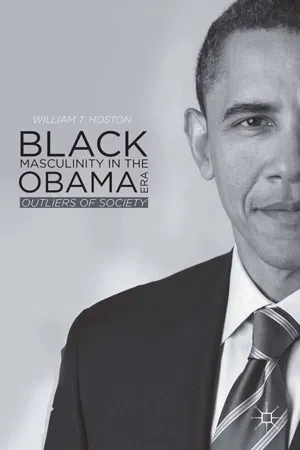
Black Masculinity in the Obama Era provides an in-depth examination of the current state of black males and identifies the impact of living in the Obama era. In the era of the first black president, Barack H. Obama, this book gauges the status of black masculinity and provokes discourse to discover whether his election and presence has had an influential impact on black male achievement. A purposeful sample of black males was asked, what does it mean to be a black male in the 21st century? Throughout the interviews with black males, we learn that the 'Obama Effect' has not had the intended impact on black male achievement and black males continue to be plagued by structural and cultural forces that have historically burdened their plight and level of achievement.
Information
C H A P T E R 1
The Black Male Identity
If there is anyone out there who still doubts that America is a place where all things are possible; who still wonders if the dream of our founders is alive in our time; who still questions the power of our democracy, tonight is your answer.
—President-Elect Barack H. Obama, November 4, 2008, Chicago, Illinois
On November 4, 2008, Black Americans, as well as many Democrats, shed tears of joy while witnessing the election of Senator Barack H. Obama of Illinois as the country’s first Black president. He was elected the forty-fourth president of the United States with 53 percent of the popular vote and 365 Electoral College votes, far exceeding the 270 threshold to capture the presidential office. The election of Obama was a significant moment in Black American history. This was a moment to be cherished for members of the Black community and African ancestry who had struggled for centuries to obtain economic, social, and political equality.
Since the election of President Obama, what are the continuing economic, social, and political challenges faced by the Black community, particularly Black males? Has the election of Obama changed the discourse among Black males? Has the societal perception of his achievement been a catalyst to alter negative stereotypes that haunt the Black male image? Has Obama’s presence sparked added motivation for more Black males to strive to alleviate themselves from circumstances that may burden their progress or advancement? Much discussion has taken place about the “Obama Effect” on Black males. His attainment of the highest executive position in the United States should serve as a model to inspire Black males to reach their full potential void of excuses perpetuated by institutional and systemic discrimination and racism. However, limited retort has directly surveyed the opinions of Black males regarding the impact of the “Obama Effect” and what issues continue to be of grave importance to Black males during his presidency.
Many social observers, Black and White, believe that since Obama has been elected to the presidential office, Black males no longer face the same discriminatory barriers as before. Their perception is that we have moved beyond institutional and systemic discrimination that has in the past crippled the plight of Black males. Needless to say, Obama’s presence alone cannot cure the social ills that impact Black males. The symbolic achievement of one man cannot erase the centuries of injustices against masses of Black males.
The ideal of Obama as a symbol of Black male progress is rather ironic considering that during his 2008 presidential run many Blacks did not consider him a Black American and questioned the validity of his “Blackness.” This part of his cultural identity was initially debated in the Black community. Cultural identity refers to “the attribution of a set of qualities to a given population” identified by a number of demographics such as race, ethnicity, gender, and social class (Friedman 1994, 29). Obama’s race was at the center of the national spotlight and the validity of his “Blackness” was thought to be a deciding factor of whether he would be able to attract potential Black voters and appeal to the Black community as a legitimate candidate. His biracial heritage that includes an African father from Kenya and a White mother from Kansas made many in the Black community skeptical of his allegiance and commitment to representing Black interests.
In Obama’s 1995 book, Dreams from My Father, he explains the influence of his Caucasian roots and discusses how his mother mostly shaped his cultural identity while his father was absent from his life. In a phase of Obama’s life where his cultural identity takes shape and he begins to accept his identity as a Black American, he reflects:
I knew it was too late to ever claim Africa as my home. And if I had come to understand myself as a black American, and was understood as such, that understanding remained unanchored to place. What I needed was a community, I realized, a community that cut deeper than the common despair that black friends and I shared when reading the latest crime statistics, or the high fives I might exchange on a basketball court. A place where I could put down stakes and test my commitments. (115)
Obama’s understanding of community and awareness of the needs of the Black community propelled him to be an agent of social and political change and become a community organizer on Chicago’s South side. As a community organizer in the Altgeld Gardens public housing project in the mid-1980s, he was a tireless worker for this majority Black housing development where residents struggled financially, lived in dilapidated units, and faced the constant fear of crime.
The controversy surrounding Obama’s “Blackness” caused extensive debate in mainstream media. In October of 2006 when Time Magazine contributor Joe Klein wrote an article on Obama suggesting he could be “The Next President,” members of the Black media offered a barrage of critical and harsh comments. Stanley Crouch, a Black columnist for the New York Daily News, wrote some pointed words in a November 2006 editorial titled “What Obama isn’t: Black like me on race.” He expresses, “Obama’s mother is of white U.S. stock. His father is a black Kenyan. Other than color, Obama did not—does not—share a heritage with the majority of black Americans, who are descendants of plantation slaves.”1 These comments drew strong criticism from Obama supporters. Crouch further states:
If he [Obama] throws his hat in the ring, he will have to run as the son of a white woman and an African immigrant. If we then end up with him as our first black President, he will have come into the White House through a side door—which might, at this point, be the only one that’s open.2
Crouch’s comments were followed by Black writer Debra Dickerson on the liberal online website, Salon. In her 2007 editorial titled “Colorblind,” Dickerson advised against “lumping us all together” for the benefit of recognizing Obama as a “Black man.” Her claim was that “Black, in our political and social vocabulary, means those descended from West African slaves.”3 However, such criticism of defining “Blackness” is debatable, as cultural identity is not simply relegated to skin color but includes a number of demographic identifiers that shapes one’s identity.
In Dreams from My Father, Obama recognizes that many would question his biracial identity. He recalls, “My father looked nothing like the people around me—that he was black as pitch, my mother white as milk—barely registered in my mind” (10). As a rule to the ideology of the one-drop theory that in the past assumed that a single drop of “Black blood” classified someone as Black, Obama is considered by many to be a Black American. In a 2008 CNN interview with Charlie Rose while on the campaign trail, Obama addressed the “Blackness” debate by stating, “If I’m outside your building trying to catch a cab they’re not saying, ‘Oh, there’s a mixed race guy.’”4
The heightened condemnation of Obama’s presidential run and need for proof of his “Blackness” spawned from the lack of cultural similarities with those in the Black community. Academic and friend of the Obama family, the late Ronald Walters, in a 2007 article that discussed Obama’s Blackness, writes:
It is legitimate that Black Americans raise questions about “Blackness” as an objective issue, because it is the core concept that defines the basic cultural identity of Black people. That is why the cultural identity of Barack Obama evoked such confusion. (12–13)
In his analysis, Walters indicates that Obama possessed a different cultural background than most Black Americans by living in different geographical areas thus making it difficult to relate to his life’s journey. He expresses that, “his [Obama] identity omitted many of the cultural markers with which Blacks are more familiar to the extent that it has promoted a curiosity of ‘cultural fit’ that in turn has become an issue of political trust” (13).
Despite questioning Obama’s “Blackness” because he had an African father, White mother, was raised by White grandparents, grew up in Hawaii, and had a brief stint in Indonesia, he did have a number of specific cultural markers many in the Black community could relate to that molded his cultural identity and should have provided acceptance in the Black community prior to his presidential run. First, he grew up without a father. Second, he is married to a Black woman, Michelle Obama. Third, he attended a majority Black church, Trinity United Church of Christ (TUCC), headed by Jeremiah A Wright Jr., for over twenty years before he denounced his affiliation amid public scrutiny. Last, he became a community organizer in Chicago and later a state legislator representing a majority Black district.
Cultural similarities are important markers in distinguishing Obama as a member of the Black community. For instance, on several occasions Obama has strongly advocated during his presidency for the presence of Black males in the home. He has expressed that the evolving cultural identity of the Black male is highly dependent on current Black fathers assuming parental responsibility and rearing a child to have a solid foundation for success. The absence of such a relationship has an adverse effect on the Black male identity. In Dreams from My Father, he recollects:
At the time of his death, my father remained a myth to me, both more and less than a man. He had left Hawaii back in 1963, when I was only two years old, so that as a child I knew him only through the stories that my mother and grandparents told. They all had their favorites, each one seamless, burnished smooth from repeated use. (5)
After a stretch of narrating positive, memorable stories told from the perspectives of his mother and grandfather, Obama enters a reflective mode and expresses, “My father was missing. He had left paradise, and nothing that my mother or grandparents told me could obviate that single, unassailable fact. Their stories didn’t tell me why he had left” (26).
Obama, like so many other Black males, wanted to know why his father did not return. This question has lingered in the minds of many Black males who seek the answer for their own personal refuge. In a 2008 Father’s Day address at the Apostolic Church of God on Chicago’s South Side, Obama spoke to the congregation about his own experience growing up without a father and the responsibility needed on the part of Black males. In the speech, he voiced parental responsibility:
But if we are honest with ourselves, we’ll admit that what too many fathers also are is missing—missing from too many lives and too many homes. They have abandoned their responsibilities, acting like boys instead of men. And the foundations of our families are weaker because of it.
We need fathers to realize that responsibility does not end at conception. We need them to realize that what makes you a man is not the ability to have a child—it’s the courage to raise one.5
How can a man who grew up without his father, raised in a White culture, by his own admission experienced little racial discrimination, and was sheltered from life as a Black American in his childhood and adolescent years as told in the book The Audacity of Hope (2006) have a profound impact on other Black males? The answer is simple. Obama can have an impact the same way that a young Rev. Dr. Martin Luther King Jr. led a nation against racial injustice, discrimination, and admittedly said he was isolated from those same burdens as a youth.
The culmination of Obama’s personal journey has been inspirational for the Black community. With a highly intelligent, regal, Black wife by his side, First Lady Michelle Obama, and two beautiful daughters, the Obamas represent a strong nuclear Black family. In particular, he represents the idea of what it means to be a God-fearing, strong, wholesome, loving, caring, highly educated family man that is in high demand in the Black community, in contrast to the constant negative societal portrayals of Black males as individuals who do not marry the mother of their children, have multiple children out of wedlock, are unemployed, uneducated, and considered criminal misfits.
Obama represents the twenty-first century’s version of the “New Negro,” a term promoted by Alain Locke in the 1920s during the Harlem Renaissance period that represented social and cultural change for Black Americans and catapulted positive and progressive images of Black males. Locke (1925) wrote in the foreword of the seminal text, The New Negro: An Interpretation, “Negro life is not only establishing new contacts and founding new centers, it is finding a new soul. There is a fresh spiritual and cultural focusing” (ix).
During the Obama era, similar to the times of the Harlem Renaissance and Civil Rights movement, the cultural identity of Black male life is at the center of this discussion. Cultural identity plays a significant role in the representation of one’s self, both positively and negatively. It is difficult to dissect the multiple layers of the Black male identity, especially in one such as Obama. According to Gerald, Entrepreneur, 36:
Obama is cool as hell. His identity is so complex, yet simple and refreshing.
On one hand, he was the first Black president of the Harvard Law Review and later went on to become the first Black president of the United States. On the other hand, you see pictures of him with his wife and kids, chilling at the basketball game like an every day dude. He is such an inspiration. I love my president.
President Obama campaigned on “hope,” “change,” and “forward.” We assume his presidential message of creating a better America had a profound effect on the 93 percent of Black voters who re-elected him in 2012. This strong commitment to Obama has led social scientists and political pundits to attempt to identify what has Obama’s effect been on Black America? Proponents believe that Obama’s transformational potential is unlimited and should have an awe-inspiring influence on the Black community as a whole, particularly Black males. On the contrary, some opponents have indicated that the “Obama Effect” may be waning, especially among Black males, and some were never swayed by his election and presence. For example, as I shall discuss in Chapter Four, criticism has loomed that Obama’s presence may not have a significant influence on the lives of Black males and what the future holds for them.
Have the 2008 and 2012 elections of Obama created a new cultural narrative for Black males? What is the root cause of the continual discrimination and racism against Black males and the behavioral responses of this marginalized group? Are Black males still victims of discrimination and racism? Or, are these actions toward them and pointed racial stereotypes now self-inflicted? Have they become their own worst enemies? Can a majority of Black males assimilate and achieve the highest levels of economic, social, and political success? What has truly been the influence of President Obama on the plight of Black males? More importantly, what does it mean to be a Black male in the twenty-first century?
This book explores the current autonomous Black male subculture. The aim is to expand the discussion on the economic, social, and political plight of Black males in the twenty-first century. The fracture of Black solidarity since the Civil Rights movement, coupled with decades of limited productive opportunities and quality resources, leads this dialogue to first dissect the multiple layers of the Black male identity. What is the current cultural identity of Black males? And what role do structural factors such as joblessness, poverty, and the broken-down public education system play in shaping their identity? As stated above, the identity of Black males is further magnified since the electio...
Table of contents
- Cover
- Title
- Introduction
- 1 The Black Male Identity
- 2 We All Came from a Woman: Rap Music and Misogyny
- 3 Black-on-Black Murders: A Case Study of Chiraq, Killinois
- 4 Living in the Obama Era
- 5 Black Boy Fly
- Postscript I Love Being a Black Man: The Plight, Triumph, and Reflective Mode of Black Male Success
- Appendix A.1: Interview Schedule of Black Male Participants
- Appendix A.2: Chapter Two Methodology
- Notes
- References
- Index
Trusted by 375,005 students
Access to over 1.5 million titles for a fair monthly price.
Study more efficiently using our study tools.
Frequently asked questions
Yes, you can cancel anytime from the Subscription tab in your account settings on the Perlego website. Your subscription will stay active until the end of your current billing period. Learn how to cancel your subscription
No, books cannot be downloaded as external files, such as PDFs, for use outside of Perlego. However, you can download books within the Perlego app for offline reading on mobile or tablet. Learn how to download books offline
Perlego offers two plans: Essential and Complete
- Essential is ideal for learners and professionals who enjoy exploring a wide range of subjects. Access the Essential Library with 800,000+ trusted titles and best-sellers across business, personal growth, and the humanities. Includes unlimited reading time and Standard Read Aloud voice.
- Complete: Perfect for advanced learners and researchers needing full, unrestricted access. Unlock 1.5M+ books across hundreds of subjects, including academic and specialized titles. The Complete Plan also includes advanced features like Premium Read Aloud and Research Assistant.
We are an online textbook subscription service, where you can get access to an entire online library for less than the price of a single book per month. With over 1.5 million books across 990+ topics, we’ve got you covered! Learn about our mission
Look out for the read-aloud symbol on your next book to see if you can listen to it. The read-aloud tool reads text aloud for you, highlighting the text as it is being read. You can pause it, speed it up and slow it down. Learn more about Read Aloud
Yes! You can use the Perlego app on both iOS and Android devices to read anytime, anywhere — even offline. Perfect for commutes or when you’re on the go.
Please note we cannot support devices running on iOS 13 and Android 7 or earlier. Learn more about using the app
Please note we cannot support devices running on iOS 13 and Android 7 or earlier. Learn more about using the app
Yes, you can access Black Masculinity in the Obama Era by W. Hoston in PDF and/or ePUB format, as well as other popular books in Social Sciences & European Politics. We have over 1.5 million books available in our catalogue for you to explore.