eBook - ePub
The Material Cultures of Enlightenment Arts and Sciences
- English
- ePUB (mobile friendly)
- Available on iOS & Android
eBook - ePub
The Material Cultures of Enlightenment Arts and Sciences
About this book
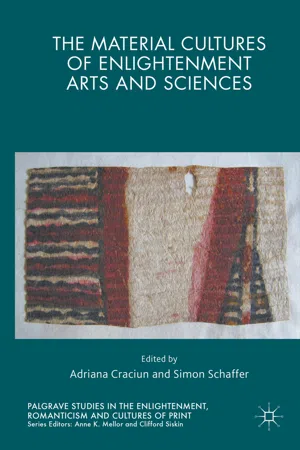
In this book the eighteenth century Enlightenment receives an important reassessment, using an astonishing range of materials and objects drawn from Europe and beyond, including artefacts from India and China, West Africa and Polynesia. A series of authoritative essays written by experts in the field explores the full range of material culture in the long eighteenth century, raising crucial questions about notions of property and invention, homely and commercial lives. The book also includes a series of well-illustrated exhibits, a startling and provocative assemblage of objects from the Enlightenment world, each accompanied by expert commentaries. The collection of essays and exhibits is the result of collaborative debate by scholars from Europe and north America, who have together worked on the cross-disciplinary importance of material history in making sense of how past society was fundamentally transformed through the world of goods.
Information
© The Author(s) 2016
Adriana Craciun and Simon Schaffer (eds.)The Material Cultures of Enlightenment Arts and SciencesPalgrave Studies in the Enlightenment, Romanticism and the Cultures of Print10.1057/978-1-137-44379-3_11. Introduction
Adriana Craciun1 and Simon Schaffer2
(1)
Department of English, University of California, Riverside, Riverside, CA, USA
(2)
Department of History and Philosophy of Science, University of Cambridge, Cambridge, UK
These Creatures were as large as Partridges, I took out their Stings, found them an Inch and a half long, and as sharp as Needles. I carefully preserved them all, and having since shewn them with some other Curiosities in several parts of Europe; upon my Return to England I gave three of them to Gresham College, and kept the fourth for my self. (Jonathan Swift, Travels into Several Remote Nations of the World by Lemuel Gulliver, book 2, 1726)1
The largest room, or rather the largest apartment, would not be too great a space to contain collections of every kind of Nature’s different productions. What an immense and wondrous assemblage! How indeed to make a correct idea for oneself of the spectacle offered to us by all the types of animals, vegetables, and minerals, if they were assembled in one and the same place, and seen, so to speak, at a glance? This display, varied to infinity by the smallest steps, cannot be conveyed through any description, save by the very objects of which it is composed (Denis Diderot, ‘Cabinet d’histoire naturelle’, Encyclopédie, ou dictionnaire raisonné des sciences, des arts et des métiers, vol. 2, 1752).2
Here is a list of things: a penny coin shipped from Birmingham to west Africa, a hand-engraved sextant destined for a voyage to China, an ulcerated oesophagus removed from a London woman, an English book made of Polynesian barkcloth, a French artist’s colour box, a bundle of bound papers carrying seditious verses from the Glorious Revolution, an embroidery concealing a bird skull, a ceramic cup discarded in a Chinese kiln, and centuries-old Banksia seeds entombed in a Pacific shipwreck. Things may be the wrong term here. We might as well speak of objects, artifacts, waste, commodities, specimens, ephemera, relics, artworks, instruments, souvenirs. Each of these terms is bound up with specific economic models, of making, seizure, collection, appropriation, storage and exchange. Such characteristic economies all possess their own remarkable histories.3 Thus, even naming turns out to be a difficult and slippery task, sometimes brutally anachronistic or inaccurate. In the Enlightenment’s exemplary printed assemblage, the alphabetic array and brightly lit tabulations of the Encyclopédie, the orderly disposition and proper nomenclature of things and tasks were taken to be crucial for a project to catalogue and master the processes of labour and the world of newfangled goods.4 The very activity of classification—an enterprise so characteristic of Enlightenment arts and sciences, in natural history and chemistry, in markets and workshops—could barely be pursued or even understood unless seen as entirely entwined with the production, distribution and movements of the mass of commodities and artifacts that freshly populated eighteenth-century worlds.5
Taxonomy and terminology mattered, especially in the histories of the occupants of this commodity system. Enlightened inventiveness, commonly identified with the enterprises of ambitious manufacture and global traffic, was much devoted to the production of new things as well as of novel processes.6 Eighteenth-century metropoles were peculiarly fascinated and disturbed by this kind of innovation in the inhabitants of the world of goods. Part of the trouble, and the appeal, was the puzzle of mutability. None of the things in our list was so robust that it preserved just the same sense in all the milieux where it happened to find itself, yet none was quite malleable enough simply to borrow its character entirely from its surroundings. As Nicholas Thomas has argued, artefacts cannot be defined solely by their makers’ intent: they are all the things they become. Roger Chartier has comparably urged that in studies of eighteenth-century material cultures, consumption must not be seen as passive, but rather as part and parcel of worlds in which goods were appropriated anew, redirected and redefined, and often bound up with conflict and resistance.7 The careers of such things were often a challenge to received notions of the good order of creation, precisely because of their protean quality and the sheer difficulty of fixing their character.
Some people hoped it might be possible to get things to define themselves, if only they could become sufficiently eloquent. Within the fraught workings of long-range commodity trade in particular, this became a principal aim of the name systems that Europeans invented in the eighteenth century. Thus, in 1763 the pre-eminent Swedish naturalist Carl Linnaeus lectured that by associating naming with diagnosis of properties, his labels would allow everyone ‘to distinguish any plant whatsoever at first glance, even if it came from farthest India, since the plant itself informs them about its name, its taste, its smell, its properties, powers and uses, yes, points them with a finger, as it were, to all that is known about it, for the good of mankind’.8 While later scholars have been somewhat less sure than Linnaeus that such things can reliably speak their character, it has become a major concern in studies of Enlightenment culture to use the eloquent testimonies of that epoch’s material worlds to make new sense of its life and labour. According to what has been called a kind of ‘methodological fetishism’, it has been argued that it is precisely when objects misbehave or err, when they resist or escape the apparently directive powers of their makers and users, that they are then registered as things with their own agency and character.9
Conceptual tools drawn from variants of the new materialism at work across the humanities and social sciences can be brought to bear on the eclectic range of materials assembled in this collection. The Material Cultures of Enlightenment Arts and Sciences explores the generative potential of materiality in rethinking the Enlightenment, and more broadly eighteenth-century studies. Attention to materiality in general, and material culture specifically, is a welcome corrective, or complement, to the traditions of intellectual and textual history that dominate Enlightenment and eighteenth-century historiography. If the task of the human sciences is to make the familiar unfamiliar and the unfamiliar familiar, our book pursues this defamiliarizing project with a focus on the transculturated material culture shared by humanistic inquiry. To this end, the work assembles a host of well-known and more humble or obscure objects in the fashion of a rather loosely ordered cabinet. There may, indeed, be a specific aspect of eighteenth-century commerce and aesthetics in play in the arrangement of this collection. Playful vocabulary and disposition are scarcely avoidable, and in some ways desirable, in dealing with such Enlightenment goods as appear here: terminologies of grammar and semantics became entangled with the idioms of market and commodity culture. As James Bunn has noted, for example, import had the sense both of commodity acquisition and of the conveyance of meaning. Eighteenth-century critics sometimes condemned the apparent accumulation of individual objects of curiosity and value, imports looted or purchased with no special care for their original import. ‘I have got twenty things of China that are of no use in the world’, exclaims a London lady of distinction to Oliver Goldsmith’s astonished and disgusted Mandarin visitor in his Citizen of the World (1760). ‘Look at those jars, they are of the right pea-green,’ she continues, ‘these are the furniture!’ It was a fashionably enlightened commonplace, much in question in the contributions to this book, that arguments about possession and use were bound up with the places where such goods were made, or stored, or displayed, or manipulated.10
Debates about luxury and commerce, about threats to the good order of domestic life and the moral conduct of a society of orders, can be re-examined and better analysed by tracing such objects’ pathways. Commenting on an early eighteenth-century painted cloth now hung in a Gloucestershire manor house, Tara Hamling explains how traditional art history has neglected the material form of such apparently domesticated decorative crafts. Similarly, Alexi Baker’s exhibit of an early eighteenth-century telescope shows how conventional histories of scientific instruments have mistakenly and patronisingly neglected the vital role played by retailers and ‘toymen’ in such trades. In her remarks on a 1790 Staffordshire earthenware plate decorated with an image of a pair of compasses, Katy Barrett points out that warnings against the evils of consumption were widely consumed as marketable commodities. There was thus a fundamental relation between judgements of the morality of goods and of the appropriate ways in which they should be acquired, stored and displayed. The relation was marked in contemporary language. For example, one sense of case, referring to a state of affairs or a persuasive argument, which in the later eighteenth century came to refer to a matter of detection and inquiry (Latin casus), somewhat strangely converged in English with the other sense of case (Latin capsa), a secure containment, a place for storage and accumulation. This is a book of cases, in both senses.
In some respects, cases are arrayed here according to principles of eighteenth-century disposition: a well-entrenched distinction between naturalia and artificialia, a connoisseur’s privilege granted to objects understood as exotic, a separate gathering of paper materials handwritten, engraved or printed. Yet recognizing that readers do not read in linear fashion, these assemblages group longer essays with a series of shorter exhibits, inviting readers to explore the many possibilities evoked in longer case studies by considering a series of alternative objects of attention. As Adriana Craciun’s and Mary Terrall’s essays show, seeds recovered from a shipwreck or insects dissected in a Parisian cabinet speak to the value of natural curiosities in Enlightenment sciences. However, they also ‘put on view a record of work and pleasure, inventions and techniques, sociability and exchange’ reaching far outside metropolitan scientific circles.11 Several of the exhibits bring out the multi-dimensionality and ambiguity of objects’ construction. Just as Mary Delany’s Flora Delanica, cut-paper collages of plants described here by Kim Sloan, often included original leaves or flowers, so the late seventeenth-century embroidery on show in Mary Brooks’s exhibit incorporated birds’ beaks, perhaps finches or linnets. Such needlework could be considered as a novel form of a natural history cabinet, or an affective memorialization of beloved animal companions, or a genteel form of feminine material culture with rich connections to networks of science.
The brief glimpse caught of these extraordinary hybrid objects opens up new directions for longer analyses and recombinations. More conventional themes of Enlightenment public culture, such as the investment in publicity and celebrity on display in Faramerz Dabhoiwala’s exhibit of a 1765 portrait of the courtesan Kitty Fisher, or the colonial circulation of currency linked with the 1790s Soho-made coin described by Catherine Eagleton, can be queried and reorganized by close attention to objects’ pathways. Fisher’s portrait is artfully balanced between composure and manipulation of its audiences; the coin moved between Birmingham, Sierra Leone and the polite cabinets of fashionable London. ‘Tracking the story of this rather ordinary-looking penny links together several topics that are often considered separately when looking at the late eighteenth century’, Eagleton explains.12 The assemblages proposed here are designed to encourage such fluid readings, playing with scale of attention and analysis, through which in future work exhibits may become essays and vice versa.
An aim of this collection is to make the case both for objects’ surprising mobility and for their ‘implacability’, a term that Jonathan Lamb’s essay here adopts from Theodor Adorno’s discussion of the new powers of objects in an age of aggressive technology. Adorno damned the ways in which engagement with such things had been reduced to mere functionality: ‘what does it mean for the subject that there are no more casement windows to open...
Table of contents
- Cover
- Frontmatter
- 1. Introduction
- 1. Natural Curiosities
- 2. Tools and Travels
- 3. Artificial Curiosities
- 4. Exotic Goods
- 5. Worlds on Paper
- Backmatter
Trusted by 375,005 students
Access to over 1.5 million titles for a fair monthly price.
Study more efficiently using our study tools.
Frequently asked questions
Yes, you can cancel anytime from the Subscription tab in your account settings on the Perlego website. Your subscription will stay active until the end of your current billing period. Learn how to cancel your subscription
No, books cannot be downloaded as external files, such as PDFs, for use outside of Perlego. However, you can download books within the Perlego app for offline reading on mobile or tablet. Learn how to download books offline
Perlego offers two plans: Essential and Complete
- Essential is ideal for learners and professionals who enjoy exploring a wide range of subjects. Access the Essential Library with 800,000+ trusted titles and best-sellers across business, personal growth, and the humanities. Includes unlimited reading time and Standard Read Aloud voice.
- Complete: Perfect for advanced learners and researchers needing full, unrestricted access. Unlock 1.5M+ books across hundreds of subjects, including academic and specialized titles. The Complete Plan also includes advanced features like Premium Read Aloud and Research Assistant.
We are an online textbook subscription service, where you can get access to an entire online library for less than the price of a single book per month. With over 1.5 million books across 990+ topics, we’ve got you covered! Learn about our mission
Look out for the read-aloud symbol on your next book to see if you can listen to it. The read-aloud tool reads text aloud for you, highlighting the text as it is being read. You can pause it, speed it up and slow it down. Learn more about Read Aloud
Yes! You can use the Perlego app on both iOS and Android devices to read anytime, anywhere — even offline. Perfect for commutes or when you’re on the go.
Please note we cannot support devices running on iOS 13 and Android 7 or earlier. Learn more about using the app
Please note we cannot support devices running on iOS 13 and Android 7 or earlier. Learn more about using the app
Yes, you can access The Material Cultures of Enlightenment Arts and Sciences by Adriana Craciun, Adriana Craciun,Simon Schaffer in PDF and/or ePUB format, as well as other popular books in Literature & Library & Information Science. We have over 1.5 million books available in our catalogue for you to explore.