eBook - ePub
Phronesis and Quiddity in Management
A School of Knowledge Approach
- English
- ePUB (mobile friendly)
- Available on iOS & Android
eBook - ePub
Phronesis and Quiddity in Management
A School of Knowledge Approach
About this book
Phronesis and Quiddity in Management addresses the issue of the excellence in judgment-making, its concept and characterisation. This book investigates first into what constitutes excellent managerial skills centred on leadership revolving around judgement-making (rather than decision-making) and second into whether they can be taught.
Information
1
Introduction
This book addresses the issue of the excellence in judgement-making,1 its concept and characterisation. Our concept is basically a breed of Aristotle’s phronesis and Izutsu’s (Izutsu, 1983, 1991) consciousness (Bewusstsein), although many other authors get also drawn upon when needed. We keep the term ‘phronesis’ (or its translation as ‘wisdom’ or ‘practical wisdom’) to emphasise its conceptual dependence on Aristotle (2001). At the same time, however, this book, through its title, stresses another conceptual derivation from Toshihiko Izutsu’s main work, Consciousness and Quiddity (Izutsu, 1983, 1991), in that it is inspired by the metaphysical thesis of the Japanese philosopher.
In a nutshell, it will be sustained in this book that phronesis and action guided by it are a privileged access to the core of reality as it is.2 Excellent managerial decisions would be those able: (1) to capture how business situations could be according to their true nature and (2) to turn them into reality. Since ‘one swallow does not make a summer’ (Aristotle), one action may not make an excellent judgement-maker, but its repetition does. Many good decisions build up to become wisdom and make the decision-maker ‘a wise manager’. The notion of the wise manager developed in one of Nonaka’s (2011) latest works adds an essential contribution to the object of this book.
We will set out some further details about the thrust of this book. We mean ‘reality as it is’ in a philosophical sense, by which we imply that phronesis is knowledge of a metaphysical kind. In this regard, it goes beyond the way Aristotle understands it, for him meta-physics is the object of the theoretical, not practical, part of human soul.
According to Izutsu (1983), the essence of reality is contingency. Thus, to give precedence to stability over change, to universal essences over time, to necessity over contingency as the essence of reality, as some metaphysics do, is a misconception: reality’s hallmark is contingency.
This misconception is traceable back to the subject/object dichotomy or, in other words, to the divide between consciousness and world. This divide originates in the efforts of the individual self to hold onto itself and not to let itself be fused with the world (Varela et al. 1993). These are attempts born from fear of the loss of own identity. Western metaphysics could be thoroughly explained by this process (Varela et al., 1993: xvii). In management theory, the subject/object divide epitomises rational choice theory (Flyvbjerg, 2004b).
Meditation techniques available in Eastern traditions, such as Buddhism or Islamic Sufism, help the individual to correct this view (Izutsu, 1971). As soon as the individual self realises its efforts were delusional and the only way to gain itself is by losing itself in the world, it enters into contact with reality as contingency and is ready to perceive reality as it is. This way, the individual self achieves wisdom.
Since contingency means that reality could be this way or the other, coming to being or not being at all, an important part of such wisdom will consist of turning the possibility of being into actual being. This is the nature of action. Therefore, action unfolds the intimate structure of reality when it originates in wisdom. As a consequence, and in the case of managerial judgement-making, it will be argued that managers’ good decisions are those where a possible true state of things is made to happen in reality.
This is pregnant with far-reaching consequences. First, practical reason has priority over theoretical reason.Second, those factors closely related to action, such as body, language, emotions, the un conscious, social interaction and so on, acquire metaphysical relevance. The importance of these factors for the practice of management can be hardly exaggerated, as will be seen, especially through the concept of the wise leader.
1 Research question
This book investigates, first, what constitutes excellent managerial skills centred on leadership revolving around judgement-making (rather than decision-making) and, second, whether they can be taught.
Excellence in management manifests itself best, in the words of Dreyfus (1981: 33), in ‘unstructured situations’, such as strategy-making in turbulent environments, selection of key executives, pre-emption of adverse business trends, disruptive product innovation and so on.
Therefore, we aim in this book to identify and clarify the kind of knowledge (and personal disposition, traits, characteristics etc.), which would allow managers to cope most effectively with these unstructured situations. In addition, we aim to delve into the possibility or not of inculcating managers with such knowledge and disposition by training.
Thus, the basic twofold purpose of this research leads us to the review and analysis of the business reality facing management, and the knowledge profile required to deal with it. In other words, and as expressed in the title of this book, this research builds upon the ideas of phronesis and quiddity.
Phronesis is a term that first appeared in Aristotle’s Ethica Nichomachea (2001) and has been translated as prudentia (Aquino, 2007), ‘practical wisdom’ (Finnis, 1998; MacIntyre, 1984; Murphy, 2001; Simon, 1991), ‘practical knowledge’ (Simon, 1991) or ‘practical rationality’ (Murphy, 2001).
This book rests mainly on Aristotle’s understanding of the concept and the further developments it has experienced within (see Macintyre, 1984) or in the vicinity (Flyvbjerg, 2001, 2002, 2004b; Nonaka and Toyama, 2007; Nonaka et al. 2008) of the Aristotelian tradition.
Phronesis can be considered the informed or reasonable making of decisions in order to achieve some goal that has been elucidated as worth pursuing by the subject: what is sought ultimately is a higher level of well-being – be it Aristotle’s ‘good life’ (2001: 21, 1095a: 15–22) or another concept performing the same function.
Quiddity is a Latin term that may be translated as ‘what it is’. It designates reality as it is or the essence of reality. The concept has a very long history of interpretations (oftentimes conflicting), as will be seen in Chapter 4. We will argue that at the core of reality lies contingency. It may sound odd to define quiddity as ‘what it is’ while arguing that at its heart lies ‘what could be’. However, as will be discussed later, in reality as it is, time is a meaningless concept, so what is already contains what could be without meaning by that everything is predefined from the beginning.
Phronesis would be the ability to turn that contingency, that is, something possible, into something real, that is, necessary. That does mean we aim to demonstrate that phronesis is a kind of knowledge that opens a privileged access to quiddity. Our proposition follows closely the ideas advanced in the work of Professor Toshihiko Izutsu entitled Consciousness and Quiddity (1991) (and, in its German translation, Bewusstsein und Wesen (1983)). Thus, we are greatly indebted to Izutsu’s thinking beyond the mere resemblance of the book title. Our book draws general inspiration from it, including many instances of insight. This constitutes the first pillar of our research.
The second pillar is to show, by applying our conceptual framework to real-life case studies of successful managers, that excellence in managerial skills boils down to phronesis. In this regard, Nonaka’s recent proposal of the ‘wise leader’ (Nonaka and Takeuchi, 2011) provides a deep insight into it.
Excellent managers are able to discern opportunities that nobody else can identify (to grasp the reality of a business situation as it is) and bring them about. Likewise, they are capable of pre-empting negative situations before they take place, thanks to their discernment. As explained later, phronesis-informed judgement-making is rather a co-creation of reality than a stocktaking of what already exists.
Related to the notion of phronesis is the issue of intuitive knowledge. There is empirical and conceptual evidence that intuition yields superior results in unstructured situations, in general (Dreyfus, 1980) as well as in business settings (Cohen et al. 1972; Kase et al. 2011). The concept of intuition will be explained in detail in Chapter 5. Here, given that some familiarity with this notion is needed, we take a phenomenological approach and roughly describe it by means of contrast to analytical or systematic knowledge.
Whereas the analytical or systematic knowledge entails reflection, tends to be time-consuming and proceeds top-down from general principles to concrete data, intuition operates below the level of consciousness, moves light-fast and builds conclusions from the particular, concrete data of the situation upwards to general principles. In terms of decision skills, intuition is usually to be found among expert ‘decision-makers’, whereas analysis is the prerogative of novices (Dreyfus, 1980).
The idea defended in this book is that practical judgement works much like intuition, so to speak. The truth is that some practical deliberation, especially when involving dilemmas, may require much analysis and time. Yet usually those occasions involve two conflicting intuitions (which give rise to the dilemma) rather than the outcome decision being a consequence of an incremental addition of data, as in systematic analysis. As illustrated in Annex 1 on Idemitsu Sazo and Annex 2 on Kazuo Inamori, the judgement-making process has features of intuition, especially as practised by excellent judgement-makers.
The relevance of this research is all the greater, since the view of practical reason present in management and economic studies and education – namely, the main representative thereof – is rational choice theory (RCT), which is plagued with ‘scientist’ assumptions (Goshal, 2005). Scientism is a term coined by Hayek (1979). Through it he wanted to separate truly scientific statements from those from which a pseudoscientific character arises, by trying to apply scientific methods, suitable for the physical reality, to social/human phenomena.
This book contends that the ‘scientist’ reading of management underpinning most mainstream management theories has greatly impaired the development of a sound account of managerial activity (Nonaka et al., 2008). The treatment of three aspects of human activity vital for the concept of wise manager are, as later explained, particularly misguided in RCT and other related approaches. These are: (1) a deficient account of emotions, (2) difficulties in fitting ethical considerations into the management discourse and (3) poor understanding of social phenomena.
We will argue that the main error of RCT was to apply a mechanistic or instrumental way of thinking (appropriate for the manipulation of objects) to human actions and relationships (Figure 1.1).
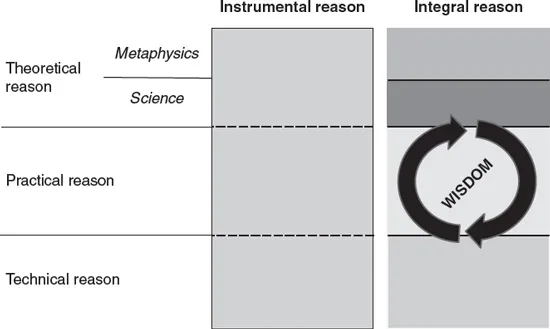
Figure 1.1 Rationality schemes: Rational choice theory vs metaphysical realism
To illustrate this point and the general argument of this book, we resort, as shown in Figure 1.1, to the Aristotelian division of reason in episteme (theoretical reason), phronesis (practical reason) and techne (technical reason) (2001: VI, 3), which will be explained in further detail in Chapter 5. For Aristotle (‘Integral reason’ column), phronesis is an intellectual virtue that stands halfway between two other forms of knowledge: analytical, scientific knowledge (episteme) and technical, instrumental knowledge or know-how (techne) (Flyvbjerg, 2004a: 399–400).
The increment in colour intensity in the column ‘Integral reason’ (from pale to dark gr...
Table of contents
- Cover
- Title Page
- Copyright
- Dedication
- Contents
- List of Figures and Tables
- Foreword
- Prologue
- Acknowledgements
- 1. Introduction
- 2. The Rationalist Approach to Judgement-Making: Description and Critique
- 3. The Metaphysics of Judgement-Making: Contingency
- 4. Consciousness and Quiddity
- 5. Phronesis and Quiddity
- 6. Conclusions and Discussions
- Annex 1: Idemitsu Sazo (1885–1981)
- Annex 2: Kazuo Inamori
- Annex 3: La Fageda: Knowledge Generation in Social Business
- Notes
- Index
Trusted by 375,005 students
Access to over 1.5 million titles for a fair monthly price.
Study more efficiently using our study tools.
Frequently asked questions
Yes, you can cancel anytime from the Subscription tab in your account settings on the Perlego website. Your subscription will stay active until the end of your current billing period. Learn how to cancel your subscription
No, books cannot be downloaded as external files, such as PDFs, for use outside of Perlego. However, you can download books within the Perlego app for offline reading on mobile or tablet. Learn how to download books offline
Perlego offers two plans: Essential and Complete
- Essential is ideal for learners and professionals who enjoy exploring a wide range of subjects. Access the Essential Library with 800,000+ trusted titles and best-sellers across business, personal growth, and the humanities. Includes unlimited reading time and Standard Read Aloud voice.
- Complete: Perfect for advanced learners and researchers needing full, unrestricted access. Unlock 1.5M+ books across hundreds of subjects, including academic and specialized titles. The Complete Plan also includes advanced features like Premium Read Aloud and Research Assistant.
We are an online textbook subscription service, where you can get access to an entire online library for less than the price of a single book per month. With over 1.5 million books across 990+ topics, we’ve got you covered! Learn about our mission
Look out for the read-aloud symbol on your next book to see if you can listen to it. The read-aloud tool reads text aloud for you, highlighting the text as it is being read. You can pause it, speed it up and slow it down. Learn more about Read Aloud
Yes! You can use the Perlego app on both iOS and Android devices to read anytime, anywhere — even offline. Perfect for commutes or when you’re on the go.
Please note we cannot support devices running on iOS 13 and Android 7 or earlier. Learn more about using the app
Please note we cannot support devices running on iOS 13 and Android 7 or earlier. Learn more about using the app
Yes, you can access Phronesis and Quiddity in Management by K. Kase,I. Nonaka,C. González Cantón,Kenneth A. Loparo,César González Cantón in PDF and/or ePUB format, as well as other popular books in Business & Business Strategy. We have over 1.5 million books available in our catalogue for you to explore.