Claire Penn and Jennifer WatermeyerCommunicating Across Cultures and Languages in the Health Care SettingCommunicating in Professions and Organizationshttps://doi.org/10.1057/978-1-137-58100-6_1
Begin Abstract
1. Prologue
Claire Penn1 and Jennifer Watermeyer1
(1)
Health Communication Research Unit, School of Human and Community Development, University of the Witwatersrand, Johannesburg, Gauteng, South Africa
End Abstract
Introduction
Communication has been identified as the single biggest barrier to health care in a global world, and the provision of culturally and linguistically appropriate services is a top priority, particularly in the light of the increased migration patterns and complex illness burden imposed by diseases such as HIV/AIDS .
Responding to such complex challenges of communication, within the past decade, the Health Communication Research Unit at the University of the Witwatersrand in South Africa has produced a body of research which has had a significant influence on ways in which intercultural health interactions can be viewed.
Using methods from the social sciences and linguistics, this project has explored, in detail, same- and cross-language interactions in the healthcare setting, the role of the mediator in such settings and ways in which interactions can be modified to improve communication.
Our research goals have been:
1.
To describe and analyse cross-language and intercultural interactions between health professionals and patients and to understand the role of the interpreter in this process.
2.
To establish the perceptions of the different participants (patients, health professionals and interpreters) regarding the role of the interpreter and the language dynamics of medical interviews.
3.
To assess the influence of different sites of service delivery on the process.
4.
To develop and implement appropriate guidelines for training health professionals who work in cross-cultural and cross-linguistic contexts.
The research to date has examined cross-linguistic communication and interpreting practices in the areas of HIV/AIDS , TB, genetic counselling , psychiatry, respiratory illness , stroke, disability, audiology, pharmacy , antiretroviral (ARV) treatment, paediatrics, diabetes, emergency care and general health issues. Our research has also focused on cultural beliefs regarding illness and causality as well as the impact of healthcare systems on rural communities. The findings of some of these studies have shown an urgent need for revision of current practices, as well as linguistic and cultural tailoring of information for the patient, to ensure successful transfer of information and concordance . The research has led to the formulation of recommendations for policy and practice as well as the development of communication skills training programmes for health professionals. Efficacy studies on training programmes suggest that the communication behaviours of health personnel can be modified effectively and demonstrably after appropriate context-specific training.
This book represents the consolidation of this decade of experience into a text which will hopefully significantly influence ways in which communication practices in all intercultural health settings are managed and understood. The culturally diverse context in which this research has taken place has obvious and immediate application in a wider international context, given globalization and increased patterns of migration .
Four lines of research have emerged from the research:
1.
The first body of evidence stems from an investigation of intercultural healthcare interactions in various settings and the examination of a range of verbal and non-verbal features in such settings which facilitate and inhibit such interactions.
2.
The second line of research has been concerned with the impact of a third party (interpreter or cultural broker ) on the dynamics of such settings and the perceptions of the participants around this process.
3.
The third body of research (including the new field of genetic counselling ) has explored cultural explanations of illness and how these may interface with the medical model.
4.
The fourth line of research focused on the understanding of how this knowledge can be transferred into training and development models for individuals and institutions.
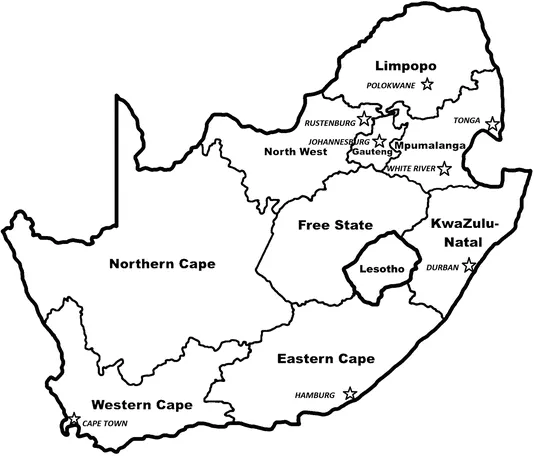
Having had the opportunity to work at numerous sites, across numerous diseases with multiple participants and across multiple languages, this book offers us a chance to stand back, take stock and take a bird’s-eye view—in other words a perspective about the whole. We have worked in seven of the nine provinces of South Africa and across six of its official languages. Figure 1.1 shows some of our sites of research.
Fig. 1.1
Map of South Africa indicating our sites of research
Much of our work has been published, and we do not want to make the mistake here of repeating that work and its findings. Indeed, our own perspective on that work has often changed with time and with hindsight and with the emergence of new evidence. Rather we use this book as an opportunity to begin to compare and contrast the evidence and to interface the collective experiences with our growing insights and the global literature, and our experience at sites with patients and doctors.
Thus, while part of the book is very much about making sense of the real evidence (and we now have a lot of that) and highlighting useful methods and recurrent themes, the other part is very much forward-looking and drawing connections where none existed, making recommendations or observations which are novel and which will hopefully influence new ways of addressing practice.
This text presents these findings and shows how the methods we have developed are unique and have wide potential application. The text is intended for health professionals, language specialists, medical educators, researchers and practitioners, and includes a range of theoretical, methodological and empirical considerations. We have developed a set of recommendations for reframing the notion of ‘cultural safety’ in health care. This will hopefully influence both individual and systemic practices for managing diversity.
There is a clear relationship between effective communication practices and outcomes which can be measured in tangible benefits for patients, the health professional and the institution. Among documented benefits for the patients are increased accuracy of diagnosis, understanding of treatment, improved adherence to treatment and research protocols, greater satisfaction and greater likelihood of returning for follow-up treatment. Potential benefits for the health professional include increased speed and efficiency, more accurate diagnosis, less stress and burnout and, in turn, greater job satisfaction and, because of the improved use of the diagnostic power of the interaction, less dependence on costly diagnostic tests. Institutions benefit from effective communication, as they are likely to experience decreased turnover of staff and financial savings, and arguably, most importantly, they comply with the legal and ethical obligation of providing equitable services to all patients.
To date much of the research on such factors has not been done in the context of the multi-lingual clinic, and where it has, some of the methods of measurement have been unidimensional. The complexities introduced, for example in the mediated healthcare interaction in a situation of linguistic and cultural diversity, are not well understood and require methods which capture such interactional complexity. Further, little is known about the effect of disease on the process. The work of our project has thus been deliberately framed within a multi-dimensional perspective of the problem. In addition to the direct evidence we have of recorded interactions, we have the perceptions of the participants, as well as narrative and ethnographic perspectives on sites of practice and from particular illness and communication experiences. It also seems important to consider the impact of the broader ‘macro’ context in health care and to understand the socio-political and institutional context of the interaction.
Many South African patients continue to experience numerous potential barriers to accessing the healthcare system, interacting with health professionals or adhering to treatment regimens. These barriers are linked to factors such as stigma and discrimination, poverty , unemployment, gender , education, religion, literacy , access to treatment and health care, financial resources, and trust of the healthcare system or health professional. In other words, the separate world views of the participants in healthcare interactions have a very real impact on the process and often cause breakdowns, which have marked consequences in terms of efficiency of diagnosis and treatment.
Fascinating material has emerged from the project. As reflected in the dissertations and publications produced, we have a body of unique material which spans a range of healthcare settings, a range of diseases and a number of health professionals (see the table in the Appendix for details of each study). We have patient narratives and health professionals’ perspectives, and we have...
Table of contents
Cover
Front Matter
Part I. Background and Central Constructs
Part II. Research Methods and Challenges
Part III. The Evidence
Part IV. Implementation
Back Matter
Trusted by 375,005 students
Access to over 1.5 million titles for a fair monthly price.
Study more efficiently using our study tools.
Frequently asked questions
Yes, you can cancel anytime from the Subscription tab in your account settings on the Perlego website. Your subscription will stay active until the end of your current billing period. Learn how to cancel your subscription
No, books cannot be downloaded as external files, such as PDFs, for use outside of Perlego. However, you can download books within the Perlego app for offline reading on mobile or tablet. Learn how to download books offline
Perlego offers two plans: Essential and Complete
Essential is ideal for learners and professionals who enjoy exploring a wide range of subjects. Access the Essential Library with 800,000+ trusted titles and best-sellers across business, personal growth, and the humanities. Includes unlimited reading time and Standard Read Aloud voice.
Complete: Perfect for advanced learners and researchers needing full, unrestricted access. Unlock 1.5M+ books across hundreds of subjects, including academic and specialized titles. The Complete Plan also includes advanced features like Premium Read Aloud and Research Assistant.
Both plans are available with monthly, semester, or annual billing cycles.
We are an online textbook subscription service, where you can get access to an entire online library for less than the price of a single book per month. With over 1.5 million books across 990+ topics, we’ve got you covered! Learn about our mission
Look out for the read-aloud symbol on your next book to see if you can listen to it. The read-aloud tool reads text aloud for you, highlighting the text as it is being read. You can pause it, speed it up and slow it down. Learn more about Read Aloud
Yes! You can use the Perlego app on both iOS and Android devices to read anytime, anywhere — even offline. Perfect for commutes or when you’re on the go. Please note we cannot support devices running on iOS 13 and Android 7 or earlier. Learn more about using the app
Yes, you can access Communicating Across Cultures and Languages in the Health Care Setting by Claire Penn,Jennifer Watermeyer in PDF and/or ePUB format, as well as other popular books in Languages & Linguistics & Communication Studies. We have over 1.5 million books available in our catalogue for you to explore.