eBook - ePub
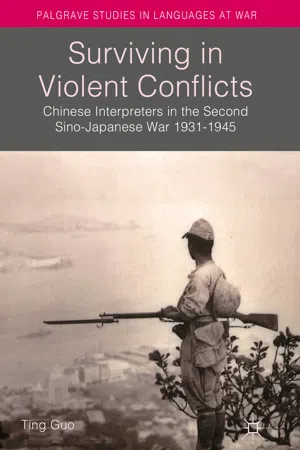
Surviving in Violent Conflicts
Chinese Interpreters in the Second Sino-Japanese War 1931–1945
- English
- ePUB (mobile friendly)
- Available on iOS & Android
eBook - ePub
Surviving in Violent Conflicts
Chinese Interpreters in the Second Sino-Japanese War 1931–1945
About this book
This book examines the relatively little-known history of interpreting in the Second Sino-Japanese War (1931-45). Chapters within explore how Chinese interpreters were trained and deployed as an important military and political asset by competing domestic and international powers, including the Chinese Nationalist Government (Kuomingtang), the Chinese Communist Party and Japanese forces. Drawing from a wide range of sources, including archives in mainland China and Taiwan, memoirs and interviews with former military interpreters, it discusses how the interpreting profession was affected by shifts of foreign policy and how interpreters' professional habitus was formed through their training and interaction with other social agents and institutions. By investigating individual interpreters' career development and border-crossing strategies, it questions the assumption of interpreting as an exclusive profession and highlights interpreters' active position-taking as a strategy of self-protection, a route to power, or just a chance of a better life.
Information
© The Author(s) 2016
Ting GuoSurviving in Violent ConflictsPalgrave Studies in Languages at War10.1057/978-1-137-46119-3_11. Introduction
Ting Guo1
(1)
Department of Modern Languages, University of Exeter, Exeter, UK
In Devils on the Doorstep, a Chinese war film set in the Second Sino-Japanese War (1931–45), a Chinese interpreter, Dong Hancheng,1 serves the Japanese forces but is captured together with a Japanese soldier by Chinese guerrillas and left in the custody of Chinese villagers for interrogation. The interpreter, knowing that the Japanese soldier’s arrogance and his own collaboration with the Japanese forces will endanger his life, makes full use of his language abilities to mediate between the soldier and the Chinese villagers and to secretly pass a call for help to the Japanese troops stationed nearby. Despite a later clash between the Chinese villagers and the Japanese forces, the interpreter manages to survive the vicissitudes of the war. However, when the war comes to the end, the interpreter is accused as a traitor and publicly executed by Chinese Kuomintang (KMT) troops in front of both the Chinese and Japanese forces, as well as the Chinese public. The executioner says to him: “You have aided the enemy and tried to avoid punishment. This is the worst crime. Your hands are soaked with Chinese people’s blood. Only executing you can dispel the masses’ anger. Do you have anything to say?”2
Although fiction, this movie provides a glimpse into the important but little researched history of interpreting during the Second Sino-Japanese War. This conflict began in 1931 with a clash between China and Japan in North China, but because of internal competition between the Chinese Communist Party (CCP) and the Chinese Kuomintang (KMT) government (also called the Nationalist or Republican government) as well as their respective allegiances to foreign powers during World War Two, it soon developed into an arena of national and international political and military powers (see the Appendix for a timeline3). More specifically, the CCP’s growth threatened the KMT’s political dominance and diverted its attention away from the Japanese forces in the north. Although this internal conflict halted temporarily in 1937 to form a united front against further Japanese expansion beyond their previously occupied Manchurian area (Ienaga 1978: 64), in terms of military operations, foreign policy, and control of geographical regions, the CCP and the KMT remained separate because of different political and ideological values. This separation inevitably led to the presence of two resistance powers representing China’s interest against Japan.
The interpreter depicted in the movie is situated in the nexus of these national and international power relationships. Captured by Chinese communist guerillas, detained by Chinese villagers, saved by the Japanese forces, and executed by the Chinese Kuomintang troops, this fictional character becomes the focus of the complicated wartime power relationships, although what he cares about most is simple survival. This cinematic representation of interpreting and interpreters is not the focus of this book, but it does raise several interesting questions about the actual history of the period which this book addresses, for example: What kind of interpreting tasks were involved in this international war? Who were the interpreters? How did the war affect the interpreters’ practices? Why were some interpreters targeted as traitors, and how did they respond to this accusation and its potentially extreme consequences?
There has been little research on the history of interpreting and Chinese interpreters in this period. As far as I am aware, only two Chinese scholars have addressed this topic: Yan Jiarui (2005) and Luo Tian (2008, 2011). Luo (2008) provides a brief history of the KMT government’s recruitment of military interpreters and argues that these interpreters made significant contributions to Sino-American military cooperation during the war. With information collected from narratives and anecdotes about some individual interpreters, Luo (2011) specifically addresses the roles of Chinese military interpreters at the Burma Campaign during the war and provides some important information on these interpreters’ engagement in the Chinese army’s operation in the campaign. Yan, as a witness to the KMT’s military interpreting training, has published extremely valuable information on this history, including the preface of an interpreter training textbook, Forty English Lessons for Interpreting Officers (1945), which is crucial to my research on the KMT’s training of interpreters. However, apart from these two studies, interpreting during the Second Sino-Japanese War is an almost untouched field in translation studies, especially the interpreting that involved the Chinese communists and the Japanese forces. Moreover, there has been little theorization or conceptualization of interpreter training and practice in this specific war. Hence, this book aims to fill these two gaps by presenting a more complete picture of the wartime interpreting situation and conceptualizing these interpreters’ various practices in this war using Bourdieu’s sociological framework.
Before beginning the discussion, however, it is necessary to clearly define the term ‘interpreter’ as used here, especially given that during the Second Sino-Japanese War, individuals who conducted interpreting tasks were referred to differently in different contexts. Given the fact that the profession of interpreter did not become established anywhere until the end of World War Two, the distinction between translating and interpreting remained unclear for both the Chinese authorities and the public during the war. For example, interpreters employed by the Chinese Kuomintang government were generally referred to as fanyi guan (翻译官, translation officers) or yiyuan (译员, translation staff).4 However, the KMT correspondence in English with US forces in China clearly refer to fanyi guan or yiyuan as ‘interpreters’ and the KMT’s ‘translation staff training programs’ (译员训练班 yiyuan xunlianban) as ‘interpreter schools’. Therefore, these umbrella terms do not mean that interpreters were no different from the translators, who dealt mainly with texts. In fact, a majority of the KMT interpreters were military staff whose interpreting work was interspersed with translation work because of the army’s hybrid linguistic needs and the sparse wartime resources. Nevertheless, interpreters in areas occupied by the Japanese forces were often referred as tongyi (通译, those who help smooth communication between others with different languages),5 a word quite probably borrowed from the Japanese term for interpreter, 通訳 (Tsūyaku), given the Japanese influence at that time, rather than a reflection of the Chinese word tongshi (通事, ‘interpreting clerk’) used during the Jin Dynasty (1142–55) (Cheung 2006: 198). Despite these various Chinese source terms, this book consistently uses the term ‘interpreter’ to distinguish true interpreters from the wartime literary translators addressed in earlier studies (e.g., Zhou 1994; Yuan 2005; Cheng 2005).
1.1 Interpreters’ Role and Agency in Wars
Despite a long history of linguists’ use in both peace negotiations and military operations in international politics, interpreters’ role and agency in wartime as a topic was not explicitly addressed until recently. One exception is the studies of interpreting in war tribunals such as the Nuremberg Trials and the International Military Tribunal for the Far East (IMTFE) (Gaiba 1998; Shveitser 1999; Takeda 2007). As in court interpreting studies, however, most of this research is discourse analysis of simultaneous interpreting during the trials and examination of the structure of the interpreting system, including the selecting and monitoring of interpreters. More relevant to the study of wartime interpreters’ role and agency are the historical studies of interpreters by scholars like Michael Cronin (2003/1997, 2006), Anthony Pym (1998), Jean Delisle and Judith Woodsworth (1995), and Ruth Roland (1982, 1999). In her book, Interpreters as Diplomats: Diplomatic History of the Role of Interpreters in World Politics (1990), Roland offers a stimulating historical account of interpreters’ multiple roles in diplomatic and political history based on diplomatic anecdotes, interpreters’ diaries, memos of international political and military meetings and treaties, and governmental administrative records. As she notes, interpreters are a crucial source in military conquest and political negotiation and could have significant power in wartime due to their political or military affiliations (1999: 171). However, when they encounter both conflicting ideological and cultural inculcation and risk to their lives, it is quite possible for interpreters to “grossly abuse their power” rather than voluntarily abide by any professional codes (Roland 1999: 172).
Margareta Bowen, discussing the recruitment and usage of interpreters in colonial times and during the two world wars, argues that the use of interpreters is often associated with many problems (e.g., “loyalty, breaches of etiquette or ethics”) because interpreting is a human activity and involves a “highly personal act of mediation between individuals, often with strong personalities” (1995: 273). These problems, however, in Michael Cronin’s eyes are not “a problem” but “a strategy for survival” (1997: 394). For him, the issue central to interpreting events is the problem of control, which directly affects interpreter practices in society. He argues:
[t]he role of interpreters throughout history has been crucially determined by the prevailing hierarchical constitution of power and their position in it. In this respect, if you or your people are seriously disadvantaged by the hierarchy, the most ethical position can be to be utterly “unfaithful” in interpreting in the name of another fidelity, a fidelity of resistance. This is not a “problem”. It is a strategy for survival. (ibid.: 394)
This notion of “strategy for survival” captures and articulates interpreters’ practical concerns in conflict situations and is further elaborated as “embodied agency” by Cronin (2006). As he emphasizes, interpreters, unlike translators, are visible to other agents and institutions, and thus are more vulnerable to any torture resulting from failed communication during interpreting (Cronin 2006: 78). Hence, for Cronin, this embodied agency not only means that interpreters can express their views through bodily actions like voice, intonation, gesture, and facial expression but also implies that the interpreters’ bodies affect their practices because they are usually well aware of the consequences of their interpreting activities (ibid.).
Recently, translation and interpreting scholars have taken up the topic of translation and conflict, in particular translators’ and interpreters’ interventionist roles (for example, Baker 2006, 2010; Cronin 2006; Dragovic-Drouet 2007; Footitt and Kelly 2012a, b; Inghilleri 2003, 2005a, b, 2008; Jones and Askew 2014; Kelly and Baker 2012; Palmer 2007; Torikai 2009). Focusing on translators and interpreters who were involved in recent international political controversies (e.g., at the USA detention center at Guantánamo Bay, Cuba) and armed conflicts (e.g., in Iraq and the former Yugoslavia), their research has shown that these interpreters, no matter whether they were locally recruited or received training before their deployment, perform duties far beyond merely interpreting. For example, on the basis of interviews with Western journalists working with local Iraqi interpreters since 2003, Jerry Palmer notes that local interpreters were used by these journalists as ‘fixers’ to perform a range of duties from arranging interviews, selecting interviewees (within limits), security assessment, and gaining access to a network of local contacts to secure protection for the journalists (2007: 18–23). This non-linguistic use of interpreters by Western journalists in Iraq was not unusual, according to Palmer, and their competence as fixers almost determines the success of their employment (ibid.). This fixer model is further enriched through research by Mila Drogovic-Drouet (2007) on translator and interpreter practices after the dislocation of the federal state in 1991. Drogovic-Drouet shows that in the former Yugoslavia, a large number of liaison interpreters and assistant interpreters were hired from among local residents to work for the media, international organizations, NGOs, and peace-keeping forces. Many of them did not receive any training at all and played a role similar to that of Palmer’s model of fixer. However, as she notes, local authorities chose a special kind of interpreter, the ‘official translator’, based on allegiance (Drogovic-Drouet 2007: 34–5). Thus, these liaison interpreters were not only linguistic mediators but also the extension of local powers in that, while interpreting, they were able to censor or amend information unfavorable to the government to maintain their positions. These scholars’ research points out an important but often purposely diluted fact, that is, in wars interpreter agency is recognized and sometimes even constitutes an indispensible part of their roles.
In fact, as research from the recent Languages at War project (see Footitt and Kelly 2012a, b; Footitt and Tobia 2013; Jones and Askew 2014; Kelly and Baker 2012) reveals, it is not unusual at all for interpreters to actively engage in military tasks other than interpreting. For example, research by Hilary Footitt and Michael Kelly (2012a) and Footitt and Simona Tobia (2013) show that, in World War Two, British military once used trained translators/interpreters in its intelligence activities based at Bletchley Park. Although their research does not provide many details of these interpreters’ intelligence collecting and analyzing work, it challenges the assumption that interpreters with proper training will limit themselves to exclusive interpreting. As Michael Kelly and Catherine Baker (2012: 55) note, deployment of individuals with language expertise in warstime is essentially based on practical needs. Training is, therefore, only an effort ...
Table of contents
- Cover
- Frontmatter
- 1. Introduction
- 2. Responsibility and Accountability: Military Interpreters and the Chinese Kuomintang Government
- 3. Political Beliefs or Practical Gains?: Interpreting for the Chinese Communist Party
- 4. Interpreting for the Enemy: Collaborating Interpreters and the Japanese Forces
- 5. A Case Study of Two Interpreters: Xia Wenyun and Yan Jiarui
- 6. Conclusion
- Backmatter
Trusted by 375,005 students
Access to over 1.5 million titles for a fair monthly price.
Study more efficiently using our study tools.
Frequently asked questions
Yes, you can cancel anytime from the Subscription tab in your account settings on the Perlego website. Your subscription will stay active until the end of your current billing period. Learn how to cancel your subscription
No, books cannot be downloaded as external files, such as PDFs, for use outside of Perlego. However, you can download books within the Perlego app for offline reading on mobile or tablet. Learn how to download books offline
Perlego offers two plans: Essential and Complete
- Essential is ideal for learners and professionals who enjoy exploring a wide range of subjects. Access the Essential Library with 800,000+ trusted titles and best-sellers across business, personal growth, and the humanities. Includes unlimited reading time and Standard Read Aloud voice.
- Complete: Perfect for advanced learners and researchers needing full, unrestricted access. Unlock 1.5M+ books across hundreds of subjects, including academic and specialized titles. The Complete Plan also includes advanced features like Premium Read Aloud and Research Assistant.
We are an online textbook subscription service, where you can get access to an entire online library for less than the price of a single book per month. With over 1.5 million books across 990+ topics, we’ve got you covered! Learn about our mission
Look out for the read-aloud symbol on your next book to see if you can listen to it. The read-aloud tool reads text aloud for you, highlighting the text as it is being read. You can pause it, speed it up and slow it down. Learn more about Read Aloud
Yes! You can use the Perlego app on both iOS and Android devices to read anytime, anywhere — even offline. Perfect for commutes or when you’re on the go.
Please note we cannot support devices running on iOS 13 and Android 7 or earlier. Learn more about using the app
Please note we cannot support devices running on iOS 13 and Android 7 or earlier. Learn more about using the app
Yes, you can access Surviving in Violent Conflicts by Ting Guo in PDF and/or ePUB format, as well as other popular books in Languages & Linguistics & Asian History. We have over 1.5 million books available in our catalogue for you to explore.