eBook - ePub
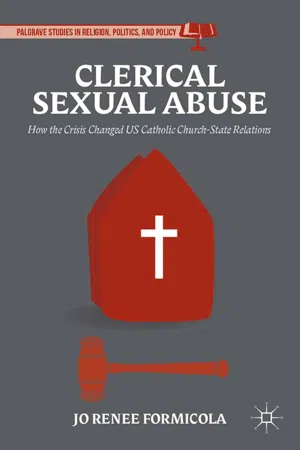
Clerical Sexual Abuse
How the Crisis Changed US Catholic Church-State Relations
- English
- ePUB (mobile friendly)
- Available on iOS & Android
eBook - ePub
About this book
The book discusses the changing relationship between American Catholic Bishops and civil authorities in the United States, as civil authority has eclipsed traditional Catholic ecclesiastical privilege and clerical exemption resulting from the hierarchical mismanagement and cover-up of clerical sexual abuse in the United States.
Information
1
Early Warnings and Denials: Father Gauthe
Introduction
When did it all start, this dirty little secret of clerical sexual abuse in the American Catholic Church? And why didn’t anybody in the Church leadership do anything to stop it?
Even now, more than a decade after the shocking, public revelations and responses to the Catholic clerical abuse scandals in so many places, it is apparent that there were plenty of rumors, whispers, and serious, unheeded warnings about predator priests. There were scandalous allegations floating around in small towns and hierarchical circles for more years than anyone cared to remember—like the accusations against Father Gilbert Gauthe in Henry, Louisiana in 1984.
What is so incredible is that the most religious, supposedly well-educated, politically astute, and elite leaders among Catholic Church officials understood little to nothing about the behavior of sexually perverted priests. And they did even less to try to understand the pathology of the disease, paying virtually no attention to the criminal ramifications of what their fellow clergymen were perpetrating on young, innocent children for a long, long time.
Experts1 now seem to think that denial, ignorance, arrogance, and deference were what the victims, the perpetrators, and the enablers of sexual abusers used as their means to cope with their own personal and emotional stress. Compounded by institutional pressures to deal quietly and swiftly with misunderstood, priestly perversions, Church leaders also often reacted by simply refusing to accept, or even consider, the charges against child abusers. Instead, in many cases, they simply ignored them.
The victims had to build up their own emotional defenses in order to survive. They existed alone within their own world of fear—isolated, embarrassed, and angry. It was through these psychological responses that the abused were able to survive within their Catholic religion and culture.
As a result, many minors and their families simply succumbed to the bishops’ ecclesiastical control, prestige, and wealth. They reluctantly accepted the Church leaders’ ability to use the weight and legitimacy of their power and canon law, a means to confuse and defeat accusers.
In time, victims faced the fact that bishops also existed within their own separate institutional realm as well—a place where they were totally committed to the protection of their priest-brethren and the reputation of the Church. It was a world of hierarchical silence and loyalty to the clerical culture and Church law that would never give children an equal chance to pursue justice for sexual molestation. In reality, that recognition was the only way for victims to deal with Catholic religious chauvinism and ecclesiastical privilege in matters of clerical sexual abuse.
On the other hand, the priest-perpetrators often could not, and usually would not, face their own spiritual failings, psychological debilitation, and heinous crimes. It was as though they existed in another kind of world, a sexually duplicitous one in which they were unable to escape the perverted double lives that they led.
Their almost schizophrenic sexual existences were further enabled by many Church leaders, too. The members of the hierarchy who sent abusive priests for psychological “treatment” or moved them from parish to parish were actually or unconsciously complicit in the sexual abuse. They believed that by following such a plan of therapy and reassignment, they would somehow help abusive clerics to rest and repent, to become reconciled with their personal spirituality, and to make psychic recoveries. In the process, however, the cardinals, archbishops and bishops who approved various treatments and new ministries for clerical sexual abusers essentially covered up the sins as well as the crimes of the priests.
They believed they were protecting the Church’s religious interests by protecting its clergy and reputation. But instead, they ultimately hindered the Church’s ability and responsibility to face the truth and to deal with it. The ecclesiastical leadership neglected its duty to pursue justice for those who lost their innocence and to reform the system of dysfunctional hierarchical management that allowed it to happen and of which they were a part.
Such behaviors by those involved in the sexual abuse crisis reflected the power relationship between the Church hierarchy, the clergy, and the laity. It was one that had traditionally been based on a privileged and monopolistic connection, a lay dependence created by the Church leadership due to its perceived religious affinity to the supernatural, advanced education, and political involvement throughout Christian history. Eventually, the hierarchy controlled more and more matters among itself and the clergy, its adherents and its opposition, as well as its relations with civil structures. It did this through the development of its own legal system, known as canon law.
Over the centuries, the Church’s legal system empowered it to dominate or form “concordats,” politically advantageous alliances with emerging civil states. These privileged legal and political positions allowed Church leaders to carry out both the Church’s religious and social missions effectively, and to assume controlling spiritual and temporal roles that waxed and waned in a number of countries throughout the last two millenniums.
This historical church-state relationship, however, was complicated and interrupted in the United States by a unique, new, and complex situation. It developed a different rapport between the Catholic Church and the US government through the First Amendment and the notion of the separation of Church and State.
The continuing evolution of the right to religious freedom and the civil strictures on the establishment of a state religion in the First Amendment formed a dynamic tension in church-state relations. Both the freedom and the limits were balanced and counter balanced during American history by the belief in the principle of the separation of Church and State. This notion clashed with traditional papal and hierarchical teachings regarding the Church’s right to preferential religious treatment and, often, political power as well.
It was Pope Leo XIII, in the late nineteenth century, who clearly responded in a negative way to American constitutional principles. He believed that modernism, liberalism, and secularism were the doctrinal enemies of the Church. He maintained that the Church’s appropriate relations with civil states, including those with the United States government, had to guarantee the Church a superior position in a civil-religious relationship.
He based this view on four religious perspectives. First, Pope Leo contended that the state had the obligation to protect and assure the freedom of the Church to carry out its salvific mission, that is, to teach, preach and sanctify its adherents. Second, he believed that civil governments should accept Catholicism as the one, true religion; that it should be given a preferred status or at least an accommodation within civil infrastructures. Third, he asserted that the spiritual order and its sphere of interest should take precedence over the temporal and civil concerns. And fourth, he believed that there should be harmonious cooperation between Church and State for the common good.
Pope Leo’s numerous encyclicals reflected the traditional reluctance of Church leaders to give up any perceived Church authority in its own sphere of competence, even within the context of the US democratic experiment.2 In fact, he clearly opposed the model of the American principle of the separation of Church and State, saying that the “dissevered and divorced” relationship in the United States is not “the type of the most desirable status of the Church.”3 Instead, he insisted, “It is to the Church that God has assigned the charge of seeing to, and legislating all that concerns religion . . . in accordance with her own judgment in all matters that fall within its competence.”4
In other words, Pope Leo, like his predecessors, wished to have no interference from civil authorities about managing any of the internal affairs of the Church. Instead, he expected Catholic adherents “to be ruled and directed by the authority and leadership of bishops, and above all, of the Apostolic See.”5
Thus, lay Catholics, even those belonging to the Church during the twentieth century, obeyed Church teachings without question. The members existed within a hierarchical structure where power was controlled from the top down. It was an autocratic religious system characterized by spiritual sovereignty and religious superiority inculcated over centuries by popes and implemented by bishops.
Church members were, therefore, even in the United States, often torn between papal edicts carried out on the local level by the hierarchy and clergy, and demands that were often contrary to accepted social and political norms.6 As a result, American Catholics were considered politically suspect by other religious denominations who challenged their political loyalty to the pope rather than the United States government during much of its history.
It wasn’t until the 1940s and ‘50s, however, that progressive Catholic theologians, such as John Courtney Murray, S. J., began to question the hierarchy’s traditional reticence to accept the notion of the separation of Church and State.7 Murray, an influential Jesuit, argued that theology was evolutionary, and thus able to change in the light of time, place, and circumstance. As a result, he put forward an innovative way of thinking about Catholic church-state relations. He stressed the need for a new reliance on religious pragmatism. In order to accomplish this, Murray emphasized the importance of the development of an educated citizenry, one that would be able to bring about church-state cooperation and concord in America.
These ideas, which Murray believed would lead to civil peace, were published in influential Catholic journals. They caused him, however, to be “silenced” by Vatican officials, and to be denied the right to publish on church-state theory.
Then, in 1962, the pope of the Catholic Church at the time, John XXIII, called a General Council, or meeting of all the hierarchy, to come to Rome to discuss church renewal. Murray was invited to attend by Francis Cardinal Spellman of New York, even though the priest was essentially censured. He was credentialed at the conference, known as Vatican II, as a theological expert, a status that allowed Murray the ability to influence the course of future Church thinking about church-state relations. He, along with other like-minded theologians advanced the notion of freedom of conscience and, in turn, religious freedom. It was significant because it had the potential to catapult official Catholic thinking into a new, modern phase of church-state relations—a move that would reflect American constitutional principles.
A number of socially progressive documents, then, were promulgated at the Church’s General Council at Vatican II.8 These included, first and most importantly, Lumen Gentium. It stressed, with the approval of all the hierarchy, that the Church had to recognize its role vis-à-vis governments based on changing situations. In essence, it recognized the rights of states in temporal matters and repudiated the ideas of earlier popes such as Leo XIII. The document clearly stated that “Christ, to be sure, gave his Church no proper mission in the political, economic or social order. The purpose he set before her is a religious one.”9 In fact, Lumen Gentium went so far as to say that the Church “does not lodge her hope in privileges conferred by civil authority. Indeed she stands ready to renounce the exercise of certain legitimately acquired rights if it becomes clear that their use raises doubt about the sincerity of her witness or that new conditions of life demand some other arrangement.”10
Church officials also passed another critical document at Vatican II, entitled Dignitatas Humane. It recognized freedom of religion as an inherent and civil, constitutional right. It said:
This Vatican Synod declares that the human person has a right to religious freedom. This freedom means that all men are to be immune from coercion on the part of individuals or of social groups of any human power, in such wise that in matters religious no one is to be forced to act in a manner contrary to his own beliefs. Nor is anyone to be restrained from acting in accordance with his own beliefs, whether privately or publicly, whether alone or in association with others, within due limits . . . This right of the human person to religious freedom is to be recognized in the constitutional law whereby society is governed. This is to become a civil right.11
In making such a statement, the hierarchy essentially changed the traditional, Leonine principles that demanded civil states recognize the superiority of Catholicism, and to accept, instead, the principles of the First Amendment and the notion of the separation of church and state. These potential changes between the Church officials in Rome created a more equal relationship with the United States government and had the potential to end the traditional antagonism that had existed throughout most of American history.
In addition to recognition of their loyalty to the United States in World War I and World War II, their enhanced education and financial status meant Catholics began to become part of the American social and economic structures. Along with the election of one of their own, John Fitzgerald Kennedy, to the presidency in 1960, ordinary lay Catholics started participating in the American political mainstream by the end of the decade.
But old ideas die slowly. While some progressive clergyman, like John Courtney Murray, adhered to a more liberal ideology characterized by notions of social justice and the view that religion was a constitutional right, other theologians held more doctrinally conservative views.12 They still adhered to vestiges of Leonine thinking. This often placed the laity in a quandary about how to relate to the teachings and management of the leaders of Catholics in a particular “diocese” or geographical area.
Those Catholics in a parish led by the more conservative clergymen were more likely to follow the Church leadership and doctrine in an unquestioning manner. They relied on the authority of the Pope and bishops, and the historical notion that the Church should be allowed “to administer freely and without hindrance in accordance with her own judgment all matters that fall within its competence.”13
This was mea...
Table of contents
- Cover
- Title
- Introduction
- 1 Early Warnings and Denials: Father Gauthe
- 2 Revelations and Scandals: Boston and Beyond
- 3 Challenge and Complexity: Canon Law and Civil Law
- 4 Too Little, Too Late: The Hierarchy Responds
- 5 Pushback and Payback: The Laity and the Lawyers
- 6 From Crisis to Power Shift and the Future
- Notes
- Bibliography
- Index
Trusted by 375,005 students
Access to over 1.5 million titles for a fair monthly price.
Study more efficiently using our study tools.
Frequently asked questions
Yes, you can cancel anytime from the Subscription tab in your account settings on the Perlego website. Your subscription will stay active until the end of your current billing period. Learn how to cancel your subscription
No, books cannot be downloaded as external files, such as PDFs, for use outside of Perlego. However, you can download books within the Perlego app for offline reading on mobile or tablet. Learn how to download books offline
Perlego offers two plans: Essential and Complete
- Essential is ideal for learners and professionals who enjoy exploring a wide range of subjects. Access the Essential Library with 800,000+ trusted titles and best-sellers across business, personal growth, and the humanities. Includes unlimited reading time and Standard Read Aloud voice.
- Complete: Perfect for advanced learners and researchers needing full, unrestricted access. Unlock 1.5M+ books across hundreds of subjects, including academic and specialized titles. The Complete Plan also includes advanced features like Premium Read Aloud and Research Assistant.
We are an online textbook subscription service, where you can get access to an entire online library for less than the price of a single book per month. With over 1.5 million books across 990+ topics, we’ve got you covered! Learn about our mission
Look out for the read-aloud symbol on your next book to see if you can listen to it. The read-aloud tool reads text aloud for you, highlighting the text as it is being read. You can pause it, speed it up and slow it down. Learn more about Read Aloud
Yes! You can use the Perlego app on both iOS and Android devices to read anytime, anywhere — even offline. Perfect for commutes or when you’re on the go.
Please note we cannot support devices running on iOS 13 and Android 7 or earlier. Learn more about using the app
Please note we cannot support devices running on iOS 13 and Android 7 or earlier. Learn more about using the app
Yes, you can access Clerical Sexual Abuse by Jo Renee Formicola in PDF and/or ePUB format, as well as other popular books in Social Sciences & Civil Rights in Law. We have over 1.5 million books available in our catalogue for you to explore.