eBook - ePub
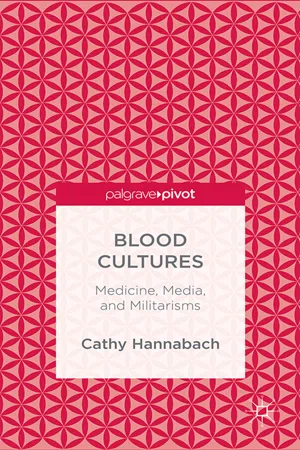
Blood Cultures: Medicine, Media, and Militarisms
Medicine, Media, and Militarisms
- English
- ePUB (mobile friendly)
- Available on iOS & Android
eBook - ePub
About this book
Offering a cultural history of blood as it was mobilized across twentieth-century U.S. medicine, militarisms, and popular culture, Hannabach examines the ways that blood has saturated the cultural imaginary.
Information
Print ISBN
9781137581587
Subtopic
Social History1
Bleeding Identities: The Racial and Sexual Politics of Blood Drive Activism
Abstract: Hannabach analyzes how race and sexuality were mobilized in twentieth-century blood drive activism, revealing conflicting interests between donors, recipients, and regulators. The chapter traces the history of blood transfusion and the rise of blood banking. Hannabach also offers several case studies of moments in which blood banking and a “national blood supply” rose to public concern: post-World War I blood banking associations influenced by eugenics, the racial segregation of the blood supply during World War II, 1980s hemophilia and Haitian activism around AIDS, and a twenty-first century queer blood drive in New York that drew on these histories. The chapter argues that blood drive activism reveals the ways US national identity has been defined through racial and sexual ideologies.
Keywords: AIDS; blood drives; eugenics; Haiti; immigration; race; sexuality
Hannabach, Cathy. Blood Cultures: Medicine, Media, and Militarisms. New York: Palgrave Macmillan, 2015. DOI: 10.1057/9781137577825.0004.
Blood is both invisible and hypervisible across twentieth-century US culture. Even under a microscope it refuses to reveal social differences such as race, gender, sexuality, class, and citizenship, yet it is often invoked to define those categories. One of this book’s key claims is that it is precisely because social differences cannot be seen in blood that attempts to visualize such differences have been so prevalent. This chapter examines activist responses to representations of bodily difference in blood banking, and the role of such activism in constructing the twentieth-century US body politic. Activists responded to medical and state blood discourses with discourses of their own, drawing on varied rhetorics of identity, community, and health. I trace here several key historical moments when blood banking and a “national blood supply” became a public concern: post-World War I blood banking associations influenced by eugenics, World War II military and civilian blood banking activism protesting the racial segregation of the blood supply, 1980s hemophilia and Haitian activism around AIDS, and an example of early twenty-first century queer activist legacies of these histories.
I argue that these struggles mark conflicting interests between donors who give blood, recipients who need blood, and professionals who broker the transactions—including physicians, corporations, the military, and the government. These activist responses and the legal, medical, and cultural contexts from which they emerge index shifting constructions of the US national body in relation to blood. Blood’s circulation between bodies and communities carries with it other identity markers including race, sexuality, citizenship, class, and gender. Over the course of the twentieth century, different activist groups sought to ameliorate, highlight, and critique the cultural anxiety this movement engenders. In doing so, they simultaneously configured national belonging and unbelonging.
Producing a national body: the blood bank
Blood drive activism has blood transfusion medicine as its origin story. Blood transfusion medicine does not merely name the ability to extract one person’s blood and insert it into another’s body. It also names the legal, medical, economic, and media apparatus organizing the tools needed, the labor force involved, and the popular support necessary for an adequate supply of donors and recipients. The first human-to-human blood transfusion was completed in 1818,1 but it was not until the 1930s that a blood transfusion apparatus—a blood bank—was consolidated. Initially, regional hospitals paid professional donors to be on call. When a physician had a patient in need of blood, they would notify the professional on-call donor who would come give blood on the spot. In other words, the donor stored blood in their body until it was needed for a recipient. In 1930 in the Soviet Union, physician Sergei Yudin built the world’s first “blood bank”—a physical, non-human repository into which blood could be deposited, stored, and withdrawn. US physician Bernard Fantus adopted this model (and coined the term), establishing the first US blood bank at Chicago’s Cook County Hospital in 1937.2 Blood banking took off as a global industry, generating billions of dollars by the end of the century. In addition to this global reach, twentieth-century blood medicine offered a particular construction of the national body defined through blood, binding some bodies together and excluding others.
During the 1920s and 1930s, military leaders, physicians, and politicians championed a US “national blood supply” comprising blood from citizen bodies that could supply soldiers on the battlefield and civilians at home. As World War I’s killing technologies increased the need for blood at the front, military and civilian physicians struggled with how to move blood between bodies en masse. This interwar concern was further energized by media accounts of the Spanish Civil War circulating in US broadcast and print media. Through them, people in the US heard for the first time about a successful national blood supply line that transported stored civilian blood to soldiers at the front, even though that blood could only be stored for a short time.3 The Spanish blood supply line revealed one way that technology, industry, media, military medicine, and the civilian population far from the front lines could form a national apparatus for moving blood between bodies. Materializing the metaphor of a national population bound through blood, the supply line moved that blood in the patriotic service of war.
In addition to this military impetus, the US blood bank’s development was shaped by the 1929 global economic crash and ensuing Great Depression. In a decade of financial collapse and omnipresent class conflict, the blood bank embodied popular banking language and anxieties. For example, when collecting blood from donors, blood bank interns recorded their own name, the date of donation, and the donor’s name, address, and race. This was recorded in an “account book” that tracked deposits and withdrawals in the language of credits and debits, mirroring financial banking norms.4 Fantus’s choice of the term blood bank and financial language to describe the collection, measurement, purchase, and distribution of blood might seem ironic, given how the Great Depression largely demolished popular confidence in the financial banking system. Further, the economic crisis revealed the stark class divisions built into US capitalism and society. However, physicians’ use of banking logics in 1930s blood medicine attempted to salvage precisely what the Great Depression killed: the myth of a unified national body whose social differences mattered less than their national unity. In this logic, medicine could fix what capitalism broke—the idea of a unified nation. Despite this patriotic story, however, interwar blood policy and blood drive activism reveals the lie at the heart of nationalism, demonstrating that only selective bodies and blood count as part of the national body.
Blood identity: the Blood Transfusion Betterment Association
During the 1920s and 1930s, while those who had their blood drawn were called “donors,” blood donation was in fact paid.5 Poor people donated as often as possible, especially those disproportionately affected by the global economic crisis due to race, gender, sexuality, or immigrant status. In 1929, elite blood industry physicians sought to “better” the national blood supply by better categorizing and controlling donor populations. With financial backing from John D. Rockefeller, they formed the Blood Transfusion Betterment Association (BTBA) in New York City. The BTBA was a professional (paid) donor panel whose members had to register with the New York City health department and provide on a quarterly basis proof of a recent physical exam and negative syphilis test.6 The BTBA banned people with communicable disease histories or drug and alcohol abuse histories from becoming donors. BTBA donors had to meet standards of “intelligence,” “good character,” and middle-class living arrangements, as well as be “presentable in appearance.”7 Further, BTBA donors were required to carry with them at all times a green, BTBA-issued “passbook” containing records of all donations, exams, and other pertinent information.
These passbooks index several logics shaping interwar medical, military, and state networks. First and foremost, the books functioned as identity documents, categorizing their holders according to norms of race, “intelligence,” sexuality, class, and morality. But the books also functioned as exclusionary documents, as they simultaneously marked some bodies as having “good blood” and marked others as unable to “better” the national blood supply. BTBA policies reflected a long-standing association between social identity and “good” versus “bad” blood. Physicians and capitalists formed the BTBA to ensure that blood only came from “quality” donors—donors whose class, race, lifestyle, morals, and sexual practices served the interests of the state and of capital. Harnessing social scientific theories of racial hygiene to biopolitical health discourses of self-discipline and regulation, the BTBA sought to collect and distribute a pool of “good blood” taken from a population of “good citizens.”
BTBA physicians and administrators used passbooks to mark these distinctions and modeled their passbooks on a document that regulated the movement of bodies across nation-state boundaries: the US passport. The BTBA passbooks “followed the modern passport book, even to the photograph of the legitimate holder.”8 As Jane Caplan and John Torpey point out, the modern passport emerged only after World War I, when international migration was newly framed as threatening and a person’s ability to enter or leave a country became dependent upon their citizenship status and proper documentation.9 In issuing national passports and BTBA passbooks, both the US state and the activist organization legitimated certain bodies and delegitimized others. Further, the BTBA passbooks provided visual evidence of that which could not be discerned from a person’s physical appearance alone: race, health, and blood. Both passports and passbooks anointed select bodies as members of a blood-based collective, be it metaphoric in the case of the state (“national stock”) or material in the case of the BTBA.
BTBA passbooks and US passports were part of a larger set of transformations in interwar immigration and citizenship law, transformations that were ripe with debates over blood and identity. For example, as I explore more thoroughly in Chapter 2, the 1920 Hawaiian Homes Commission Act sought to legally codify and measure “native Hawaiian blood” for the purposes of regulating property ownership and citizenship. Four years after the Commission’s findings, Congress authorized the 1924 Immigration Act (the Johnson-Reed Act), which set annual entry quotas for the number of migrants from different countries. With the goal of “whitening” the national population, the act severely restricted migrants from eastern and southern Europe, encouraged migrants from western Europe, and banned migrants from Asia. The act was a direct result of extensive lobbying by the American Eugenics Society.10 Co-author Senator David Reed said that he wrote the 1924 act to make up for what he saw as a failing in previous statutes—namely that earlier versions did not allow the government enough leeway to restrict immigration based on race, “character,” country of origin, and “blood.”11 The new act enabled precisely this type of restriction. Further, the Johnson-Reed Act mobilized public health discourse to align undesirable immigrants with disease, as these moving bodies were figured as threatening to infect the health and vigor of the (white) American body politic. As is further explored in Chapter 3, this fear of bodies that cross national bo...
Table of contents
- Cover
- Title
- Introduction
- 1 Bleeding Identities: The Racial and Sexual Politics of Blood Drive Activism
- 2 Cartographies of Blood and Violence
- 3 Technologies of Blood: The Biopolitics of Asylum
- 4 Blood and the Bomb: Atomic Cities, Nuclear Kinship, and Queer Vampires
- Conclusion: Sanguinary Futures
- Works Cited
- Index
Trusted by 375,005 students
Access to over 1.5 million titles for a fair monthly price.
Study more efficiently using our study tools.
Frequently asked questions
Yes, you can cancel anytime from the Subscription tab in your account settings on the Perlego website. Your subscription will stay active until the end of your current billing period. Learn how to cancel your subscription
No, books cannot be downloaded as external files, such as PDFs, for use outside of Perlego. However, you can download books within the Perlego app for offline reading on mobile or tablet. Learn how to download books offline
Perlego offers two plans: Essential and Complete
- Essential is ideal for learners and professionals who enjoy exploring a wide range of subjects. Access the Essential Library with 800,000+ trusted titles and best-sellers across business, personal growth, and the humanities. Includes unlimited reading time and Standard Read Aloud voice.
- Complete: Perfect for advanced learners and researchers needing full, unrestricted access. Unlock 1.5M+ books across hundreds of subjects, including academic and specialized titles. The Complete Plan also includes advanced features like Premium Read Aloud and Research Assistant.
We are an online textbook subscription service, where you can get access to an entire online library for less than the price of a single book per month. With over 1.5 million books across 990+ topics, we’ve got you covered! Learn about our mission
Look out for the read-aloud symbol on your next book to see if you can listen to it. The read-aloud tool reads text aloud for you, highlighting the text as it is being read. You can pause it, speed it up and slow it down. Learn more about Read Aloud
Yes! You can use the Perlego app on both iOS and Android devices to read anytime, anywhere — even offline. Perfect for commutes or when you’re on the go.
Please note we cannot support devices running on iOS 13 and Android 7 or earlier. Learn more about using the app
Please note we cannot support devices running on iOS 13 and Android 7 or earlier. Learn more about using the app
Yes, you can access Blood Cultures: Medicine, Media, and Militarisms by Cathy Hannabach in PDF and/or ePUB format. We have over 1.5 million books available in our catalogue for you to explore.