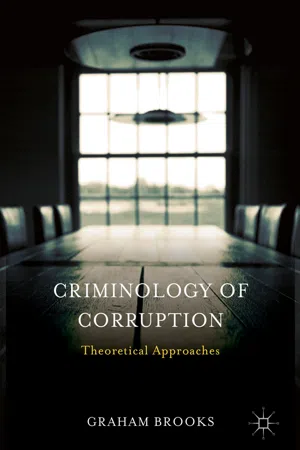
This book uniquely applies theoretical approaches from criminology and sociology to the problem of corruption. Theoretical thoughts have future consequences on how we treat, punish and deter and corruption policy illustrates that theoretical approaches affect what laws and techniques are implemented. Theoretical approaches, however, are not developed in a social and political vacuum; they are a part of the changing social world and understanding why corruption occurs is a preface to developing strategies to control and prevent it.
- English
- ePUB (mobile friendly)
- Available on iOS & Android
eBook - ePub
About this book
Information
© The Author(s) 2016
Graham BrooksCriminology of Corruption10.1057/978-1-137-51724-1_11. Introduction
Graham Brooks1
(1)
University of Wolverhampton, Wolverhampton, UK
Introduction
The essence of this book is to apply relevant sociological and criminological theoretical approaches to the problem of corruption. The inspiration behind this book comes from Huisman and Vande Walle (2010) and the aim is to produce a text that I hope is useful to both those with knowledge of sociology and criminology and those with knowledge of corruption but rarely both. Most theoretical approaches that explain corruption fall under the disciplines of political science and economics with some reference to sociology and/or criminology. This book is an attempt to address this imbalance. This is not a criticism of the corruption literature but a contribution to the debates regarding international corruption. As such, this book expands on the theoretical frameworks currently used in the corruption literature and helps broaden the discussion on why and how individuals, organizations and states commit corrupt acts. Political science and economics focus on the measurement of corruption and on strategies of prevention and view offenders as mostly rational actors. This echoes some criminological approaches—such as rational choice (Wilson and Herrnstein 1985) and routine activity (Cohen and Felson 1979), but these, in both the corruption and criminology literature, do not really focus on why individuals and organizations resist corruption, since acts are considered only as rational and self-interested. In the literature on rational criminological approaches and corruption the primary focus is on making it difficult for such acts to occur by changing processes and structures to prevent access to openings and avenues of corruption.
Sociology and criminology, however, offer a more nuanced explanation of corruption with ‘punishment’ playing a far more important role in preventing it, and with an emphasis on criminality being learned in interaction with others in a process of communication and from observations of what are referred to as definitions favourable to violation of law(s) (Sutherland 1939). In addition there are those who are unable to achieve ‘success’—defined as an accumulation of wealth—in a legitimate manner and who therefore behave in an illegitimate way (Merton 1938), justifying criminal acts via techniques of neutralization (Sykes and Matza 1957) and who drift in and out of crime (Matza 1964). There are also explanations as to why people refrain from, and resist the temptation to commit, acts of corruption (Hirschi 1969; Hirschi and Gottfredson 1987), with corruption seen as inevitable in capitalism (Dahrendorf 1958; Turk 1969; Quinney 1969; Chambliss 1975) where the power to label (Becker 1963; Erickson 1966) and characterize ‘others’ as corrupt whilst also engaged in acts of corruption. I mainly draw on the ‘original’ theoretical proposals in this book but where useful also use relevant contemporary literature. The reason for this is that those new to sociological and criminological theoretical approaches are able to access the ‘original’ source and make a personal assessment of the usefulness of the approach rather than rely on the interpretation of others.
Often dismissed as ‘empty ruminations’, theorizing does have consequences on how we treat, punish and deter offenders (Lilly et al. 1989). A brief scan of criminal justice policy illustrates that theoretical approaches affect what laws and techniques are implemented and therefore constitute a core element of preventing crime. Furthermore, corruption ranges from unethical but legal acts to highly illegal acts; it can therefore be considered deviant and/or criminal. This in particular is where the usefulness of sociology and criminology comes into play; and there are many texts that offer those with a limited knowledge of these subjects an analysis of theoretical approaches that lie beyond the scope of this book (Tierney and O’Neill 2009; Hagan 2012; Siegal 2012; Treadwell 2012; Hopkins-Burke 2013; McLaughlin and Newburn 2013; Vito and Maahs 2015). Both sociology and criminology have a history of explaining deviance, the breaking of rules and moral codes, and also criminal acts—and the approaches in this book reach beyond the current, mostly political science and economic, explanations as to why people are corrupt and how to prevent it. The search for why people commit acts of corruption and crime is not conducted in some social vacuum: rather it is part of the changing social world, and understanding why corruption occurs is a prelude to developing strategies to control and prevent it. Theoretical approaches are advanced to suggest a policy change—or, following a policy change, to justify and explain it—as the best way to prevent and reduce crime (Lilly et al. 1989). Theoretical approaches can and do go through a process whereby they legitimize techniques of control (Garland 2001) and prevention (Clarke 1980; O’Malley 1992; Clarke 1997; Farrington et al. 2003; Crawford 2009), usually linked to different views on individual responsibility and welfare (Currie 1985; Murray 1990); but, as with the ravages of time, they also collapse under the weight of ‘new’ approaches that fit the changing social and political context. The changes in theoretical explanations that alter or maintain policy are themselves the product of political and social transformations and thus how offenders are viewed. However, previous approaches do not simply disappear; elements of them remain as ‘new’ approaches are developed. In this book I chart what I considers to be the development of the most relevant theoretical approaches to help explain acts of corruption. Apart from differential association (Sutherland 1939), which focussed on what is referred to as white-collar crime, and also crimes committed by the powerful, in the conflict literature (Dahrendorf 1958; Turk 1969; Quinney 1969), these original sociology and criminology theoretical approaches rarely mentioned corruption and instead focussed primarily on street crime. Adaptations of these original explanations (Agnew 1992; Agnew and White 1992), have, however, extended beyond the focus on street crime and illustrated the contribution sociology and criminology can make to debates on corruption. Placing corruption into theoretical frameworks reaches across sectors and/or national borders and deals with understanding the concept on an international scale.
A note of clarification is needed before starting the book. I mostly, but not always, refer to organizations rather than corporations since I wish to illustrate that corruption is not the province of corporations; rather, it is committed by states, NGOs and all types of organizations. The most egregious acts might be committed by corporations, particularly in concert with a corrupt state, but all organizations, regardless of size, can and do commit acts of corruption. I also use the term ‘corruption’ to refer to legal but immoral acts, such as nepotism, and to highly illegal acts, such as fraud, both of which are part of the continuum of corruption (Brooks et al. 2013). However, where relevant I use the term ‘criminal corruption’ to indicate that a criminal act has occurred rather than one that falls under some moral code. Furthermore, acts of corruption are also termed white-collar crimes, which is favoured in American literature (Wheeler et al. 1982; Weisburd et al. 1991; Weisburd and Waring 2001) where white collar crime is often referred to as economic offenses committed by the use of some combination of fraud, deception, or collusion (Weisburd et al. 1991; Weisburd and Waring 2001; Shover & Hochstetler 2006; Ferguson 2010; Gottschalk 2010; Payne 2013) This terminology has also expanded its reach into Europe (van Erp et al. 2015).
The problem with such a broad definition concerns the different types of white-collar crimes and complexity of the offence, the number of individuals involved and the degree of victimization. Whilst I replicate this term faithfully here in reference to the literature I make a distinction between fraud and white-collar crime which is not always the case in the literature. The reason for this is that white-collar crime only denotes the position—white collar—of the person that has committed the act. For example, if a person who is a solicitor commits benefit fraud it is defined as a white-collar crime (as well as fraud), but if someone unemployed commits benefit fraud, it is fraud. The same act has been committed but the position, the status, of the person has defined the crime. Therefore, I will name the crime—money laundering, fraud and bribery—where possible to avoid confusion.
A Problem of Definition
As a discipline, criminology has a history of debating the usefulness and limitations of crime data and the problematic nature of recording crime and thus its measurement. Coleman and Moynihan (1996) explain how crime is recorded and also why crime statistics substantially under-record crime. Regardless of the criminal justice system—adversarial or prosecutorial—similar issues arise, such as no confidence in the police, lack of trust in the police, no insurance, committing a crime whilst victimized, or items stolen of little personal value (Bott...
Table of contents
- Cover
- Frontmatter
- 1. Introduction
- 2. Studying Corruption: An Interdisciplinary Problem
- 3. The Extent of Corruption
- 4. Explaining Corruption: Differential Association
- 5. Explaining Corruption: Experiencing Strain in the ‘Modern’ World
- 6. Explaining Corruption: Drifting In and Out of Corruption and Techniques of Neutralization
- 7. Explaining Corruption: Why Don’t We All Commit Acts of Corruption?
- 8. Explaining Corruption: As Inevitable in a ‘System’ of Conflict?
- 9. Explaining Corruption: The Power to Label Organizations, Institutions and Individuals as Corrupt
- 10. Explaining Corruption: A Rational, Calculated Choice?
- 11. Explaining Corruption: A Routine ‘Business’ Activity?
- 12. Reflections and Conclusion
- Backmatter
Trusted by 375,005 students
Access to over 1.5 million titles for a fair monthly price.
Study more efficiently using our study tools.
Frequently asked questions
Yes, you can cancel anytime from the Subscription tab in your account settings on the Perlego website. Your subscription will stay active until the end of your current billing period. Learn how to cancel your subscription
No, books cannot be downloaded as external files, such as PDFs, for use outside of Perlego. However, you can download books within the Perlego app for offline reading on mobile or tablet. Learn how to download books offline
Perlego offers two plans: Essential and Complete
- Essential is ideal for learners and professionals who enjoy exploring a wide range of subjects. Access the Essential Library with 800,000+ trusted titles and best-sellers across business, personal growth, and the humanities. Includes unlimited reading time and Standard Read Aloud voice.
- Complete: Perfect for advanced learners and researchers needing full, unrestricted access. Unlock 1.5M+ books across hundreds of subjects, including academic and specialized titles. The Complete Plan also includes advanced features like Premium Read Aloud and Research Assistant.
We are an online textbook subscription service, where you can get access to an entire online library for less than the price of a single book per month. With over 1.5 million books across 990+ topics, we’ve got you covered! Learn about our mission
Look out for the read-aloud symbol on your next book to see if you can listen to it. The read-aloud tool reads text aloud for you, highlighting the text as it is being read. You can pause it, speed it up and slow it down. Learn more about Read Aloud
Yes! You can use the Perlego app on both iOS and Android devices to read anytime, anywhere — even offline. Perfect for commutes or when you’re on the go.
Please note we cannot support devices running on iOS 13 and Android 7 or earlier. Learn more about using the app
Please note we cannot support devices running on iOS 13 and Android 7 or earlier. Learn more about using the app
Yes, you can access Criminology of Corruption by Graham Brooks in PDF and/or ePUB format, as well as other popular books in Social Sciences & Business Ethics. We have over 1.5 million books available in our catalogue for you to explore.