eBook - ePub
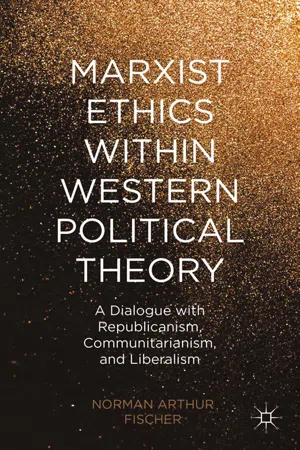
Marxist Ethics within Western Political Theory
A Dialogue with Republicanism, Communitarianism, and Liberalism
- English
- ePUB (mobile friendly)
- Available on iOS & Android
eBook - ePub
Marxist Ethics within Western Political Theory
A Dialogue with Republicanism, Communitarianism, and Liberalism
About this book
As widely applied as Marxist theory is today, there remain a host of key western thinkers whose texts are rarely scrutinized through a Marxist lens. In this philosophical analysis of Marx's never-before translated German notes on Machiavelli, Montesquieu, Rousseau, and Lewis Henry Morgan, Norman Fischer points to a strain of Marxist ethics that may only be understood in the context of the great works of Western political theory and philosophy particularly those that emphasize the republican value of public spiritedness, the communitarian value of solidarity, and the liberal values of liberty and equality.
Information
Chapter 1
Introduction, Marxist Ethics within Western Political Theory
“I speak here of political virtue, which is general virtue in the sense that it is directed to the general Good.”1
Marxist Ethics within Western Political Theory uncovers, through intellectual history and abstract philosophy, a specific tradition of Marxist ethics within the context of key debates in the history of Western political theory, and both builds upon and contrasts it with earlier excavations of Marxist ethics. For example, throughout the crisis-ridden 1920s and 1930s in the German-speaking world, political philosophers, such as the Hungarian Georg Lukács, acutely aware of the context of German philosophical ethics out of which Marxism arose, probed the ethical question with intensity, a probing that continued throughout the twentieth century. A second overlapping ethical probing occurred during the events leading up to World War II, when Marxists such as Lukács and the English classicist George Thomson, working with popular fronts against fascism, placed Marxist ethics within the broader framework of Western political thought. A third revival of the probing occurred against antiliberal versions of Marxism in nations outside or on the fringes of the Western world, when Marxist ethics became a rallying cry of dissent against the authoritarian Marxism in power. A fourth model for probing of Marxist ethics began in the last quarter of the twentieth century, when English-speaking philosophers took up the question again and raised it to an international debate. A different, fifth model for Marxist ethics developed during the same period in Spanish-speaking South and Central America and in Mexico, when liberation theologians took a very different path toward a Marxist ethics for Catholicism, and, more broadly, for Christianity and for religion in general.2
Yet, all of these ethical reconstructions of Marxism have run up against an anti-ethical appeal to immoralism within Marxism itself. Political theory needs ethics, and so does Marxist political theory.3 A seemingly intractable problem, however, has beset virtually all writers on Marxist ethics: either they have remained so closely within the topical, practical, and contemporary aspects of the Marxist tradition that they have excluded themselves from presenting a genuine abstract and principled political ethics characteristic of the great Western canon, or else they have imposed an ethical viewpoint that is fundamentally external to Marxism. To overcome this problem, I use an abstract political philosophy to probe the meaning of an alternate intellectual history of Marxism’s encounter with ethics. What results is alternate tradition Marxism, and no attempt is made to say that this is the only attitude toward ethics in Marx or Marxism.
Four tools help place Marxist ethics within Western political theory:
1.Within alternate tradition Marxism the ending of unjust property class is seen as the fundamental and necessary goal of Marxist ethics. Although Marx and most Marxists thought that socialism or communism as social or state ownership of the means of production were necessary to reach the goal of the end of unjust property class society, alternate tradition Marxist ethics does not treat the aim of ending unjust class society as logically entailing socialism or communism.
2.In alternate tradition Marxism the concept of class ethics is seen as a form of what political theorists of the last four decades have explored as group identity or diversity ethics.
3.Fundamental concepts in Western political ethics about what the good society should be, such as (a) democracy and (b) economic justice, are also seen as fundamental to Marxist ethics. Alternate tradition ideal democracy, however, is inextricably linked with the concept of what classical republicans called public-spirited citizen participation; and alternate tradition Marxist economic justice is inextricably linked with the concept of property.
4.Alternate tradition Marxist ethics is unlocked through debate in the past forty years over communitarian and liberal values within Western political thought to show that there exists within Marxism a specific form of philosophical communitarian ethics, which has more in common with that unifying value system, and the unifying value system of philosophical liberalism, than does most group identity and diversity ethics, the majority of which choose fragmentation over unity.
Like Montesquieu, the eminent Enlightenment chronicler of republican concepts of what the good society should be, I assume that a political theory that is part of the great Western canon must have a specifically political ethics, which is not just about the facts of the political system, nor the norms of the individual, but also about the individual within the norms of the political system itself, about what Montesquieu called “political virtue, which is general virtue in the sense that it is directed to the general good.”4 Much of the most fundamental reconstruction of the great Western political theorists has been broadly about their political ethics of what a good society should be. For alternate tradition Marxist ethics of what a good society should be to fit into the Western canon, selected elements of Marxism must be synthesized, abstracted, and compressed into a unified political ethics text that would bear a similar relation to concrete politics of the last century and a half as do Plato’s and Aristotle’s ideal city-states to the actual Athenian or Spartan polis; Cicero’s, Machiavelli’s, and Rousseau’s ideal republics to the actual Roman republic and empire, fifteenth- and sixteenth-century Renaissance Italian republics and monarchies, and eighteenth-century Swiss communes; St. Augustine’s and St. Thomas Aquinas’s Christian polities to the actual politics of the Christian state within the declining Roman empire and the Middle Ages; Hobbes’s and Locke’s ideal commonwealths to the seventeenth-century English and Scottish state; Montesquieu’s spirit of the laws to his ancient Greek, Roman, and eighteenth-century French, British, and American examples; Kant’s, Thomas Paine’s, and Mary Wollstonecraft’s Enlightenment reconstruction of rights—and Edmund Burke’s reconstruction of tradition—to the actual condition of rights and traditions at the end of the eighteenth century; G. W. F. Hegel’s philosophy of right and law to the various nineteenth-century European states that serve as examples; John Stuart Mill’s concept of liberty to the nineteenth-century British legal system; and John Rawls’s political liberalism to current US practices.5 All these texts possess one common trait: as time passes, the abstract ethical theories of what a good society should be at their core increasingly now are seen to bear a very different relation to their concrete examples than the authors thought it did. The same rule applies to Marxism, insofar as it expresses political ethics. Marxist political ethics must include, as it has always included, the aim of ending the unjust property basis of class society. But Marxist political ethics within the Western canon goes far beyond, and does not include as an example at all, non-Western socialism and communism, or its traditional aim as social or state ownership of the means of production, from 1917 to the present.
But to what tradition of Western political ethics of what a good society should be does Marxism within this political ethics belong? My intellectual history and abstract philosophy do not attempt to show that alternate tradition Marxist ethics is consistent with anything close to all the major theses stated by Marx or other Marxists. My aim is only to convince the reader that this moral and ethical tradition now does occupy a firm, albeit buried, place within Marxism. What results is certainly one of the largest gaps yet created in intellectual history between this alternate tradition of Marxist ethics within Western political theory, and all societies that claimed to put Marxism into practice between 1917 and the present. This book intentionally embraces this gap.
Marxist fragmenting and disunifying class/group identity ethics can incarnate itself within the broad context of the unifying political ethics texts that characterize the Western canon. Over the past 30 years, a great debate has been occurring in political theory about the relative value of two such unifying systems: (1) liberalism and (2) communitarianism, and their relation to (3) group—including class—identity ethical systems. Alternate tradition Marxist ethics can be fit into Western political theory when it can be seen to share parts of all three elements.
Liberalism became more ethically interesting with the attempt starting in the 1970s to understand the Western liberal tradition in its deepest philosophical impulses, with writers throughout the English-speaking world and Europe trying to show that Western liberal ethics, conceived in the most abstract possible sense, has many more ethical dimensions than considered.6 From this perspective, the dialogue between liberal and Marxist ethics is made more intricate. Liberal ethics become broadened and so do Marxist ethics. Indeed, following this line of thought, Marxist class ethics could be seen as a logical extension of liberal commitments to individual liberties and to equality.7
The second development has been a reaction against the first. Starting in the late 1970s, communitarians throughout the Western world claimed that liberalism, or at least traditional liberalism, must either give way to or be complemented by an emphasis on the integration of the individual into the community that goes far beyond a commitment to equality—which may be neutral about community—or to rights to individual liberties—many of which at least some communitarian critics of liberalism find positively hostile to community. Other communitarians have sought a more nuanced balance of rights to individual liberty and communitarian values.8
The third development has been the flowering of a group identity, diversity, or multicultural ethics, which is often hostile to the unifying themes of either Western liberalism or Western communitarianism in its emphasis on the fragmentation of political ethics into group interests.9 This debate between communitarian and liberal versions of unity and different group identity versions of disunity is ethical to the core, and so is a Marxist class ethic that is placed within its perspective. Alternate tradition Marxist class ethics is a group identity ethics that differs strongly from much contemporary group identity ethics, because at its philosophical core it is compatible with the unifying perspectives of Western communitarianism and liberalism, whereas much contemporary group identity and diversity ethics is not. Seen within this nuanced context, Marx’s and Marxist class ethics can be characterized more clearly as part of a great tradition of Western ethical political theory.
The communitarian/liberal/group identity debate can be enriched by looking at Marxist class ethics, and vice versa. For Marxist class/group identity ethics to be properly seen as either communitarian or liberal, or, the perspective of this book, as part of Western liberal communitarianism, it must be put on a stage on which advocates of the fundamental ideals of Western political ethics have been arguing for a very long time, going back to ancient Greece and Rome.10 When seen from this perspective, communitarian and liberal ethical systems define themselves by their fundamental values. Liberal ethics is above all concerned with liberty and equality, communitarian ethics with solidarity.11 All versions of Marxist class/group identity ethics, insofar as they are forms of communitarian and liberal ethics, also concentrate on some combination of liberty, equality, and solidarity. Communitarianism and liberalism as categories of political ethics can thus include the subcategory of class/group identity ethics. Marxist class ethics can be either exclusively communitarian, or exclusively liberal, or a combination of both. Marxist Ethics within Western Political Theory delineates and reconstructs a liberal Marxist version of communitarian ethics and shows how it could apply to a society aiming to end unjust property-based class divisions.
Within Western political ethics there are many communitarian systems of ethics, and many liberal systems of ethics, just as there are many approaches to Marxist class/group identity ethics. Some versions of communitarian ethics, and some versions of Marxist ethics, do not overlap at all. Indeed, there is a specifically Marxist version of communitarian ethics and a specifically communitarian version of Marxist ethics. Nevertheless, Marxist and communitarian ethics overlap significantly enough that a specific tradition of communitarian Marxist ethics can be reconstructed. There are also many versions of liberal ethics, and some do not overlap at all with Marxist ethics. But it is only that version of communitarian Marxism that significantly overlaps with liberal ethics that places Marxist ethics firmly within the Western political canon. Liberal communitarian Marxism contrasts with nonliberal communitarianism, both within and outside Marxism. Marxist ethics within Western political theory, however, does not constitute a standard liberal ethic. Nor, for that matter, is it a standard communitarian ethic. It is a unique ethical variant of Western communitarianism and a unique ethical variant of Western liberalism, whereby these two unifying systems cohere with a disunifying and fragmenting class/group identity perspective.
Western liberal ethics has usually aimed to secure both a broad liberty of the person to be free of domination, and also, particularly since the seventeenth century, a narrower procedural right to this liberty. This liberty has often been called negative, because it demands removal or negation of obstacles to its exercise. Western liberalism also often defends both a broad equality, and a narrower procedural equality; the latter is now usually enunciated in terms of rights. I call the equality that liberalism often (but not always) demands “broad,” in order to distinguish it from any procedure for gaining equality. Marxist liberal communitarianism does have as fundamental values both negative liberty of the person—defined broadly as avoidance of domination and coercion through removal of obstacles—and also a substantive and not merely procedural equality.12
Marxist ethics can be placed in a dialogue with ethical liberalism, which, going beyond slogans of the media, tries to determine the proper role of negative liberty and equality, and in some versions tries to determine their relation to community and group identity values. The liberal elements in the historical tradition of communitarian and liberal Marxist ethics did not usually—at least before the last quarter of the twentieth century—explicitly culminate in a detailed philosophical account of negative liberty and equality rights, although they are compatible with such rights, often imply or touch upon such rights, and, for full development, demand such rights.
Although it is easier to say what Western liberalism is than it is to say what a standard form of Western communitarian ethics is, one version that has emerged in the liberalism/communitarianism debate in North America and European political philosophy of the last 40 years defines its leading value, solidarity, as being above all the willingness to identify some or all of an individual’s ethical goals with those of society or some part of it. I call this identification global solidarity. Out of global solidarity a non- or antiliberal communitarianism can be constructed, which is in opposition to negative liberty, either as a goal or as a claim to procedural rights. Yet, the emphasis on global solidarity does not have to lead to antiliberalism, and can be both liberal and democratic. Of course, there have been many antiliberal forms of communitarianism: Marxist and non-Marxist.13
But communitarian and liberal Marxist class/group identity ethics, insofar as it utilizes central strands of Western political ethics, stand opposed to antiliberal communitarianism for three reasons. First, they are committed to fundamental values of liberalism: negative liberty and equality. Second, it is compatible with and for their full development demand procedural rights to both negative liberty and equality. Third, Marxist communitarianism accepts a role for global solidarity but, solidarity is also characterized as an institutional lessening of disharmony between individual ethical goals and social ethical goals, dictated by material and economic conditions and needs, and requiring an account of property for full development. I call this material solidarity, in contrast to global solidarity. Emphasis on material solidarity, and balancing it with negative liberty and equality, forecloses a mandate of global solidarity, although allowing it as a fundamental value. For Marxism to be liberal, only material solidarity, properly balanced with negative liberty and equality, can be mandated while global solidarity cannot be.
Thus, the ethical niche of a Marxist class ethics that is both communitarian and liberal displays itself in the relation between the four values of negative liberty, equality, and global and material solidarity. A political ethics committed to these four values must ask, for example, what are the links between the broad aims of negative liberty—such as ensuring due process of law and fr...
Table of contents
- Cover
- Title
- 1 Introduction, Marxist Ethics within Western Political Theory
- Part I Marxist Ethics of Republican Democracy
- Part II Marxist Communitarian and Liberal Ethics of Economic Justice and Property
- Notes
- Index
Trusted by 375,005 students
Access to over 1.5 million titles for a fair monthly price.
Study more efficiently using our study tools.
Frequently asked questions
Yes, you can cancel anytime from the Subscription tab in your account settings on the Perlego website. Your subscription will stay active until the end of your current billing period. Learn how to cancel your subscription
No, books cannot be downloaded as external files, such as PDFs, for use outside of Perlego. However, you can download books within the Perlego app for offline reading on mobile or tablet. Learn how to download books offline
Perlego offers two plans: Essential and Complete
- Essential is ideal for learners and professionals who enjoy exploring a wide range of subjects. Access the Essential Library with 800,000+ trusted titles and best-sellers across business, personal growth, and the humanities. Includes unlimited reading time and Standard Read Aloud voice.
- Complete: Perfect for advanced learners and researchers needing full, unrestricted access. Unlock 1.5M+ books across hundreds of subjects, including academic and specialized titles. The Complete Plan also includes advanced features like Premium Read Aloud and Research Assistant.
We are an online textbook subscription service, where you can get access to an entire online library for less than the price of a single book per month. With over 1.5 million books across 990+ topics, we’ve got you covered! Learn about our mission
Look out for the read-aloud symbol on your next book to see if you can listen to it. The read-aloud tool reads text aloud for you, highlighting the text as it is being read. You can pause it, speed it up and slow it down. Learn more about Read Aloud
Yes! You can use the Perlego app on both iOS and Android devices to read anytime, anywhere — even offline. Perfect for commutes or when you’re on the go.
Please note we cannot support devices running on iOS 13 and Android 7 or earlier. Learn more about using the app
Please note we cannot support devices running on iOS 13 and Android 7 or earlier. Learn more about using the app
Yes, you can access Marxist Ethics within Western Political Theory by N. Fischer,Kenneth A. Loparo,Asher Z Milbauer in PDF and/or ePUB format, as well as other popular books in Politics & International Relations & Political Philosophy. We have over 1.5 million books available in our catalogue for you to explore.