eBook - ePub
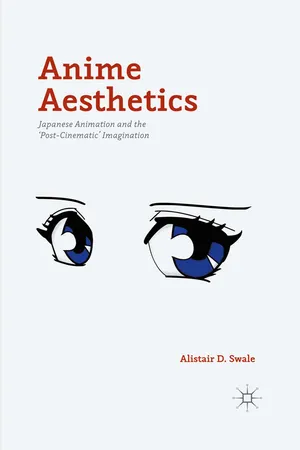
Anime Aesthetics
Japanese Animation and the 'Post-Cinematic' Imagination
- English
- ePUB (mobile friendly)
- Available on iOS & Android
eBook - ePub
About this book
Japanese animation has been given fulsome academic commentary in recent years. However, there is arguably a need for a more philosophically consistent and theoretically integrated engagement. While this book covers the key thinkers of contemporary aesthetic theory, it aims to reground reflection on anime within the aesthetics of R.G. Collingwood.
Information
Topic
Scienze socialiSubtopic
Arte generale1
R. G. Collingwood and a “Philosophical Methodology” of Aesthetics
R. G. Collingwood’s The Principles of Art has enjoyed something of a resurgence in interest thanks to the endeavours of scholars such as Aaron Ridley who have proposed a reading that refutes the charge of ontological Idealism as articulated by Richard Wollheim and engages with the dimensions of Collingwood’s aesthetic philosophy that deal with expression and imagination. David Davies has endorsed Ridley’s argument and taken this “revisionism” one step further by proposing a “performative” interpretation of Collingwood’s theory of art based on Collingwood’s conception of the work of art as an activity rather than the product of an activity.1 Nevertheless, he also highlights a series of puzzles that Collingwood cannot fail but generate when he attempts to reconcile the conception of art as activity with the art/craft distinction. He concludes by suggesting that, despite these ambiguities, it is Collingwood’s novel conception of art as a “language” that enables us to better understand the structure of The Principles of Art and Collingwood’s significance as a commentator on the role of imagination in the experience of art.
This chapter aims to reinforce the key assertions of Davies’ commentary by contextualizing Collingwood’s conception of art as expression, and his employment of imagination as the primary vehicle for engaging with such expression. This is undertaken by positing Collingwood’s art theory within the broader compass of his intellectual concerns, including the philosophy of history and questions of philosophical method. Initially, it will be argued that the seeming “ontological Idealism” apparent in Book I of The Principles of Art is in fact a misreading of a methodological approach first enunciated in An Essay on Philosophical Method and given important subsequent clarification in The Idea of History, which was published posthumously.2 This material will also be employed to address some of the lingering “puzzles” put forward by Davies, in particular the questions of (i) how Collingwood conceived of the relation between art as activity and art as expressive artefact, and (ii) how the “re-experiencing” of art might plausibly be defended as an exercise of imagination.
The perception of Collingwood’s theory of art being grounded in ontological Idealism remains persistent, largely due to the abiding influence of Richard Wollheim’s critique of the “Collingwood-Croce theory” expressed in Art and Its Objects in 1968.3 The critique characterized Collingwood and Croce as the twentieth century torch-bearers of continental Idealism, and, accordingly, Collingwood’s conception of artistic practice was depicted as being purely “imaginary” with no externalized dimension. Wollheim’s view did not go unchallenged at the time, and perhaps the most forthright counter from this period is that of Richard Sclafani who faulted Wollheim’s critique on two key points: the first being that Wollheim misread Collingwood’s definition of “imagination”, preferring to interpret all references to it in Collingwood’s The Principles of Art as thought with no basis in physical activity.4 This, Sclafani argues, neglects the passages that explicitly relate inner experiences to outward behaviour. The other point he makes is that Collingwood should not be regarded as being indistinguishable from Croce but should be understood in relation to the British Empiricist tradition, particularly the Hobbesian dictum that “mind is a function of language” which is a theme that can be traced in both The Principles of Art and The New Leviathan (Sclafani, 1976: 353–359).
Despite such counter arguments, there would seem to be no altering the fact that, when attempting to re-evaluate Collingwood’s aesthetic philosophy, one is nonetheless obliged to deal with the Wollheimian interpretation in the first instance. Even as there have been a number of incremental steps taken to establish a space for re-evaluating Collingwood’s aesthetic philosophy, the Wollheimian critique remains acutely contested.
Within the last decade Aaron Ridley has made one of the most strident attempts to retrieve the essence of Collingwood’s continued relevance to the theory of art in “Not Ideal: Collingwood’s Expression Theory” (Ridley, 1997: 263–272). In this article Ridley has the fundamental aim of questioning Wollheim’s characterization of Collingwood as an ontological Idealist. Ridley acknowledges that Wollheim’s interpretation of The Principles of Art is understandable to a point, given an admittedly rather loose depiction of artistic experience in Book I of The Principles of Art. For example, when Collingwood focuses on the example of music he asserts that the artistic experience of a musical performance is not to be understood as a process of listening to sounds, but an act of imagination whereby we hear those sounds as music. This could be taken to imply that the essence of music is in the mind, but Ridley argues that we should resist the temptation to construe such passages as an endorsement of the position that art “only exists in the head” and nowhere else. By referring to the more detailed discussions of the processes of creating works of art in Part III (as in the case of a tactile art such as painting), Ridley argues persuasively (and in common with Sclafani) that we should engage in an interpretation of Collingwood that acknowledges the fact that he was, after all, not indifferent to the material or physical dimensions of both creative practices and the resultant artistic artefacts. In fact, Ridley suggests that Collingwood had anything but an Idealist position in his theory:
Collingwood, whatever his apparent commitments, really operates as a kind of fifth columnist against the Ideal theory: as we have seen, he claims that the ideas in the artist’s and the spectator’s heads should be the same; he acknowledges the artist’s relationship to the real, public materials of his or her art; and he pays homage to the imaginative activity of the spectator while affirming the constraints placed on that activity by what the artist has actually done. Surely ... Collingwood cannot really have espoused the theory that Wollheim and others have attacked at all. (Ridley, 1997: 269)
The ultimate strength of Ridley’s article, however, is that he brings the focus more clearly on Collingwood’s own preoccupations, particularly the relationship between expression and imagination. Based on the premise in Book III that, for the artist, there can be no distinction between means and ends, Ridley deftly unpacks the significance of this in relation to Collingwood’s conception of artistic expression, particularly the insistence that the artist doesn’t know what they have created until it is done, as the process of exploring the medium is itself part and parcel with the process of becoming conscious of what it is one wants to say or present.
the work of art proper, is a success not if it matches up with something independently specifiable (a plan) – not, that is, through being “a thing of a certain kind” – but if it counts as an expression, if it counts as “a certain thing”. (Ridley, 1997: 271)
Art, conceived in this sense, is an activity, one that incidentally produces artefacts (“works of art”) which emerge through a combination of physical and psychological operations. These works are contingent on artistic expression, not independent of it, but it is imagination which is posited as the primary vehicle for consciously engaging with that process, whether as artist or as a member of the artist’s “audience”.
This re-interpretation has not met with an altogether sympathetic response. John Dilworth, for example, redeployed the essence of the Wollheimian critique, and went further to suggest that Ridley’s apologia actually gets Collingwood into deeper trouble by transposing the problem from art as an ideal construct to art as an ephemeral performative expression (hence Dilworth’s suggestion that Ridley was being “uncharitable”). Ridley’s response was, naturally enough, to reject the suggestion that he had performed such a “disservice” and he reasserted his original plea for an interpretation that was more accommodating of the acknowledged flaws and shortcomings in The Principles of Art.5
This debate has been taken up afresh more recently by David Davies who has endorsed Ridley’s rejection of the Wollheimian view, particularly the interpretation of Collingwood based on the problematic passages in Book I. Davies argues that this interpretation misconstrues the expository purpose of Book I, which was explicitly to conduct a prolegomena discussing the relation of art to other “imposter” definitions based on contingent aspects of the production and experiencing of art: “craft”, “representation”, “magic” and “amusement”. Davies highlights that “art proper” does not get addressed in detail until Book III and, again in a manner consonant with Ridley’s interpretation, reasserts the basic premise of Collingwood’s theory that art is an activity, albeit one that incidentally produces a variety of tangible outputs and artefacts (Davies, 2008, p. 164) . Moreover he emphatically embraces a “performative” conception of the Collingwood’s theory of art and rejects the critique offered by Dilworth.
Davies retrieves, at the very least, a great deal that is positive in Ridley’s “revisionist” reading of Collingwood, although I do not propose to engage directly with the “performative” conception of art as put forward by him in this chapter. The point of more immediate interest in Davies’ article is the manner in which he raises three “puzzles” that linger when one considers the relative differences between varying forms of artistic expression (music, literature, visual arts, etc.) and what they imply for our understanding of the relationship between the activity of creating a work of art, and the experiencing of the subsequent artefact. At root, there are a number of questions that arise when we examine the complex inter-relation of the ontology of artistic artefacts, the nature of the experience of creating and/or receiving them and the role of imagination in each stage of that process. For Davies these are inter-related issues that persist regardless of whether one considers that Ridley has, on balance, made a convincing argument to refute the Wollheimian critique or not.
The first puzzle can be summarized as the problem of the lack of generalizability of arts:
It is not clear how ... the treatment of one art is supposed to generalise to the others. How, in the absence of a notation, can I create a painting through imaginative activity alone? And what plays the role, in music and literature, of the physical manipulations of the medium that ... provide the psycho-physical basis for expression in painting. (Davies, 2008: 164)
More particularly, Davies seems to be questioning the relationship between imagination and the physical act of creating art relative to each art form. If it is not the same for each art form and if it is not generalizable how are we to account for the differences?
The second “puzzle” is the problem of what tangible aspect of art there might be that provides the means for the “audience” to engage with the imaginative experience of the artist:
where the tactile aspects of the “total imaginative experience” enjoyed by the artist are associated with the elements presented to the receiver in the artistic product, it is not difficult to see how the reader might come to have the same kind of “total imaginative experience” as the artist ... On the other hand, if, in the case of a work like Eliot’s The Waste Land or Vaughan Williams’s The Lark Ascending, we take the “total imaginative experience” identified with the work to be the expressive dimension of the artist’s manipulation of the medium, it is unclear how this can be made accessible to us through our engagement, however imaginative, with the product of that manipulation. (Davies, 2008: 166)
In other words, how universal or “sharable” is the “total imaginative experience” of art; can the experience of the artist be literally shared by the audience or viewer?
Finally, Davies raises a closely related issue – even if we assume that a “total imaginative experience” could be shared, we still need clarification of precisely what this “re-experiencing” entails:
if Collingwood is claiming, as Ridley suggests, that to appreciate the musical work is to hear the noises produced by the performers as music, where this requires that we ourselves have the “total imaginative experience” that is the imaginative counterpart of the psycho-physical activity of the composer, and if that activity draws on the artistic tradition in which the composer was working and her conception of the audience, how is this feat of “re-experiencing” to be accomplished? (Davies, 2008: 167)
In the absence of any tangible trace of the creative artistic process beyond notation or symbols, how is a “re-experiencing” of the original total imaginative experience even possible?
To summarize, then, the first issue relates to a discussion of the possibility of generalizing the artistic experience across a number of art forms. The second relates more specifically to how we might plausibly link what the artist thinks, feels and expresses at the moment of producing an artefact of art, with what a viewer or listener of that artefact might sense or feel when encountering the work of art post factum. The third relates to the mechanics of the “total imaginative experience” – if it does work, how does it work?
In the ensuing discussion within his article Davies reviews a number of specific instances of art form and examines the nature of how we might understand the particular difficulties of accounting for a “total imaginative experience” of art for each one. One key example is T. S. Elliot’s Wasteland, and it is evident that, for Davies, it is literature that would seem to present most clearly the nub of the “puzzles” enumerated at the outset. Davies concludes that there is one particular and overwhelmingly obvious “lacuna” in Collingwood’s theory:
What Collingwood lacks, it seems, is a distinction between the work of art, as expressive process, and the artistic vehicle through which the artist comes to express something for herself and for the audience. (Davies, 2008: 171)
The reason for this lacuna, Davies suggests, is that Collingwood remained averse to a “technical theory” of art where the “work of art” was the product of a craft rather than part of a process of expression. A person who became the recipient of some form of artistic expression might share in the expressive process of the artist via an imaginative engagement with the product (however substantial, tangible or otherwise that might be), but Collingwood would naturally be resistant to giving too much license to the notion that the “expressive charge” of the work was somehow embedded in the product given his earlier rejection of art as craft in the first Book of The Principles of Art (Davies, 2008: 171). This is the core of Davies’ concern: how is an “expressive charge” embedded in a work of art and what it is it that enables us to conceive of a means to bridge that between the artist and the audience when they engage with it?
The solution Davies raises to resolve this seeming lacuna is to consider more closely the implications of Collingwood’s radical definition of art as “language” and how it fits within his broader definition of expression. As Davies explains:
Collingwood uses the term “language” in a broad sense that incorporates not only natural language but also gesture insofar as it performs what he takes to be the original primary function of language: “it is an imaginative activity whose function is to express emotion”, something which is modified to permit the expression of thought. (Davies, 2008: 225)
Here we see that imagination is integral to expression, and that expression itself is capable of more than what we might consider to be the simple communicative function – it encompasses both emotion and thought as well. Again, to quote Davies’ account of the role of emotion in expression:
expression, for Collingwood, is most accurately viewed as the bringing to consciousness of experience, rather than as the expression of emotion in a more standard sense, because, for Collingwood, all experience has an emotional charge – all sensing and perceiving is ipso facto feeling. (Davies, 2008: 172)
If we accept these parameters to art as ...
Table of contents
- Cover
- Title
- Introduction
- 1 R. G. Collingwood and a Philosophical Methodology of Aesthetics
- 2 Anime as Craft
- 3 Anime as Representation
- 4 Anime as Amusement
- 5 Anime as Magic
- 6 Anime as Art: Digital Cinema and the Anime Aesthetic
- Conclusion
- Notes
- Filmography
- Select Bibliography
- Index
Trusted by 375,005 students
Access to over 1.5 million titles for a fair monthly price.
Study more efficiently using our study tools.
Frequently asked questions
Yes, you can cancel anytime from the Subscription tab in your account settings on the Perlego website. Your subscription will stay active until the end of your current billing period. Learn how to cancel your subscription
No, books cannot be downloaded as external files, such as PDFs, for use outside of Perlego. However, you can download books within the Perlego app for offline reading on mobile or tablet. Learn how to download books offline
Perlego offers two plans: Essential and Complete
- Essential is ideal for learners and professionals who enjoy exploring a wide range of subjects. Access the Essential Library with 800,000+ trusted titles and best-sellers across business, personal growth, and the humanities. Includes unlimited reading time and Standard Read Aloud voice.
- Complete: Perfect for advanced learners and researchers needing full, unrestricted access. Unlock 1.5M+ books across hundreds of subjects, including academic and specialized titles. The Complete Plan also includes advanced features like Premium Read Aloud and Research Assistant.
We are an online textbook subscription service, where you can get access to an entire online library for less than the price of a single book per month. With over 1.5 million books across 990+ topics, we’ve got you covered! Learn about our mission
Look out for the read-aloud symbol on your next book to see if you can listen to it. The read-aloud tool reads text aloud for you, highlighting the text as it is being read. You can pause it, speed it up and slow it down. Learn more about Read Aloud
Yes! You can use the Perlego app on both iOS and Android devices to read anytime, anywhere — even offline. Perfect for commutes or when you’re on the go.
Please note we cannot support devices running on iOS 13 and Android 7 or earlier. Learn more about using the app
Please note we cannot support devices running on iOS 13 and Android 7 or earlier. Learn more about using the app
Yes, you can access Anime Aesthetics by Alistair D. Swale in PDF and/or ePUB format, as well as other popular books in Scienze sociali & Arte generale. We have over 1.5 million books available in our catalogue for you to explore.