eBook - ePub
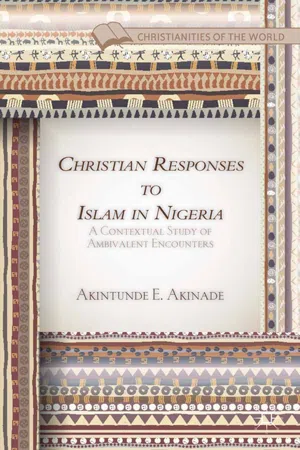
Christian Responses to Islam in Nigeria
A Contextual Study of Ambivalent Encounters
- English
- ePUB (mobile friendly)
- Available on iOS & Android
eBook - ePub
About this book
This book examines the various Christian responses to Islam in Nigeria. It is a study of the complex, interreligious relationships in Nigeria. Using a polymethodic approach, the book grapples with many narratives dealing with interreligious competition and cooperation in Nigeria.
Information
Topic
Theology & ReligionSubtopic
ChristianityChapter 1
Interpretations: Toward a New Approach in Christian-Muslim Encounters
Introduction: Encountering Christian-Muslim Relations
In a world that is ravaged by the torments of sacred fury and violence, there is perhaps no other subject that calls for serious academic study more than interreligious relations. This book deals with the varied and complex Christian responses to Islam in Nigeria. In the twenty-first century, no one can ignore the complex paradigms connected with the precarious relationship between Christians and Muslims all over the world. Since the seventh century, Christians and Muslims have interacted with one another in a variety of ways. It is truly a relationship that is satiated with both meaningful engagements and baffling ambiguities.1 The interaction between the two religions has run the gamut from constructive dialogue, lethargic encounters, open conflicts, to internecine violence. Jean-Marie Gaudeul has aptly described these dimensions as “encounters and clashes.”2 Nonetheless, nowhere is the need for interreligious cooperation and understanding more pressing than within the sphere of the largest religious communities. Christian-Muslim encounters offer a perspective for understanding our contemporary world and future world order. We are confronted with encounters and relationships that have religious, economic, and political ramifications.
Christians and Muslims comprise nearly half of the world’s population. Although both religious traditions are experiencing exponential growth, Islam is experiencing faster growth. The Muslim umma is spread all over the world. From Lagos to London, Muslims constitute a formidable global presence.3 Christianity has also been transformed into a world religion. In postcolonial societies, Christianity is experiencing unprecedented growth and transformation that continues to baffle secular skeptics and pundits. It seems that in the twenty-first century, a new spirit of renewal has enlivened both Christianity and Islam. Both have been transformed into global religions that challenge provinciality and narrow analysis.4
This new resurgence from the so-called underside of history has brought fresh insights into Scripture, theology, hymns, liturgy, prayers, and spiritual life. The resurgence in world Christianity represents a remarkable globalization from below, with multiple voices and trajectories, rather than an imposition from a single dominant world power. In the words of Lamin Sanneh, “Christianity is a multicolored fabric where each new thread, chosen and refined as the Designer’s hand adds luster and strength to the whole.”5 The growth of both religious traditions does not however correspond to any sustained improvement in the relationship between Christians and Muslims.
In the twenty-first century, Christian-Muslim encounters seem to be in a state of disarray and uncertainty. One writer has characterized this situation as a “struggling dialogue.”6 This is rather unfortunate considering the huge interest that the subject commands. Seyyed Hossein Nasr has remarked that during the past half century, Islamic-Christian dialogue “has turned from a rivulet into a roaring river, from an occasional conference to numerous meetings, oral and written exchanges and round-table discussions taking place year-round in nearly every corner of the globe.”7 This book is less concerned with a sanguine analysis of the current state of affairs, even though it cannot be dismissed. Rather, it seeks to renew and reinvigorate Christian thinking about relations with Muslims by providing a new perspective drawing on pertinent literature on the subject and on the lessons from the Nigerian case study. This perspective from a nation in the African continent presents a veritable challenge to the hegemonic control of western models in Christian-Muslim relations.
In our post 9/11 world, relations between Christians and Muslims continue to be couched in polarizing language. Public discourse generally demonizes Muslims, naively depicting Islamic culture as the complete antithesis of Western values and heritage. The term “Islamophobia” refers to the pervasive and collective generalized views about Islam. The term was coined by the Runnymede Trust in 1997, and it has been used to describe the reckless antagonism toward Islam that has become an increasingly recognizable aspect of Western cultures since the 1991 Gulf War, and has been accentuated by the horrendous events of September 11, 2001.8 This perception has deep historical antecedents and roots that go back to the Crusades. The clash of civilizations thesis has, to a large extent, pitted the Muslim world against the rest of the world and created a skewed binary construct of “us versus them.”9 Global conflicts are often couched in a rhetoric of good versus evil. This discourse becomes more inflamed when it is reinforced by skewed and sinister religious ideologies. Thus, it is not happenstance that more atrocities and acts of violence have been committed in the name of religion than any other institutional agency in human history. At a recent conference on the Culture of Peace and Non-Violence organized by the United Nations, Wole Soyinka remarked:
To such a degree has Religion fueled conflict, complicated politics, retarded social development and impaired human relations across the world, that one is often tempted to propose that Religion is innately an enemy of Humanity, if not indeed of itself a crime against Humanity . . . let us however steer away from hyperbolic propositions and simply settle for this moderating moral imperative: that it is time that the world adopt a position that refuses to countenance Religion as an acceptable justification for, excuse or extenuation of – crimes against humanity.10
This observation calls for a new path of genuine dialogue and a willingness to understand the other in our complex world. The crucial challenge of formulating a new paradigm that speaks to the new reality of a complex and multilayered “we” still persists. This pertains to a new perspective that valorizes the multiple, diverse, and mutually enriching identities of people all over the globe, of which Christians and Muslims constitute a formidable majority. The active involvement of religion in public life in our contemporary world is actually very complicated. This development enables us to deal with a whole range of religious dimensions and sensibilities: its peace and perversity, the tranquility and the terror, the promise and the peril. The ambivalence of religion therefore calls for deeper reflections and analyses. This understanding challenges both the image of an innocent religion that is only prone to political manipulations and the gross ignorance that tends to demonize an entire religious tradition based on isolated violent acts. Desmond Tutu once remarked that “religion is like a knife: you can either use it to cut bread, or stick in someone’s back.”11
The paradoxical nature of religion demands objective and critical analysis that resists the conclusion that valorizes the total innocence or utter depravity of religion.12 Religion can be the source of solemn songs that calm the soul or it can emit a cacophony of jarring sounds without rhyme or reason. It can provide the balm in Gilead that heals and comforts, but it can also spew fire like a furnace. Religion is obviously susceptible to different approaches and interpretations. It entails both destructive and transformative potential. We are inexorably confronted with a paradox about whether to look at religion as an innocent bystander or a culprit in the spate of violence and terror that has been unleashed upon humanity in the name of religion. I vividly recall a cartoon conspicuously posted on the office door of my main mentor in graduate school, the late Kosuke Koyama. The cartoon confirms Koyama’s penchant for candor in the face of religious bigotry and self-glorification. With pictures of adherents of different religious traditions menacingly wielding destructive weapons ranging from guns to bombs, it basically states that “all God’s children have guns.” This is a chilling affirmation that people from different religious traditions have committed horrible violence in the name of God. In their passionate pursuit of myopic religious ideologies, they have unleashed terror on a global scale. Inevitably, these episodes of holy madness and rage have concomitant consequences on international security and diplomacy. Although the caption of this cartoon sounds callous and alarming, it is the heart-wrenching reality of our contemporary world. The sociopolitical landscape in the twenty-first century is rife with dissenting voices and movements.
A note of caution is apropos at this point. The purpose of this book is not a wanton condemnation of religious affiliations and identities. Rather, it is a call for dialogue because we have been reminded in many ways that there a pristine message in all religious traditions that could be capriciously twisted in a way that can lead to deadly violence and terror. Religious fervor definitely adds more fuel to the embers of preexisting conditions of hate, paranoia, and fear. The ensuing conflagration burns with reckless intensity and with boundless range. Religious traditions from time immemorial have been a double-edged sword, cutting in different ways. Religious convictions have evoked zealous passion that has helped to bring down repressive regimes in a nation like South Africa.13 But it has also been the lethal weapon that has maimed, destroyed, and aided genocidal onslaught in nations like Rwanda and Kosovo. Religion has been used to justify slavery, oppression, colonization, repression, and murder.
There is no gainsaying the fact that religious differences have aggravated existing global dissensions and conflicts. The most common explanation for this distressing phenomenon is that it is not the religious factor itself but the abuse and instrumentalization of religions by certain forces or powers. This line of reasoning further states that the problem is not with either Christianity or Islam as faiths in their own right, but with the irredentist possibilities in these two religions. It is hard to reconcile the fact that religions should play a positive role in preventing internecine conflicts with the other unsavory fact that religiously motivated people can also be hoodwinked and manipulated into behaving immorally or even violently.
In recent times, several scholars have remarked that interreligious discourse is actually burdened by an unmitigated clash of ignorance. This is a fundamental malaise that prevents people from appreciating complementarities and symbiotic religious experiences. It is a pesky albatross that still hangs on the neck of any project on interreligious relations and engagement. The process of breaking free from this formidable obstacle will inevitably involve what Ninian Smart has described as “the diagnosis of differences”14 among religious traditions and also a deep understanding of the degrees of enduring affinities that exist among people of faith all over the globe.
It is important to point out that the word “encounter” has tremendous implications for this study. Encounter can be interpreted as people meeting face to face, whether this is planned or unexpected.15 It may also connote a situation of dialogue, contestation, or mutual exchange. It signifies the day-to-day experiences of Christians and Muslims in different contexts. It enunciates the real sitz im leben16 of the various ways Christians and Muslims interact and contend with various existential circumstances. This perspective also relates to the significance of contextualization in Christian-Muslim relations. Rather than dealing with prefabricated theories and conditions, contextualization valorizes the concrete experiences of the dramatis personae in interreligious relations. This is full immersion into the daily situations where faith and life relate. It moves the discussion beyond sterile abstractions to a deep exploration of the human aspects and issues that Muslims and Christians grapple with everyday. Kenneth Cragg once remarked that “the human situation itself, as it has come to be in this bewildering and exacting time, acts as a searching Muster-Master-General of the worlds of faith.”17 This is an invitation to explore the linkages between tradition and praxis in theological reflections.
Christians and Muslims may be outsiders to each other’s theological nuances and emphasis; but the common existential issues and circumstances that they confront everyday are not products of fiction and imagination and may offer resources for interreligious dialogue. This perspective with less emphasis on lex credendi offers a good foundation for interreligious engagements that are deeply genuine and critical. The emphasis on encounter underscores the potential for transformation and change. It invokes an ambivalent sensibility in terms of either positive or negative transformation. Human encounters are fraught with different consequences and implications. This dimension gets to the crux of the matter in interreligious relations. While it is a known fact that religion is susceptible to different interpretations and usages, there is still ineluctable understanding that a sound prophetic awareness of the Christian faith has the potential for peacemaking and conflict resolution. There is also a strong tradition of prophetic teaching and search for justice in the Islamic tradition. Such a perspective is truly relevant to the Nigerian context.
The process of encountering people of different religious traditions provides the opportunity to hear different stories and perspectives on matters of faith, culture, and society. Their narratives may not contain carefully formulated theological analyses, but they are invaluable for understanding the concerns and insights of the interlocutors in interreligious matters. The participants at the second International Conference of Christian and Muslim youths held in Jos, Nigeria, in October 2010, concluded that “an enemy is one whose story we have not heard.” When we ignore or dismiss the stories of others, we open the door for exclusion, oppressive tendencies, and unilateral imposition.18 One of the essential hallmarks of the postcolonial enterprise is to create the space where multiple stories and experiences can be expressed and accounted for. The ecumenical movement is also about hearing many voices and perspectives.19
There is a dire need for new narratives that stress the complex experiences of Christians living side-by-side with Muslims in various communities all over the world. The living and fluid interreligious experiences that are engendered by this inevitable reality are no less valid than other theoretical models that have been developed in other contexts. The so-called custodians of the guild especially within the Western magisterium cannot dismiss the rich experiences within multireligious communities and families. The oft-tottered paradigms of exclusivism, inclusivism, and pluralism cannot be seen as the last words on approaches to religious diversity.20
The Genesis of the Encounter in Africa
Africa has a long connection with Islam. When the followers of Prophet Muhammad were facing persecution in Mecca, he advised his followers to seek refuge in Abyssinia (modern-day Ethiopia). In the Muslim tradition, this remarkable event is known as the first hijrah (migration). Iman Buhari reported in his Sahih Buhari that these Muslim refugees went back to Arabia after Islam had been fully established. Those who returned to Medina are known in Islamic legends as the “people of the ship.”
Prophet Muhammad died in 632 CE. Seven years later, an Arab army invaded Egypt. The Islamic advance across northern Africa was done with commanding aplomb and dexterity. In fact, within 60 years of the Prophet’s demise, the Arab hegemonic hold was on all of North Africa along the Mediterranean Sea to the Atlantic. The success of the Arab invaders was greatly enha...
Table of contents
- Cover
- Title
- Introduction Exploring a New Trajectory in Interreligious Encounter
- Chapter 1 Interpretations: Toward a New Approach in Christian-Muslim Encounters
- Chapter 2 Glimpses of the Terrain: The Cross, the Crescent, and the Nigerian Terrain
- Chapter 3 Abiding Faith: Varieties of Christian Responses to Islam
- Chapter 5 On Faithful Presence: Religion and Human Wholeness in Nigeria
- Conclusion On Living and Walking Together into the Future
- Notes
- Bibliography
- Index
Trusted by 375,005 students
Access to over 1.5 million titles for a fair monthly price.
Study more efficiently using our study tools.
Frequently asked questions
Yes, you can cancel anytime from the Subscription tab in your account settings on the Perlego website. Your subscription will stay active until the end of your current billing period. Learn how to cancel your subscription
No, books cannot be downloaded as external files, such as PDFs, for use outside of Perlego. However, you can download books within the Perlego app for offline reading on mobile or tablet. Learn how to download books offline
Perlego offers two plans: Essential and Complete
- Essential is ideal for learners and professionals who enjoy exploring a wide range of subjects. Access the Essential Library with 800,000+ trusted titles and best-sellers across business, personal growth, and the humanities. Includes unlimited reading time and Standard Read Aloud voice.
- Complete: Perfect for advanced learners and researchers needing full, unrestricted access. Unlock 1.5M+ books across hundreds of subjects, including academic and specialized titles. The Complete Plan also includes advanced features like Premium Read Aloud and Research Assistant.
We are an online textbook subscription service, where you can get access to an entire online library for less than the price of a single book per month. With over 1.5 million books across 990+ topics, we’ve got you covered! Learn about our mission
Look out for the read-aloud symbol on your next book to see if you can listen to it. The read-aloud tool reads text aloud for you, highlighting the text as it is being read. You can pause it, speed it up and slow it down. Learn more about Read Aloud
Yes! You can use the Perlego app on both iOS and Android devices to read anytime, anywhere — even offline. Perfect for commutes or when you’re on the go.
Please note we cannot support devices running on iOS 13 and Android 7 or earlier. Learn more about using the app
Please note we cannot support devices running on iOS 13 and Android 7 or earlier. Learn more about using the app
Yes, you can access Christian Responses to Islam in Nigeria by A. Akinade in PDF and/or ePUB format, as well as other popular books in Theology & Religion & Christianity. We have over 1.5 million books available in our catalogue for you to explore.