eBook - ePub
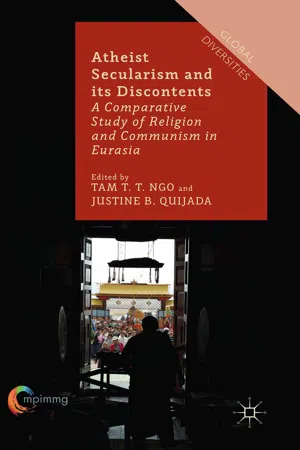
Atheist Secularism and its Discontents
A Comparative Study of Religion and Communism in Eurasia
- English
- ePUB (mobile friendly)
- Available on iOS & Android
eBook - ePub
Atheist Secularism and its Discontents
A Comparative Study of Religion and Communism in Eurasia
About this book
Atheist Secularism and Its Discontents takes a comparative approach to understanding religion under communism, arguing that communism was integral to the global experience of secularism. Bringing together leading researchers whose work spans the Eurasian continent, it shows that appropriating religion was central to Communist political practices.
Information
1
Introduction: Atheist Secularism and Its Discontents
Tam T. T. Ngo and Justine B. Quijada
Twenty years ago, a poor peasant who lives about 30 kilometers west of Hanoi survived a strange illness that almost killed her. Since then, she claimed that every night in her dreams she met Uncle Ho, who taught her “the way of Ho Chi Minh”. When she woke up, she wrote down these teachings, using a popular Vietnamese traditional poem form. Very soon, a growing crowd began to gather around her, honoring her as the Master (Thầy), and seeking healing and moral teaching. Such was the birth of the Ho Chi Minh religion. Today, the Ho Chi Minh religion has thousands of followers in thirteen provinces in North, Central and South Vietnam. Followers of this religion worship Uncle Ho as the “Jade Buddha of the Nation” (Ngọc Phật Nước Nam) and follow the teachings in the “Book of Prophecies”, a compilation of the Master’s poems. A bronze statue of Ho Chi Minh is venerated in the halls of the religion’s main temples, which are adorned with the national flag of Vietnam and the communist hammer-and-sickle flags. Once initiated into the religion, followers are required to replace ancestral and Buddhist altars in their home with a Ho Chi Minh altar, similar to the decorations in the temples. Ritually, the religion has adopted all national and communist holidays, such as Independence Day (September 2), Reunification Day (of north and south Vietnam, April 30), International Labor Day (May 1) and the annual commemoration of war casualties (July 27), as their own celebrations. On some of these occasions, followers in different places organize themselves into units and hold processions on the street, or to the Ho Chi Minh Mausoleum in Hanoi, using a typical socialist style of processions such as “reporting achievement to uncle Ho”.
Vietnamese government authorities have become alarmed by the movement and want to suppress it. The problem is, however, it is not easy to suppress a popular movement whose followers do exactly what the state has told them to do. For the last four decades, Ho Chi Minh has been venerated by the state as the founding father of the nation. A mausoleum was built for him, government offices venerate his statues, people were encouraged to worship his pictures in their home, his thoughts on virtually all matters of life and politics were cited the way Christians cite bible verses. Ho Chi Minh’s home village became a popular pilgrim destination, and his biography is sanitized of any human and worldly details. His morality is promoted as the model for all national citizens to follow. In short, he was made a god in the religion of Vietnamese nationalism. This puts the state in an awkward position, since the members of the Ho Chi Minh religion are ostensibly doing exactly what the state wants them to. However, their apotheosis of a political leader reveals the contradictions in the state’s own tactics. The state has turned to denouncing the movement for abusing the name of the nation’s father to lure and exploit the masses into violating Vietnamese religious laws. Lately, the government’s headache intensified when followers formally invited different government officials to join them in celebration of “Uncle Ho’s” ritual occasions.
What is remarkable about this example is that it is really not that remarkable. Despite the widespread perception that communism and atheism are inseparable, throughout the communist and post-communist world, religious and political imaginaries are intimately intertwined. In China, Mao’s mangos became political relics (Chau, 2010). On the steppes of Siberia, Buryat Buddhists explain the 1937 purges as a result of Stalin’s karmic debts (Humphrey, 2002b). In contrast, shamans in Siberia explain their shamanic callings as a genetic inheritance (Quijada, 2009), Buddhists use forensic analysis to confirm miracles (Quijada, 2012), and in Moscow faith healers wear white lab coats and wield machines that produce aura analyses (Lindquist, 2006), showing that atheist scientific forms have migrated into religious practices. And yet, atheism was central to communist ideology, so central that Smolkin-Rothrock, for example, has argued that one of the pivotal moments in the USSR’s collapse was the decision to officially celebrate the 1000 year anniversary of Christianity in Russia.1 While this may seem like a contradiction, in fact, it is precisely because atheism was so central to the communist project that atheism’s others, superstition and religion, were essential to the communist experience.
What is surprising instead is that it has taken so long to come to this realization. The past twenty years have produced a considerable amount of scholarship on what appeared to be a florescence of religion after the fall of the Soviet Union. The result is a rich tapestry of data that shows the intimate intertwining of religious practices and communist governance, complicating Cold War understandings of communism.2
The end of the Soviet Union, which occurred at the same time as transformative economic reform in China, was a socio-political watershed moment. The Cold War was over in practice, but the interpretive frameworks of the Cold War continued, and still continue, to influence scholarship about these territories. It is time to reassess what the past twenty years have taught us about the relationship between religion and communism, and leave behind, once and for all, the ideological assumptions of Cold War scholarship (see also Rogers, 2005). Once we do so, it becomes clear that state-sponsored atheism is best understood as one variant of the global experience of secularism.
We are not alone in viewing Soviet state-sponsored atheism as a form of secularism. Catherine Wanner (2007) and Sonja Luehrmann (2011b), for example, have both explored Ukrainian and Russian state atheism specifically as a form of secularism through detailed and focused case studies. Comparative studies have also treated the Soviet experience as a form of secularism in Russia and the Ukraine (Wanner, 2012), and Central Asia (Hann and Pelkmans, 2009). The research on religion under and after communism by the Max Planck Institute for Social Anthropology under the direction of C. M. Hann has produced a rich array of case studies in the only context that bridges both Eastern European and Asian experiences of communism, but the theoretical framework of these studies focus more on civil society and economic transformation than on secularism (Hann, 2000; 2006; 2010a; 2010b). While studies of the former Soviet Union tend to be limited to the temporal and geographic boundaries of the Soviet experience, studies of secularism in China, in contrast, locate secularization within the historical experience of colonialism and modernization, underplaying the peculiarities of communist secularism (Mayfair Yang, 2008; Goossaert and Palmer, 2011). The authors in this volume draw on the insights of all these authors, attempting to synthesize these approaches.
The intertwined relationship of communism and religion deserves our attention not only because it promises to offer greater insight into communism as a political system, but because it promises to offer greater insight into secularism as a global phenomenon. Beginning with Casanova (1994) there has been an ever-growing body of literature about secularism, challenging the Weberian assumptions that dominated 20th Century social science. A new body of literature, taking up Asad’s call to reconsider secularism (2003) has produced a vibrant body of work that explores secularism as a cultural system in its own right, rather than as merely a backdrop for political action, defined by the absence of religion (see for examples Mack, 2009; Warner et al., 2010; Calhoun et al., 2011a).3
As Calhoun et al. put it, secularism “is not in itself neutral. Secularism should be seen as a presence” (2011b, p. 5). Secular values, such as the separation of church and state, or religious freedom as a human right, are increasingly shown to be grounded in very Western and Protestant conceptions of what religion is and does. Mahmood (2006) for example, through an analysis of the International Religious Freedom Act, shows how secular practices presume and thereby create certain kinds of religious subjectivities as normative.
This new research has presented compelling new perspectives that have deeply influenced all the contributors in this volume. We argue, however, that in order to fully see secularism’s “presence” as a global, rather than a Western phenomenon, we must bring the communist experience into the picture. As Calhoun et al. note, the ideology of secularism has shaped the academic study of it, producing theoretical blind spots that we are only now beginning to fill (2011b, p. 4). Whether we choose to define secularism philosophically as framing religious belief and practice, as Charles Taylor does (2007), or anthropologically as a project of power in the Foucauldian sense, as Talal Asad (2003) does, secularism is a state of being that exists primarily in the West, and that is inextricably linked to democracy and modernity. Theories of “our” secular age have, until recently, been limited to the historical experience of Western Christianity, leaving large parts of the Christian world (including Eastern Christianity) and other religions out of the picture entirely. There are good reasons for this. Secularism, as it is conventionally understood, grew out of the European reformation and the Enlightenment, and as a result Protestant ideas are fundamental to its logic. Most notably, Western post-Enlightenment secularism privileges the idea that religion ought to be about belief, rendering practices secondary. This assumption becomes less and less applicable, the further secularism spreads from its European point of origin, and like its alter-ego “religion”, colonial and communist empire-building projects have spread secularism around the globe. Or at least this is how the dominant narrative of secularism would have us understand the process. However, both the European Reformation and the Enlightenment were, to a large degree, a response to the changing horizons of European expansion and colonialism. The idea of “religion” as an abstract concept describing an area of human endeavor (rather than Christian truth, for example) developed as much out of the colonial encounter as out of the Protestant Reformation. Secularism, as an ideology that posits that some spheres of life should be separate from religion, requires that religion be defined as a field of human endeavor, rather than as truth. “Belief” becomes the privileged form of religion out of a comparative project that posits “our belief” as superior to “your (Catholic/heathen) practice”. Therefore, we argue, not only is secularism a global phenomenon now, it has been one since the very beginning.
Not surprisingly, a considerable amount of new critical research is focused on one of the fault-lines of Western secularism: the presence of Islam in Western Europe (Göle, 2006; Fernando, 2010; Roy, 2007; Al-Azmeh, 1993; Lewis, 1993; Goody, 2004), while the other focuses on states such as Turkey (Çınar, 2005) or India (Madan, 1998), where secular principles are perceived to have been imposed on non-secular subjects either by modernizing reformers or colonial powers (Göle, 2008; Nandy, 1988; Tambar, 2009). This work is important and extremely valuable, but it risks re-inscribing the ideological formations that underpin secularism, and paints Islam as its only “other”, a particularly troubling conceptualization, because of all religious practices, Islam most clearly matches a secular definition of religion as being about belief. To avoid this mistake a number of scholars have pursued an “interactionist” approach to study how secular principles have evolved in non-Western contexts (Van der Veer, 2001; Chatterjee, 2006; Bhargava, 2010). Secularism presumes that religion ought to be a form of belief, but many forms of religious practice cannot or should not productively be considered forms of “belief”. What of religions that foreground practice and that posit multiple-inflected selves? Clearly, “religion” is a concept that developed out of imperial projects of knowledge production (Asad, 1993; Smith, 1998; Van der Veer, 2001; Gottschalk, 2013). Local concepts that are sometimes translated as “religion”, like dharma or jiao (teaching) have connotations that are quite different from “universal religion”. If the world ever was moving towards increasing secularism, the resurgence of public religion, in radically new forms, in recent years has proven that we need a more nuanced understanding, a new history if you will, of secularism. We want to enter into this debate by bringing a previously unconsidered geographical area to the table: the so-called Second World of the former and current communist countries. We contend that a new comparative understanding of secularism cannot be generated without attention to Western secularism’s twin: state-sponsored atheist secularism.
Regardless of its recently burgeoning growth, the scholarship on secularization and secularism until today still largely remains within the Western world. For instance, while Casanova (1994) does examine the role of Catholicism in the transformation of Poland into a post-communist society, his comparative work remains entirely within the Western, Christian world. The same is true for another major contribution to the study of secularism by the philosopher Charles Taylor. In his seminal book A Secular Age, Taylor (2007) explicitly limits his analysis to Western Europe and the USA. As Chris Hann (2010a) observes, very little effort has been expended on studying secularism in East Asia, which, drawing on non-Western roots, is quite different from the patterns of European history. We indeed know very little about how older political traditions that have come to be seen as secularism shaped the socialist experience. There have recently been some attempts in historical sociology to make comparisons between Western and non-Western secularisms by focusing on imperialism. For instance, Peter Van der Veer (2001) suggests that the project of European modernity should be understood as part of what he has called “interactional history”. That is to say that the project of modernity, with all of its revolutionary ideas of nation, equality, citizenship, democracy and rights, developed not only in Atlantic interactions between the United States and Europe, but also in interactions with Asian and African societies as they came within the orbit of imperial expansion. Instead of the oft-assumed universalism of the Enlightenment, he proposes to look at the universalization of ideas that emerges from a history of interactions. Enlightened notions of rationality and progress, which are intimately intertwined with secularism, are not simply invented in Europe and accepted elsewhere, but are both produced and spread through the expansion of European power. Examining secularism in India and China, for instance, uncovers some of the peculiarities of this universalization by showing how it is inserted into different historical trajectories in these societies (Van der Veer, 2011). While Van der Veer focuses on imperial encounters, what is missing from his, and other discussions, is the comparative analysis of one of the major transformative international movements of the 20th Century: Communism.
This void is a product of the Cold War and its discursive effects (Chari and Verdery, 2009). During the Cold War the secular West, and particularly America, was figured as a champion of religious freedom in contrast to the repressive atheism of communist states (Grimshaw, 2011). This role might seem contradictory for a secular state, but is in fact, the logical result of the way in which secular discourse defines religion as a matter of privatized and internalized belief. This type of individualized and privatized religion is not only compatible with, but is best protected by a separation of church and state. Martin Luther argued for such a separation, in the interest of protecting religious faith, as early as 1523 (Luther, 1991). As the enlightenment progressed, however, internal belief came to be understood as separate and exempted from the kind of rational, logical debate that should characterize the public sphere of politics and government (Calhoun et al., 2011b, p. 7). Within the growing discourse of Western secularism, the sphere of private belief needed to be protected from politics, just as politics needed to be protected from irrational private belief. Marx’s approach to secularism developed from this same ideological ground, accepting the definition of religion as privatized belief, with all that this entailed, but resisting the argument that this belief could be safely bracketed from politics.4 By protecting religion through the separation of church and state, the United States became the champion of religious freedom. In contrast, it was a popular Cold War argument that Communism was “like a religion”. This statement reveals the post-Enlightenment assumption that religion is irrational, and therefore best kept out of the political sphere, an assumption that reveals the shared philosophical roots of liberal and communist politics. Within Cold War discourse, communism was liberal secularism’s evil twin, which, like fascism, blurred the appropriate boundaries between “irrational belief”, which belonged in the private conscience of the individual, and “rational statecraft” which is the realm of political debate.
However, both liberal secularism and communist atheism are ideal-typical political visions. In practice, both secular and atheist states invoke ideas about transcendent power, creating slippages that disturb the neat division between “rational statecraft” and “irrational religion”. The existence of state-sponsored atheist secularism within the parameters of the Cold War has transformed not only the religious practices of those living under atheist regimes, but the political valence of religion around the globe. For example, the Cold War has produced a militant anti-communism in dominant forms of both Catholicism and Protestantism that continues to inflect international politics and debates over the freedom of religion as a universal human right. A closer examination of the relationship between communism and religion has the potential to contribute significantly to the debate on secularism and religion as a global phenomenon.
Assertions and assumptions
State-sponsored atheist secularism, a political project that dominated half the globe for most of the 20th Century, is not usually considered a form of secularism because of the prevailing discourse about religion in Communist states. This discourse rests on three assertions: Religious practice was forcibly repressed by communist regimes, communist ideology can be considered akin to a religion, and communist nationality politics turned religious practice into an expression of ethno-national identity. A close examination of the realities of religious life in communist countries complicates these assumptions, revealing them to be not so much wrong, but merely limited and limiting. These generalizations originally arose to help make sense of a flood of social changes, but now, like most simplifications, they obscure more than they reveal, and it is time to revise them.
Assumption #1: Communism repressed religion
The prevailing scholarly narrative about secularism has omitted communist varieties of secularism in large part because of the assumption that communist states repressed religious practice. If Western secularism seeks to separate church and state, and relegate religion to the private sphere, then Communism seeks to eradicate religion completely. This view is not wrong so much as incomplete and insufficient. It takes communist ideology at face value, rather than examining the historical facts, and ignores the shared ideological heritage of the Enlight...
Table of contents
- Cover
- Title
- 1 Introduction: Atheist Secularism and Its Discontents
- Part I Genealogies
- Part II Creative Destruction
- References
- Index
Trusted by 375,005 students
Access to over 1.5 million titles for a fair monthly price.
Study more efficiently using our study tools.
Frequently asked questions
Yes, you can cancel anytime from the Subscription tab in your account settings on the Perlego website. Your subscription will stay active until the end of your current billing period. Learn how to cancel your subscription
No, books cannot be downloaded as external files, such as PDFs, for use outside of Perlego. However, you can download books within the Perlego app for offline reading on mobile or tablet. Learn how to download books offline
We are an online textbook subscription service, where you can get access to an entire online library for less than the price of a single book per month. With over 1.5 million books across 990+ topics, we’ve got you covered! Learn about our mission
Look out for the read-aloud symbol on your next book to see if you can listen to it. The read-aloud tool reads text aloud for you, highlighting the text as it is being read. You can pause it, speed it up and slow it down. Learn more about Read Aloud
Yes! You can use the Perlego app on both iOS and Android devices to read anytime, anywhere — even offline. Perfect for commutes or when you’re on the go.
Please note we cannot support devices running on iOS 13 and Android 7 or earlier. Learn more about using the app
Please note we cannot support devices running on iOS 13 and Android 7 or earlier. Learn more about using the app
Yes, you can access Atheist Secularism and its Discontents by T. Ngo, J. Quijada, T. Ngo,J. Quijada in PDF and/or ePUB format, as well as other popular books in Social Sciences & Political History & Theory. We have over 1.5 million books available in our catalogue for you to explore.