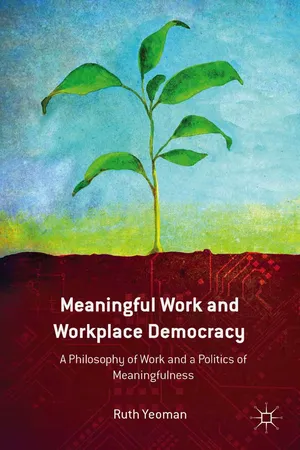
eBook - ePub
Meaningful Work and Workplace Democracy
A Philosophy of Work and a Politics of Meaningfulness
- English
- ePUB (mobile friendly)
- Available on iOS & Android
eBook - ePub
Meaningful Work and Workplace Democracy
A Philosophy of Work and a Politics of Meaningfulness
About this book
This book is a timely revival of the social and political importance of meaningful work, which explores a philosophy of work based upon the value of meaningfulness and argues for the institution of a new politics of meaningfulness.
Information
Topic
PhilosophySubtopic
Management1
Conceptualising Meaningful Work as a Fundamental Human Need*
I begin by claiming that the widespread institution of meaningful work is a proper moral and political project, which is attentive to contemporary concerns for the nature and organisation of work.1 My reasons for making meaningful work for all a political project is grounded in a normative argument that being able to experience one’s life as meaningful is a fundamental human need, which, under present economic arrangements, is extremely difficult for most people to satisfy if their work lacks the structure for meaningfulness. I shall argue that meaningful work is a fundamental human need because it satisfies our inescapable interests in being able to experience the constitutive values of autonomy, freedom, and dignity. By requiring social organisation to ensure that all work is structured for meaningfulness, I distinguish my approach from liberal political theorists, for whom meaningful work, whilst an important ideal, is an individual preference which may or may not be expressed in any particular conception of the good life, and thus cannot be the legitimate target of state intervention without coming into conflict with the principle of liberal neutrality. Instead, I propose that meaningful work is a fundamental human need within a liberal perfectionist framework (cf. Roessler, 2012). I go on to evaluate the conceptual content of meaningfulness using Wolf’s (2010) concept of a bipartite value of meaningfulness, arguing that, in order to experience our lives as meaningful, we require certain capabilities for objective valuing and affective attachment, supported by the recognition of our equal status as co-authorities in the realm of value. This makes the possibility of experiencing meaningfulness in work dependent upon our becoming valuers, situated in social structures allowing us to develop the relevant capabilities (Sen, 1999a) and enabling us to join with others in interpretive sense-making (see for example Wrzesniewski & Dutton, 2001; Wrzesniewski et al, 2003; Bechky, 2003; Weick, 1995).2
Meaningfulness in work: Preference or need?
I claim that meaningfulness is a fundamental human need which liberal political theorists have subordinated to their commitment to the principle of liberal neutrality. As a result, our need for work which is free, autonomous, and dignified has been relegated to the status of an individual taste or preference, which is no business of the state’s to promote. But this settlement is normatively inadequate as the centrality of work in modern societies makes it increasingly difficult for individuals to remedy non-meaningful work in other action contexts.
The argument for meaningful work as a preference
Meaningful work, liberal political theorists complain, is an immodest ideal, because, by making work central to the possibility of a meaningful life, individual preferences for meaning in other action contexts, such as the family, community, or political life, are crowded out (Arneson, 1987). Moreover, since meaningful work is constituted by substantive normative commitments to what it is to live a good life, variously including values such as autonomy (Schwartz, 1982), expressive freedom and self-realisation (Marx, 1978[1844]; see also Gewirth, 1988), complex activities (Rawls, 1999[1971]; Elster, 1986a; see also Walsh, 1994), or self-respect (Honneth, 1995b), then it arbitrarily specifies the content of the good life for all (see also Michaelson et al, 2013; Rosso et al, 2010; Steger & Dik, 2010). As a result, the substantive normative content of meaningful work violates the liberal principle of neutrality, which maintains that a liberal democratic state must remain neutral between different conceptions of living. Since people possess a diversity of subjective preferences for the kind of work they wish to undertake, then the state has no legitimate role in specifying whether or not that work should be meaningful.
The liberal neutralist is concerned that to legislate for the character of work means that one kind of good will be prioritised over other equally valuable goods. If the state were to privilege meaningful work, then the range of values which people might incorporate into their conception of living would be narrowed. So, even though we can acknowledge the importance of meaningful work for living a good life, meaningful work must be restricted to the status of an individual preference (Kymlicka, 2002; Miller, 1999; Christman, 2002). To do otherwise is to support state sponsored perfectionism which promotes one conception of living, constraining options for finding meaning in other activities. In arguing against both a strong and a weak right to meaningful work, Arneson (1987) says: ‘implementing a right to meaningful work elevates one particular category of good, intrinsic job satisfaction, and arbitrarily privileges that good and those people who favour it over other equally desirable goods and equally wise fans of those other goods’ (ibid: 524–5). For Arneson, meaningful work is a perfectionist ideal which ‘assumes objective knowledge of the good life for human beings, the activities that constitute human flourishing’ (ibid: 520).
As a consequence of similar anxieties, Rawls (1999[1971]) acknowledges the value of meaningful work (ibid: 463–4) from the point of view of human flourishing and autonomy (it is one of the human goods), but does not make meaningful work a primary good because to do so would result in the good of meaningful work being prioritised over equally valuable human goods. For Rawls, meaningful work is crucial to justice as fairness, because work with the requisite structure supports the self-respect of citizens, but it need not be part of the good for everyone – and to make it so is to advocate perfectionism which breaches the priority of liberty. Since to legislate for the interior content of work would require interference in the available range of values which society allows to be constitutive of the good life, a liberal democratic state ought to have no interest in the normative content of work, except to ensure that work meets basic humane standards, such as health and safety, employment rights, or welfare support for the unlucky, and that society is organised to secure justice in the equality of opportunity for the available supply of meaningful work. Where equality of opportunity pertains, we do not require guarantees for the interior content of work because the market will sort out individual preferences for meaningful or non-meaningful work (cf. Nozick, 1974). Thus, provided individuals are able to satisfy their preferences for meaning in other spheres of living, we need have no further concerns for the normative content of the work they choose to do.
The compensation argument
But constructing meaningful work as an individual preference which can be satisfied in the market does not entirely eliminate the intuition that liberal political theory should have something more to say about the interior content of work. We are uncomfortable concurring with Henry Ford’s conclusion that ‘to some types of mind […] the ideal job is one where the creative instinct need not be expressed’ (Breen, 2011: 9).3 Surely preferences for some kinds of work over others do not extend to the desire to do work where no expressive human faculty need be exercised? Instead, I argue that it is incumbent upon a liberal democratic state to take seriously the moral concern that the interior content of much contemporary work stunts the human flourishing of workers by failing to meet their fundamental human interests in autonomy, freedom, and social recognition. This is because non-meaningful work visits extensive harms upon those who have to do it, which for most people cannot be offset by compensations in other spheres of action.
If people are harmed by having to do non-meaningful work, then liberal complacency with respect to the availability and distribution of meaningful work becomes difficult to maintain. After all, despite the remarkable growth in varieties of work, as well as persisting expectations that work should be attractive or meaningful, work often fails to provide even a basic standard of living, let alone meets minimal standards for a humane and dignified experience of working. A common response to these concerns is some variant of the Compensation Argument: that work does not have to be meaningful, provided we can find our lives as a whole to be meaningful because of our activities in other spheres of living, such as our status in a community of interest (see Gomberg, 2007). Whilst I admit this to be a possibility, I argue that, in contemporary societies, such a strategy is extremely difficult for most individuals to pursue, because of the ways in which the burdens and benefits of the work we do shape our lives as a whole. Work provides access to the roles, practices, and social institutions of society which allocate resources for the development of the capabilities necessary to secure our social position and economic participation over the life course. Furthermore, such social structures embody the values we can potentially incorporate into our practical identities, grounding the sense that our lives have meaning (Roessler, 2012; cf. Korsegaard, 2009). This means that, in no small way, the work we do determines ‘the distribution of lives’ (Walzer, 1994). Indeed, to such an extent that, when our work lacks the requisite content in a system which restricts the supply of meaningful work, then we suffer from constrained opportunities to develop the human capabilities necessary for equal participation over the life course, with the result that our lives as a whole are less likely to be structured for meaningfulness.
I argue that the Compensation Argument fails to address three kinds of concerns arising from a social organisation of work which generates a scarcity of meaningful work: firstly, the injustice of an unfair distribution of the most attractive work; secondly, harms to the capability formation necessary for equal participation in making one’s contribution; and thirdly, the diminishing of human well-being.
Firstly, the injustice of an unfair distribution of the most attractive work – all societies provide forms of meaningful work, but it has been meaningful work for the few and not for the many: Lane (1991) comments that it is the ‘privileged class’ for whom work offers ‘self-direction, substantive complexity and challenge, variety, little supervision, and intrinsic satisfaction of excellence or self-determination’ (ibid: 302). But liberal political theory has had little to say on the subject of elite expropriation of the most ‘attractive work’ (Fourier, 1983), nor has remedying the harms of non-meaningful work been central to theories of liberal egalitarian justice – and particularly of how social structures operate to shape an individual’s search for meaning by enabling or disabling his capabilities for experiencing meaningfulness. Schooler (2007) theorises that one way in which social structure directly affects psychological functioning is through occupational conditions, where she defines social structure as ‘the patterned interrelationships upon a set of individual and organisational statuses, as defined by the nature of their interacting roles’ (ibid: 371). Schooler concludes that being able to undertake complex work, that is, work requiring self-direction, thought, and judgement, depends upon where the job is located in the social structure of society (ibid: 375). The unequal distribution of good quality work results in uneven health and well-being outcomes. In her review of health inequalities, Bambra (2011) shows that ‘work and the socio-economic polarities it creates play a fundamental role in creating inequalities in the distribution of morbidity and mortality’ (ibid: 187). She finds that the damage of harmful psychosocial work environments can be mitigated by doing work which allows for control over tasks, in organisations which consult workers over changes and underpinned by social welfare systems which support an individual’s capacity to cope with stress and reversal. Taken together, such research provides a strong basis for concluding that the way society arranges the work of social cooperation is unjust, because it unfairly allocates and unnecessarily constrains the kind of work which is most likely to enable individuals to satisfy their fundamental human interests in exercising thought and judgement.4 Given the importance of the nature of work for the development of human capabilities, justice requires that all work be organised to allow each person to experience the beings and doings which foster vital human capacities for thinking and feeling (cf. Sen, 2009).
Secondly, the harms of non-meaningful work to the capability formation necessary to secure equal participation over the life course – such harms are not mere inconveniences to be remedied elsewhere, because, from poorly developed human capabilities to physical, mental, and psychological deterioration, they affect the flourishing of an individual in every dimension of her life (Kohn & Schooler, 1983). Drawing upon Kohn and Schooler, Schwartz (1982) argues that the prevailing structure of work is degrading because it fails to provide for the exercise of autonomy which is vital to moral personhood (Schwartz, 1982: 636). Lack of autonomy whilst at work affects a person’s ability to lead an autonomous life as a whole, because diminished autonomy at work cannot be made up for by full autonomy elsewhere: ‘When persons work for considerable lengths of time at jobs that involve mainly mechanical activity, they tend to be made less capable of and less interested in rationally framing, pursuing and adjusting their own plans during the rest of their time’ (Schwartz, 1982: 637). Autonomy is not simply having the capability to form one’s own plans and purposes – it is also being able to exercise those capacities throughout all aspects of one’s life. Schwartz (ibid) argues that action contexts cannot be artificially separated, and we cannot assume that if a person is able to practice autonomy in one sphere, then it does not matter if a person is deprived of autonomy in another. Kohn and Schooler (1983) find that the structure of work affects the development of abilities to sustain thought and exercise judgement, and that the loss of these abilities carries over into the rest of the person’s life so that those who undertake challenging and creative market work also demonstrate a preference for leisure work with similar characteristics. Kornhauser (1965) in his study of factory workers in Detroit found that: ‘factory employment, especially in routine production tasks, does give evidence of extinguishing workers’ ambition, initiative, and purposeful direction toward life goals’ (ibid: 252).
Specifically, the harms of non-meaningful work undermine an individual’s ability to participate in the work of social cooperation over a lifetime by: stunting the development of her capabilities for free and autonomous action; undermining her sense of self-esteem and self-worth, of her standing relative to others; and thwarting her sense of efficacy, of being able to act with others upon the world. Together, these harms to capabilities, status, and efficacy reduce a person’s ability to build the practical identity necessary to securing a sense that her life has meaning (cf. Korsegaard, 2009). Thus work with the right content for avoiding such harms is an essential experience for those living in contemporary societies who have an interest in the development of their human capabilities, the securing of their social status, and their sense of being able to act with others – which is all people.
Thirdly, the diminishing of human well-being – the psychology of work and organisational studies literatures provides compelling empirical evidence that being involved in ‘satisfying work’ is fundamental for psychological well-being ‘across various domains of human functioning’ (Blustein, 2008). Being able to experience meaningful work is linked to greater reported levels of well-being (Arnold et al, 2007) and to higher levels of job satisfaction (Sparks & Schenk, 2001). Kohn and Schooler (1983), in their studies of how occupational conditions affect cognitive and psychological functioning in a 1970s longitudinal research of male workers in the US, present evidence for the pervasive impact of the interior content of work upon an individual’s sense of competence and self-respect: ‘Hence, doing substantially complex work tends to increase one’s respect for one’s own capacities, one’s valuation of self-direction, one’s intellectuality (even in leisure-time pursuits), and one’s sense that the problems one encounters are manageable’ (ibid: 304). Kohn and Schooler (1983) looked at occupational self-direction in terms of substantial complexity, closeness of supervision, and routinisation, of which substantive complexity was the core concept. They define substantively complex work as ‘work that, in its very substance, requires thought and independent judgement’ (ibid: 106), and identify a positive link between the substantive complexity of work and intellectual flexibility. They observed that job conditions shape personality (ibid: 47): jobs differing in complexity and self-direction were occupied by people with differing levels of cognitive functioning, but over time the nature of the job led to changes in the intellectual flexibility of job holders. Kohn and Schooler (1983) conclude: ‘The structural imperatives of the job – particularly those conditions that facilitate or restrict the exercise of self-direction in work – affect workers’ values, orientations to the self and society, and cognitive functioning primarily through a direct process of learning from the job and generalising what has been learned to other realms of life’ (ibid: 62–6, 126; see also Kornhauser, 1965).
The Kohn-Shooler hypothesis receives strong confirmation from a 1978 study of Polish workers (Kohn & Slomczynski, 1990), and a Japanese study of employed males (Naoi & Schooler, 1985). More recently, Hauser and Roan’s (2007) evaluation of the Wisconsin Longitudinal Study shows there are moderate, but significant, effects of work complexity upon abstract reasoning abilities in mid-life. Additionally, Kornhauser (1965) identifies how the mental health of workers deteriorated ‘as we move from skilled, responsible, varied types of work to jobs lower in those respects’ (ibid: 75–6). Physical as well as mental health is affected by the interior content of work: for example, the Whitehall I and II studies showed that lack of control in the work environment, indicated by low job status, was associated with an increase in heart disease amongst government office workers (Bosma et al, 1997). Importantly, Bosma et al find that the objective state of low job control, independent of subjective reporting of the experience of low job control, has a deleterious impact upon health. They conclude that the harmful effects of disease can be ameliorated by increasing task variety and providing enriched opportunities for having a voice in decision-making.5
Such studies are highly suggestive of the way work affects the shape of a life, making the harms experienced at work difficult to remedy elsewhere. Taken together, evidence for the harms of non-meaningful work compels us to re-consider the claims of liberal theory – that the promotion of meaningful work is not state business because it violates liberal neutrality. Of course, such research does not allow us to claim that a particularly forthright, reflective, and capable individual doing non-meaningful work cannot find their lives to be meaningful because of their activities in other action contexts. But if the present organisation of work unjustly distributes, and constrains the supply of, meaningful work, resulting in distorted capabilities and diminished well-being, then having to do non-meaningful work does present formidable barriers to most people being able to do so.
In sum, the Compensation Argument fails because, firstly, our experiences in work shapes the capabilities, status, and identities which structure our lives as a whole and, secondly, the course of our life is influenced by the associations we belong to, and the social and economic positions we occupy (Young, 1990). But even though being able to do work with the requisite content structures an individual’s life as whole, the supply of meaningful work is restricted. This means that a just society should seek to make available to everyone work which secures the opportunity to develop important human capabilities through being able to do something worthwhile in mutually respectful relations with others.
The need for meaningfulness argument
The harmfulness of non-meaningful work is derived from its inability to satisfy inescapable human interests in experiencing freedom, autonomy and dignity. Given the centrality of work in modern societies, the fundamental human need for meaning implied by such interests justifies institutional guarantees for meaningful work. Indeed, Terkel (1975) identifies the important relationship between meaningfulness and the everyday experience of working when he says ‘Working is about the sea...
Table of contents
- Cover
- Title Page
- Copyright
- Contents
- Acknowledgements
- Introduction
- 1 Conceptualising Meaningful Work as a Fundamental Human Need
- 2 Proliferating Meaningful Work: Meaning-Making and an Ethic of Care
- 3 Overcoming Alienation: Irreducible Autonomy and Phronetic Techne in a Practical Rationality of Caring
- 4 Confronting Domination: Freedom and Democratic Authority
- 5 Restoring Dignity: Social Recognition in Practical Identity Formation
- 6 ‘The Inner Workshop of Democracy’: Agonistic Democratic Practices and the Realisation of Emancipatory Potentials
- 7 Capability Justice and a Politics of Meaningfulness
- Conclusion
- Notes
- Bibliography
- Index
Trusted by 375,005 students
Access to over 1.5 million titles for a fair monthly price.
Study more efficiently using our study tools.
Frequently asked questions
Yes, you can cancel anytime from the Subscription tab in your account settings on the Perlego website. Your subscription will stay active until the end of your current billing period. Learn how to cancel your subscription
No, books cannot be downloaded as external files, such as PDFs, for use outside of Perlego. However, you can download books within the Perlego app for offline reading on mobile or tablet. Learn how to download books offline
Perlego offers two plans: Essential and Complete
- Essential is ideal for learners and professionals who enjoy exploring a wide range of subjects. Access the Essential Library with 800,000+ trusted titles and best-sellers across business, personal growth, and the humanities. Includes unlimited reading time and Standard Read Aloud voice.
- Complete: Perfect for advanced learners and researchers needing full, unrestricted access. Unlock 1.5M+ books across hundreds of subjects, including academic and specialized titles. The Complete Plan also includes advanced features like Premium Read Aloud and Research Assistant.
We are an online textbook subscription service, where you can get access to an entire online library for less than the price of a single book per month. With over 1.5 million books across 990+ topics, we’ve got you covered! Learn about our mission
Look out for the read-aloud symbol on your next book to see if you can listen to it. The read-aloud tool reads text aloud for you, highlighting the text as it is being read. You can pause it, speed it up and slow it down. Learn more about Read Aloud
Yes! You can use the Perlego app on both iOS and Android devices to read anytime, anywhere — even offline. Perfect for commutes or when you’re on the go.
Please note we cannot support devices running on iOS 13 and Android 7 or earlier. Learn more about using the app
Please note we cannot support devices running on iOS 13 and Android 7 or earlier. Learn more about using the app
Yes, you can access Meaningful Work and Workplace Democracy by R. Yeoman in PDF and/or ePUB format, as well as other popular books in Philosophy & Management. We have over 1.5 million books available in our catalogue for you to explore.