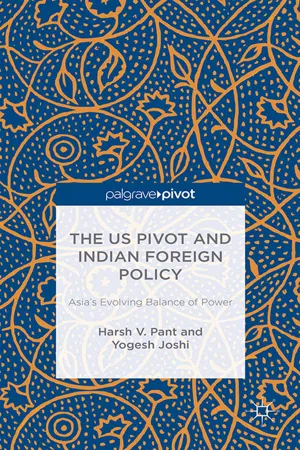
eBook - ePub
The US Pivot and Indian Foreign Policy
Asia's Evolving Balance of Power
- English
- ePUB (mobile friendly)
- Available on iOS & Android
eBook - ePub
The US Pivot and Indian Foreign Policy
Asia's Evolving Balance of Power
About this book
China's exponential rise and America's relative decline have led to a transition of power in contemporary Asia. The US pivot towards Asia is the most evident manifestation of such a transition, and Indian foreign policy shows signs of a hedging strategy, with attempts to strengthen ties with both China and the US.
Information
1
Introduction
Abstract: Transition of power in international politics often leads to conflict and confrontation between the existing hegemon and the rising challenger. For secondary powers, this period of transition is marked by strategic flux. Uncertainty over the ultimate results of such transition motivates the tendency to hedge. Against the backdrop of the US “pivot” to Asia, Indian foreign policy also shows signs of a hedging strategy.
Pant, Harsh V. and Yogesh Joshi. The US Pivot and Indian Foreign Policy: Asia’s Evolving Balance of Power. Basingstoke: Palgrave Macmillan, 2016. DOI: 10.1057/9781137557728.0003.
Shaped by China’s miraculous rise and perceptions of relative decline in American prowess, contemporary Asia is witnessing a transition of power. Unlike the immediate aftermath of the Cold War when the US power reigned supreme in the world, China’s ascendance in Asia is increasingly turning Asian geopolitics into a bipolar contest between Beijing and Washington. On the one hand, China’s policies in the region have taken an increasingly assertive turn since 2008. On the other, America has indicated its determination to maintain its primacy in the region by tightening its erstwhile alliances, embracing new strategic partners and by realigning its strategic focus back to the Asia-Pacific. This has been underscored by a formal announcement of the strategy of pivot in 2011.
Power transition, strategic flux and hedging behavior
International politics is often characterized by hegemonic world orders.1 The hegemon’s overwhelming power helps not only in maintaining peace but also provides for norms and rules of global conduct and integration of the international system. Concentration of power in the hegemon leads to stability and peace and is a prerequisite for maintenance of order. As William Wohlforth has argued, “unipolarity favours the absence of war among great powers and comparatively low levels of competition for prestige or security.”2After the end of the Cold War, the first two decades of global politics were defined by absolute American hegemony. With China’s ascendance, both economic and military, the US “unipolar moment is drawing to a close” and its primacy today stands increasingly contested.3 From extreme concentrations of power at the end of the Cold War, the world is now moving toward a parity of sorts between Beijing and Washington.4 Such transitions in global structures of power, as “Power Transition” theorists would argue, often lead to instability in the global system, increases chances of conflict and confrontation, and sometimes results in major wars between the declining hegemon and the rising challenger.5 Peaceful transitions of power are possible, as was the case with Britain handing over the baton to the US between the First and the Second World War. However, under conditions of parity, peace can only be guaranteed when both parties are satisfied with the existing system.6 Though in international politics it is always hard to read others intentions, China’s assertive behavior suggests that it is far from being a satisfied power under the current world order.7 The “masked revisionism” which was underlined by the adage of China’s “peaceful rise” during the first decade of the 21st century is now slowly and surely shifting toward more assertive revisionism.8 Given its behavior since the 2008 financial crisis, a “gnawing distrust” prevails in Asia and around the world over China’s ultimate intentions.9
Since 2009, Beijing has been aggressively pursuing its territorial interests in East China Sea, South China Sea and along the Himalayan border with India.10 Assertive territorial diplomacy is backed by the use or threat of use of force. Its massive military modernization is aimed at developing asymmetric offensive capabilities to counter US intervention in the region while simultaneously exerting control over its smaller neighbors. This has stoked an arms race across Asia.11 Even when China’s rise has been possible under the US-led liberal international economic and security order, it remains committed to an alternative system: from currency wars to the creation of new financial institutions, China’s contentment with the existing international rules of the game remains highly doubtful.12 China’s alternative political system only adds up to the ideological conflict with the liberal and democratic world order.
Given increasing economic interdependence, China’s stakes in the system remain substantial. Economic interdependence also translates into absolute gains for all states integrated in the international system and China remains critical to the overall health of the world economy. However, such economic interdependence is highly skewed in China’s favor; its exports remain exorbitantly high compared to its imports. This skewed economic interdependence has made China gain relatively more than other stakeholders in the system, in turn fueling its military power.13 China has shown no restraint in using economic interdependence to pursue its territorial interests and use economic coercion against states—such as Japan and Philippines—who have tried to resist China’s territorial assertiveness.14 As Ashley Tellis has argued, “its [economic interdependence]fecundity and depth imply that the US and its allies today contribute towards enhancing the prosperity and the material capability of countries that will one day become their rivals.”15 It is now readily accepted that the most powerful of these potential rivals is China and if Beijing “continues to accumulate national power” through its integration with the international economy, USA’s decline, which may be a “statistical artefact” today, will become “politically fateful” tomorrow.16
The process of transition often injects huge uncertainties in the system. Whereas the perceptions of transition increase the risk of conflict, results of such transition are often uncertain.17 The current transition in Asia presents a similar dilemma. Even when China is rapidly catching up with the US, it is still far from certain who will appear on the top of this geo-political competition. Will Beijing replace Washington’s primacy in Asia? Would US be able to successfully throttle Beijing’s hegemonic ambitions and maintain its preeminent position? Or would US and China form a condominium of power, dividing Asia into spheres of influence? All these possibilities remain open ended.18 Such uncertainty is further aggravated by the fact that the rise of China and relative decline of the US is also accompanied by what has been termed as the “rise of the rest”: many other states in Asia are growing simultaneously along with the transition of power between China and the US.19 They are also called “swing states” because of the unknown nature of their ultimate intentions and also because their eventual choices could tilt the balance of power in one way or the other.20 Overall, the picture in Asia appears to be one of strategic flux: transition of power inducing uncertainty in the system where clear cut strategic choices are hard to make.
Economic theory suggests that uncertainty and volatility in the market drives hedging behavior which has been explained as “risk shifting,” where actors invest in diverse policies to insure against unexpected failures.21As Van Jackson argues, hedging is a “strategy of pursuing opposing or contradictory actions as a means of minimizing or mitigating downside risks associated with one or the other action.”22 International relations scholars have suggested that hedging gains prominence among actors during periods of structural transformation. It has been suggested that “leaders ... operate under the constraints of the current structure, but act to hedge against the uncertainty that accompanies structural transformation.”23 Some scholars have argued that hedging is not a strategy; rather, it is a default foreign policy option when clear-cut strategies are unavailable.24 Caught in the trap of uncertainty induced by the current transition of power in Asia, many states in the region are exhibiting a tendency to hedge.25 India is no exception.26
India and the US pivot to Asia
The perception that America is in decline holds sway both among its allies and adversaries.27 Overwhelmed by financial crisis, military overstretch and also the rapid rise of China, two decades after the end of the Cold War, the US primacy is under challenge. To counter an increasingly assertive China and perceptions of American decline, US announced the strategy of pivot toward Asia in late 2011. Soon after, in January 2012, this strategy was rechristened as “strategic rebalancing” by the Pentagon. Pivot or “strategic rebalancing” indicates America’s desire to balance China’s growing economic and military influence in Asia. Pivot emphasizes upon strengthening America’s existing alliances as well as on building partnerships with like-minded states in the region.
India has emerged as an important element in the US strategy of pivot. Aimed at balancing China’s growing power, New Delhi is a natural strategic choice for Washington: the only state in Asia comparable to China in geography and demography, an economic growth story of the 21st century, and a state which believes in democratic and liberal values.28 From the very initiation of the rebalancing strategy in December 2011, the Obama administration has underscored India’s important role in the new US framework for Asia. In fact, Leon E. Panetta, former Secretary of Defense,...
Table of contents
- Cover
- Title
- 1 Introduction
- 2 Power Transition in Asia and Indian Foreign Policy
- 3 Indo-US Ties in the Age of Pivot
- 4 Indias China Challenge
- 5 The Indo-Japanese Strategic Partnership and Power Transition in Asia
- 6 India and Regional Balance of Power in Asia
- 7 Conclusion
- Bibliography
- Index
Trusted by 375,005 students
Access to over 1.5 million titles for a fair monthly price.
Study more efficiently using our study tools.
Frequently asked questions
Yes, you can cancel anytime from the Subscription tab in your account settings on the Perlego website. Your subscription will stay active until the end of your current billing period. Learn how to cancel your subscription
No, books cannot be downloaded as external files, such as PDFs, for use outside of Perlego. However, you can download books within the Perlego app for offline reading on mobile or tablet. Learn how to download books offline
Perlego offers two plans: Essential and Complete
- Essential is ideal for learners and professionals who enjoy exploring a wide range of subjects. Access the Essential Library with 800,000+ trusted titles and best-sellers across business, personal growth, and the humanities. Includes unlimited reading time and Standard Read Aloud voice.
- Complete: Perfect for advanced learners and researchers needing full, unrestricted access. Unlock 1.5M+ books across hundreds of subjects, including academic and specialized titles. The Complete Plan also includes advanced features like Premium Read Aloud and Research Assistant.
We are an online textbook subscription service, where you can get access to an entire online library for less than the price of a single book per month. With over 1.5 million books across 990+ topics, we’ve got you covered! Learn about our mission
Look out for the read-aloud symbol on your next book to see if you can listen to it. The read-aloud tool reads text aloud for you, highlighting the text as it is being read. You can pause it, speed it up and slow it down. Learn more about Read Aloud
Yes! You can use the Perlego app on both iOS and Android devices to read anytime, anywhere — even offline. Perfect for commutes or when you’re on the go.
Please note we cannot support devices running on iOS 13 and Android 7 or earlier. Learn more about using the app
Please note we cannot support devices running on iOS 13 and Android 7 or earlier. Learn more about using the app
Yes, you can access The US Pivot and Indian Foreign Policy by H. Pant,Y. Joshi,Kenneth A. Loparo,Sowerbutts in PDF and/or ePUB format, as well as other popular books in Politics & International Relations & American Government. We have over 1.5 million books available in our catalogue for you to explore.