eBook - ePub
Trilingual Talk in Sicilian-Australian Migrant Families
Playing Out Identities Through Language Alternation
- English
- ePUB (mobile friendly)
- Available on iOS & Android
eBook - ePub
Trilingual Talk in Sicilian-Australian Migrant Families
Playing Out Identities Through Language Alternation
About this book
This book explores the linguistic and cultural identities of Sicilians in Australia, through conversations gathered within the family, survey data and interviews. The study is placed in the context of the family migrant experience and the shifting attitudes towards immigrant languages in Australia.
Information
1
The Context of Italian Migration
For many centuries Italians have been leaving their home in search of better lives in great numbers, to the extent that some historians talk of them as ‘among the most migratory of peoples on the earth’ (Gabaccia, 2000: 1). Migration took on epic dimensions particularly after Italy became a unified country in 1861, and between 1876 and 1976 about 26 million Italians left the country (Favero and Tassello, 1978). Mass migration stopped in the 1970s, thanks to the considerable improvements in social and economic conditions, and in that same decade Italy became a country that attracted, rather than produced, migrants (Castles, 1992: 37).
In the initial stages of Italian mass migration and up to 1945, the majority of migrants were from the northern regions (particularly Veneto, Friuli, Piedmont and Lombardy). However, between 1946 and 1976, it became a predominantly southern phenomenon. Also, the routes of Italian migrants changed throughout the century. While Europe was always a preferred destination, South American countries (for example, Argentina and Brazil) and the United States were well represented in the first stages. In the post-Second World War period, Australia and Canada increased remarkably their appeal as host countries.
Among all Italian regions, Sicily is the one that, together with Veneto and Calabria, has yielded most migrants in absolute numbers in these 100 years of mass migration. Over 2.5 million Sicilians have left the island (Favero and Tassello, 1978), which represents approximately 50 per cent of the current population of Sicily. After 1976, as for the rest of Italy, migration from Sicily also declined considerably. However, as the socio-economic development of the island continued to lag far behind compared with the rest of Italy, Sicily remained one of the regions with the highest number of migrants.1
Against the background of Italian migration, in this chapter I provide a brief historical introduction to the migratory experience of my participants. In the first part I present Sicilian migration to Australia within the broader context of the Italian presence in this continent. In the second part I illustrate some features of the Sicilian-Australian community, taking Sydney as an example.
1.1 Italian migration to Australia
Italian migration to Australia became a mass phenomenon only in the post-Second World War period.2 However, relatively sizeable Italian settlements were present even before; for example, in the late nineteenth century fishermen from Sicily and Puglia settled in Western Australia (Alcorso, 1992: 9–10). In 1933, numbering over 26,000, the Italians represented 3 per cent of the overseas-born population, and Sicilians were well represented.
The Italian presence increased dramatically in the late 1940s, as a result of Australia’s mass migration programme and a series of bilateral agreements with Italy. Although the Italians were allowed to enter the country, they did so under a very discriminatory system that differentiated between the more ‘desirable’ northern European migrants and the less desirable southern ones (Castles, 1992: 40). The peak in arrivals was reached in the decade 1951–61, with an average of almost 18,000 new migrants per year and a total of 179,420 net migrants (Castles, 1992: 43). Among the over 4.3 million migrants that arrived in the continent between 1945 and the 1980s, the Italians represented the largest group with a non-English-speaking background (Collins, 1988: 29).
The intake of migrants from Italy started to decline in the decade 1966–75, when economic conditions in Italy improved and access to employment in other nations of the European Community became less restrictive. At the same time the Australian government redirected its recruitment efforts for migrants to other European and Middle Eastern nations (Castles, 1992). The decline in new arrivals from Italy is reflected in Table 1.1.
In 1971, with 289,476 people born in Italy, the Italians in Australia represented 11.2 per cent of the overseas-born population (Castles, 1992: 43). In 2011, with 185,402, the percentage has decreased to 3.5 per cent (ABS, 2013). Italians now represent the third largest non-English-speaking ethnic group.
Six regions – Calabria, Sicily, Veneto, Campania, Friuli and Abruzzo (all from the South except Veneto and Friuli) – have been the source of approximately 60 per cent of Italian migrants to Australia (Ministero degli Affari Esteri, 1982: 199). This is partly the result of chain migration, a mechanism that has characterized Italian migration to Australia since its very beginnings (Alcorso, 1992: 9). In the post-war period discussed here, chain migration, lack of settlement services and the fact that most employment opportunities were in the largest cities meant that the majority of Italians settled in Melbourne and Sydney, which are still the cities with the highest number of Italian born. Furthermore, Italians tended to congregate in fairly clustered communities, often forming subcommunities from particular villages, towns and regions in individual suburbs.
Table 1.1 Italian-born population in Australia
| Census year | Number |
| 1947 | 33,632 |
| 1954 | 119,897 |
| 1961 | 228,296 |
| 1971 | 289,476 |
| 1981 | 275,883 |
| 1991 | 253,332 |
| 1996 | 238,246 |
| 2001 | 218,718 |
| 2006 | 199,124 |
| 2011 | 185,402 |
Sources: Castles (1992); McDonald (1999); ABS (2007, 2013).
The majority of post-war Italian migrants were day labourer agricultural workers from small rural villages and towns who were forced to emigrate due to the poor socio-economic conditions of the country and encouraged by the policy of the Italian government of the time. The first inflow was dominated by men; this imbalance, however, was soon to a large extent redressed as a result of the processes of chain migration. Furthermore, most of the Italian born who arrived in the 1950s and 1960s only attended primary or lower secondary school.3 Given their limited formal qualifications and the difficulties in having them recognized when they did exist, a great proportion of them worked in the semi-skilled or unskilled sectors of industry. Chain migration also had an impact on occupational patterns, as the Italians already established in Australia often employed the newly arrived compatriots (for example, in construction and building industries). Another typical feature of employment among Italians has been the high rate of self-employment, which also provided an escape from the racism of employers and other workers (Collins, 1992: 75). The typology of Italian migrants changed at the end of the 1960s, when more tradespeople and skilled workers came from larger cities and emigrated, often as individuals, mainly in order to better their conditions. As mentioned in the Introduction, Family A is representative of the first wave, Family B of the second.
The Italo-Australian community is also characterized by the maintenance of strong family ties. Chain migration and a relatively high rate of ‘in-marriage’ (endogamy) among the Italian born have contributed to such maintenance (Ware, 1981: 79–81). Attachment to and respect for the family are fundamental to most Italo-Australians, irrespective of the region of origin, so much so that it has been recognized as their major ‘core’ value (Smolicz, 1981). Thus, family networks as well as co-regional friends have been the two important support systems socially, emotionally and economically (cf. Vasta, 1995).
As a result of lack of new arrivals from Italy and the ageing of the Italo-Australians, since the 1990s the proportion of second-generation Italians4 has outnumbered the Italy born (by nearly 30 per cent according to the 1996 Census, McDonald, 1999: 5); today the community is well into the third generation. Compared to their parents, second-generation Italians display higher levels of educational attainment and different occupational patterns, with a remarkable shift from the trades and labouring area to clerical jobs, that is, from blue-collar jobs to the lower status end of the white-collar occupational scale. As Collins (1988: 192) observes, this is not so much an ‘upward’ movement in wage and career structure terms as a mere ‘sideward’ shift. Indeed, until the late 1990s Australian-born people with Italian-born parents were still overrepresented in the trades sector or among process workers, and underrepresented in the professional and technical categories, with skilled vocational qualifications representing the highest percentage of all qualifications they obtained (McDonald, 1999: 37).5
With regard to the broader Australian context, the immediate post-war migrants of the late 1940s and 1950s, like the parents in Family A, arrived when the prevailing immigration policy of the Australian government was one of assimilation, whereby migrants were expected to quickly assimilate into Australian society. Many Italian born reacted by sheltering within their networks in the Italo-Australian community and minimizing any contact with the Anglo section of society, while others, particularly the younger ones, reacted by assimilating. On the other hand, the Italians who came in the late 1960s, like the parents in Family B, arrived during the adoption of the policies of integration first and then of multiculturalism, which fully acknowledged and promoted the different languages and cultures brought by immigrants (Ozolins, 1993).
On the whole, the Italian community in Australia is considered to represent a case of successful settlement both in terms of economic indicators and acceptance by the wider society (Office of Multicultural Affairs, 1989). Italians enjoy a relatively good level of economic security which has been achieved through very hard work and a life of sacrifice and savings, not just in the attempt to improve their own condition, but in particular to give a better future and better opportunities to their children. This optimistic view of the community, however, is not shared equally by historians (cf. Cresciani, 2003: 175–7).
1.1.1 A brief history of Sicilians in Australia
Information about Sicilian migration to Australia is far from being systematic and exhaustive, as a history of this regional group – like many others – is still to be written. So far we have only a limited number of studies on specific subgroups, such as the fishermen in Fremantle (Gamba, 1952), migrants from Messina (Pascoe, 1987), or the Liminoti in Sydney (Wilton and Rizzo, 1983; see however Biscaro, 2006). Therefore this presentation is based mainly on information gathered from a number of sources that deal more generally with Italian migration to Australia.
Sicilians appear to have been in Australia as far back as 1788, when a presumably Sicilian sailor, Giuseppe Tusa, allegedly landed in Botany Bay with the First Fleet (Cresciani, 2003: 28), and 1811, when three Sicilian convicts arrived in New South Wales (Randazzo and Cigler, 1987: 17). In the late 1850s the two Orsini brothers appeared to have sailed from Catania to the Victorian coast (Randazzo and Cigler, 1987: 111). (See Map 1.1.) Even before the Italian Unification formal diplomatic relations existed between the colonies of New South Wales and Victoria and the Kingdom of the Two Sicilies (Cresciani, 2003: 39).
The first sizeable settlements of Sicilians date back to the end of the nineteenth and the beginning of the twentieth century. Small groups of fishermen from Lipari in the Eolian Islands and from villages near Messina (particularly Capo d’Orlando) settled down in Western Australia (Randazzo and Cigler, 1987: 85), and later on also on the eastern coast south of Sydney (for example, Ulladalla). In the 1920s other Sicilians, particularly from the area of Catania, headed for north Queensland to work on the sugar cane plantations, joining the Piedmontese, Lombard and Veneto migrants who were there already (Pascoe, 1987: 114; Menghetti, 2001: 491). In Sydney, Sicilians have been one of the major regional groups since the 1920s, when clusterings from specific Sicilian villages were identified in such parts of the city as Woolloomooloo, Balmain and Leichhardt (Burnley, 1988: 628). In these early years, in the inner suburbs of both Sydney and Melbourne migrants from the Eolian Islands ran fruit and vegetable shops (Pascoe, 1987: 15).
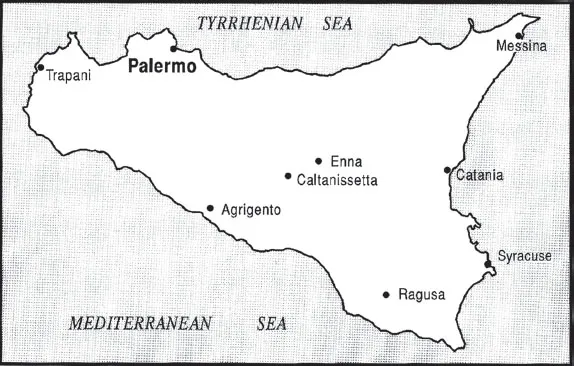
Map 1.1 Map of Sicily with its nine provincial capitals
Racism, scarcity of services and chain migration were all factors that encouraged Sicilians, like most other regional groups, to settle down in fairly clustered communities. In spite of the hostility that such concentrations often encountered, they are to be seen ‘as an inevitable and necessary accompaniment to a new land’ (Price, 1963a: 273). In the pre-1940 migration, most southern Italian migration chains showed relatively high rates of village-based concentrations compared with northern Italian chains (Price, 1963a: 251). However, in the majority of cases mixed concentrations, with people from different districts,6 regions or nations, were more the rule. In the Sydney suburb of Leichhardt, for example, in the 1930s–1940s the first families to settle were not just from Catania and the Eolian Islands but also from Veneto and Friuli (Pascoe, 1987: 166). Overall, between 1890 and 1940 almost 6000 Sicilian men arrived in Australia, the majority of whom from the Eolian Islands and the areas of Messina and Catania (Price, 1963a: 19–20). This represents 23 per cent of the total 25,680 Italian males who came in the same period.
In the post-Second World War period, of the over 400,000 Sicilians who migrated in the 1950s and the 1960s, about 25 per cent chose transoceanic countries, not just the United States but also Canada, Oceania, Africa and Asia. The majority moved to northern European countries and over one quarter chose the thriving industrialized regions of North Italy of the ‘economic miracle’ (Tirabassi, 2008). In selecting a destination, distance and possibility of returning home frequently were important factors to be considered, which did not favour Australia. This is attested in Angela’s7 words, who migrated from Palazzolo (in the province of Syracuse) to Sydney in 1958, to follow her husband. In spite of her efforts, her brother turned down her offer to join her, and decided instead to move to Germany.
Non vuole venire nessuno qua ci sembra troppo lontano perché c’è mio fratello c’ha tanti anni che lavora in Germania (.) prima voleva venire qua e poi la moglie rici no rici io non ci vado dice in Australia dice perché è troppo lontano (.) poi io ci ho detto dico ma tu no mica ti devi fare la strada a piedi non vengo dice in Australia dice è troppo lontano (.) fa’ come ti vuoi e così e poi mio mio fratello è andato e:: in Germania a lavorare in Germania e lui lavora in Germania (...) la moglie sta:: al paese (...) lui è sempre in Germania ogni sei mesi va a casa no (...) là è vicino
(Nobody wants to come here, it seems too far away, because there is my brother, he has been working in Germany for many years. First he wanted to come here and then his wife said no she said I won’t go she says in Australia she says because it’s too far away. Then I said to her but you don’t have to come here by foot. I am not coming she says to Australia she says, it’s too far away. Do as you like. And so and then my brother went to Germany to work in Germany and he works in Germany, his wife lives in th...
Table of contents
- Cover
- Title
- Copyright
- Contents
- List of Illustrations
- List of Tables
- Acknowledgements
- Transcription Conventions
- Introduction
- 1 The Context of Italian Migration
- 2 From Bilingualism in Sicily to Trilingualism in Australia
- 3 Approaches to Multilingual Talk
- 4 Trilingual Talk in Family A
- 5 Trilingual Talk in Family B
- 6 From Qualitative to Quantitative Data: Language Choice in the Family
- 7 Summary and Conclusions
- Notes
- References
- Index
Trusted by 375,005 students
Access to over 1.5 million titles for a fair monthly price.
Study more efficiently using our study tools.
Frequently asked questions
Yes, you can cancel anytime from the Subscription tab in your account settings on the Perlego website. Your subscription will stay active until the end of your current billing period. Learn how to cancel your subscription
No, books cannot be downloaded as external files, such as PDFs, for use outside of Perlego. However, you can download books within the Perlego app for offline reading on mobile or tablet. Learn how to download books offline
Perlego offers two plans: Essential and Complete
- Essential is ideal for learners and professionals who enjoy exploring a wide range of subjects. Access the Essential Library with 800,000+ trusted titles and best-sellers across business, personal growth, and the humanities. Includes unlimited reading time and Standard Read Aloud voice.
- Complete: Perfect for advanced learners and researchers needing full, unrestricted access. Unlock 1.5M+ books across hundreds of subjects, including academic and specialized titles. The Complete Plan also includes advanced features like Premium Read Aloud and Research Assistant.
We are an online textbook subscription service, where you can get access to an entire online library for less than the price of a single book per month. With over 1.5 million books across 990+ topics, we’ve got you covered! Learn about our mission
Look out for the read-aloud symbol on your next book to see if you can listen to it. The read-aloud tool reads text aloud for you, highlighting the text as it is being read. You can pause it, speed it up and slow it down. Learn more about Read Aloud
Yes! You can use the Perlego app on both iOS and Android devices to read anytime, anywhere — even offline. Perfect for commutes or when you’re on the go.
Please note we cannot support devices running on iOS 13 and Android 7 or earlier. Learn more about using the app
Please note we cannot support devices running on iOS 13 and Android 7 or earlier. Learn more about using the app
Yes, you can access Trilingual Talk in Sicilian-Australian Migrant Families by A. Rubino in PDF and/or ePUB format, as well as other popular books in Languages & Linguistics & Historical & Comparative Linguistics. We have over 1.5 million books available in our catalogue for you to explore.