eBook - ePub
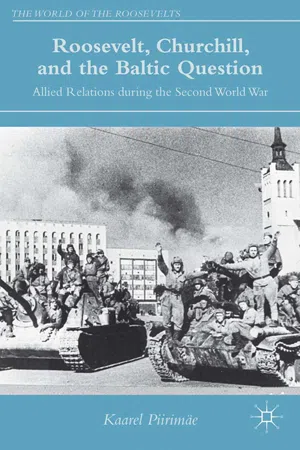
Roosevelt, Churchill, and the Baltic Question
Allied Relations during the Second World War
- English
- ePUB (mobile friendly)
- Available on iOS & Android
eBook - ePub
Roosevelt, Churchill, and the Baltic Question
Allied Relations during the Second World War
About this book
In 1940, the USSR occupied and annexed Estonia, Latvia, and Lithuania, leading to calls by many that the Soviets had violated international law. This book examines British, US, and Soviet policies toward the Baltic states, placing the true significance of the Baltic question in its proper geopolitical context.
Information
C H A P T E R 1
THE SOVIET ANNEXATION AND THE ESTONIAN DIPLOMATS-IN-EXILE, 1940
SHORTLY BEFORE MIDNIGHT ON JUNE 14, THE SOVIET COMMISSAR OF FOREIGN affairs, Viacheslav Molotov, presented an ultimatum to the Lithuanian foreign minister, Juozas Urbšys, who was staying in Moscow for talks. The terms were severe: the Lithuanians had to form a new government subservient to Soviet interests and permit the entry of an unspecified number of Soviet troops and their stationing in the most important centers of Lithuania. The reply had to reach Moscow by 10 a.m. the following morning, but in any case the Red Army would cross the frontier regardless of the Lithuanian response. After an intense debate, at which President Antanas Smetona insisted on resistance, the government complied, and at 3 p.m. Soviet forces crossed the border.1 According to the report of the German military attaché, the Red Army “massed” on the East-Prussian frontier in what was described as a “defensive move” against Germany.2 At the same time, Deputy Commissar for Foreign Affairs Vladimir Dekanozov, a Georgian and an ally of Beria working as an assistant to Molotov, arrived in Kaunas to supervise the overthrow of the existing regime.
On June 16, the Soviet government delivered similar ultimatums to Estonia and Latvia, accusing them of forming a military alliance with Lithuania against the Soviet Union, of harboring pro-British sympathies, and of not believing in the strength of the German-Soviet friendship. The countries were occupied the following day. Andrei Zhdanov, the chief party ideologue of the war against Finland, was sent to Tallinn and Andrei Vyshinskii, the famous prosecutor at the 1930s’ trials, to Riga to take charge of affairs in Estonia and Latvia, respectively. Soon “peoples governments” composed of leftist intellectuals were established with the acquiescence of President Konstantin Päts in Estonia, Kārlis Ulmanis in Latvia, and Antanas Merkys in Lithuania (Smetona had fled to Germany on June 15). All coups were carried out under the semblance of popular support, carefully reported by the pro-Soviet press in the West.3
There is a strong temptation to cast Soviet actions as a desperate reaction to the German triumph in the West. By a dramatic coincidence, Paris fell on the same day as Lithuania received the first ultimatum. But as Alfred Senn had observed, the political-military campaign against the Baltic states could not be pulled off on a day’s notice. It required long-term planning. Senn situates the start of the preparations to February, when the Winter War was coming to a conclusion and when Moscow called its polpreds, the envoys in Kaunas, Riga, and Tallinn, to Moscow for consultation. The final decision to overrun the Baltic states was probably taken on May 24 or 25, when France was already showing clear signs of collapsing.4
Back in the autumn of 1939, Stalin had decided on a clever backdoor strategy of Sovietizing the Baltic states without provoking an open conflict. After the British and French declarations of war on Germany on September 3, Stalin assumed, basing his predictions at least partly on the experience of the First World War, that the war of attrition on the Western Front (but not in the East) would be a prolonged one. On September 7, Stalin told Dimitrov, Molotov, and Zhdanov that two equally matched camps of capitalist countries were fighting for world domination.5 He probably assumed that during that “war of attrition” he would have time to consolidate his gains from the secret protocol of the Molotov-Ribbentrop Pact of August 23, which had assigned the Baltic states, together with Finland, eastern Poland, and Bessarabia, to the Soviet sphere of influence. Stalin was satisfied that the status quo in Europe had finally been destroyed by the pact, and he could not foresee that this would lead to the German dominance of the continent so swiftly.6
Destroying the Versailles-Riga system in the East justified the risks, however. Tangible gains in power and territory were the chief official justification for the pact with Hitler. As Molotov told the Supreme Soviet on October 31, 1939, it gave “the Soviet Union new possibilities to influence the course of events in the international arena.”7 Nikita Khrushchev would later remark that Stalin “knew that Hitler wanted to betray, outwit us. But he thought that we, the Soviet Union, had outsmarted Hitler by signing the pact. Stalin told us that the pact would give us real power over Estonia, Latvia, Lithuania, Bessarabia and Finland.”8 Perhaps Stalin preferred a treaty with the Western powers, but London and Paris had not been prepared to endorse a Soviet “Monroe Doctrine” in the Baltic.9 “The English and the French wanted to have us as slaves,” Stalin told Georgii Dimitrov, the general secretary of the Comintern, on September 7.10
If precautionary measures against the German forces stationed in East Prussia were perhaps foremost in the minds of Soviet leaders in June 1940, opening the Finnish Gulf for the Baltic fleet had loomed large in Moscow’s actions in September 1939. Estonia had therefore the unenviable role of being the focus of Soviet attention in 1939. In parallel to the invasion of Poland, the Red Army had prepared for operations against the Baltic states. By the end of September, Moscow had amassed 270,000 troops on the borders of Estonia and Latvia, with the orders to march into enemy territory on September 30.11 Since mid-September Soviet ships and aircrafts had appeared in Estonian territorial waters and airspace to intimidate and possibly provoke a conflict. However, Stalin hesitated to use force and instead decided for diplomatic pressure.
There was also the desire on Estonia’s part to prevent the conflict from escalating and to pinpoint Soviet demands.12 On September 24, Foreign Minister Karl Selter traveled to Moscow to sign a trade agreement. Molotov seized the opportunity and asked Selter to conclude a treaty of mutual assistance, allowing the Soviets to establish strategic bases on the Estonian territory. The escape of the Polish submarine Orzel from Tallinn harbor, where it had been interned, provided a pretext for presenting far-reaching demands. According to Molotov, the incident had demonstrated the Estonian inability or unwillingness to control its territory, which was jeopardizing Soviet security.13 He brushed aside Selter’s apologies, questioned Estonia’s neutrality, and warned that the Soviet government would have to take “active measures,” use force if necessary, to “expand its security system on the Baltic.” He noted: “20 years ago you forced us to sit in this Finnish puddle [Gulf of Finland]. Do you think this will last forever?”14
On September 28, Estonia and the USSR signed a mutual assistance pact that allowed Moscow to station 25,000 troops on the Estonian territory. Similar agreements were concluded with Latvia and Lithuania later in October. Molotov told Latvian foreign minister Wilhelms Munters: “Peter the Great was already concerned about an exit to the sea . . . we cannot permit small states to be used against the USSR. Neutral Baltic states—that is too insecure.” Stalin added: “I tell you frankly a division into spheres of influence has taken place . . . As far as the Germans are concerned we could occupy you. But we want no abuse.”15
The “time of bases,” as the period between September 1939 and June 1940 is known in Estonia, was a novel experiment in the Soviet tactics of exporting its system to capitalist countries. No similar example of self-restraint can be found in Soviet Sovietization policies. For nine months Stalin kept his word and did not intervene in the internal affairs of Estonia, Latvia, and Lithuania. Soviet legations were forbidden to entertain contacts with the Communist circles, and troops in the garrisons were ordered not to interfere with the local population.16 Stalin was extremely optimistic about the Soviet ability to win sympathies among the Baltic people, so that the Stalinist system could eventually be introduced without much resistance. He even told Dimitrov: “We will not try to Sovietize them. Time will come, when they will do it themselves!” Moreover, Stalin thought the Soviets had found a “formula,” which could be used to draw even more states into the sphere of influence of the USSR. “But for that we need to be careful,” he cautioned, and expressed the need “to strictly observe the internal regime and independence of these states.”17
The Baltic peoples refused to Sovietize themselves, as even the Soviet leaders were forced to admit. Molotov would explain the need for “external encouragement” at the Supreme Soviet on August 1, 1940, by complaining that the expected rapprochement had been “opposed by the ruling bourgeois groups of the Baltic countries,” who had “begun to increase their hostile activities.”18 In order for the common man to develop genuine sympathies for the Soviet system, the ruling and the propertied classes had to be liquidated. As was common for Soviet practice, the police and the security forces began a thorough cleansing of the population immediately after the takeover.19
Back in the autumn of 1939 there had been a clear strategic rationale for Stalin to proceed with caution. It would have been unwise to fuel the fears of other small states on the Soviet border, from Finland to Turkey. These considerations receded to the background after the completion of the peace treaty with Finland on March 13, 1940, and quite drastically so after the success of German arms in Western Europe.
The Winter War from November 30, 1939, to March 13, 1940, had left a profound suspicion in the Soviet mind toward the West. Awareness of the British and French plans about intervention in Scandinavia and an attack on the oil fields in the Soviet Caucasus confirmed old Bolshevik fear of capitalist encirclement. According to Patrick R. Osborn, the Politburo’s decision on March 5 to kill the around 22,000 Polish officers and civil servants in camps and prisons in Russia may have been the result of the anxiety.20 From the Soviet point of view, they were not dealing with just a couple of hostile small states but rather with a potential coalition secretly supported by capitalist enemy nations. As Gabriel Gorodetsky notes, the move against Lithuania, Latvia, and Estonia was thus not a measure taken against Germany only, but also against Britain.21 The Pravda article of May 28 that heralded a propaganda campaign against the Baltic states referred to the pro-Allied sympathies of the Baltic governments as a major offense against the Soviet Union.22 Just as the Polish prisoners of war in Soviet custody, the Baltic states appeared as a fifth column in the Soviet rear in a dangerous military situation.
The speedy fall of France only strengthened the Kremlin’s fears of an impending capitalist drive against the Bolshevik state. Why did the French not fight? Why did Hitler allow the evacuation of Dunkirk? Stalin and his entourage suspected that French capitalists were joining hands with the Germans and that Hitler was engaging in negotiations with the British to join forces against the Soviet Union.23 Dunkirk confirmed for Stalin that Anglo-German negotiations had either borne fruit already or else Hitler was doing his utmost to promote such discussions.
The mission of Stafford Cripps, the new British ambassador to Moscow, did not alleviate these suspicions. Cripps could likely be a British maneuver to demonstrate to the Nazis that the Soviets could not be trusted and thereby strengthen their own position in negotiations with Berlin. Then there was also a genuine fear in the Kremlin about the possibility of Germany turning its armies to the East.24 According to an informant of the American envoy John C. Wiley in...
Table of contents
- Cover
- Title
- Introduction
- 1. The Soviet Annexation and the Estonian Diplomats-in-Exile, 1940
- 2. British Perceptions and Reactions, 1939–1940
- 3. The Nonrecognition Policy of the United States, 1940
- 4. The “Fighting Alliance,” the Atlantic Charter, and the Baltic Question, 1941
- 5. The British-Soviet Treaty, 1942
- 6. Postwar Planning, the Question of Self-Determination, and Small States
- 7. The “Big Russian International Game” and the Allied Conferences in Moscow and Teheran, 1943
- 8. United to the End: The Road to the Yalta Summit, 1944–1945
- 9. The Drift into the Cold War and the Freezing of the Baltic Question
- Conclusion and Epilogue
- Notes
- Bibliography
- Index
Trusted by 375,005 students
Access to over 1.5 million titles for a fair monthly price.
Study more efficiently using our study tools.
Frequently asked questions
Yes, you can cancel anytime from the Subscription tab in your account settings on the Perlego website. Your subscription will stay active until the end of your current billing period. Learn how to cancel your subscription
No, books cannot be downloaded as external files, such as PDFs, for use outside of Perlego. However, you can download books within the Perlego app for offline reading on mobile or tablet. Learn how to download books offline
Perlego offers two plans: Essential and Complete
- Essential is ideal for learners and professionals who enjoy exploring a wide range of subjects. Access the Essential Library with 800,000+ trusted titles and best-sellers across business, personal growth, and the humanities. Includes unlimited reading time and Standard Read Aloud voice.
- Complete: Perfect for advanced learners and researchers needing full, unrestricted access. Unlock 1.5M+ books across hundreds of subjects, including academic and specialized titles. The Complete Plan also includes advanced features like Premium Read Aloud and Research Assistant.
We are an online textbook subscription service, where you can get access to an entire online library for less than the price of a single book per month. With over 1.5 million books across 990+ topics, we’ve got you covered! Learn about our mission
Look out for the read-aloud symbol on your next book to see if you can listen to it. The read-aloud tool reads text aloud for you, highlighting the text as it is being read. You can pause it, speed it up and slow it down. Learn more about Read Aloud
Yes! You can use the Perlego app on both iOS and Android devices to read anytime, anywhere — even offline. Perfect for commutes or when you’re on the go.
Please note we cannot support devices running on iOS 13 and Android 7 or earlier. Learn more about using the app
Please note we cannot support devices running on iOS 13 and Android 7 or earlier. Learn more about using the app
Yes, you can access Roosevelt, Churchill, and the Baltic Question by K. Piirimäe in PDF and/or ePUB format, as well as other popular books in History & European History. We have over 1.5 million books available in our catalogue for you to explore.