This book examines the politics of policing in Greater China, including mainland China, Taiwan, Hong Kong, and Macao. As the author shows, police ideological indoctrination is strongest in mainland China, followed by Hong Kong, and Taiwan, where the police is under increasing political stress, in the aftermath of rising public protests and socio-political movements. Macao's police, on the other hand, is far less politicized and indoctrinated than their mainland Chinese counterpart. This book demonstrates that policing in China is a distinctive and extensive topic, as it involves not only crime control, but also crisis management and protest control, governance and corruption (or anti-corruption), the management of customs and immigration, the control over legal and illegal migrants, the transfer of criminals and extradition, and intergovernmental police cooperation and coordination. As economic integration is increasing rapidly in Greater China, this region's policing deserves special attention.
Sonny Shiu-Hing LoThe Politics of Policing in Greater ChinaPolitics and Development of Contemporary China10.1057/978-1-137-39070-7_1
Begin Abstract
1. Introduction: Toward an Analytical Framework of Understanding the Context and Content of Policing
Sonny Shiu-Hing Lo1
(1)
Department of Social Sciences, The Education University of Hong Kong, Hong Kong, Hong Kong
End Abstract
Although the studies of policing in the People’s Republic of China (PRC), the Republic of China (ROC) on Taiwan, the Hong Kong Special Administrative Region (HKSAR) and the Macao Special Administrative Region (MSAR) have been numerous, none of them has really adopted a comparative approach to examine the similarities and differences of the context and content of policing in these four regions. This book aims at filling in the existing gap in the literature on policing in Greater China, which embraces the PRC, ROC, HKSAR and MSAR. In order to understand the context and content of policing in these four regions, it is necessary to develop an analytical framework of comparisons.
Specifically, a theory of the relationships between policing and politics, as advanced by political sociologists Brewer, Guelke, Hume, Moxon-Browne and Wilford, will first be discussed.1 They tried to apply their framework to study policing in the USA, Great Britain, Northern Ireland, the Irish Republic, Israel, South Africa and China. This book will then seek to combine their analytical framework with another one that was developed from political scientist David Easton so that policing in the four regions of Greater China will be studied comparatively.
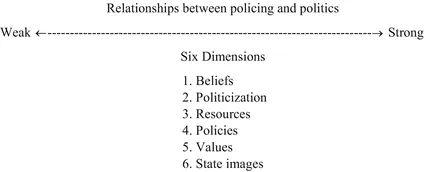
According to the theory of the relationships between politics and policing, as advanced by Brewer, Guelke, Hume, Moxon-Browne and Wilford, a spectrum ranging from weak to strong can be used to delineate six major dimensions of the relationships between policing and politics: (1) beliefs, (2) politicization, (3) resources, (4) policies, (5) values and (6) state images.2 For political beliefs, policemen and women are “political animals” who have their political views.3 If their political views are strong, police conduct is bound to be affected. With regard to politicization, it is strong when the police identify with one political party or faction and are entangled in political disputes. The third dimension is related to police resources. Police resources are relatively weaker if the police are part of the government’s expenditure and if they are subject to the control or priorities of the state. However, police resources become stronger if the police manipulate state priorities and acquire “a disproportionate share of resources.”4 Moreover, the police relationships with politics are relatively weak if the former “implement government policies impartially through enforcement of the laws which enact them.”5 Their relationships are strong if the police become partisan in the form of either supporting government policies staunchly or opposing them fiercely. The fifth dimension of police–politics relationships is the degree of penetration of governmental values and ideology into the police. Their relationships are relatively weak if the police are affected by the governmental values and ideology. On the contrary, their relationships are strong if the police actively support such values and ideology “by denying legitimate opposition to them or in the expression of alternative values and ideologies.”6 The final dimension refers to the conduct of the police that shapes public perceptions of the state and state institutions, thus affecting politics indirectly. If the police manipulate these public perceptions, their relationships are relatively strong. Overall, the more intervention from the police in politics, the stronger the relationships between police and politics (see Fig. 1.1).
Fig. 1.1
A model of the relationships between policing and politics (Source: Slightly adapted from John R. Brewer, Adri...
Table of contents
Cover
Frontmatter
1. Introduction: Toward an Analytical Framework of Understanding the Context and Content of Policing
2. Policing in China
3. Modernization of China’s Police and Learning from Hong Kong
4. Knowledge Transfer from Hong Kong Police to Mainland Chinese Police
5. Policing in Hong Kong
6. Policing the Anti-WTO Protests in Hong Kong
7. Policing the Occupy Central Movement in Hong Kong
8. The 2016 Mongkok Riot in Hong Kong
9. Policing Crises in Mainland China: The Shenzhen Landslide, Tianjin Explosion and Shanghai Stampede
10. Policing in Taiwan
11. Policing in Macao
12. Conclusion
Backmatter
Trusted by 375,005 students
Access to over 1.5 million titles for a fair monthly price.
Study more efficiently using our study tools.
Frequently asked questions
Yes, you can cancel anytime from the Subscription tab in your account settings on the Perlego website. Your subscription will stay active until the end of your current billing period. Learn how to cancel your subscription
No, books cannot be downloaded as external files, such as PDFs, for use outside of Perlego. However, you can download books within the Perlego app for offline reading on mobile or tablet. Learn how to download books offline
Perlego offers two plans: Essential and Complete
Essential is ideal for learners and professionals who enjoy exploring a wide range of subjects. Access the Essential Library with 800,000+ trusted titles and best-sellers across business, personal growth, and the humanities. Includes unlimited reading time and Standard Read Aloud voice.
Complete: Perfect for advanced learners and researchers needing full, unrestricted access. Unlock 1.5M+ books across hundreds of subjects, including academic and specialized titles. The Complete Plan also includes advanced features like Premium Read Aloud and Research Assistant.
Both plans are available with monthly, semester, or annual billing cycles.
We are an online textbook subscription service, where you can get access to an entire online library for less than the price of a single book per month. With over 1.5 million books across 990+ topics, we’ve got you covered! Learn about our mission
Look out for the read-aloud symbol on your next book to see if you can listen to it. The read-aloud tool reads text aloud for you, highlighting the text as it is being read. You can pause it, speed it up and slow it down. Learn more about Read Aloud
Yes! You can use the Perlego app on both iOS and Android devices to read anytime, anywhere — even offline. Perfect for commutes or when you’re on the go. Please note we cannot support devices running on iOS 13 and Android 7 or earlier. Learn more about using the app
Yes, you can access The Politics of Policing in Greater China by Sonny Shiu-Hing Lo in PDF and/or ePUB format, as well as other popular books in Politics & International Relations & Asian Politics. We have over 1.5 million books available in our catalogue for you to explore.