- English
- ePUB (mobile friendly)
- Available on iOS & Android
eBook - ePub
About this book
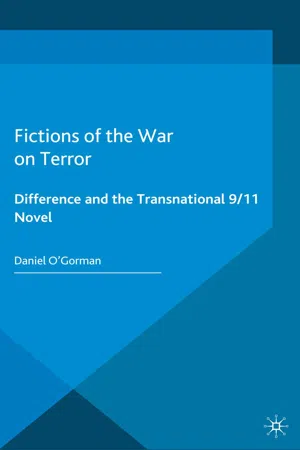
This book argues that there are a number of contemporary novels that challenge the reductive 'us and them' binaries that have been prevalent not only in politics and the global media since 9/11, but also in many works within the emerging genre of '9/11 fiction' itself.
Information
1
New Constellations: Judith Butler’s ‘Frame’ and Dave Eggers’ What Is the What
This chapter aims to critique Judith Butler’s recent use of the concept of the ‘frame’ in the context of the war on terror. While many of the questions that Butler raises about the ways in which violence is framed in the post-9/11 world are perspicacious, I argue that this conceptual reliance on framing actually stands in the way of her ability to answer them. Instead, it causes her to inadvertently exacerbate precisely the kind of framing process that she is ostensibly attempting to deconstruct. By making this argument, I do not mean to negate the ultimate goals of her project, nor the headway she makes towards them in other ways. Neither am I attempting to undercut her ideologically, by taking what some might interpret as a Badiouian position that rejects her as a proponent of a nihilistic ‘ethics of difference’.1 Rather, my aim is essentially to push her thinking further, holding her to account when she claims that her point is ‘not to paralyze judgement, but to insist that we must devise new constellations for thinking about normativity if we are to proceed in intellectually open and comprehensive ways to grasp and evaluate our world’.2 I suggest that Butler’s analysis of the frame does in fact involve a partial paralysis of judgement, which prevents these ‘new constellations for thinking about normativity’ from being as fully realised as they otherwise might be.
With reference to Dave Eggers’ biographical novel, What Is the What (2006), a text that actively strives to challenge the media-driven post-9/11 framing of reality by telling the ‘real-life’ story of a marginalised figure, this chapter contends that literature can prompt its reader to think about the framing of contemporary reality in ways that may help more radical ‘new constellations’ to begin to emerge. I make this case in two parts. In the first, I analyse Butler’s understanding of the frame, showing why her approach to literature plays a key part in what is problematic about her theorisation. In the second, I explain how Eggers’ novel offers a more nuanced and radical approach to the process of framing post-9/11 reality; an approach that foregrounds the textuality of the frame and suggests that the reality it limns might be more open to interpretation than Butler’s analysis allows.
Butler’s frame
‘Grievability’ and new empathic ties
Butler has employed the notion of the frame as a means of helping to explain why, during wartime, the Western mass media can sometimes appear to deem the lives of certain people more worthy of grief than those of others. The idea is developed primarily over the course of two of her more recent major studies: Precarious Life (2004) and Frames of War (2009). In each book, Butler attempts to confront what she identifies as a dehumanising ‘derealization of loss’ – or in other words, an ‘insensitivity to human suffering and death’ – that is enacted through an imbalance in the degree of compassion with which prominent media outlets respond to (or ‘frame’) death, depending on where it takes place and who it is that dies.3 In response, Butler aims for an ethics based upon the establishment of new empathetic global ties. She insists that the creation of such ethical ties is ‘not a matter of a simple entry of the excluded into an established ontology, but an insurrection at the level of ontology, a critical opening up of the questions, What is real? Whose lives are real? How might reality be unmade?’4
In Precarious Life, as an example of what she describes as a kind of ‘hierarchy of grief’ in Western discourse, Butler cites the case of a Palestinian citizen of the United States who attempted to submit obituaries to the San Francisco Chronicle for two families killed by Israeli troops, only to be eventually rejected on the grounds that the newspaper ‘did not wish to offend anyone’.5 She suggests that by placing these lives outside its frame of ‘grievability’, the newspaper’s politically motivated editorial stance might actively contribute to the perpetuation of an imperialistic culture of violence: ‘[w]hat is the relation’, she asks, ‘between the violence by which these ungrievable lives were lost and the prohibition on their public grievability? Are the violence and the prohibition both permutations of the same violence?’6 She later asserts that media coverage of the war on terror is generally constituted by images that ‘do not show violence’, but that contain ‘violence in the frame [of] what is shown’.7 The resulting ‘derealization of loss’, she posits, ‘becomes the mechanism through which dehumanization is accomplished, ... [taking] place neither inside nor outside the image, but through the very framing by which the image is contained’.8 As its title suggests, in Frames of War Butler explores the idea further, emphasising its power to capture and to dominate: ‘As we know,’ she writes,
‘to be framed’ is a complex phrase in English: a picture is framed, but so too is a criminal (by the police), or an innocent person (by someone nefarious, often the police), so that to be framed is to be set up, or to have evidence planted against one that ultimately ‘proves’ one’s guilt.9
She goes on to explain that:
[t]o call the frame into question is to show that the frame never quite contained the scene it was meant to limn, that something was already outside, which made the very sense of the inside possible, recognizable. ... Something exceeds the frame that troubles our sense of reality; in other words, something occurs that does not conform to our established understanding of things.10
The drive to reduce and contain reality causes the frame to help perpetuate a kind of dominating, Orientalist epistemic violence against those represented within it. It is, as such, of particular use to those in power during times of war, whether they consciously exploit it or not.
Forestalling judgement
As I have already stated, I argue that Butler’s analysis of the frame is problematic because it partially forestalls judgement, and as such ultimately maintains some of the ‘mechanisms of inclusion and exclusion’ (to borrow Paul Gilroy’s phrase) that underpin the very normativity that she wishes to challenge.11 Despite numerous attempts to avoid an over-reliance on East/West or Third World/First World binaries, I would suggest that such binaries remain implicit in her argument: while the frames through which war is represented are shaped by what she claims are a set of hegemonic, normative values, she never gives any clear sense of precisely what these values are or by whom they are perpetuated, besides a loosely defined ‘non-figurable and, to some extent, non-intentional operation of [state] power’.12 While in Butler’s earlier work on gender, the normative values under analysis are of a clearly defined type (heteronormativity, in particular, specifically denotes a privileging of heterosexual experience in a deeply gendered contemporary society), in the broader context of US foreign policy the values implied by the term have become considerably more diffuse.
It is also worth noting that Butler’s emphasis on the power of mainstream news outlets to reinforce ‘certain larger norms’ makes almost no acknowledgement of blogs, social media and other online methods of news distribution: as David Gauntlett argues in his article ‘Media Studies 2.0’, ‘[c]onventional concerns with power and politics are [now] reworked ... so that the notion of super-powerful media industries invading the minds of a relatively passive population is compelled to recognise and address the context of more widespread creation and participation’.13 This is not to say that such innovations have necessarily undercut mass-media power, but simply that given their patent impact on the ways in which contemporary war is framed, it is odd that she merely glances over them.
The main problem is not simply that Butler avoids a detailed explication of her suggested link between media framing and state power: more importantly, it is that she appears to make an implicit assumption that the reader shares her own value judgements about the norms that this link is perpetuating. Developing the point with a discussion of the framing of the war on terror during the 2005 Abu Ghraib controversy, for example, Butler suggests that ‘the problem ... is not just internal to the life of the media, but involves the structuring effects that certain larger norms, themselves often racializing and civilizational, have on what is provisionally called “reality”’.14 This is, of course, not a new claim, and has been repeated frequently in the dozens of books about 9/11 and the mainstream media published in Europe and the United States throughout the last decade.15 My point is that Butler makes her argument in a way that reinforces precisely the kind of ‘structuring effects’ on reality that she ostensibly aims to critique. Specifically, her use of the non-committal adjective ‘certain’ appeals to her reader’s existing prejudices rather than challenging them, an appeal that recurs when she repeats the word at key points throughout: ‘certain secular conceptions of history’; ‘a certain conception of freedom’.16 The implied meaning in each instance is easy to determine, but only in an imprecise, conversational sort of way: to discern what she means in more exact terms is a difficult task, and any attempt at detailed interpretation may vary in key ways from what Butler herself has in mind. I do not mean to be pedantic here (it would of course be impossible for Butler to avoid using shorthand completely), but in each of these cases, ‘certain’ is used to indicate – and to subtly pass judgement upon – a set of ‘conceptions’ that are of central concern to her thesis. By relying on the reader to take her implied meaning for granted, she reinforces an existing, consensually agreed-upon left-wing ‘constellation for thinking about normativity’, which by her own reasoning should itself be subject to an ‘ontological insurrection’.
Mark Neocleous identifies a similar lack of specificity in his review of Frames of War for Radical Philosophy:
Symptomatic of the lack of clarity concerning the book’s central purpose is the number of rhetorical questions that appear again and again through the text, with some rhetorical questions containing more than one question. ... One is tempted to respond with a version of that item of 1980s’ corporate bullshit directed at workers who bring their bosses problems when they should be bringing solutions: ‘Don’t give me questions, Judith, give me answers.’17
Although I would not go as far as Neocleous in my critique (his extremely harsh review dismisses Frames of War all-but-entirely), highlighting Butler’s rhetorical questions is important because it again draws attention to an apparent reluctance on her part to substantiate the normativity that ‘we’ need to devise new constellations for thinking about. It raises the possibility that this reluctance to specify might actually be an inability, as doing so would require her to question the ideological assumptions upon which her own left-wing academic language relies. The problem here is that by exempting these assumptions from a full analysis, Butler comes uncomfortably close to perpetuating precisely the kind of unhelpful cultural relativism that, in its more crass manifestation as conspiracy theory, she elsewhere rightly dismisses as ‘simply [another way] of asserting US priority and encoding US omnipotence’.18
A problem for literature: the ‘visual divide’ and Poems from Guantánamo
As I have already indicated, I do not dispute Butler’s basic assertion that ideologically inflected norms of one kind or another are at play in the process of framing reality: she explicitly accepts that ‘full inclusion and full exclusion are not the only options’, and that, as such, ‘the point [of analysis] would not be to locate what is “in” or “outside” the frame, but what vacillates between those two locations, and what, foreclosed, becomes encrypted in the frame itself’.19 However, the nuance of this argument is once again undercut later on, when she resorts to an analysis of the globe that does not blur the boundary between the ‘inside’ and the ‘outside’, but instead relies on an overly clear-cut ‘visual divide’ between the First and Third Worlds:
[t]he critique of the frame is, of course, beset by the problem that the presumptive viewer is ‘outside’ the frame, over ‘here’ in a first world context, and those who are depicted remain nameless and unknown. In this way, the critique I have been following stays on this side of the visual divide, offering a first-world ethic and politic that would demand an outraged and informed response on the part of those whose government perpetrates or permits such torture.20
Butler is, admittedly, trying hard to question the discursive structures in which her own ‘ethic and politic’ is framed. Nevertheless, it is also evident that the characterisation of this ethic and politic as ‘first world’ – and, thus, ‘outside’ the frame – relies on an assumption that the ‘presumptive viewer’ has no meaningful access to the world on the other side of the visual divide. By this I do not mean to make the Orientalist argument that this ‘third world’ reality is actually in some way straightforwardly knowable. Nor do I want to suggest that the representations of it within Western media-driven frames might be more accurate, so to speak, than Butler claims. Rather, what I am taking issue with is specifically the implication, inherent in this notion of a visual divide, that the ‘first world’ reality on one side of the frame is somehow less authentic than the ‘third world’ reality on the other: as she has herself argued elsewhere, on the topic of Giorgio Agamben’s heavy reliance on the categories of sovereignty and bare life in his analysis of post-9/11 US counterterrorism policy, ‘[w]e need more complex ways of understanding the multivalence and tactics of power to understand forms of resista...
Table of contents
- Cover
- Title
- Copyright
- Dedication
- Contents
- Acknowledgements
- Introduction
- 1 New Constellations: Judith Butler’s ‘Frame’ and Dave Eggers’ What Is the What
- 2 Gazing Inward in Jonathan Lethem’s Chronic City and Teju Cole’s Open City
- 3 Connective Dissonance: Refiguring Difference in Fiction of the Iraq War
- 4 Ambivalent Alterities: Pakistani Post-9/11 Fiction in English
- 5 ‘The stories of anywhere are also the stories of everywhere else’: Salman Rushdie’s Shalimar the Clown and The Enchantress of Florence
- Conclusion
- Notes
- Bibliography
- Index
Trusted by 375,005 students
Access to over 1.5 million titles for a fair monthly price.
Study more efficiently using our study tools.
Frequently asked questions
Yes, you can cancel anytime from the Subscription tab in your account settings on the Perlego website. Your subscription will stay active until the end of your current billing period. Learn how to cancel your subscription
No, books cannot be downloaded as external files, such as PDFs, for use outside of Perlego. However, you can download books within the Perlego app for offline reading on mobile or tablet. Learn how to download books offline
Perlego offers two plans: Essential and Complete
- Essential is ideal for learners and professionals who enjoy exploring a wide range of subjects. Access the Essential Library with 800,000+ trusted titles and best-sellers across business, personal growth, and the humanities. Includes unlimited reading time and Standard Read Aloud voice.
- Complete: Perfect for advanced learners and researchers needing full, unrestricted access. Unlock 1.5M+ books across hundreds of subjects, including academic and specialized titles. The Complete Plan also includes advanced features like Premium Read Aloud and Research Assistant.
We are an online textbook subscription service, where you can get access to an entire online library for less than the price of a single book per month. With over 1.5 million books across 990+ topics, we’ve got you covered! Learn about our mission
Look out for the read-aloud symbol on your next book to see if you can listen to it. The read-aloud tool reads text aloud for you, highlighting the text as it is being read. You can pause it, speed it up and slow it down. Learn more about Read Aloud
Yes! You can use the Perlego app on both iOS and Android devices to read anytime, anywhere — even offline. Perfect for commutes or when you’re on the go.
Please note we cannot support devices running on iOS 13 and Android 7 or earlier. Learn more about using the app
Please note we cannot support devices running on iOS 13 and Android 7 or earlier. Learn more about using the app
Yes, you can access Fictions of the War on Terror by D. O'Gorman in PDF and/or ePUB format, as well as other popular books in Literature & Literature General. We have over 1.5 million books available in our catalogue for you to explore.