eBook - ePub
Sustainable Community Development: Dilemma of Options in Kenya
Dilemma of Options in Kenya
- English
- ePUB (mobile friendly)
- Available on iOS & Android
eBook - ePub
Sustainable Community Development: Dilemma of Options in Kenya
Dilemma of Options in Kenya
About this book
Community development has lately gained much prominence, but the emphasis has remained on the economic and social welfare of communities, rather than the environment. By focusing on 'sustainable' development in Kenya, this study shows the importance of integrating ecological concerns in socio-economic and cultural development processes.
Information
1
Introduction
Abstract: This chapter lays the background of the book by discussing the persistent problem of poverty and its indignity, using its practical manifestations within communities. Reference is made to Africa’s development irony, given its wealth in natural resources and human capital, to question the inability of Kenya to catch up with her peers at independence such as the Asian Tigers. The assumption is made that since the living standard of an average Kenyan is declining, past development approaches are wanting and new ideas need to be tried out to catapult Kenya into a newly developed country as envisaged in the nation’s blue print—called Vision 2030. This calls for people-centered visionary leadership that has hitherto been the missing link.
Waswa, Fuchaka, Christine Ruth Saru Kilalo, and Dominic Mwambi Mwasaru. Sustainable Community Development: Dilemma of Options in Kenya. New York: Palgrave Macmillan, 2014. DOI: 10.1057/9781137497413.0008.
“Something is wrong when the more things change, the more they remain the same in the fight against poverty” in Kenya
—Authors
1.1Background
In 1963, the newly inaugurated Kenya Government embarked on a mission to eradicate three major obstacles that were considered critical to development: poverty, diseases, and ignorance. This was to be actualized through the establishment and implementation of five-year development plans. Today, more than 50 years later, Kenya is still grappling with the stigma of underdevelopment and a widening gap between the rich and the poor. Most key development indicators have been on a downward trend. Recent estimates from the Kenya Bureau of Statistics show that 54% and 53% of the rural and urban people respectively live in absolute poverty.
Although the data may not be conclusive, the general trend suggests that poverty has little to do with natural factors like adverse climate since the levels of poverty in both medium and low potential zones are similar (Table 1.1). The misplaced significance of adverse natural factors is further annulled because many countries with such conditions have broken out of poverty. Financial capital may not also be a critical challenge, given the level of mega corruption and wastage of national financial resources in Kenya. Poor management of human capital and social capital thus stands out as the critical development challenge. This malaise is directly related to persistent bad politics, which has unfortunately remained the governance culture despite the negative implications that often accompany it.
TABLE 1.1 Poverty levels by provinces in Kenya
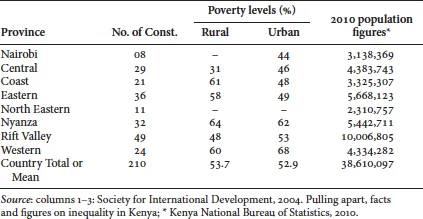
These statistics are indicative of policy flaws when considered along the economic potential of each province indicated in the table. Western and Nyanza provinces, for instance, are within the medium to high potential agro-ecological zones (Farm Management Handbook, 2010), yet more than 60% of their inhabitants are classified as poor (living on one dollar or less per day). While several reasons may be advanced for such inter-province disparities, poor governance is perhaps the single most important factor responsible for this observation. Details on the role of poor governance in under-development are discussed in Chapter 4. The scenario for the future in most Kenyans’ minds can best be described as desperate. While the living standards for the average Kenyan was considered high after independence in 1963, it is widely acknowledged that most households are sinking into poverty with time, and the living standard of an average Kenyan is declining (Figure 1.1).
One possible cause of persistent poverty has been the continuation of political and economic marginalization of communities and regions after independence in 1963. For instance, Sessional Paper No. 10 of 1965 was anchored on a strategy of investing resources in high potential areas with high economic returns to attain rapid economic growth. This effectively marginalized the Arid and Semi Arid Lands (ASALs), which have remained the poorest regions to date as evidenced also by the County Development Index (CDI) developed by the Commission for Revenue Allocation (CRA, 2014). How to shift communities from the status from ill-being to well-being (i.e., having materially enough for a decent life, enjoyment of security, enjoyment of good health, having good social relationships, and having the ability to choose and make preferences) remains a critical governance challenge for Kenya. This volume provides a menu of options that could address this challenge.
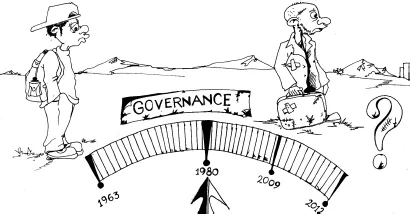
FIGURE 1.1 Scenario for the future based on current circumstances
The status of ill-being (poverty) in Kenya is manifested mainly in hunger, famine, and related problems such as illness, death, crippled children’s learning capacities, and reduced potential of people to work (Republic of Kenya, 2000). Borrowing from Chambers (1983), such events contribute to “physical weakness” within the populace that ultimately undermines the realization of the current slogan of “a working nation.” Chambers (1983) has discussed the role of physical weakness in perpetuating integrated poverty1 and what could be done to enhance rural livelihoods through his concept of “clusters of disadvantage.”
This scenario is also ironical given that Kenya’s economy is largely agricultural. That the fight against poverty cannot be won without fighting hunger was further amplified through the theme for the 2001 World Food Day: “Fight hunger to reduce poverty.” Similar observations were made by Baas and Rouse (1997), who indicated that poverty, environmental degradation, and land are directly related in most developing countries.
Alleviation of poverty remains the single most important entry point for sustainable community development in most agriculture dependent economies such as Kenya. This goal is achievable, bearing in mind that the GNP of Kenya and South Korea were statistically the same in the early 1960s. Ironically, Kenya’s GDP was USD 32,724 in 2009, while that of South Korea was USD 832,512 (International Monetary Fund, 2010). Leadership that is development conscious would be interested in identifying the factors responsible for the widening gap between these two countries once at par with respect to GNP. In this volume it is hypothesized that the apparent failure of past poverty reduction approaches and strategies is attributed to several factors such as:

Table of contents
- Cover
- Title
- 1 Introduction
- 2 Development Approaches and Competing Paradigms
- 3 Entry Points for Sustainable Community Development
- 4 Roles of Strategic Stakeholders
- 5 Creating an Enabling Environment
- 6 Back to the Basics
- Glossary
- Bibliography
- Index
Trusted by 375,005 students
Access to over 1.5 million titles for a fair monthly price.
Study more efficiently using our study tools.
Frequently asked questions
Yes, you can cancel anytime from the Subscription tab in your account settings on the Perlego website. Your subscription will stay active until the end of your current billing period. Learn how to cancel your subscription
No, books cannot be downloaded as external files, such as PDFs, for use outside of Perlego. However, you can download books within the Perlego app for offline reading on mobile or tablet. Learn how to download books offline
Perlego offers two plans: Essential and Complete
- Essential is ideal for learners and professionals who enjoy exploring a wide range of subjects. Access the Essential Library with 800,000+ trusted titles and best-sellers across business, personal growth, and the humanities. Includes unlimited reading time and Standard Read Aloud voice.
- Complete: Perfect for advanced learners and researchers needing full, unrestricted access. Unlock 1.5M+ books across hundreds of subjects, including academic and specialized titles. The Complete Plan also includes advanced features like Premium Read Aloud and Research Assistant.
We are an online textbook subscription service, where you can get access to an entire online library for less than the price of a single book per month. With over 1.5 million books across 990+ topics, we’ve got you covered! Learn about our mission
Look out for the read-aloud symbol on your next book to see if you can listen to it. The read-aloud tool reads text aloud for you, highlighting the text as it is being read. You can pause it, speed it up and slow it down. Learn more about Read Aloud
Yes! You can use the Perlego app on both iOS and Android devices to read anytime, anywhere — even offline. Perfect for commutes or when you’re on the go.
Please note we cannot support devices running on iOS 13 and Android 7 or earlier. Learn more about using the app
Please note we cannot support devices running on iOS 13 and Android 7 or earlier. Learn more about using the app
Yes, you can access Sustainable Community Development: Dilemma of Options in Kenya by F. Waswa,C. Kilalo,D. Mwasaru,Kenneth A. Loparo,Alan Kennedy in PDF and/or ePUB format, as well as other popular books in History & African History. We have over 1.5 million books available in our catalogue for you to explore.