- English
- ePUB (mobile friendly)
- Available on iOS & Android
eBook - ePub
Transnational Turkish Islam
About this book
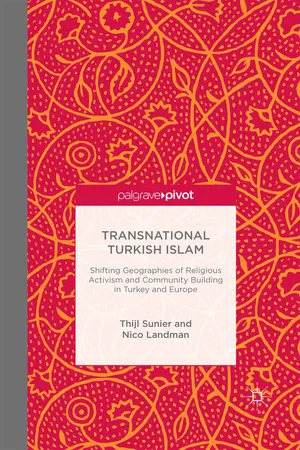
Transnational Turkish Islam provides an overview of Turkish organized Islam in seven European countries. It shows how Turkish Islamic organizations have developed from typical migrant associations in the 1970s and 1980s into present-day European Islamic associations with their own cultural and religious specificities and agendas.
Trusted by 375,005 students
Access to over 1.5 million titles for a fair monthly price.
Study more efficiently using our study tools.
Information
Topic
PhilosophySubtopic
European History1
Islam and Politics in Turkey
Abstract: This chapter addresses the changing relation between Islam and the Turkish state since the foundation of the republic in 1923. This is necessary information to understand the origins of Turkish Islamic organizations in Europe and the way they have developed since. Rather than reproducing the simplistic secular-religious dichotomies that characterize many historical accounts on Turkey, the authors approach the complex relation between state and Islam as a political struggle around the question, ‘What place Islam has and should have in society?’. It shows that the relationship among religion, politics, and economy changed fundamentally in each of the four historical stages to be distinguished. It reveals what issues were at stake; who the principal actors were; and how Islam was organized politically and socially.
Sunier, Thijl, and Nico Landman. Transnational Turkish Islam: Shifting Geographies of Religious Activism and Community Building in Turkey and Europe. Basingstoke: Palgrave Macmillan, 2015. DOI: 10.1057/9781137394224.0004.
Introduction
Although the Turkish Islamic landscape in Europe increasingly develops according to its own dynamics, the significance of the Turkish context in co-shaping this landscape has not diminished; it has changed. The developments in Turkey in the past three decades, particularly those in the past years with the coming to power of the Adalet ve Kalkınma Partisi (AKP; Justice and Progress Party), have prompted existing Islamic organizations in Europe to reconsider their position vis-à-vis Turkey. But also the relative success of the Gülen-movement in recent years cannot be understood without a thorough assessment of the position of Islam in Turkish society, particularly the changing relation between Islam and the state. The Turkish context has become part of a larger transnational field that has transformed from a typical hierarchical migrant-configuration into a more horizontal network of exchange and interaction. In this chapter we will address the Turkish context and explore the relevant traits for the current situation.
In much of the early literature on the foundation of the Turkish re-public in 1923 and the subsequent societal, cultural, and political reforms, the transformation has been depicted as a historically necessary and inevitable process of modernization in which the role of Islam has been relegated to the private sphere. The founder of the Turkish republic, Mustafa Kemal Atatürk, would build a modern, western nation-state on the ruins of the Ottoman Empire.1 Turkey was often depicted as the phoenix rising from the ashes of more than 600 years of Ottoman rule.
In the rather simplistic image of the Turkish republic that has been developed since then, the Kemalist revolution was depicted as a ‘total social and cultural revolution’. The Kemalist takeover had rendered an almost mythical status, a complete breach with the past. The Ottoman Empire was an Islamic empire; the Turkish republic was founded on secular principles. In this way the two societal models were juxtaposed as each other’s mirror image and found their way into political, educational, and cultural programs. Islam with all its institutions, principles, and practices represented obscurantism, while the Kemalist state model represented progress and modernization. The emerging resistance against the rigorous and highly symbolic reforms initiated by the Kemalist government was explained as a struggle between traditional backwardness and modernization, old and new, progress, and reactionary forces. As a political statement the image served the goals of the Kemalists, but analytically it is an obvious simplification, not least because it reduces the Kemalist reforms to anti-religious measures whereas the new government had a much more extended, predominantly economic agenda. It also implicitly assumes that the foundation of the Turkish republic in 1923 was the initial and decisive moment of societal reform and thus ignores the fundamental societal changes that took place in the mid-19th-century Ottoman Empire.
The foundation of the Turkish republic is a crucial, symbolically laden event in the development of the relation between the state and Islam of over 150 years. However, in terms of societal impact it is not more important than subsequent transformations of Turkish society and not least than those that took place before 1923. The political liberalization that took place after the Second World War, the economic transformations in the 1950s and those in the 1980s had in many respects a more transformative effect than the Kemalist revolution. As Turam (2007) argues, the growth of a civil society in the 1980s has been a crucial condition for the modernization of the political system in Turkey. Along with Turam and other scholars we contend that Islamic political actors, rather than resisting modernization, were decisive forces in that process. The victory of the AKP in the 2002 elections did not herald the end of the secular state model of the republic as some critics argue, but the integration of Islamic societal political and social actors in the secular state (Turam, 2007, p. 8). As Çinar (2006, p. 471) argues, the success of the AKP with its Islamic program has laid bare the democratic deficit of the Kemalist model.2 The successive stages in the relation between state and religion in Turkey clearly show the dynamics of secularism as a political project and a social imaginary and demonstrate that it is far more complex than the ‘separation of religion and state’. To understand this we need to analyse the specific traits of Turkish secularism and trace its historical trajectory and its manifold manifestations.
Four stages can be distinguished in this trajectory. The first stage (1923–1945) covers the heydays of Kemalist reform. In those years the state occupied a central role in the reconstruction of society. Many reforms were implemented top-down. The second stage (1946–1979) is characterized by political liberalization, the introduction of the multi-party system, and the emergence of Islam as a political pivot. In the last part of this stage, migration to Europe reached its peak. Most of the present-day Turkish Islamic movements and organizations in Europe arrived towards the end of the 1970s. They were a product of the fierce struggle between ‘official’ state secularism and the oppositional religious field. From then on events took a different route in Turkey and in Europe. The third stage (1980–2002) started with the military coup d’état and is characterized by the emergence and extension of civil society. An important development in those years was the growth of a relatively wealthy middle class with an Islamic outlook. In this stage Muslims entered all segments of society and all spheres of public life. The fourth stage (2003–present) is marked by the coming to power of the AKP and its continuous political dominance.
The political struggle in each of these four periods revolves around the question of the place Islam has and should have in society. It is a struggle about the very foundations of the Turkish state. An analysis of these four periods reveals what issues were at stake, who the principal actors were, and how Islam was organized politically and socially. We will show that each of these stages, rather than delineating sharp ruptures with the period before, provided the necessary conditions for each following stage.
Stage 1 (1923–1945)
Although the Kemalist state was modelled after the Western concept of people’s sovereignty, it was forced upon the population (Kieser, 2013; Lewis, 1968, p. 352). A national ideology was meant to provide the regime with political legitimacy to rule the entire population, irrespective of race or ethnic or religious background. Populism, one of the central creeds of the Kemalist doctrine, not only implied a certain equality of all people, it was also understood as ‘the people ruling the people’ (Shaw and Shaw, 1977, p. 378). Consequently, only one party was allowed according to the Kemalist regime: Cumhuriyet Halk Partisi (CHP; Republican People’s Party). This party would promote the new Turkish national identity. Organization on the basis of class, ethnicity, or religion was forbidden (Toprak, 1981, pp. 38–39). From then on state sovereignty was no longer based on divine legitimacy, but on the Kemalist conception of people’s power. There is a considerable similarity between the position of the Communist Party in the early Soviet Union and the CHP in that the party, rather than being the organization of a certain political loyalty, constituted the political vanguard that was supposed to lead the people.
Reforms with respect to religion had a highly symbolic significance, but they were certainly not unique. The first series of reform measures concerned secularisation of state, education, and legal institutions. Many of these reforms were already initiated almost 75 years earlier during the so-called Tanzimat reforms and concluded during the rule of the Young Turks (1908–1918) (Zürcher, 2006, pp. 227–235). Mustafa Kemal belonged to the radical wing of the Young Turks who were in favour of a forced process of societal renewal. He considered Islam as a ‘natural’ aspect of the Turkish people, but it could never play any significant role in the building of the Turkish nation-state (WRR, 2004, p. 98).
Religion, according to the Kemalists, not only had a dominant position in Ottoman state institutions, it was also thoroughly intertwined with Turkish society. Consequently it was the task of the state and party to ‘domesticate’ Islam according to Kemalist principles and to build a new secular state. The Directorate of Religious Affairs (Diyanet Işleri Başkanlığı), founded in 1924, was entrusted with the task of organizing religious services and of coordinating religious accommodation and religious instruction. Diyanet was reminiscent of the French Bureau Central des Cultes (Gözaydın, 2008, p. 218) and served as a format for similar institutions in the Soviet Union. One of the main goals was the total centralization and reorganization of religious life in Turkish society. In that respect the Diyanet model had more far-reaching consequences than the French institute.
In 1931 all mosques were brought under the direct control of a separate institute, the Directorate for Religious Institutions. All mosques that were not part of this foundation were de facto illegal. Imams became employees of the Turkish state, and they were obliged to work according to strict regulations. The reforms explained here were a reorganization of Islam, rather than a separation of state and religion. The Turkish concept laiklik, generally translated as secularism, thus had a different meaning than the way it is applied in the West (Kinzer, 2001).
The second series of reforms were aimed at secularizing culture, eradicating religious symbols from the public sphere, and transforming the dominant symbols in society. In 1928 the Arabic script was replaced by Latin alphabet, and the Turkish language was gradually purified from Arabic idiom. It was forbidden to do the call to prayer (ezan) in Arabic. A proposal to even turn Quran recitation into Turkish was not effectuated. The motivation behind the ‘turkification’ of religious rituals and practices was the idea that it would cut off the Turkish population from the Arab world. Many of these early reforms have been turned back in the course of years. A more important aspect of symbolic secularization was the reconceptualization of history from a Turkish nationalist perspective. According to the Kemalists the strong link between Islam and the Arab world had caused a neglect of the historical links between the Turks of Anatolia and the Turkic people in central Asia. By emphasizing these ethnic roots they intended to provide their nationalist ideology with a firm historical basis. The abolition of the caliphate in 1924, the introduction of the Gregorian calendar and Sunday as the weekly holiday, the introduction of family names, and the prohibition of certain clothing were all intended to turn the Turkish people away from the Islamic world (Toprak, 1981, pp. 40–46; Kinzer, 2001).
The main goal of the secular reforms, however, was the complete control by the state over the religious field. Not only were the institutions and symbols of the republic being secularized, the Kemalists intended to develop a dominant religious domain that was completely subordinate to the state and subject to strict state control. In the large mosques only imams who were recognized by the state and trained by the Diyanet could be appointed. Imams who were not educated in the official institutions could only work in the smaller, more remote mosques. Later on all religious activity came under state control. Especially in rural areas the number of religious employees with sufficient knowledge of orthodox Islamic sources decreased. Religious education in schools was gradually abolished. An important consequence of this development was that for a large section of the urban population the role of Islam, even in private life, became less significant, while the lack of religious leaders in rural areas with a formal education resulted in the growth rather than the diminution of Islamic practices and convictions that were fully entangled with everyday life (Bruinessen, 1982, p. 177). While the role of orthodox Islam in politics and its influence on the state weakened, the influence of local ulama and şeyhs among the rural population further increased (Sunar and Toprak, 1983, p. 426; Sunier, 1996).
This increased influence also had a socio-economic cause. In rural areas, the existing social, economic, and administrative structures which were closely intertwined with local religious leadership were largely left intact. Administrative and economic reforms hardly reached the societal periphery, but the countryside was indirectly affected by the economic reforms. The economic policies of the government were directed towards developing a state-owned heavy industry, with the aim of becoming independent from the West. Industrial development focussed primarily on the already developed areas in the Western regions of the country. The industrialization program was funded with revenues from the countryside and thus at the expense of agriculture (Smit and Velzen, 1982, p. 54). By neglecting the periphery, traditional power structures remained relatively unaffected.
The side effect of these policies was a certain level of political stability in the periphery. Although the economic policies led to a widening of the gap between urban and rural areas, the political neglect functioned as a valve against protest and resistance. Apart from some incidents no major rebellions inspired by Islam have taken place. A major reason was the lack of organizational strength among Muslims in the peripheral areas. Most groups and brotherhoods (tarikat) had a local base and any mutual communication, necessary for massive protests, was hardly present.
That does not mean that there was no opposition or protest. However, this resistance had a strong local character and was based on existing traditional organizational networks. It was primarily directed against specific measures of the regime. Most protests also had a messianic character. The arrival of Atatürk was taken as a sign that the end times had come (Bruinessen, 1982, p. 175). Yet also new organizational structures emerged that sought to protect Islam against the regime. In many places they organized demonstrations. Many of these organizations were founded by leaders of the influential Nakşibendi-order. The most important major uprising in 1925 in south-east Turkey was led by the influential Nakşibendi şeyh Said. However, some observers argue that nationalist rather than Islamic motives were behind this relatively sizeable rebellion. The insurgents were Kurds (Olson, 1989). The regime suppressed the uprising with a bloody attack. Subsequently a decree was issued that outlawed all the tarikats in the course of 1925. In this way a so-called parallel Islam emerged next to the official Islam monitored by the state (Dumont, 1984, pp. 364–375; Çakır, 1990). Within these parallel Islamic networks a wide range of religious services came into being to replace the atrophied official orthodox Islam in the cities. These networks constituted the organizational basis for the new organizations that developed in the period after the Second World War.
Stage 2 (1946–1979)
In 1946 Turkey, forced by the Allies, introduced a multi-party system. This had profound effects on the place of Islam in society and politics. Islam became a crucial factor in political struggle not only to build up rank-and-file, but also to establish a new political agenda. In the 1940s 75 per cent of the population still lived in rural areas. They constituted an important electoral potential, not just because of their religious affiliation, but also in relation to the socio-economic situation. The rural areas hardly benefited from the economic fruits of Kemalist development. The parties that appeared in the political arena in 1946 not only challenged the monopoly position of the Republican Party (CHP), but also put the emphasis on economic development in rural areas (Öktem, 2011, p. 40; Szyliowicz, 1966; Mardin, 1989).
Due to the poor infrastructural facilities, election campaigns hardly reached the rural population. Most opposition parties had no organizational base in the countryside. For that reason, by way of some sort of goodwill campaign, all parties, including the CHP, proposed to soften the legal and institutional restrictions on Islam. The CHP still won the first elections in 1946 with a majority in parliament, but in subsequent years and with the gradual opening up of the countryside their support diminished. In April 1950 the CHP-government decided to grant Diyanet a more autonomous status and transferred the management of religious accommodation back to the board of the directorate. A favourable side effect was that the growing dissatisfaction in the ranks of Diyanet about the control of the state waned and the prestige of the organization increased again (Gözaydın, 2008, p. 220).
In May 1950 the CHP was defeated in the general elections by the Demokrat Parti (DP; Democratic Party). In the preceding years the party had worked hard to build up an electorate by acquiring support among local Islamic leaders and networks, particularly among supporters of the Kurdish Islamic scholar and preacher Said Nursi (1876–1960). Nursi initially supported the Kemalist revolution, but became an import opponent in the 1930s. Unlike others parties which focussed almost exclusively on the urban population, the DP effectively made use of the electoral potential of the rural population.
One of the first measures of the new DP prime minister Adnan Menderes was to allow the ezan, the call to prayer, to be done in Arabic again. Furthermore, religious education and the training of imams were expanded. In 1951 Imam-Hatip schools were established with a large religious curriculum designed for pupils who wanted to plan a religious career (Shaw and Shaw, 1977, p. 409). ...
Table of contents
- Cover
- Title
- Introduction
- 1 Islam and Politics in Turkey
- 2 Turkish Organized Islam in Europe
- 3 Diyanet
- 4 Sleymanls
- 5 Milli Gr
- 6 Glen-movement (Hizmet)
- 7 Alevis
- 8 Other Movements and Organizations
- Conclusions, Dynamics, and Tendencies
- Bibliography
- Index
Frequently asked questions
Yes, you can cancel anytime from the Subscription tab in your account settings on the Perlego website. Your subscription will stay active until the end of your current billing period. Learn how to cancel your subscription
No, books cannot be downloaded as external files, such as PDFs, for use outside of Perlego. However, you can download books within the Perlego app for offline reading on mobile or tablet. Learn how to download books offline
Perlego offers two plans: Essential and Complete
- Essential is ideal for learners and professionals who enjoy exploring a wide range of subjects. Access the Essential Library with 800,000+ trusted titles and best-sellers across business, personal growth, and the humanities. Includes unlimited reading time and Standard Read Aloud voice.
- Complete: Perfect for advanced learners and researchers needing full, unrestricted access. Unlock 1.5M+ books across hundreds of subjects, including academic and specialized titles. The Complete Plan also includes advanced features like Premium Read Aloud and Research Assistant.
We are an online textbook subscription service, where you can get access to an entire online library for less than the price of a single book per month. With over 1.5 million books across 990+ topics, we’ve got you covered! Learn about our mission
Look out for the read-aloud symbol on your next book to see if you can listen to it. The read-aloud tool reads text aloud for you, highlighting the text as it is being read. You can pause it, speed it up and slow it down. Learn more about Read Aloud
Yes! You can use the Perlego app on both iOS and Android devices to read anytime, anywhere — even offline. Perfect for commutes or when you’re on the go.
Please note we cannot support devices running on iOS 13 and Android 7 or earlier. Learn more about using the app
Please note we cannot support devices running on iOS 13 and Android 7 or earlier. Learn more about using the app
Yes, you can access Transnational Turkish Islam by Thijl Sunier,Nico Landman in PDF and/or ePUB format, as well as other popular books in Philosophy & European History. We have over 1.5 million books available in our catalogue for you to explore.