eBook - ePub
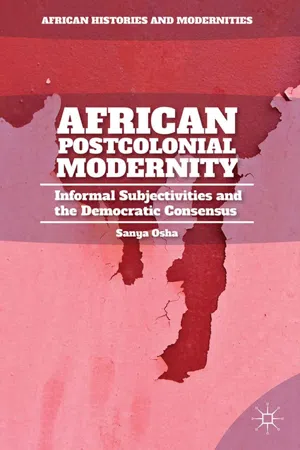
African Postcolonial Modernity
Informal Subjectivities and the Democratic Consensus
- English
- ePUB (mobile friendly)
- Available on iOS & Android
eBook - ePub
About this book
African cultures and politics remain significantly affected by precolonial and postcolonial configurations of modernity, as well as hegemonic global systems. This project explores Africa's conversation with itself and the rest of the world, critiquing universalist notions of democratization.
Information
Print ISBN
9781349496174
9781137446923
Subtopic
Social HistoryC H A P T E R 1
The Polis: From Greece to an African Athens
Speech in the Ancient Polis
It is often said that the history of democracy began in ancient Greece. Also, we owe most of our notions of the “public” to Athenian invention. In the Greek polis, all citizens apart from women and slaves were entitled to participation in the political life of the community. To be sure, the Greek invention of democracy in its classical form does have a number of positive attributes. The structure of the public sphere allowed for direct political participation. Also, the practical demands of civic participation encouraged the type of education necessary for an active political engagement with the public realm.
This particular type of education, which demanded a particular form of public speech and conduct, was developed with a certain degree of specialization by the sophists. Indeed, it is important to put in its proper perspective the role of the sophists in giving the Greek polis its distinctive character.
In this connection, it has been noted:
The sophists were the masters of Greece, it is through them that culture, properly speaking, was brought into existence. They took the place of the poets and rhapsodes who, beforehand, were the universal masters [ . . . ]. The goal of the state is the universal under which is seized the particular; it is this culture which the sophists spread. Teaching was their affair, their business, like a state of their own; they thus hold the schools; traveled around the cities, the youth would attach itself to them and was trained by them.1
In spite of their immense popularity in ancient Greece, we must also note that Socrates was in fact “the only true master.” The sophists, on the other hand, “were sages as there have been ‘new philosophers,’ and the promoters of an orthodoxy of the polis, artistans of the most traditional values.”2 And, as advocates of collective conformity, they were indeed flatterers, promoters of the status quo, as opposed to Socrates who sought to undermine it by his rigorous methods of inquiry.
Barbara Cassin highlights a crucial issue within the nature of the history of democratic practice itself: the “paradox of consensus” in relation to social change and reform. This engrossing problematique prompts us to revisit the goals and struggles that are inevitably embedded in the ontology of democratic practice, the unending tussle as it were, between social conformity and social change. It also brings us to the question of individual autonomy and the collective good. Thus it has been argued that “a radical pluralist approach, informed as it is by a non-essentialist view of politics, acknowledges the impossibility of a fully realized democracy and of the total elimination of antagonisms. It views all forms of agreement as partial and provisional and as products of a given hegemony.”3 The current project of radical democracy encourages difference and its inclusion into the dialectics of the social body; otherwise the inexorable specter of totalitarianism would hold sway. In addition, the project of radical democracy entails a rigorous critique of essentialism and the philosophies of the subject and this must be done within the framework of a pansocial goal. The tension between the so-called unitary subject and the decentered subject, indeed, lies at the heart of contemporary democratic practice and the democratic project itself. The abiding tension has been cast in these terms:
Without abandoning the idea of the unitary subject, and its source and the origin of its meanings, such a project cannot be formulated, for it requires conceiving the social agent as constituted by a multiplicity of subject positions whose articulation is always precarious and temporary.4
Given this ineluctable tension, how is “the miracle of democratic alchemy” attained? Again Cassin raises a serious issue when she addresses the subject position of professional politicians. Politicians claim to speak for the entire social body or, in other words, they appear to know what is best for everyone. Of course, this theme and set of assumptions bring us into the realm of rhetoric, a practice in which the sophists excelled. Having identified the tensions between the unitary subject and the decentered subject we come to a much severe tension, that which exists within the realm of the public. It is perhaps here (the public) that the practice of rhetoric gains its fullest potency. Politicians just like sophists must produce effects from words and speeches. They must be able to partake “of a rhetorical genre for which the sophists are to the highest degree renowned: eulogy, praise.” 5 They must bear in mind that “the people as a whole is more intelligent than everyone else.”6 And ultimately, they must cope with the necessity of forging a consensus.
To be able to forge a consensus within the public realm, one needs spectators. In this instance, the orator who possesses considerable rhetorical skills in the manner of the sophists, Protogoras, Gorgias, Zeno, Melissos, and their followers, is at liberty to produce effects with words before his/her audience.
Aristotle’s Rhetoric classifies the various rhetorical genres. For instance, “the deliberative discourse (sumbouleutikon) addresses an assembly to recommend or dissuade it from something concerning the future.”7 “The judicial discourse (dikanikon) which addresses the court, to accuse or defend, and concerns the past” is another example.8 Aristotle also identifies what is termed the “epideictic discourse” as that specifically addresses the spectator (theoros), and usually, it is the dumamis (force, power, talent) of the orator that matters most in the ultimate constitution of the doxa. In the final analysis, a combination of several elements is necessary to attain social consensus or “the miracle of democratic alchemy.”
Where does the figure of the sophist lie in all this? Indeed the figure is a very curious one and is obviously caught in a variety of conceptual logics. We noted that the sophist is a master of conformity and in that sense he is not particularly useful to projects of radical democracy that involve the conscious subversion of hegemonic modes of domination. But in another essay, Barbara Cassin perhaps ascribes a form of contemporary postmodernism to their practice. First, she avers, “ the teachings of the sophists serve as a good tool, may be even the best of the available tools, to produce something like a new narrative of the history of philosophy—the tale of a new morning which makes one want to count the fingers of the dawn—entities it constructs (sophistics as rhetoric, and then as literature).” In another essay, “Speak, If You Are a Man, or the Transcendatal Exclusion,” she mentions the three paradigms of philosophy as identified by Karl-Otto Apel. First, we have the ontological paradigm, which is concerned with “the question of beings or of the being of beings.”9 Descartes, Kant, and Husserl are responsible for fashioning the second paradigm that is engaged with “ reflexivity of consciousness and with the transcendental subject, defining truth as what is evident.”10 And finally the third paradigm has to do with the linguistic turn or “the conditions of possibility of meaningful discourse (Sinnvollen Redens) or meaningful argumentation (Sinvollen Argumentierens).” This paradigm has Ludwig Wittgenstein, Charles S. Peirce, and Karl-Otto Apel themselves as leading figures.
Indeed, there is a connection between the linguistic turn within the domain of philosophy and the spectrum of rhetorical practices. The contemporary philosophical notions of difference, play, and jouissance in a way elevate the sophists in stature in a clearly unexpected manner. Traditionally, the sophist was devalued because he is “concerned with being, but seeks refuge in non-being and what is accidental; logically, because he is not in pursuit of truth or dialectical rigor, but mere opinion, seeming coherence, persuasion and victory in the oratorical joust; ethically, pedagogically, and politically: his goal is not wisdom and virtue, for the individual or for the city, but rather personal power and gain.”11 Cassin goes on to point out that the sophist’s figures of speech are merely “the bulges of an encyclopedic vacuity.”12 In other words, his is “a philosophy of appearances and a mere appearance of philosophy.”13 Paradoxically, the philosophical critique of essentialism, the deconstruction of metaphysics, and the subversion of a broad range of master narratives, reestablishes in a productive manner some of the core practices of the sophists. But the paradox does not end there. We still have to deal with the fact that the sophists were primarily promoters of social order and this obviously goes against the grain of the contemporary understanding of radical politics. Thus the sophist can be construed as a Janus-faced figure straddling dual conceptual cosmoses in a way that valorizes philosophies of the decentered subject and the politics of multiple identities and difference while at the same time promoting social order.
These slight reflections serve as a preface to other domains of thought and inquiry upon which this chapter would eventually focus upon. What is valuable in “the paradigm of past” within the specificity of Ancient Greece? How have the histories and practices of politics changed between the period of the Greek polis and the contemporary era? These two questions are beyond the objective of this chapter. However, employing them as a broad conceptual backdrop, I shall be looking at the changing dialectics of power, politics, and domination in the African postcolony and how these are transforming the philosophies of the self and the public within the African context. Through an unpacking of this conceptual space, we shall come to know the aspects of the Greek polis that are still of relevance to the African postcolony. Also, we should have a clearer understanding of possible redefinitions of politics given the changing and largely under-theorized sociopolitical configurations yet emerging within the African postcolony. If it has been argued that the Greek polis “is the continuous creation of language” then what languages of practice and survival have emerged within the context of the African postcolony for which the Greek paradigms have no tools for classification and domestication? What new openings have emerged for which we must construct new discourses of politics? As I intend to demonstrate, new notions of politics outside the Greek polis have emerged. However, the Athenian distinctions between the public and private, between philosophy and pseudo-philosophy remain. Indeed, this effort is largely a reflection on the continuities and ruptures between the Greek polis and the African postcolony in relation to discourses of political practice.
Hannah Arendt writes that “the Greek polis will continue to exist at the bottom of our political existence,” that is, at the bottom of the sea—for as long as we use the word “politics.”14 And politics, since the beginning of the Greek polis, has been concerned with the regulation of the social bond. By extension, the social bond is a construction of human speech. As Cassin has argued in different contexts, the beginnings of politics are not to be sought in philosophy but in the medium of speech itself. For the practice (praxis) of politics we have a lot for which to thank the sophists. Politics is involved with the practice of persuasion in which the spectator also plays a crucial role. Arendt on her part claims that the polis is “the most talkative of all bodies politic.” In the polis, “there is a ceaseless competition among logoi and an effort to secure conviction by adapting your logos to the kairos or occasion. For the logos uttered at its kairos is a praxis, an action—it is political action par excellence.”15
Thus speech is a central feature of the entire political bond. To be capable of intelligible speech is to belong to the human community. To be incapable of speech or robbed of it is to be excluded or, even worse, certified insane. And the political bond is linked to the subtle violence or power of persuasion. Indeed, in most cases, only those who possess power can persuade. The art of persuasion became highly developed as a result of the work of the sophists. Politics is also an art that involves the practice of persuasion. Here, we return to the work of the sophists.
As Cassin writes, “The entire rhetoric of the sophists is [ . . . ] a vast performance which, time after time, by means of praise and counsel produces the consensus required for the social bond.”16 In the same passage, she continues, “this consensus is numimal, even minimal, because far from requiring a uniform unity, the ‘sophistical’ consensus does not require that everyone think the same thing (homonoia), but only that everyone speaks (homologia).”17 Thus the human bond is made and regulated by the medium of speech. For purposes of power and for those who happen to possess it, language must therefore be regulated. Since language defines the limits and possibilities of the social bond, it must be subject to definite mechanisms of codification and control. In this instance, the work of Aristotle is particularly fundamental. In order for the social compact to endure, all speech, both commonsensical and nonsensical, must come within the embrace of reason. And outside the city of reason, death and dementia reign.
Indeed, Cassin is able to identify some genuine aspects of value in the work of the sophists. She unearths not only their importance to the domain of philosophy but also (perhaps even more crucially) to the practice of politics. In the same connection, the influence of the sophists can be traced to Nietzsche and Wittgenstein in the modernist context and to Lyotard, Rorty, Vattino, and Derrida as theorists of the postmodern condition. Speech, rhetoric, power, and persuasion are all themes and categories that take us back to the sophists and the echoes that reverberate through their lingering impact. So as long as speech remains a key criterion in any political practice the sophists would remain relevant in any scheme of things.
The Citizen-Subject and the African Postcolony
The constitution of the public space and the history of political practices generally in Africa have a rather peculiar character. While not claiming a form of African exce...
Table of contents
- Cover
- Title
- 1 The Polis: From Greece to an African Athens
- 2 The Order/Other of Political Culture
- 3 Urbanscapes
- 4 Youth, Violence, and the Production of Knowledge
- 5 (Mis)Understanding Mbekism
- 6 Global Activism and Discourses of Dispossession in South Africa
- 7 African Sexualities I
- 8 African Sexualities II
- Conclusion Yearnings of Modernity
- Notes
- Bibliography
- Name Index
- Subject Index
Trusted by 375,005 students
Access to over 1.5 million titles for a fair monthly price.
Study more efficiently using our study tools.
Frequently asked questions
Yes, you can cancel anytime from the Subscription tab in your account settings on the Perlego website. Your subscription will stay active until the end of your current billing period. Learn how to cancel your subscription
No, books cannot be downloaded as external files, such as PDFs, for use outside of Perlego. However, you can download books within the Perlego app for offline reading on mobile or tablet. Learn how to download books offline
Perlego offers two plans: Essential and Complete
- Essential is ideal for learners and professionals who enjoy exploring a wide range of subjects. Access the Essential Library with 800,000+ trusted titles and best-sellers across business, personal growth, and the humanities. Includes unlimited reading time and Standard Read Aloud voice.
- Complete: Perfect for advanced learners and researchers needing full, unrestricted access. Unlock 1.5M+ books across hundreds of subjects, including academic and specialized titles. The Complete Plan also includes advanced features like Premium Read Aloud and Research Assistant.
We are an online textbook subscription service, where you can get access to an entire online library for less than the price of a single book per month. With over 1.5 million books across 990+ topics, we’ve got you covered! Learn about our mission
Look out for the read-aloud symbol on your next book to see if you can listen to it. The read-aloud tool reads text aloud for you, highlighting the text as it is being read. You can pause it, speed it up and slow it down. Learn more about Read Aloud
Yes! You can use the Perlego app on both iOS and Android devices to read anytime, anywhere — even offline. Perfect for commutes or when you’re on the go.
Please note we cannot support devices running on iOS 13 and Android 7 or earlier. Learn more about using the app
Please note we cannot support devices running on iOS 13 and Android 7 or earlier. Learn more about using the app
Yes, you can access African Postcolonial Modernity by S. Osha in PDF and/or ePUB format. We have over 1.5 million books available in our catalogue for you to explore.